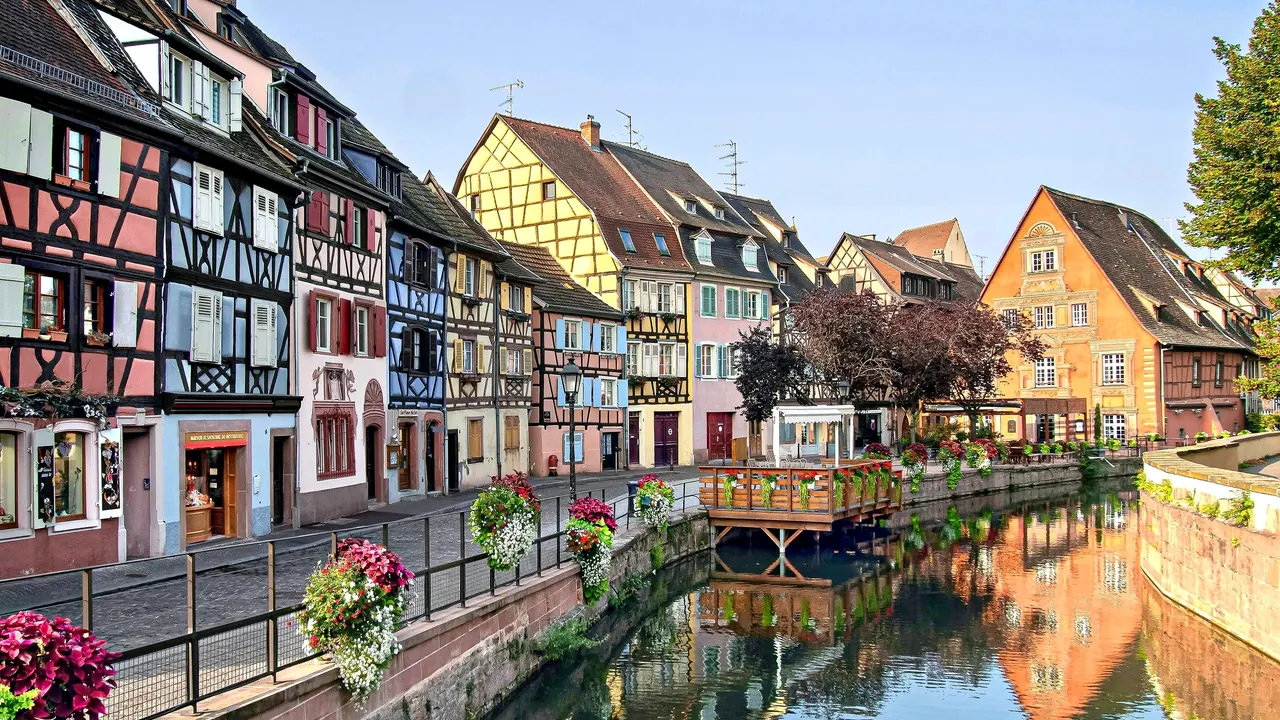
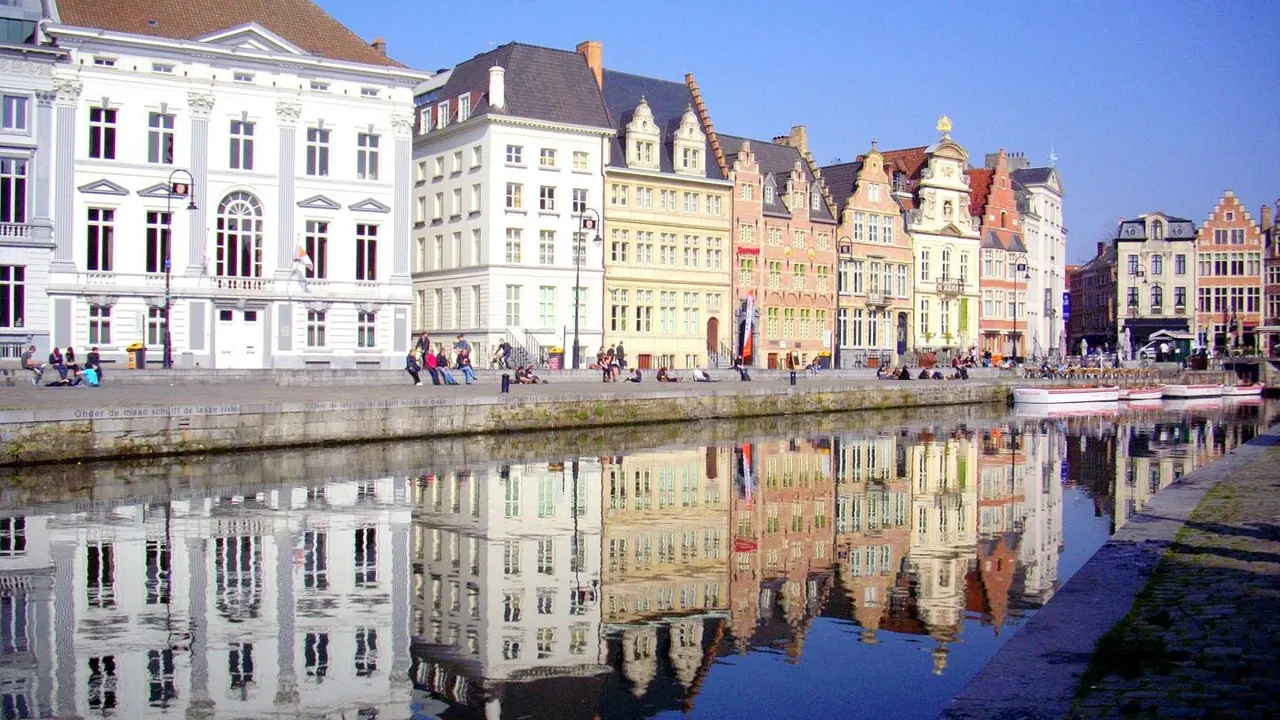
Photos: Colmar by Rolf Kranz, CC BY-SA 4.0, cropped; Ghent by ykeiko, CC BY-SA 3.0, cropped.
Colmar or Ghent?
Our verdict in twelve categories, each scored against the same fixed benchmark cities, and the climate month by month, so you can choose for your trip.
Choose Colmar for
- nature and the outdoors
- families
- prices
Colmar is the better pick when the countryside matters as much as the town. The painted old town and the Isenheim Altarpiece fill a day or two, and after that the vineyards, the wine villages and the Vosges ridges begin right at its edge. If you have a car, it is also the stronger choice with children. Meals, wine and village tastings cost a little less than in Ghent, but rooms in this small town are expensive in summer and during the Christmas markets. Evenings end with a long Alsace dinner and an early night, so it suits couples, walkers, cyclists and wine lovers more than anyone looking for a night out.
Choose Ghent for
- nightlife
- live music and the arts
- beaches
If you want a city that keeps going after dark, choose Ghent. Its medieval centre is lived in rather than kept for show. Around the van Eyck altarpiece it has contemporary museums, a real opera house and theatre, and a student crowd that keeps the bars busy late. Hotel rooms stay reasonably priced for most of the year, and you can get everywhere on foot, by bike or by train, with no car needed. It is the better choice for a city break with evenings out, for culture beyond the old masters, or as a base for touring Flanders by rail.
Scoreboard
Twelve categories on one fixed scale from 0 to 100. The shaded stretch is the gap between the two.
Your match
Pick a travel style or drag the sliders, and both match scores follow your weighting.
Wins on nature and the outdoors and families with your weighting.
Wins on nightlife and live music and the arts with your weighting.
What matters to you?
Category by category
What the scores mean for a trip.
Beaches & swimming
Neither is a swimming destination, but Ghent at least has a way to reach the sea. Ostend is about an hour away by train, and from there the coast tram runs past wide sand and dunes. The North Sea is cool and often windy, though, and the Blaarmeersen lake on the edge of the city is the easier swim on a hot day.
Colmar sits as far from any coast as you can get in France. Your only options are the municipal pools or a cold mountain lake up in the Vosges.
Food & drink
Both cities eat equally well, and both lean on hearty regional cooking, but they pour different drinks. Colmar is about wine: Riesling and Gewurztraminer next to choucroute and baeckeoffe in panelled winstubs, with cellar tastings a short drive away and a small fine-dining tier along the wine route.
Ghent is about beer, with Trappist and lambic lists in the old cafés next to waterzooi and beef stewed in dark beer. It also has frites stands and cuberdon carts, and it is the easier of the two for vegetarians.
Culture & sights
Each city centres on one great altarpiece, Grünewald's in the Unterlinden in Colmar and the van Eycks' in St Bavo's in Ghent, but Ghent has more to see around its masterpiece. Colmar's painted half-timbered streets and Petite Venise make a beautifully complete townscape, but the set of sights is small and two days covers it.
Ghent adds a moated castle in the middle of town, UNESCO-listed beguinages and a belfry, and the classic view of three towers from St Michael's Bridge. Its museums also reach past the old masters, from the SMAK's contemporary art to the Design Museum, so it rewards a longer stay.
Nightlife
Ghent is far livelier after dark. The university fills the Overpoort's bars until late, the old cafés around the Vrijdagmarkt keep beer drinkers going, and the Gentse Feesten turns July into a ten-day street party. Even so, its clubs are few and small.
In Colmar a night out means dinner and a glass of wine on a summer terrace, and the streets go quiet early. Those wanting more take the train to Strasbourg.
Nature & outdoors
Colmar has much the better outdoors. Within half an hour you can be walking through the vines between wine villages. Further up are the forested Vosges, with the Hohneck and Grand Ballon, glacial lakes, dense networks of waymarked trails and some modest winter skiing.
Ghent's surroundings are flat and farmed, and they are good for gentle riverside cycling along the Leie or birdwatching in the Bourgoyen-Ossemeersen wetland, but there is nothing to climb.
Day trips
Both make excellent bases, but you use them differently. From Colmar the best outings are the small walled wine villages, Riquewihr, Eguisheim and Kaysersberg, which are easiest by car or bike, along with Strasbourg by train and border crossings to Basel and Freiburg.
From Ghent, short and frequent trains reach big historic cities: Bruges, Brussels and Antwerp, plus Ypres and the First World War battlefields. You will never need a car.
Good for families
Colmar suits families better, though largely because of what lies outside the town. Within it you get flat streets, boat rides through Petite Venise and storks on the roofs. Within a short drive are animal parks, the Montagne des Singes, Haut-Koenigsbourg and Europa-Park.
Ghent is safe and car-free in the centre, and children love the Gravensteen and the House of Alijn. Beyond those, the attractions made for children are elsewhere in Belgium, and the cobbles are hard going with a pushchair.
Getting around
Ghent is the easier place to manage without a car. Its centre is kept largely free of traffic, trams cover the wider city, bikes are everywhere, and trains go all over Flanders.
Colmar's old town is just as easy on foot, and trains reach Strasbourg quickly, but buses to the wine villages and the Vosges are sparse. For the best of the region you will need a car or a bicycle.
Shopping & style
Ghent has the wider range of shops. It has a main high street for chains, independent fashion and design on the Serpentstraat, vintage shops in the student quarter, and weekend flea and flower markets.
Colmar's shopping is mostly regional goods to take home: wine bought from the grower, Soufflenheim pottery, Alsatian linen and gingerbread. The Christmas markets are its high point, and there is little fashion.
Affordability
Colmar is somewhat cheaper day to day. Set lunches, regional wine and village tastings are reasonable, although rooms in the small town are expensive in summer and during the Christmas market weeks.
Ghent's sit-down dinners and beer-heavy café bills add up faster. Its hotel rooms stay moderately priced for most of the year, though, apart from the July festival.
Live music & performing arts
Ghent has a real performing arts scene of its own. Opera and ballet play at the nineteenth-century opera house, NTGent's productions are known well beyond Belgium, and De Bijloke stages early and classical music in a medieval hospital.
Colmar has a small Italian-style theatre and festivals in summer and autumn, but outside those weeks serious opera or orchestral music means a trip to Strasbourg or Basel.
Wellness & relaxation
Neither has a spa culture, and in both, wellness means a hotel spa at most. The calm comes from different settings: canal-side evenings and walks through the vines in Colmar, and the enclosed beguinage gardens and slow Sundays along the Leie in Ghent.
When should you go?
Pick your month. The climate figures are measured averages, not a forecast.
Colmar in July
Ghent in July
Daytime high, °C
Rainfall in the month, mm
Where the figures come from
Ghent has no rain gauge within 25 km of the centre, so its rainfall comes from a gridded climate dataset read at the city rather than from a gauge further away.
Ghent's sunshine is measured 45 km from the centre, at Vlissingen.
Temperature and rainfall are climate normals, averaged over the years shown. Colmar: 1991-2020 normals, Ihringen (21.1 km from centre). Ghent: 2009-2025 (sunshine 1991-2020, rainfall 1991-2020) normals, Melle / Kalverhaag (10.1 km from centre).
Colmar has the bigger seasonal swing. Summers in the Alsace plain are warm, with highs around 26°C in July and August and the most sunshine of the year, which is ideal for terraces and vineyard walks but can feel close on the old town's streets on the hottest days. May and June bring the wettest spells, with heavy showers. September and October are mild and settled enough for walking, and that is harvest time. Winters are cold but fairly dry, so December's markets usually escape the worst of the rain.
Ghent never gets as warm. Summer highs stay around 23°C, pleasant for walking the city all day, and April and May are often sunnier there than in Colmar. Rain in Ghent builds through autumn and peaks in early winter at around 85mm a month, so November and December are grey and damp. The North Sea, an hour away, reaches only about 19°C in August, which is cool even at its warmest. Late spring and early autumn are the best times for Ghent, high summer and the harvest months for Colmar.
Which traveller are you?
For an outdoors trip, Colmar wins because the hills start where the town ends. You can spend a morning walking in the vines and an afternoon on a high Vosges ridge in the same day, if you drive. Around Ghent there is only flat, gentle cycling.
For a food and nightlife trip, the real question is how late you want the evening to go. In Colmar the dinner is the evening: a long Alsace meal with the local wine, then bed. In Ghent dinner is only the start, and the beer and company carry on into the small hours.
On a family trip with children, it comes down to whether you will drive. With a car, the countryside around Colmar can fill a week with animal parks and castle visits. Without one, Ghent's traffic-free centre is easier to manage, though the children will run out of things to do sooner.
Before you go
| Measure | Colmar | Ghent |
|---|---|---|
| Official language | French | French, German, Dutch |
| Currency | Euro (EUR) | Euro (EUR) |
| Sockets | CE230 V, 50 Hz | CE230 V, 50 Hz |
| Driving side | Right | Right |
| Time zone | UTC+1, UTC+2 in summer | UTC+1, UTC+2 in summer |
| Emergency number | 112 | 112 |
| Elevation | 185 m | 12 m |
| Main airport | EuroAirport Basel–Mulhouse–Freiburg (BSL)55 km from centre112 non-stop destinations | Brussels Airport (BRU)56 km from centre191 non-stop destinations |
| Public holidays this year | 11 days | 14 days |
By the numbers
| Measure | Colmar | Ghent |
|---|---|---|
| City population | 66,970 | 272,657 |
| People per km² | 1,006 | 1,728 |
| Museums within 10 km | 9 | 30 |
| UNESCO World Heritage sites within 50 km | 3 | 5 |
| Swim season, months above 21 °C | - | None |
Where else could you go?
Every comparison below shares a destination with this one, so you can follow Colmar or Ghent somewhere new.