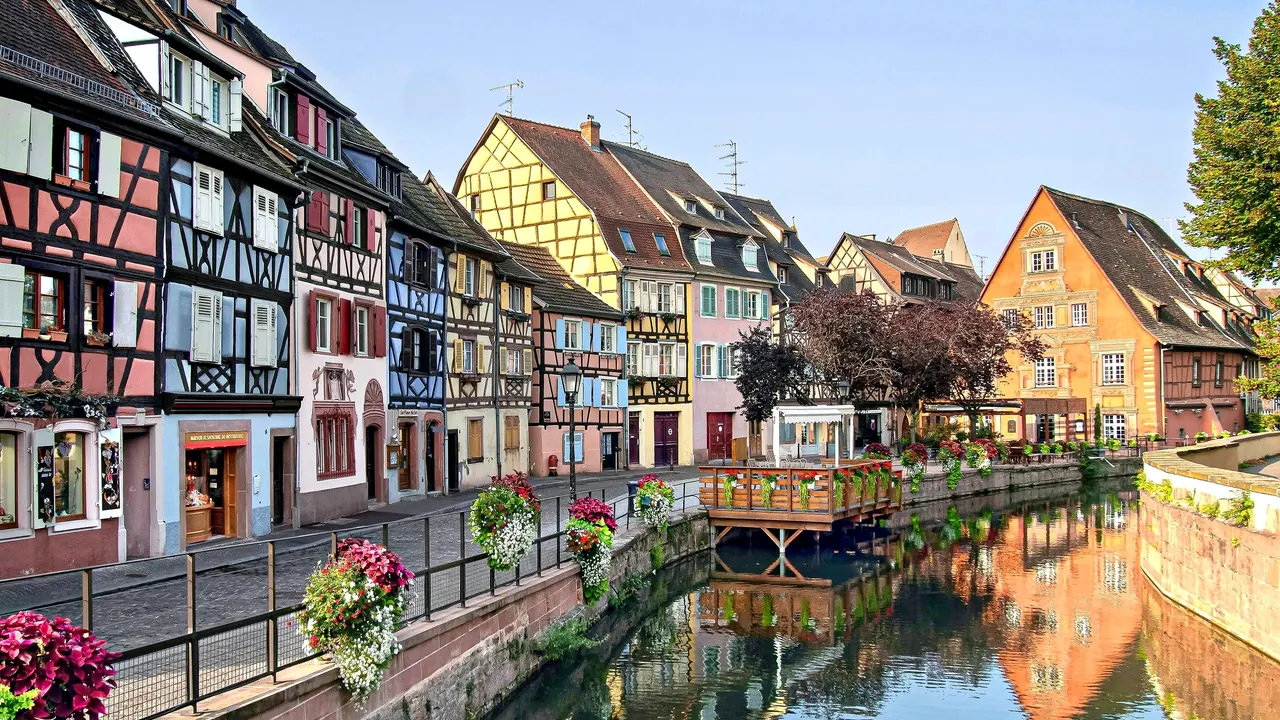
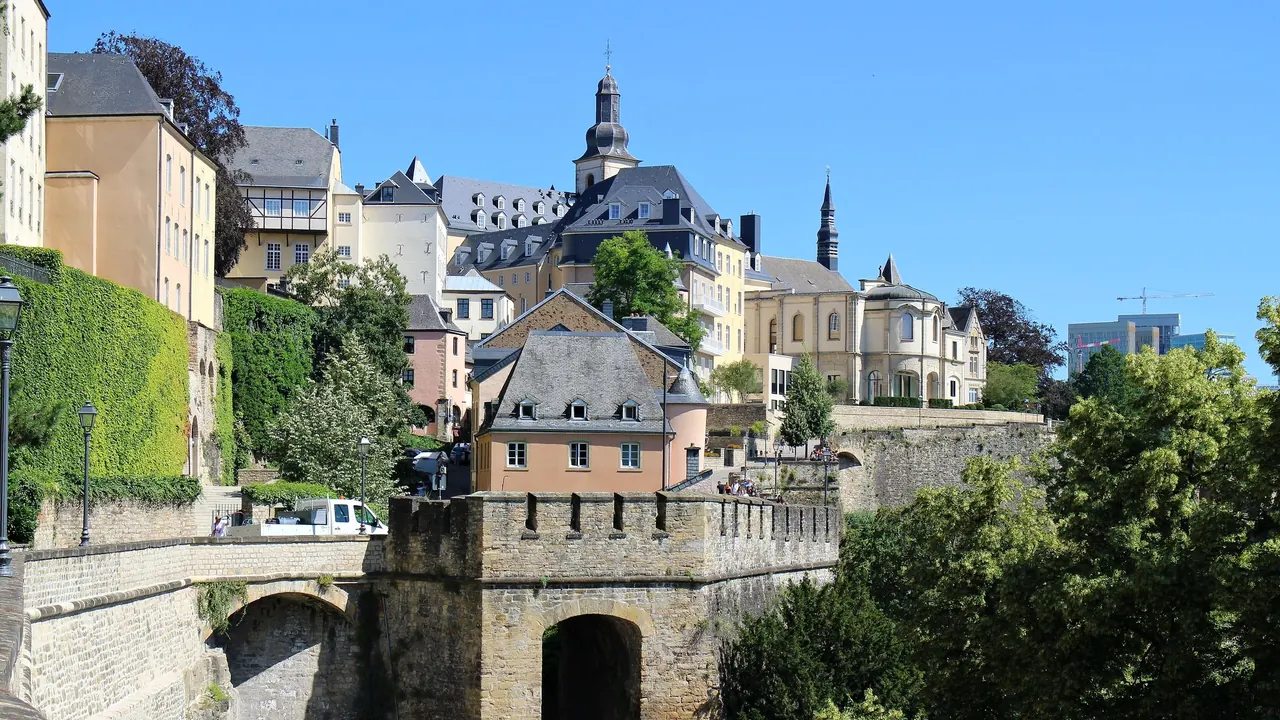
Photos: Colmar by Rolf Kranz, CC BY-SA 4.0, cropped; Luxembourg by Suicasmo, CC BY-SA 4.0, cropped.
Colmar or Luxembourg?
Our verdict in twelve categories, each scored against the same fixed benchmark cities, and the climate month by month, so you can choose for your trip.
Choose Colmar for
- prices
- food and drink
- families
Colmar suits travellers who want to eat, drink and explore the countryside. The old town is an intact painted townscape with the Isenheim Altarpiece at its heart. Alsatian cooking and wine are served in every winstub, and the wine villages, the Vosges ridges and Strasbourg are all close. It costs noticeably less than Luxembourg, and it works better with children, though you will want a car for the best of the region.
Choose Luxembourg for
- live music and the arts
- getting around
- wellness
Luxembourg is the better choice for a car-free city stay with more going on after dark. Trams, buses and trains are free, and the fortress gorges are a dramatic setting. Evenings can include a concert at the Philharmonie or drinks in Clausen, and Mondorf's thermal baths are close by for a restful day. The price is the drawback: rooms and meals here are among the most expensive in Western Europe.
Scoreboard
Twelve categories on one fixed scale from 0 to 100. The shaded stretch is the gap between the two.
Your match
Pick a travel style or drag the sliders, and both match scores follow your weighting.
Too close to call, 1 point apart
Wins on prices and food and drink with your weighting.
Wins on live music and the arts and getting around with your weighting.
What matters to you?
Category by category
What the scores mean for a trip.
Beaches & swimming
Neither city is a swimming destination, but Luxembourg has more to offer on a hot day. The Upper Sûre reservoir has proper bathing spots along wooded shores, and the gravel lakes at Remerschen are easy to reach by free train and bus. In Colmar you are mostly limited to municipal pools or a small mountain lake up in the Vosges.
Food & drink
Colmar has more of a food culture. Its wood-panelled winstubs serve baeckeoffe, choucroute and tarte flambée, with munster cheese from the valleys above town, and the Riesling and Gewurztraminer come from slopes you can see from the streets. Outside regional cooking the choice is narrow, though.
Luxembourg's cooking is more of a mix: French in the smart dining rooms, Portuguese and Italian in the neighbourhood places, and only a few hearty local dishes such as smoked pork with broad beans. It has a serious fine-dining tier, but casual meals cost more and offer less character than an evening in Colmar.
Culture & sights
Both are compact and can be seen in two days, but Colmar has the slightly stronger set. Its painted half-timbered streets, the Maison Pfister and the Koïfhus survive as one unbroken old town. It also has the Unterlinden Museum, whose Isenheim Altarpiece is reason enough to travel.
Luxembourg is impressive mostly for its setting rather than its art. You can walk through the Bock casemates and along the Corniche above the Grund, and MUDAM's contemporary art on Kirchberg adds a modern side that Colmar does not have.
Nightlife
Luxembourg has the livelier evenings, though it is no party city. The old brewery at Rives de Clausen has bars and a couple of clubs close together, the Grund has stone-walled pubs, and an international crowd fills them on Thursdays and Fridays.
In Colmar the evening usually ends after a long dinner and a last glass of wine by the canals. The streets empty early, and for a real night out people take the train to Strasbourg.
Nature & outdoors
Colmar has the better scenery nearby. Paths through the vines start half an hour from town, and the Route des Crêtes climbs past the Hohneck and the Grand Ballon, with views to the Black Forest and sometimes the Alps. There are glacial lakes, summer pastures and some skiing in winter.
Luxembourg's green spaces begin closer, with wooded gorges running through the city itself. The mossy sandstone passages of the Müllerthal are a fine day's walk, but this is hill country with no mountains.
Day trips
Both are excellent bases, and Colmar is the stronger one. Eguisheim, Riquewihr and Kaysersberg are only a few kilometres apart along the wine route, Strasbourg is half an hour by train, and Basel and Freiburg are about an hour away. The villages are far easier to reach with a car or a bike than by the sparse buses.
Luxembourg's trips within the country cost nothing to reach, because free trains and buses run to Vianden's hilltop castle, Echternach and the Moselle wine villages. Free travel stops at the border, so you need a normal ticket for Roman Trier and for Metz with its golden cathedral, each under an hour away. Luxembourg is the easier base without a car, though there is a little less choice than in Alsace.
Good for families
Colmar is the better place for children, provided you have a car. Flat lanes, boat rides and nesting storks keep younger children busy in town. Outside it are the Hunawihr stork and otter park, the free-roaming macaques at Kintzheim, the Mulhouse train museum and Europa-Park about an hour away.
Luxembourg is calm and has lifts suitable for buggies, and the casemate tunnels feel like an adventure. Beyond that there is only the small Parc Merveilleux. It is a good place for a few days with children, but not enough for a week.
Getting around
Luxembourg is far easier to get around. Trams, buses and trains are free across the whole country, public lifts and a funicular connect the upper and lower town, and you can reach Vianden or the Moselle without driving.
Colmar's centre is just as easy to walk and the station is close. The problem is the countryside: buses to the wine villages and the Vosges are infrequent, so most visitors hire a car or cycle along the vineyard roads.
Shopping & style
There is little to separate them overall, but the shopping is very different. Colmar is the place for things to take home: wine bought from the grower, Soufflenheim pottery, kougelhopf moulds, printed table linen and the Christmas markets spread across several squares. Luxembourg's Grand-Rue offers luxury fashion labels, and the Villeroy & Boch outlet is the local speciality.
Affordability
Colmar is much cheaper. Set lunches, regional wine and village tastings are reasonably priced, although rooms in the old town get expensive and book out during the Christmas market weeks.
Luxembourg is expensive throughout, with hotels aimed at business travellers and restaurant bills well above the norm. Free transport and free museums help, and so does staying in Trier or Metz and coming in by train.
Live music & performing arts
Luxembourg wins easily here. The Philharmonie on Kirchberg has a resident orchestra and hosts touring soloists all year, the Grand Théâtre puts on visiting opera and dance, and Neimënster holds open-air concerts in summer.
Colmar's small Italian-style theatre and its July classical music festival are pleasant, but outside the festival weeks there is not much on, and serious opera means going to Strasbourg or Basel.
Wellness & relaxation
Luxembourg has something Colmar does not: Mondorf-les-Bains, a nineteenth-century thermal spa with mineral pools and saunas set in a park, half an hour from the city. In Colmar, relaxing means long lunches, quiet evenings by the canals and walks through the vines, with hotel spas as the only real treatment option.
When should you go?
Pick your month. The climate figures are measured averages, not a forecast.
Colmar in July
Luxembourg in July
Daytime high, °C
Rainfall in the month, mm
Temperature and rainfall are climate normals, averaged over the years shown. Colmar: 1991-2020 normals, Ihringen (21.1 km from centre). Luxembourg: 1991-2020 normals, Luxembourg / Luxembourg (6.3 km from centre).
Colmar is the warmer of the two in summer, with afternoons around 27°C in August against about 24°C in Luxembourg. Sunshine through June and July is much the same in both, with Luxembourg slightly ahead. In both cities, July and August are the only months warm enough for a lake swim or an outdoor pool. Luxembourg's milder summer air makes long days of climbing up and down its gorges a little more comfortable.
Rainfall follows a different pattern in each city. Colmar is dry in winter and wettest in late spring, at about 87mm in May. From April to October it is good walking weather, and the harvest months of September and October are a highlight. Luxembourg gets steady rain all year and is wettest in December, at about 89mm. Both are cold and dull from November to February, but Colmar is a degree or two milder and noticeably drier in those months.
Which traveller are you?
On a trip with a tight budget, Colmar is the clear pick. Rooms and set lunches cost moderate French provincial prices and village wine tastings are often cheap. Luxembourg's hotels and restaurants are priced for business travellers, so even with free public transport it costs far more.
On a family trip with children, Colmar gives you more to do. There are boat rides through Petite Venise and storks on the rooftops, and within reach are the Hunawihr otter park, the Kintzheim monkeys and Europa-Park. Luxembourg is calm and safe but runs short of children's attractions after two or three days.
For a relaxing and wellness trip, Luxembourg has the edge. The thermal spring and pools at Mondorf-les-Bains are half an hour away, and the city has quiet river walks through the Grund. Colmar's slow evenings are restful, but its spas are limited to hotels.
Before you go
| Measure | Colmar | Luxembourg |
|---|---|---|
| Official language | French | French, German, Luxembourgish |
| Currency | Euro (EUR) | Euro (EUR) |
| Sockets | CE230 V, 50 Hz | CF230 V, 50 Hz |
| Driving side | Right | Right |
| Time zone | UTC+1, UTC+2 in summer | UTC+1, UTC+2 in summer |
| Emergency number | 112 | 112 |
| Elevation | 185 m | 300 m |
| Main airport | EuroAirport Basel–Mulhouse–Freiburg (BSL)55 km from centre112 non-stop destinations | Luxembourg-Findel International Airport (LUX)6 km from centre115 non-stop destinations |
| Public holidays this year | 11 days | 12 days |
By the numbers
| Measure | Colmar | Luxembourg |
|---|---|---|
| City population | 66,970 | 137,678 |
| People per km² | 1,006 | 2,663 |
| Museums within 10 km | 9 | 19 |
| UNESCO World Heritage sites within 50 km | 3 | 4 |
Where else could you go?
Every comparison below shares a destination with this one, so you can follow Colmar or Luxembourg somewhere new.