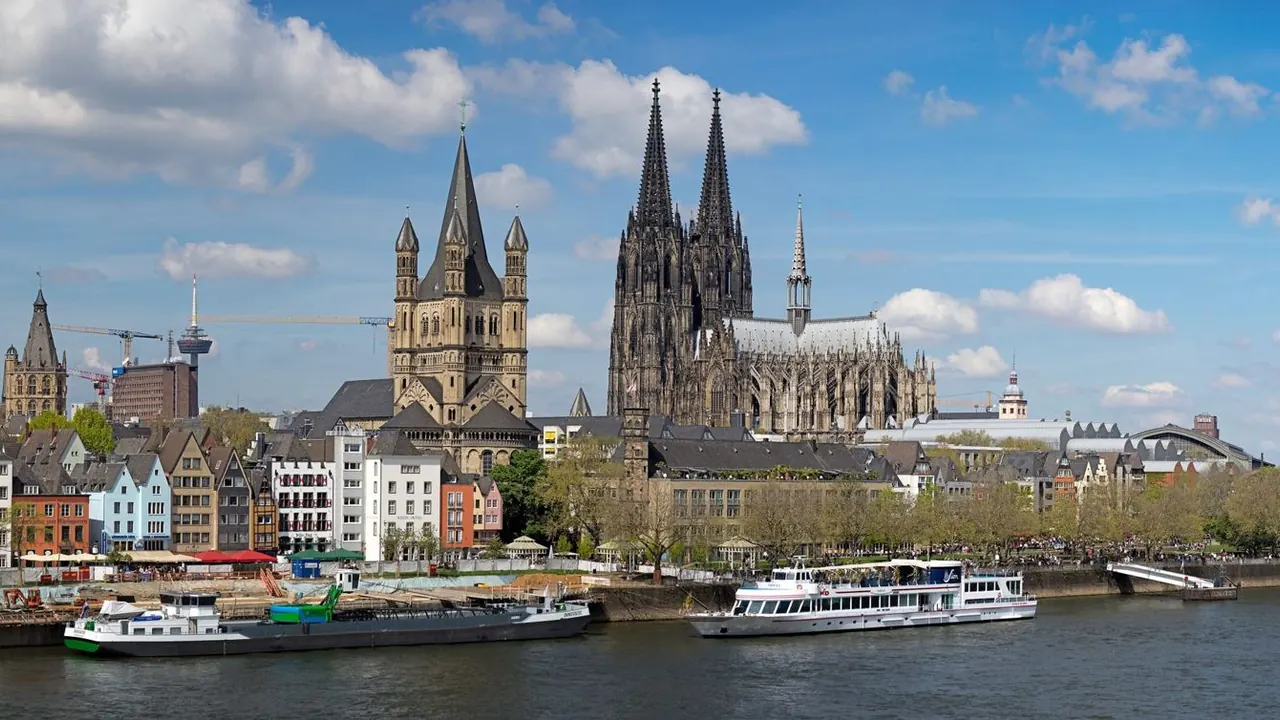
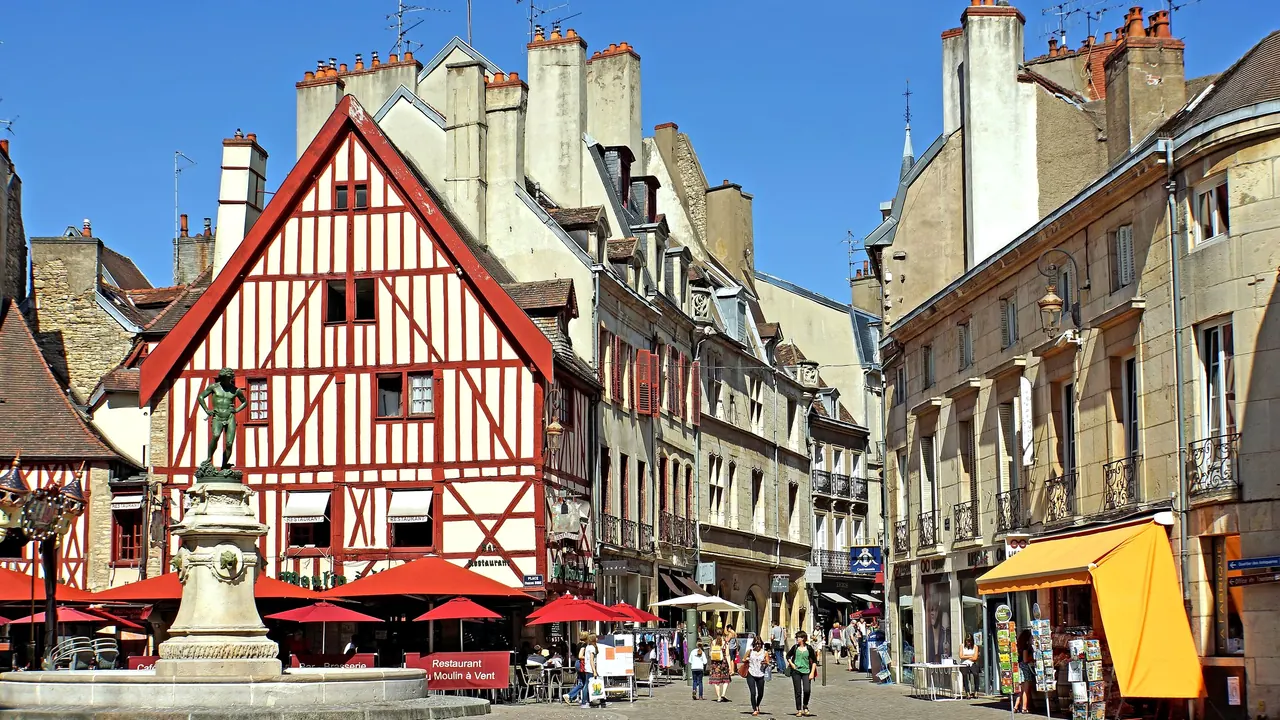
Photos: Cologne by Jörg Braukmann, CC BY-SA 4.0, cropped; Dijon by Dennis G. Jarvis, CC BY-SA 2.0, cropped.
Cologne or Dijon?
Our verdict in twelve categories, each scored against the same fixed benchmark cities, and the climate month by month, so you can choose for your trip.
Choose Cologne for
- nightlife
- families
- live music and the arts
Cologne is the better pick for travellers who want a full city around them: a cathedral and big museums by day, a proper choice of concerts and opera at night, and bars that stay busy late at weekends. It works well with children, has thermal baths and sauna culture for slower days, and fast trains put Bonn, Aachen, the Rhine Gorge and even Brussels within easy reach.
Choose Dijon for
- food and drink
- prices
Dijon rewards a slower, more focused trip built around eating and drinking. The market hall, the Burgundian bistros and wine bars pouring village wines by the glass are the main event, and the vineyards of the Côte de Nuits start at the edge of town. Couples and food lovers who are happy with quiet evenings and a compact, well-kept old centre will get more from it than families or night owls.
Scoreboard
Twelve categories on one fixed scale from 0 to 100. The shaded stretch is the gap between the two.
Your match
Pick a travel style or drag the sliders, and both match scores follow your weighting.
Wins on nightlife and families with your weighting.
Wins on food and drink and prices with your weighting.
What matters to you?
Category by category
What the scores mean for a trip.
Beaches & swimming
Neither city is a place to swim seriously: the Rhine is too fast and busy for bathing, and Dijon is hours from any coast. On a hot day both fall back on lakes at the edge of town.
Cologne has more choice, with several former gravel pits such as Fühlinger See and Otto-Maigler-See offering grassy banks and small sandy stretches. Dijon has one, Lac Kir, a reservoir with a lawn-and-sand area that is supervised in summer, which suits families wanting a single easy spot.
Food & drink
Dijon is the clear winner at the table. Burgundian classics such as boeuf bourguignon and jambon persillé, the produce stalls of Les Halles and local mustard, cassis and pain d'épices make eating the main reason to visit, and the wine is poured from vineyards a few kilometres away.
Cologne's strength is the Brauhaus ritual of Kölsch in small glasses and hearty Rhineland dishes like Himmel un Ääd, which is fun but limited. It does offer more variety than Dijon, especially the Turkish and Middle Eastern cooking along Venloer Strasse in Ehrenfeld.
Culture & sights
Both cities give a rewarding few days of sightseeing, but in different shapes. Cologne has the bigger individual landmarks: the Gothic cathedral with the Shrine of the Three Kings, twelve Romanesque churches and major collections at Museum Ludwig and the Wallraf-Richartz. Its townscape around them, though, is largely post-war.
Dijon is the opposite case, with a well-preserved historic whole. The Palace of the Dukes, half-timbered streets, Renaissance mansions and the gargoyles of Notre-Dame hang together as one walk, and the ducal tombs in the Musée des Beaux-Arts are its single great treasure.
Nightlife
Cologne is far the better city for going out. An evening can run from Altstadt brewhouses to cocktail bars in the Belgian Quarter, the student crowds on Zülpicher Strasse and late clubs in Ehrenfeld's old factories, and it has one of Germany's largest gay scenes around Rudolfplatz. Carnival turns the whole city into one long party.
Dijon's nights are small and sociable rather than late: wine bars and pubs on Rue Berbisey, terraces around Place Émile Zola and a long dinner. Outside term time the streets are quiet by midnight.
Nature & outdoors
Both are gentle bases for walkers and cyclists, with no mountains near either. Cologne's green space is mostly parkland, the Grüngürtel and the Rhine meadows, with the Siebengebirge's volcanic hills and the Eifel's crater lakes within an hour.
Dijon has wilder country closer in: the limestone combes just west of town offer trails and rock climbing within minutes, and the signed vineyard ride towards Beaune and the Burgundy Canal towpath make for some of the most attractive easy cycling either city can offer.
Day trips
Both are excellent bases, but they point in different directions. Cologne's fast trains make it a hub for cities and palaces: Brühl, Bonn, Düsseldorf, Aachen's Carolingian chapel, the castles of the Rhine Gorge and even Brussels, all without a car.
Dijon's outings are mostly rural and about wine, from Gevrey-Chambertin and Clos de Vougeot to Beaune, plus Fontenay Abbey and Semur-en-Auxois to the north-west. Beaune and Besançon are easy by train, but the vineyard villages really need a car, bike or tour.
Good for families
Cologne is much better set up for children. The zoo with its elephant park, the Chocolate Museum's working production line, the cable car to the Rheinpark playgrounds and Phantasialand nearby can fill several days, though Carnival week is best avoided with small children.
Dijon is safe, pedestrian and relaxed, and the natural history museum, planetarium and Lac Kir will please children for a day or so. Most of what the city does best, tastings and fine art, is aimed at adults.
Getting around
Neither city needs a car for the centre. Cologne's station stands beside the cathedral and the main sights are a flat walk apart, with trams and the Stadtbahn reaching Ehrenfeld and the zoo, even if the network can be crowded and confusing.
Dijon is smaller and simpler: station, market, palace and cathedral are minutes apart on foot, and two tram lines cover the rest. The catch is beyond the city, where the wine villages off the railway need a car, bike or tour.
Shopping & style
Cologne offers far more to browse. Schildergasse and Hohe Strasse are among Germany's busiest shopping streets, Ehrenstrasse and the Belgian Quarter hold independent fashion and design, and Eau de Cologne from the historic perfume houses makes a fitting souvenir.
Dijon's shopping is almost all edible: mustard in many flavours, cassis, pain d'épices, cheese at Les Halles and Burgundy from the wine merchants. For clothes, Rue de la Liberté has little beyond chains and a few boutiques.
Affordability
Both are mid-priced, with Dijon slightly easier on the budget day to day thanks to moderate hotels, bistro set lunches and cheap wine by the glass. Its costs climb with cellar tastings, wine tours and serious restaurants, which is exactly why many people come.
In Cologne, brewhouse meals and free entry to the cathedral help, but hotels are the wild card: during trade fairs and Carnival rooms become scarce and expensive, so dates matter more here than in Dijon.
Live music & performing arts
Cologne has a much deeper programme. The opera and Schauspiel share the Offenbachplatz complex, the Philharmonie beside the cathedral hosts two orchestras, and on the popular side there are jazz, electronic music, small club gigs in Ehrenfeld and the Südstadt, and the dialect songs of the Carnival sessions.
Dijon does well for its size, with the Opéra de Dijon's Grand Théâtre and acoustically fine Auditorium plus a national drama centre. Its season follows the academic year and thins out in summer, when Cologne still has plenty on.
Wellness & relaxation
For proper relaxation facilities, Cologne is ahead. Germany's sauna culture means large sauna landscapes with steam rooms and cold plunges, the Rheinpark thermal bath looks across to the cathedral, and Aachen's hot springs are under forty minutes away.
Dijon has no bathing tradition and only a few hotel spas, some with grape-based treatments. What it offers instead is a slower rhythm of long lunches, quiet squares and vineyard afternoons, a calm that busy Cologne cannot match.
When should you go?
Pick your month. The climate figures are measured averages, not a forecast.
Cologne in July
Dijon in July
Daytime high, °C
Rainfall in the month, mm
Temperature and rainfall are climate normals, averaged over the years shown. Cologne: 1991-2020 normals, Köln-Stammheim (5.4 km from centre). Dijon: 1991-2020 normals, Dijon (7 km from centre).
The two cities share almost the same calendar. Winters are cold and grey in both, with daytime highs around 6°C in January, so these are months for museums and brewhouses or bistros rather than long walks. Spring warms up at the same pace, and by May both are pleasant for exploring on foot. Dijon is the sunnier of the two right through the year, noticeably so from March to September, which helps on vineyard rides and terrace lunches.
Summer peaks a little warmer in Dijon, at about 27°C in July against 25°C in Cologne, and those are the months when the lakes on either city's edge are warm enough to swim. The rain falls differently: Cologne is wettest in high summer, with around 81mm in July and August, while Dijon's wetter spells come in May and again in October and November, at about 77mm. June and September are the most comfortable months for walking the streets in both, and early autumn suits Dijon especially, when the wine country is at its best.
Which traveller are you?
On a family trip with children, Cologne is the easier choice for the whole stay. Days can be planned around children's outings rather than squeezed between adult ones, and brewhouses welcome young guests. Dijon's itinerary leans towards tastings and galleries meant for parents.
For a relaxing and wellness trip, Cologne suits travellers who want rest built into a city break. Bathing and sauna are a local weekend habit, so a slow day fits naturally between sightseeing. Dijon's calm comes from its pace, with little to book.
On a wine-tasting trip, Dijon has no rival here. The Route des Grands Crus begins at its southern edge, Beaune is twenty minutes by train, and the city's wine bars pour village Burgundies by the glass. Cologne's own nearby vineyards in the Ahr valley are a smaller outing.
Before you go
| Measure | Cologne | Dijon |
|---|---|---|
| Official language | German | French |
| Currency | Euro (EUR) | Euro (EUR) |
| Sockets | CF230 V, 50 Hz | CE230 V, 50 Hz |
| Driving side | Right | Right |
| Time zone | UTC+1, UTC+2 in summer | UTC+1, UTC+2 in summer |
| Emergency number | 112 | 112 |
| Elevation | 59 m | 220 m |
| Main airport | Cologne Bonn Airport (CGN)15 km from centre115 non-stop destinations | Lyon Saint-Exupéry Airport (LYS)178 km from centre141 non-stop destinations |
| Public holidays this year | 11 days | 11 days |
By the numbers
| Measure | Cologne | Dijon |
|---|---|---|
| City population | 1,025,523 | 161,830 |
| People per km² | 2,532 | 3,890 |
| Museums within 10 km | 40 | 8 |
| UNESCO World Heritage sites within 50 km | 3 | 1 |
Where else could you go?
Every comparison below shares a destination with this one, so you can follow Cologne or Dijon somewhere new.