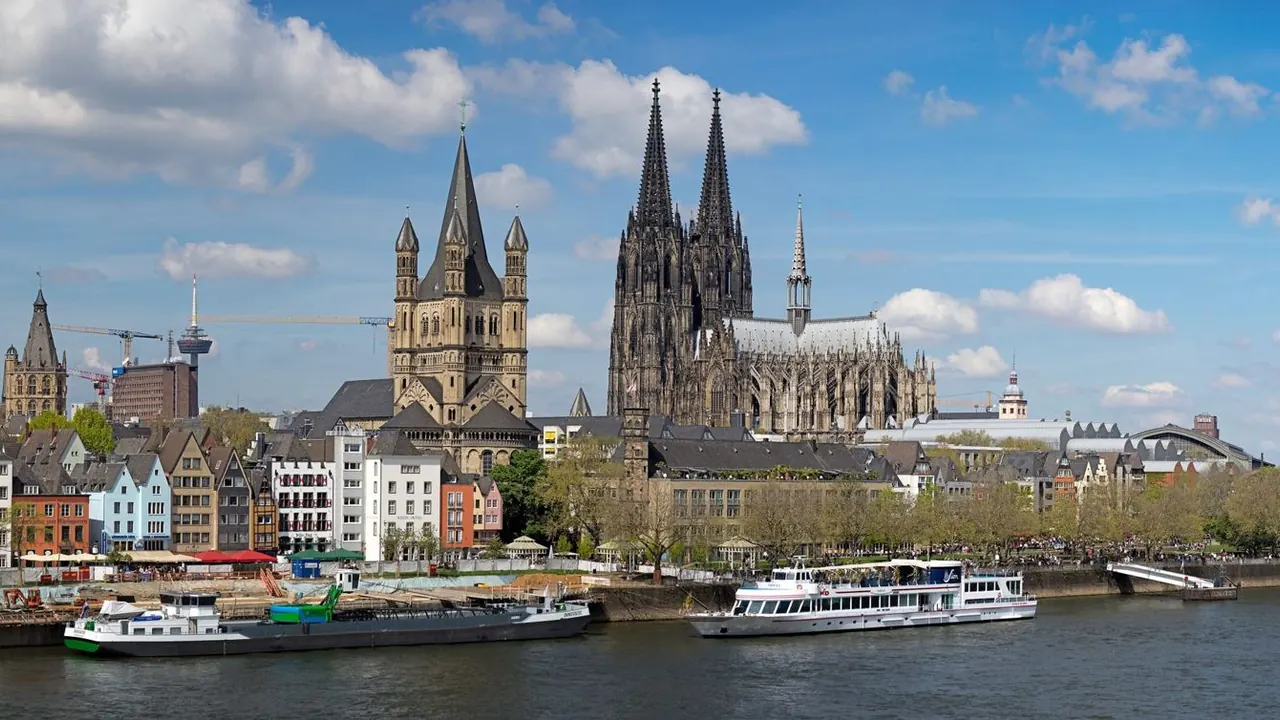
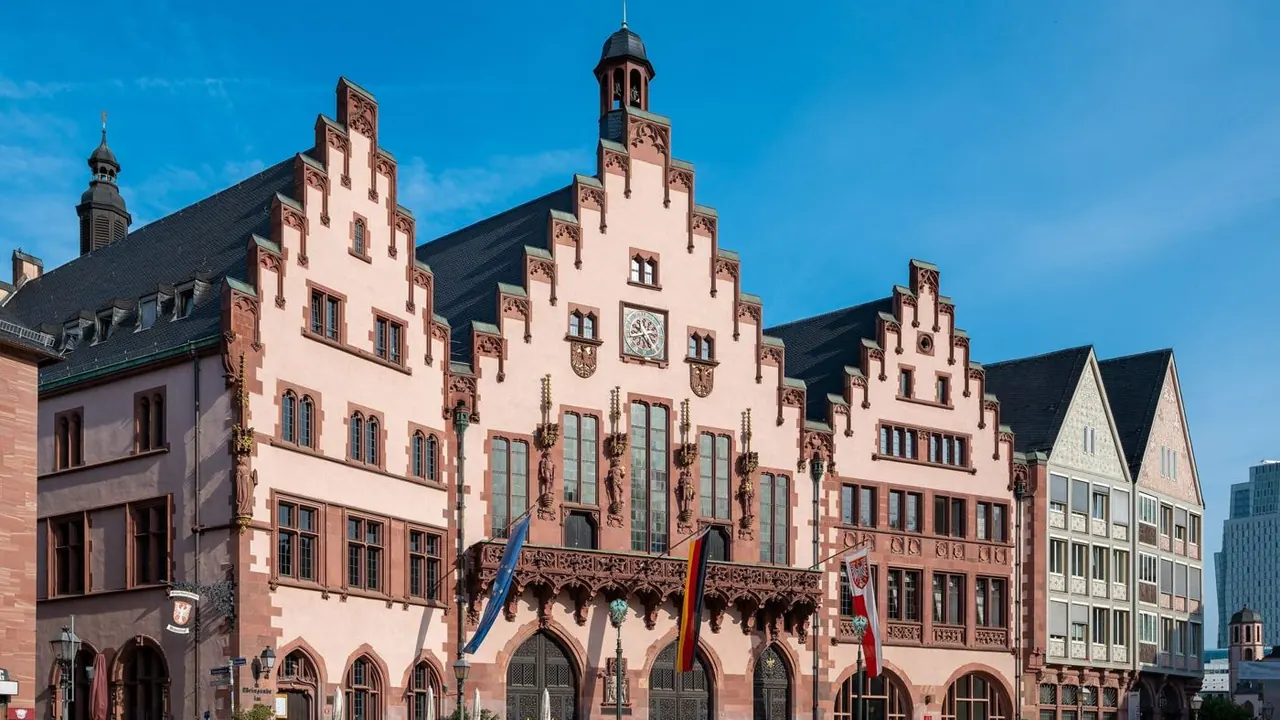
Photos: Cologne by Jörg Braukmann, CC BY-SA 4.0, cropped; Frankfurt by Thomas Wolf, CC BY-SA 3.0 DE, cropped.
Cologne or Frankfurt?
Our verdict in twelve categories, each scored against the same fixed benchmark cities, and the climate month by month, so you can choose for your trip.
Choose Cologne for
- nightlife
- families
- prices
Cologne suits travellers who want a city that goes out in the evening and doesn't charge business-hotel prices for the bed afterwards. Brewhouse rounds of Kölsch, the bars of the Belgian Quarter and Ehrenfeld, and one of Germany's most open gay scenes give it the livelier nights. The cathedral and its ring of Romanesque churches give it the stronger sights. Families do better here too, with the zoo, the Chocolate Museum and Phantasialand all close at hand.
Choose Frankfurt for
- day trips
- getting around
- nature and the outdoors
Pick Frankfurt if the trip is really about the region around it. Its rail hub reaches Heidelberg, the Rhine Gorge, Würzburg and a string of cathedral towns, and the airport is a short train ride from the centre, so it makes an efficient base for touring. The Städel and the Museumsufer reward art lovers, and the Taunus spa towns suit a slower pace. Expect higher hotel bills unless you come at a weekend or in summer.
Scoreboard
Twelve categories on one fixed scale from 0 to 100. The shaded stretch is the gap between the two.
Your match
Pick a travel style or drag the sliders, and both match scores follow your weighting.
Too close to call, 2 points apart
Wins on nightlife and families with your weighting.
Wins on day trips and getting around with your weighting.
What matters to you?
Category by category
What the scores mean for a trip.
Beaches & swimming
Neither city is a swimming destination, but Cologne gives you a little more choice on a hot day. Several flooded gravel pits on its edge, Fühlinger See, Escher See and Otto-Maigler-See, have grassy banks and small sandy stretches.
Frankfurt has outdoor pools and the Langener Waldsee in the southern forest, which has sandy shores and warm water in high summer. In both cities the river is for sitting beside, not swimming in, and the sea is out of reach.
Food & drink
The two eat in a very similar way, and neither is a reason to travel on its own. The difference is the drink at the centre of the meal. In Cologne it is the Brauhaus, where Köbes keep replacing small glasses of Kölsch until a beer mat stops them, served with black pudding and apple or the Halve Hahn cheese roll.
Frankfurt's version is the apple-wine tavern in Sachsenhausen, with tart Apfelwein from stoneware jugs, Grüne Soße and Handkäs mit Musik at shared tables. Frankfurt also has the better single food stop in the Kleinmarkthalle and cheap global eating in the Bahnhofsviertel. Cologne's best everyday alternative is the Turkish and Middle Eastern cooking along Venloer Strasse.
Culture & sights
Cologne has the stronger sights. The cathedral, with the Shrine of the Three Kings and its stained glass, comes first, and behind it is a layer Frankfurt cannot match: twelve Romanesque churches and Roman remains from two thousand years of history. Museum Ludwig's Pop Art and the Wallraf-Richartz make its museums strong too.
Frankfurt's case rests more narrowly on the Museumsufer, where the Städel stands out, and on a compact rebuilt core around the Römer, the Paulskirche and Goethe's birthplace. Both cities were largely rebuilt after the war, so neither has an intact old town, but Frankfurt adds a skyline of towers unlike anything else in Germany.
Nightlife
Cologne is the better night out by some way. Evenings move from the Altstadt brewhouses to the Belgian Quarter's bars, the Zülpicher Strasse student strip and Ehrenfeld's clubs in old factories, and the gay scene around Rudolfplatz is one of Germany's largest. At Carnival the whole city becomes a street party for days.
Frankfurt goes out mostly on Friday and Saturday, in the Bahnhofsviertel's cocktail bars, the cider taverns and pubs of Alt-Sachsenhausen and the neighbourhood bars of Berger Straße. What sets it apart is a small, serious techno and house scene, rooted in the electronic music history it shares with Offenbach.
Nature & outdoors
Both offer gentle, green country for walking and cycling rather than anything dramatic, and both have long flat riverside cycle paths and a large Stadtwald. Frankfurt's hills start closer: the Taunus and the 880m Großer Feldberg rise just beyond the northern suburbs.
Cologne takes a little longer to reach higher ground, but the choice is more varied once you do. There is the volcanic Siebengebirge with the Drachenfels crag, the reservoirs of the Bergisches Land, and the Eifel national park with its crater lakes about an hour away.
Day trips
Both are excellent bases, but Frankfurt reaches further. Heidelberg and the Rhine Gorge are each about an hour away and Würzburg's Residenz a little more. Closer in are Mainz, Wiesbaden, Darmstadt, the Rheingau vineyards and the imperial cathedrals of Speyer and Worms, and Cologne itself is an easy day out.
Cologne's list is shorter but still strong. Brühl's palaces, Bonn, Düsseldorf and Aachen are all within forty minutes. Its own advantage is crossing the border, to Maastricht, Liège and Brussels, which is something Frankfurt does not offer.
Good for families
Cologne is the easier choice with children. The zoo with its elephant park, the Chocolate Museum's production line and the cable car over the Rhine can fill several days, and Phantasialand, one of Europe's major theme parks, is a short trip away at Brühl. The one time to avoid is Carnival.
Frankfurt works well for a few days. It has the Senckenberg's dinosaur hall, a central zoo, the Palmengarten and boat trips past the skyline, plus a wildlife park and a small fairy-tale park in the Taunus. What it lacks is a single attraction worth the journey on its own, the role Phantasialand plays for Cologne.
Getting around
Both are easy without a car, with walkable centres. Cologne's advantage is how you arrive: the main station stands right beside the cathedral, and the Altstadt, the museums and the river are a short flat walk away, with the Hohenzollern Bridge leading across to Deutz.
Frankfurt's strength is its connections. The airport is about a quarter of an hour from the centre by train, and one integrated network covers both the city and the region, including the Taunus, Wiesbaden and Mainz. On the downside, Cologne's trams can be crowded and irregular, and Frankfurt's lines and zones take time to learn.
Shopping & style
On the high street they are almost interchangeable: Cologne has Schildergasse and Hohe Strasse, and Frankfurt has the Zeil with its malls. The differences are in the smaller streets.
Cologne has a real local speciality in Eau de Cologne from the historic perfume houses on Glockengasse, independent shops in Ehrenstrasse and the Belgian Quarter, and its Christmas markets in Advent. Frankfurt has more luxury around Goethestraße, boutiques on Berger Straße and Schweizer Straße, and a Saturday flea market on the Main bank.
Affordability
Cologne is easier on the wallet, mainly because its hotels are priced for ordinary visitors rather than business travellers, and the cathedral and many churches are free to enter. Rooms get expensive there mainly during trade fairs and Carnival.
Frankfurt's hotels are aimed at business travel and become scarce in fair weeks, though weekends and summer bring prices down. Eating is good value in both, at the brewhouses in one and the cider taverns and Turkish grills in the other, and in Frankfurt the Museumsufer pass helps keep sightseeing costs down.
Live music & performing arts
Both have a full stage life, with different strengths. Cologne's lies in its orchestras: the Philharmonie beside the cathedral is home to the Gürzenich and WDR orchestras, and the broadcaster adds a big band and choirs. On the popular side there is electronic and experimental music, gigs in Ehrenfeld and the Südstadt, and the dialect bands of the Carnival sessions.
Frankfurt leads with its opera company, known for adventurous productions. Around it are concerts at the Alte Oper, contemporary dance at Mousonturm, an English-language theatre and cellar jazz clubs. Its stages are quieter in summer.
Wellness & relaxation
The real difference is where you go to unwind. Cologne keeps it within the city: German sauna landscapes, and a thermal bath in the Rheinpark that looks across the river to the cathedral. Aachen's hot springs are under forty minutes away.
Frankfurt has little of its own beyond pools and hotel spas, but spa towns surround it: Bad Homburg's thermal baths, Wiesbaden's Art Nouveau Kaiser-Friedrich-Therme, Bad Nauheim and Bad Soden. Cologne's busy centre and Carnival make it the less restful of the two at times.
When should you go?
Pick your month. The climate figures are measured averages, not a forecast.
Cologne in July
Frankfurt in July
Daytime high, °C
Rainfall in the month, mm
Temperature and rainfall are climate normals, averaged over the years shown. Cologne: 1991-2020 (sunshine 1981-2010) normals, Köln-Stammheim (5.4 km from centre). Frankfurt: 1991-2020 normals, Frankfurt Westend (2 km from centre).
The two have almost the same climate, so the calendar works the same way in both. May to September is the time to go. Summer highs reach about 25°C in Cologne and 26°C in Frankfurt. That is warm enough for the gravel-pit lakes in July and August and comfortable for long days on foot. From December to February, and in Frankfurt from November, highs stay in single figures and the days are short, so museums, concerts and indoor sights work better than walking the streets. Cologne's November is a degree milder.
Where they differ, Frankfurt is the sunnier city and usually the drier one. It gets noticeably more sunshine from March to September, and the gap is widest in April and July, when Frankfurt peaks at about 246 hours. Cologne is wetter in every month except May. Its heaviest rain falls in July and August, at about 81mm a month, so you will need an umbrella there more often in summer.
Which traveller are you?
For a food and nightlife trip, Cologne wins on the evenings rather than the meals. The eating is level, Kölsch brewhouses against Frankfurt's apple-wine taverns, but Cologne's nights have more range and more energy. Frankfurt suits a dedicated techno weekend.
On a family trip with young children, Cologne is the easier base. There is enough in town to fill several days without long journeys, and a major theme park close by. Frankfurt is pleasant for two or three days, then needs outings further out.
On a tight budget, Cologne makes the money go further, because its beds are priced for ordinary visitors rather than expense accounts. Frankfurt narrows the gap if you travel at a weekend or in summer. In either city, avoid trade-fair weeks.
Before you go
| Measure | Cologne | Frankfurt |
|---|---|---|
| Official language | German | German |
| Currency | Euro (EUR) | Euro (EUR) |
| Sockets | CF230 V, 50 Hz | CF230 V, 50 Hz |
| Driving side | Right | Right |
| Time zone | UTC+1, UTC+2 in summer | UTC+1, UTC+2 in summer |
| Emergency number | 112 | 112 |
| Elevation | 59 m | 101 m |
| Main airport | Cologne Bonn Airport (CGN)15 km from centre115 non-stop destinations | Frankfurt Main Airport (FRA)13 km from centre281 non-stop destinations |
| Public holidays this year | 11 days | 10 days |
By the numbers
| Measure | Cologne | Frankfurt |
|---|---|---|
| City population | 1,025,523 | 760,656 |
| People per km² | 2,532 | 3,063 |
| Museums within 10 km | 40 | 53 |
| UNESCO World Heritage sites within 50 km | 3 | 4 |
Where else could you go?
Every comparison below shares a destination with this one, so you can follow Cologne or Frankfurt somewhere new.
- Dusseldorfvs Cologne
- Heidelbergvs Frankfurt
- Maastrichtvs Cologne
- Stuttgartvs Frankfurt
- Baden-Badenvs Frankfurt
- Utrechtvs Cologne