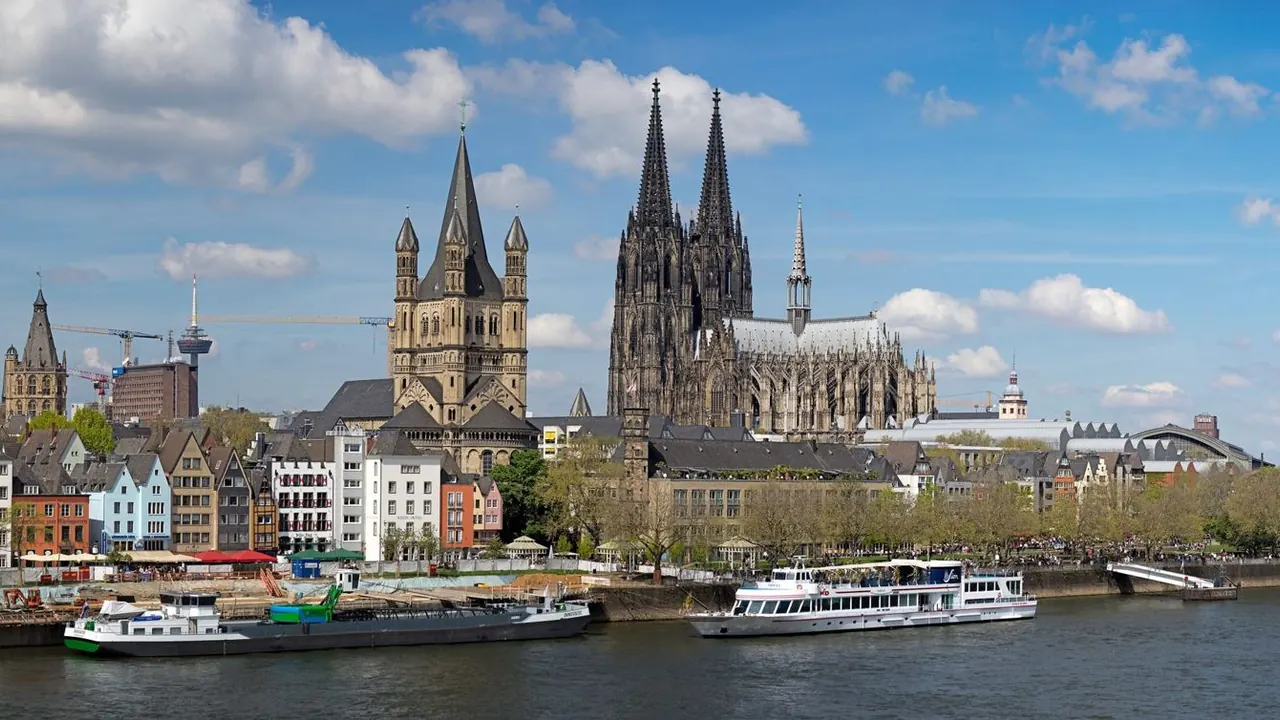
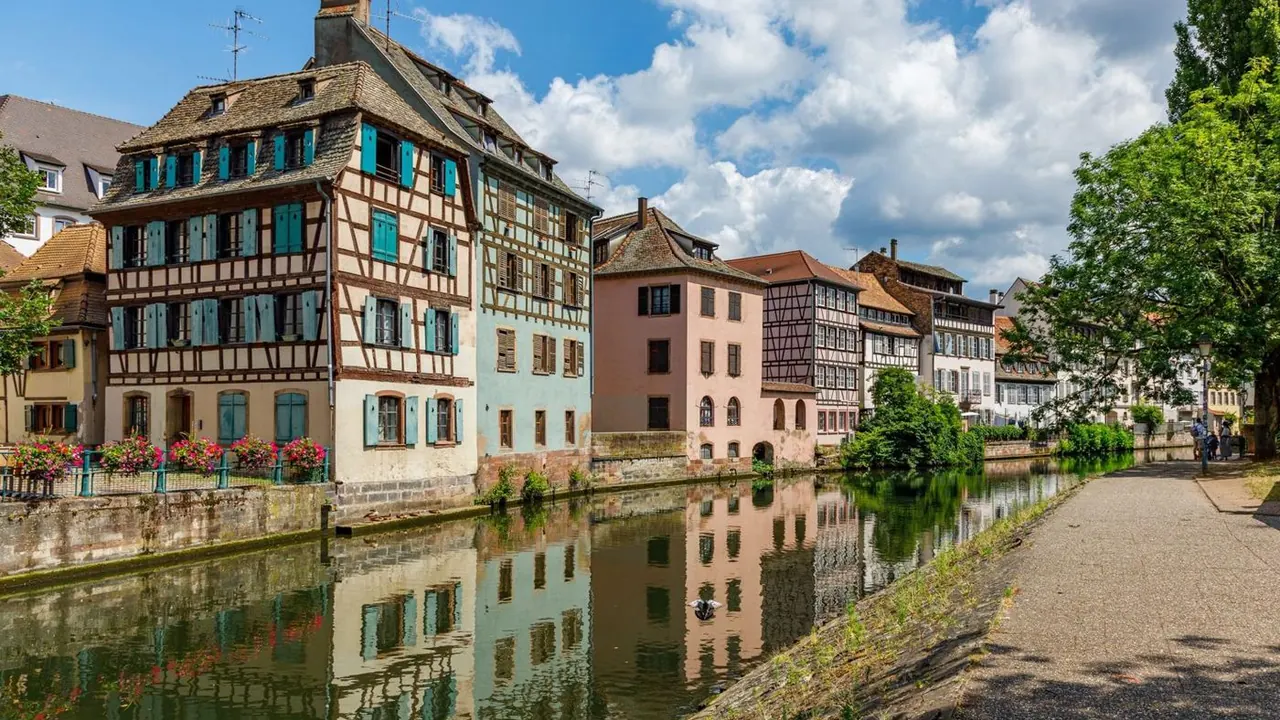
Photos: Cologne by Jörg Braukmann, CC BY-SA 4.0, cropped; Strasbourg by Edoardo Colombo, Pexels License.
Cologne or Strasbourg?
Our verdict in twelve categories, each scored against the same fixed benchmark cities, and the climate month by month, so you can choose for your trip.
Choose Cologne for
- nightlife
- live music and the arts
- shopping
Cologne is the pick for travellers who want their evenings to count. Kölsch rounds in the Altstadt brewhouses, cocktail bars in the Belgian Quarter, factory clubs in Ehrenfeld and a deep calendar of concerts and gigs give it far more going on after dark. Fast trains to Bonn, Aachen and the Rhine Gorge make it an easy base too. Come for the cathedral, Museum Ludwig and the sociable Rhineland mood, not for a pretty old town.
Choose Strasbourg for
- food and drink
- nature and the outdoors
- getting around
A slower trip built around food suits Strasbourg better. You get Alsatian cooking in wood-panelled winstubs, a whole island of timber-framed streets, and the Vosges and Black Forest within an hour. That rewards people who like long lunches, walking and cycling. Its nights are quiet by comparison, so it works better for couples and unhurried travellers than for groups who want to go out.
Scoreboard
Twelve categories on one fixed scale from 0 to 100. The shaded stretch is the gap between the two.
Your match
Pick a travel style or drag the sliders, and both match scores follow your weighting.
Too close to call, 1 point apart
Wins on nightlife and live music and the arts with your weighting.
Wins on food and drink and nature and the outdoors with your weighting.
What matters to you?
Category by category
What the scores mean for a trip.
Beaches & swimming
Neither city is a beach destination, and both send swimmers to old gravel-pit lakes on the outskirts. Cologne's Fühlinger See and Otto-Maigler-See have small sandy stretches. The sandy Rhine banks at Rodenkirchen are nice for sitting out, though the river itself is off limits for swimming.
Strasbourg's lakes are grassier and calmer. Several are lifeguarded in July and August, and the tram goes to the Baggersee, so a hot afternoon there is easy to arrange without a car.
Food & drink
Cologne's cooking is plain Rhineland fare: black pudding with apple and mash, sauerbraten, pork knuckle. The real draw is the Kölsch ritual, with the Köbes swapping small glasses until you cover yours with a beer mat. Its advantage is food from elsewhere, especially the Turkish and Middle Eastern places along Ehrenfeld's Venloer Strasse.
Strasbourg is the better place to eat. Alsace blends French and German cooking into choucroute, baeckeoffe and tarte flambée, served in winstubs with a pichet of local Riesling. The city and nearby wine villages also have a strong fine-dining tier, and the markets are full of Munster and charcuterie. Just avoid the tourist menus around the cathedral and Petite France.
Culture & sights
The two are evenly matched, but in different ways. Cologne's strength is single great buildings and collections: the cathedral with its Shrine of the Three Kings, a ring of twelve Romanesque churches, Roman remains, and Museum Ludwig's Pop Art. Between them the postwar city is plain.
Strasbourg offers a complete historic townscape instead. The Grande Ile, Petite France's half-timbered houses over the locks and the imperial Neustadt together form a UNESCO-listed whole, so simply walking around is the sight. Its museums are good but smaller, and two or three days cover them.
Nightlife
Cologne is far better for going out. A night can move from the brewhouses to the Zülpicher Strasse student strip and on to late clubs in Ehrenfeld's old factories. The city also has one of Germany's largest gay scenes, around Rudolfplatz. At Carnival the whole city sings in costume from morning until long after dark.
Strasbourg's evenings revolve around bars. There are student haunts in the Krutenau, beer cellars near Place Saint-Étienne, and river terraces that stay full on summer evenings. Clubs are few, and weeknights end early.
Nature & outdoors
Cologne's green side is close at hand. The Grüngürtel park ring and the Stadtwald suit long walks and runs, and cycle paths follow the Rhine for many kilometres. Within about forty minutes the wooded volcanic hills of the Siebengebirge rise above the river, and the Eifel's crater lakes and the Ahr vineyards are about an hour out. It is good walking country, but rolling rather than high.
Strasbourg has the edge in terrain. To the west the Vosges climb above the vineyards, with sandstone castle ruins, Mont Sainte-Odile and summits such as the Champ du Feu, which sees some winter snow. Across the Rhine the Black Forest offers longer hikes on higher ridges, and closer in, storks, herons and beavers live in the Rhine forests. A car helps for the hills, though trains and buses reach the main trailheads.
Day trips
Both are excellent bases, and the difference is the kind of outing. From Cologne it is city-hopping by fast train: Bonn in twenty minutes, Düsseldorf and Aachen soon after, Brussels in under two hours, and the castles of the Rhine Gorge in about an hour and a half. None of it needs a car.
Strasbourg's trips lean towards wine and villages. Colmar is half an hour away, and the Alsace wine route between the two runs through Riquewihr, Eguisheim and Haut-Koenigsbourg. Across the Rhine are Baden-Baden, Freiburg and Heidelberg. For the wine villages, a car or bike makes the day much easier.
Good for families
Both are easy with children. Cologne has more big attractions inside the city: the zoo with its elephant park, the Chocolate Museum's working production line, and the cable car across the Rhine. Phantasialand is just a short hop south.
Strasbourg's appeal is how easy it is: a compact, mostly car-free centre, boat trips around the Grande Ile, storks and rowing boats in the Orangerie, and the Le Vaisseau science centre. Europa-Park is about an hour away. Avoid Carnival in Cologne with small children. In Strasbourg, the Christmas market is magical but crowded.
Getting around
Both are easy without a car. In Cologne you step off the train beside the cathedral, with the museums and Altstadt a flat walk away. The Stadtbahn reaches Ehrenfeld and the zoo, though the map is confusing and the trams can be crowded.
Strasbourg's old town island takes about twenty minutes to cross on foot, and much of it is pedestrianised. Its trams are simple to use, one line even runs to Kehl in Germany, and its network of separated bike lanes makes cycling the quickest way around.
Shopping & style
Cologne is better for general shopping. Schildergasse and Hohe Strasse are among Germany's busiest high streets. Ehrenstrasse and the Belgian Quarter add independent fashion, and Eau de Cologne from the old perfume houses on Glockengasse is the classic souvenir.
Strasbourg is better for regional things to take home: Alsace wine, Soufflenheim pottery, printed linens and kougelhopf moulds from shops near the cathedral. Fashion is thin. Both cities have big Christmas markets in Advent.
Affordability
Costs are much the same: mid-priced, cheaper than a capital, with free entry to both cathedrals. In Cologne the cheap pleasure is a brewhouse meal with Kölsch. In Strasbourg it is tarte flambée and wine by the pichet.
The timing traps differ. Cologne's hotels fill and get expensive during the big Messe trade fairs and Carnival. Strasbourg's do the same during the Christmas market and the weeks the European Parliament sits.
Live music & performing arts
Cologne has the bigger stage scene. The Philharmonie beside the cathedral is home to two orchestras, and the WDR adds a big band and choirs. Small clubs in Ehrenfeld and the Südstadt host electronic music, jazz and gigs most nights, and the Carnival sessions with their dialect bands exist nowhere else.
Strasbourg has serious credentials for its size: the Opéra national du Rhin, the Théâtre National de Strasbourg and the Musica contemporary music festival in autumn. But much of it follows the season, so evenings out need planning rather than chance.
Wellness & relaxation
The two are roughly level for unwinding, but the experience is quite different. Cologne does it on a large, modern scale. Its sauna complexes are big, mostly textile-free spaces of steam rooms, cold plunges and quiet rooms, and at the mineral-spring thermal bath in the Rheinpark you can soak with the cathedral spires across the water. For a whole day of bathing, Aachen's springs, in use since Roman times, are a short train ride west. Rest is hard to find during Carnival, so avoid it if that is the aim.
Strasbourg offers less in the city itself and something grander next door. The Bains municipaux is a single early twentieth-century bathhouse with a hammam and saunas. It is a pleasant local institution rather than a reason to visit. The real spa outing is across the border in Baden-Baden, where the nineteenth-century Friedrichsbad still follows the old Roman-Irish bathing ritual, and more Black Forest spa towns lie beyond it. If quiet matters, come outside Advent, when the market takes over the old town.
When should you go?
Pick your month. The climate figures are measured averages, not a forecast.
Cologne in July
Strasbourg in July
Daytime high, °C
Rainfall in the month, mm
Temperature and rainfall are climate normals, averaged over the years shown. Cologne: 1991-2020 normals, Köln-Stammheim (5.4 km from centre). Strasbourg: 1991-2020 normals, Strasbourg (9.1 km from centre).
Both cities have the same mild central European climate. In both, the best months for walking the streets run from May to September, with summer highs of about 25°C in Cologne and 26°C in Strasbourg. From June to August that is warm enough for an afternoon at the gravel-pit lakes, but never so hot that sightseeing becomes hard work. Winters are cold and dark in both, with low single-figure highs and little sunshine from November to January.
The real difference is rain and light. Cologne is damp all year and wettest in high summer, with about 81mm in July and August, and it gets somewhat less sunshine. Strasbourg's winters are much drier, about 35mm a month in January and February, and its summers are brighter, though May is its wettest month. For a winter or early spring trip Strasbourg is the drier choice. In summer it is also a touch warmer and sunnier.
Which traveller are you?
On a food and nightlife trip, Cologne is the stronger choice overall. Strasbourg eats better, but Cologne's evenings run from Kölsch in the Altstadt brewhouses to Belgian Quarter bars and late clubs in Ehrenfeld. Strasbourg is mostly quiet by midnight.
For an outdoors trip, Strasbourg has the edge. The Vosges, with ridge walks and castle ruins, lie on one side and the higher fir-covered ridges of the Black Forest on the other. Level cycle routes follow the Rhine. Cologne's Siebengebirge and Eifel offer gentler walking.
On a relaxing and wellness trip, Strasbourg's slower pace wins. It offers canal-side walks, long winstub lunches and the tiled Bains municipaux, with Baden-Baden's thermal baths under an hour away. Cologne's busy centre and party streak make unwinding harder there.
Before you go
| Measure | Cologne | Strasbourg |
|---|---|---|
| Official language | German | French |
| Currency | Euro (EUR) | Euro (EUR) |
| Sockets | CF230 V, 50 Hz | CE230 V, 50 Hz |
| Driving side | Right | Right |
| Time zone | UTC+1, UTC+2 in summer | UTC+1, UTC+2 in summer |
| Emergency number | 112 | 112 |
| Elevation | 59 m | 132 m |
| Main airport | Cologne Bonn Airport (CGN)15 km from centre115 non-stop destinations | Strasbourg Airport (SXB)10 km from centre43 non-stop destinations |
| Public holidays this year | 11 days | 11 days |
By the numbers
| Measure | Cologne | Strasbourg |
|---|---|---|
| City population | 1,025,523 | 293,771 |
| People per km² | 2,532 | 3,752 |
| Museums within 10 km | 40 | 21 |
| UNESCO World Heritage sites within 50 km | 3 | 1 |
Where else could you go?
Every comparison below shares a destination with this one, so you can follow Cologne or Strasbourg somewhere new.