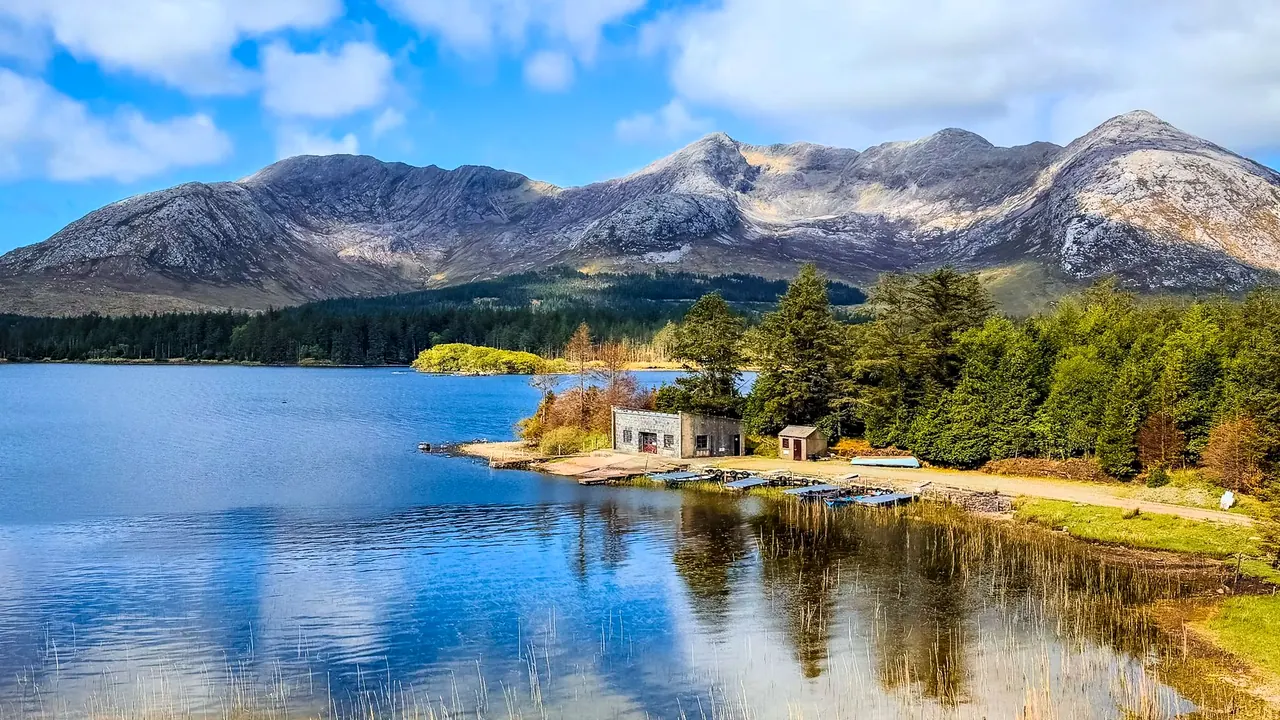
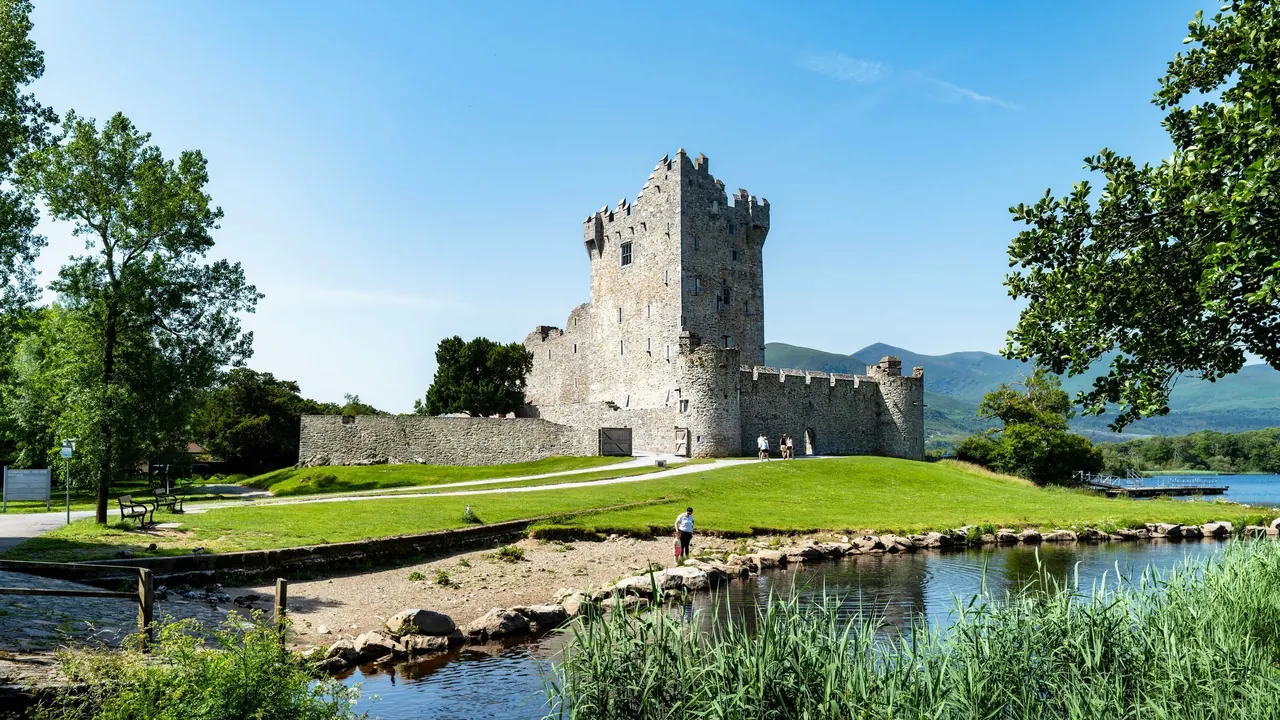
Photos: Connemara by Michael Deligan, CC BY-SA 4.0, cropped; County Kerry by Bob Jenkin, Pexels License.
Connemara or County Kerry?
Our verdict in twelve categories, each scored against the same fixed benchmark cities, and the climate month by month, so you can choose for your trip.
Choose Connemara for
- beaches
- prices
- day trips
Connemara is the quieter, barer choice. It suits travellers who want bog, lake and quartzite mountain more or less to themselves, a cottage or country house hotel as a base, and evenings that end in one pub. The Irish-speaking south and Kylemore Abbey give it character, and Galway city is close enough to cover whatever the region lacks. You give up the depth of things to do that Kerry has.
Choose County Kerry for
- nightlife
- live music and the arts
- culture and sights
Kerry is the better pick for a fuller trip. The landscape is just as strong, but there is more to fill the time between walks: Skellig Michael and the early Christian sites of Dingle, a proper run of trad sessions and folk theatre, two good food towns, and more for children when it rains. The price is more company, with busier towns and coaches on the Ring of Kerry in summer.
Scoreboard
Twelve categories on one fixed scale from 0 to 100. The shaded stretch is the gap between the two.
Your match
Pick a travel style or drag the sliders, and both match scores follow your weighting.
Wins on beaches and prices with your weighting.
Wins on nightlife and live music and the arts with your weighting.
What matters to you?
Category by category
What the scores mean for a trip.
Beaches & swimming
Both coasts have beautiful sand and the same cold Atlantic, so the difference lies in the beaches themselves. Connemara's strands are small and unusual: the twin shell-sand crescents of Dog's Bay and Gurteen, the crunchy maerl of the Coral Strand at Carraroe, and turquoise coves around Omey and Glassilaun.
Kerry's beaches are bigger and more open. Inch Strand and Banna are long dune beaches where families bodyboard and surfers find waves, and Derrynane and the inner bays of Kenmare are the calmest places to swim.
Food & drink
Both live on lamb and shellfish served plainly, but Kerry has two towns built around eating where Connemara has one. Clifden carries most of Connemara's good cooking, with Killary mussels and seafood chowder in the villages around it.
In Kerry you can split dinners between the harbour seafood of Dingle, with its ice cream and gin, and the row of serious restaurants in Kenmare. Killarney adds choice, if mostly tourist menus.
Culture & sights
Kerry has more to visit. Skellig Michael, with its monks' beehive cells on a sea rock, is one of Ireland's great sites, and the Dingle Peninsula adds the Gallarus Oratory and Kilmalkedar. Staigue Fort, Muckross House, Ross Castle and Derrynane House give a driver a full itinerary.
Connemara's heritage is thinner and quieter. Kylemore Abbey is the one big draw, alongside the Marconi station and the Alcock and Brown landing site at Derrigimlagh. Its real cultural strength is living Irish in the southern Gaeltacht rather than sites to tick off.
Nightlife
Neither region has clubs, but Kerry has far more going on after dark. Dingle on a summer night means moving from one old pub to the next, and Killarney has big bars and late venues for anyone wanting a longer night.
Connemara's evenings centre on Clifden's short main street, with one or two bars in each village. Anyone after more than a chatty pint ends up going to Galway city.
Nature & outdoors
This is the strength of both regions and they are evenly matched, though the landscapes differ. Connemara is bog, lake and bare quartzite: the Twelve Bens and Maumturks, the fjord of Killary Harbour, and a coast full of inlets along the Sky Road. Its serious hill days are often pathless.
Kerry is greener and higher. Killarney National Park has oak woods, lakes and red deer, Carrauntoohil is the country's highest summit, and the Kerry Way and Dingle Way offer waymarked walking over several days. Kerry also has surfing at Inch and puffins on the Skelligs.
Day trips
The day-trip lists are about equally good, but Connemara's has a city on it. Galway's medieval streets are about an hour from Clifden, and the ferry from Rossaveal reaches Dún Aonghasa on Inis Mór, a cliff-edge fort few island trips can match.
Kerry's trips are mostly to other small places, such as Portmagee, Valentia and the abandoned village on the Great Blasket. Cork and Kinsale are a longer drive away.
Good for families
Kerry copes better with children, mainly because it has places to go when it rains. Dingle has an aquarium, Tralee an indoor water park, and there are open farms, the Kerry Bog Village and seal-watching boats on top of the beaches.
Connemara offers simpler outdoor fun: ponies, rock pools, the play area at Letterfrack and the gardens at Kylemore. It works well for families who don't mind the weather, but on a wet week you'll be driving to Galway.
Getting around
You need a car in both, on the same narrow, slow roads. Kerry has slightly more public transport, with trains to Killarney and Tralee and walkable towns at each end, while Connemara relies on the coach from Galway to Clifden.
The hazards differ too. In Kerry it is coach traffic on the Ring of Kerry and the steep Conor Pass. In Connemara it is sheep on single-track bog roads, and island ferries that can be cancelled in rough seas.
Shopping & style
Neither is a place to shop, but Kerry has a bit more worth browsing. Dingle has small studios selling pottery and art, and Kenmare has its needlepoint lace and some galleries.
Connemara has a few craft shops in Clifden and Roundstone. The local things to take home are green Connemara marble and tweed.
Affordability
Both are expensive in summer, and a hire car adds to the bill wherever you stay. Connemara's savings come from self-catering cottages and B&Bs away from Clifden and the lakeside hotels.
Kerry's peak pressure falls on Killarney, Dingle and Kenmare, and it eases noticeably in spring and early autumn. In both, the hills and coast roads cost nothing.
Live music & performing arts
Both regions have trad sessions in their pubs through the summer, but Kerry's are the busier. In Connemara they are spread between Clifden and the villages, and what sets the region apart is the Irish-speaking south, where people still sing sean-nós and dance sets as part of everyday life. The Clifden Arts Festival brings readings and small concerts each September, and after the summer the sessions become hard to find.
Kerry has more choice on any evening. Dingle is the place to go, with local players gathering in the corner of many of its pubs, while Killarney's nightly summer sessions are more polished and aimed at visitors. Siamsa Tíre, the National Folk Theatre in Tralee, puts rural music and dance on a stage, and Listowel's Writers' Week and the Rose of Tralee add summer festivals. Neither region has opera or an orchestra.
Wellness & relaxation
Both rely on slow days rather than a bathing culture, and in that they are much alike. Kerry has more formal treatments, with full spas at the big hotels around Killarney and Kenmare, plus the old hot seaweed baths at Ballybunion.
Connemara has only a handful of hotel spas. Relaxing here usually means a cold dip off a strand and a quiet lakeside cottage.
When should you go?
Pick your month. The climate figures are measured averages, not a forecast.
Connemara in July
County Kerry in July
Daytime high, °C
Rainfall in the month, mm
Where the figures come from
Connemara's temperatures are measured 83 km from the centre, at Belmullet.
Connemara has no rain gauge within 25 km of the centre, so its rainfall comes from a gridded climate dataset read at the destination rather than from a gauge further away.
Connemara's sunshine is measured 70 km from the centre, at Galway.
County Kerry's temperatures are measured 53 km from the centre, at Valentia Observatory.
County Kerry has no rain gauge within 25 km of the centre, so its rainfall comes from a gridded climate dataset read at the destination rather than from a gauge further away.
Temperature and rainfall are climate normals, averaged over the years shown. Connemara: 1991-2020 (sunshine 1981-2010) normals, Belmullet (82.8 km from centre). County Kerry: 1991-2020 normals, Valentia Observatory (52.8 km from centre).
The two share almost the same mild Atlantic year. Daytime highs reach about 18°C in July and August and never get hot, so walking is comfortable all summer, and the sea only reaches about 16°C in August in either place. That makes beach days a matter of luck rather than season. May is the sunniest month in both, at around 182 hours, and late spring is the best bet for clear days on the hills.
Where they part is the rain. Connemara is driest from April to June, and its wet season builds through autumn. Kerry's driest stretch runs from May to July, but its winters are noticeably wetter, with about 187mm in December. Kerry also gets a little more sun in June, and Connemara a little more in July. In both, November to February are short, grey and wet, fine for a pub fire but poor for the mountains.
Which traveller are you?
On a culture and arts trip, Kerry is the stronger pick. Connemara gives you Kylemore and the everyday Irish of its Gaeltacht, but not much to fill a week. Kerry has monastic ruins to link up by car and staged folk music in Tralee.
For a food and nightlife trip, Kerry lets you stay put. In Connemara a good evening means Clifden, and anything bigger means the road to Galway. In Kerry you can eat by Dingle's harbour, book dinner in Kenmare and end up in a late bar in Killarney.
On a family trip with children, Kerry is the safer bet, because rain matters more than scenery when children are involved. Connemara suits families who are happy outdoors in any weather. A Kerry base in Killarney or Tralee keeps a wet afternoon from becoming a lost day.
Before you go
| Measure | Connemara | County Kerry |
|---|---|---|
| Official language | English, Irish | English, Irish |
| Currency | Euro (EUR) | Euro (EUR) |
| Sockets | G230 V, 50 Hz | G230 V, 50 Hz |
| Driving side | Left | Left |
| Time zone | UTC, UTC+1 in summer | UTC, UTC+1 in summer |
| Emergency number | 112 | 112 |
| Main airport | Ireland West Airport Knock (NOC)18 non-stop destinations | Kerry Airport (KIR)10 non-stop destinations |
| Public holidays this year | 11 days | 11 days |
By the numbers
| Measure | Connemara | County Kerry |
|---|---|---|
| Population | - | 147,707 |
| People per km² | - | 31 |
| Swim season, months above 21 °C | None | None |
Where else could you go?
Every comparison below shares a destination with this one, so you can follow Connemara or County Kerry somewhere new.
- Pembrokeshirevs County Kerry
- Isles of Scillyvs County Kerry
- Cornwallvs County Kerry
- Pembrokeshirevs Connemara
- Snowdoniavs County Kerry
- Snowdoniavs Connemara