Ireland
County Kerry
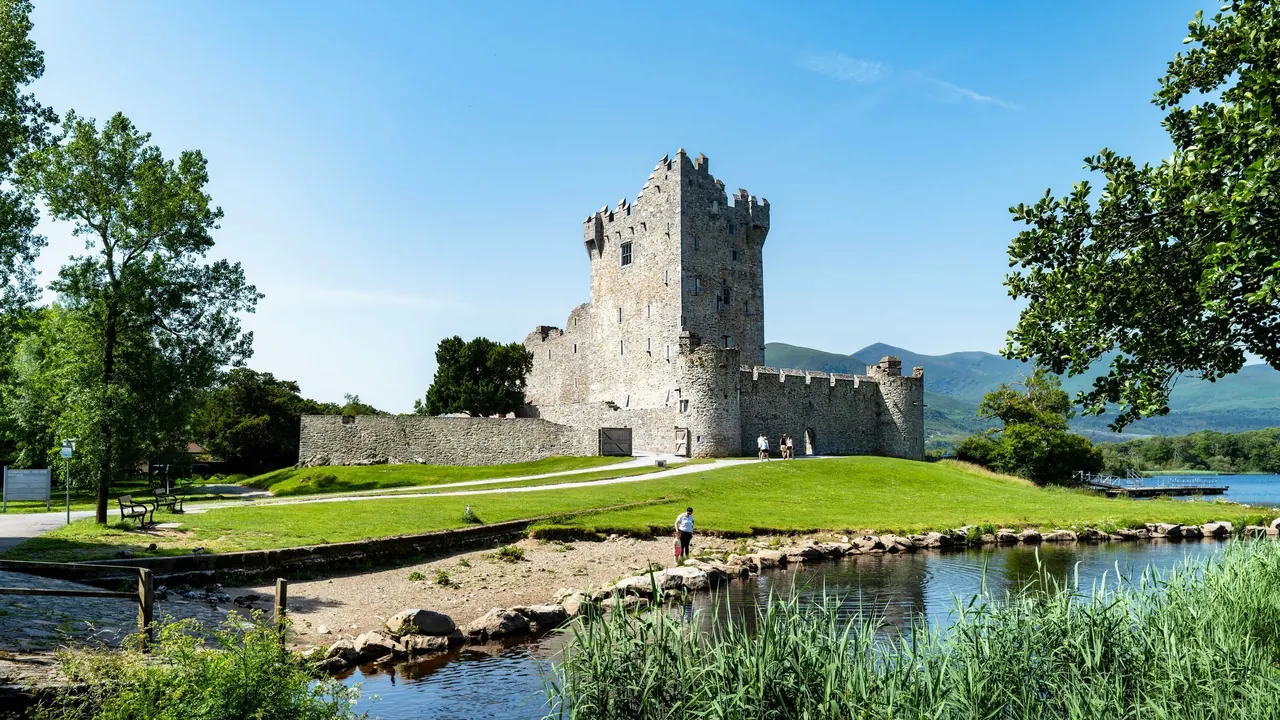
Ross Castle on the lakeshore at Killarney
- Nature & outdoors83
- Day trips56
- Families48
Photo: Bob Jenkin, Pexels License
Match
44
Every category weighted equally
- Beach & sun44
- Culture & arts44
- Food & nightlife41
- Family trip46
- Outdoors51
- Relax & unwind46
- Shopping & style41
- On a budget43
County Kerry in twelve categories
Our verdict on each, scored 0 to 100 against the same fixed benchmark cities, so a score means the same thing on every page.
Beaches & swimming. Scores 32 out of 100.
Food & drink. Scores 42 out of 100.
Culture & sights. Scores 46 out of 100.
Nightlife. Scores 38 out of 100.
Nature & outdoors. Scores 83 out of 100.
Day trips. Scores 56 out of 100.
Good for families. Scores 48 out of 100.
Getting around. Scores 38 out of 100.
Shopping & style. Scores 28 out of 100.
Affordability. Scores 32 out of 100.
Live music & performing arts. Scores 46 out of 100.
Wellness & relaxation. Scores 44 out of 100.
County Kerry category by category
Beaches & swimming
32Kerry's beaches are some of the most beautiful in Ireland: the long dune spit of Inch Strand on the Dingle Peninsula, Banna Strand north of Tralee, the sheltered sands of Derrynane on the Ring of Kerry, Rossbeigh, and the small cove at Coumeenoole under Slea Head. They are wide, clean and often nearly empty.
The catch is the water. Even in August the Atlantic sits at about 15°C to 17°C, and the weather can turn a beach day into a walk in a rain jacket. Locals swim all year and families paddle and bodyboard from June to September, but a visitor who wants warm water and long hours on the sand will be disappointed. Derrynane and the inner reaches of Kenmare Bay offer the calmest swimming.
Food & drink
42Eating in Kerry is about produce: crab, mussels and fish landed at Dingle and Portmagee, mountain lamb, farmhouse cheese and good brown bread. The two towns where it comes together best are Dingle, with its harbour seafood places and small-batch ice cream and gin culture, and Kenmare, a pretty planned town known for its run of serious restaurants along a few short streets. Killarney has the most choice but leans towards tourist menus.
Pubs do much of the everyday cooking, with chowder, fish and chips and stews, and the pint of stout matters as much as the plate. Beyond these towns the choice thins quickly, and in the quieter villages dinner can mean whatever the one pub is serving.
Culture & sights
46Kerry's heritage is scattered across the landscape rather than gathered in towns. The great site is Skellig Michael, a jagged rock 12km off the Iveragh coast where monks built beehive stone cells and terraces more than a thousand years ago; boats land only in summer and only in calm seas, and many visitors see it from the water or the island-view centre on Valentia instead.
The Dingle Peninsula is dense with early Christian remains, including the Gallarus Oratory and Kilmalkedar church, and the Iron Age Staigue Fort stands on the Ring of Kerry. Around Killarney there are Muckross House and its abbey, and Ross Castle on the lake shore. Derrynane House, home of Daniel O'Connell, and the Kerry County Museum in Tralee round it out. It is a rewarding set for a curious driver, not a museum trip.
Nightlife
38Going out in Kerry means the pub. Dingle has a remarkable number for its size, many of them old shopfront bars, and on summer nights the town is busy with people moving from one to the next. Killarney is the livelier choice for a late night, with large bars, late venues and a steady flow of weekend groups through the season.
There is no club culture to speak of and no cocktail scene beyond the hotels. Outside July and August many villages are quiet by eleven, and the evening is a slow pint by the fire rather than a big night out.
Nature & outdoors
83This is the county's reason to exist as a destination. Killarney National Park wraps lakes, oak woods and native red deer around the edge of the town, and behind it rise the MacGillycuddy's Reeks, with Carrauntoohil, Ireland's highest peak, a serious full-day climb. The Gap of Dunloe can be walked or cycled through a narrow glacial pass, and the Kerry Way and Dingle Way are long-distance trails with sea views for days.
The coast is the other half: the cliffs and islands at Slea Head, Mount Brandon above the Atlantic, the Skelligs with gannets and puffins in early summer, surfing at Inch and Brandon Bay, kayaking in Kenmare Bay. Killarney suits walkers and cyclists, Dingle the coast. The weather is soft and changeable, so the light is wonderful and the rain is certain.
Day trips
56From a base in Killarney or Kenmare, the day trips are largely to other small places: Dingle and its harbour, Kenmare's planned streets, the fishing villages of Portmagee and Cahersiveen, Valentia Island with its slate quarry and lighthouse, and the abandoned village on the Great Blasket, reached by boat from the Dingle Peninsula in summer.
Further out, Cork city and the harbour town of Kinsale are about an hour and a half by car, the thatched village of Adare in County Limerick a little closer, and the Beara Peninsula and Bantry just over the county line. Tralee and the North Kerry towns are easy too. It is a good list for a road trip, though few of these are reasons to cross a continent on their own.
Good for families
48Kerry is a relaxed, safe and welcoming place for children, with long beaches for rockpooling and bodyboarding, pony and jaunting-car rides in Killarney National Park, boat trips to see seals and seabirds, and an aquarium in Dingle. Tralee has an indoor water park that rescues wet days, and there are open farms and the old Kerry Bog Village near Glenbeigh.
What it lacks is anything large built for children, and much of the county's appeal is long drives and hill walks that small children tire of. Rain is part of every visit, so a family does best based in Killarney or Tralee with indoor options close by.
Getting around
38Trains reach Killarney and Tralee from Dublin and Cork, and both towns are easy on foot, as are Dingle and Kenmare. Beyond that, buses are sparse and coach tours fill the gap, so most visitors drive.
Distances are short but slow. Roads are narrow, often single-track on the peninsulas, and the Ring of Kerry runs thick with tour coaches in summer, which travel anticlockwise; drivers often go the other way or start early. The Conor Pass above Dingle is not for nervous drivers. Cycling is pleasant on quieter routes, and in Killarney a bike or a jaunting car covers the national park well.
Shopping & style
28Shopping here is craft and souvenir. Dingle has small studios selling pottery, jewellery, knitwear and local art, and Kenmare has a long tradition of needlepoint lace and a few good galleries and design shops. Killarney's main streets are lined with Aran sweaters, tweed caps and Celtic jewellery, much of it the same from shop to shop. There is nothing in the way of fashion or department stores, and a visitor who wants to shop seriously will need a city.
Affordability
32Kerry carries Irish prices, and in July and August rooms in Killarney, Dingle and Kenmare are expensive and book up early. Restaurant meals and drinks cost what they do across Ireland, which is a lot by European standards, and a hire car adds much to the bill.
The counterweights are real: family-run B&Bs in the villages, hearty pub lunches, and the fact that the best of the county, the mountains, lakes and coast roads, costs nothing to enjoy. Spring and early autumn are noticeably easier on the budget.
Live music & performing arts
46Traditional Irish music is the live art of Kerry, and a visitor can hear it most evenings in season. Dingle is the best place for it, with fiddles, flutes and bodhráns in the corner of many pubs, often informal sessions where local players gather. Killarney has sessions every night through the summer, more polished and aimed at visitors.
In Tralee, Siamsa Tíre, the National Folk Theatre, stages music and dance drawn from rural tradition. Listowel's Writers' Week brings readings and performances each summer, and the Rose of Tralee festival fills the town with stage shows. There is no opera or orchestra, and outside the main season the music thins to weekends.
Wellness & relaxation
44Kerry's restorative quality comes mostly from its pace: quiet roads, lake and bay views, long evenings in summer and very little to rush for. The large country-house and lakeside hotels around Killarney and Kenmare have full spas, and these are where most visitors go for treatments.
The one local bathing tradition is the hot seaweed bath, an old Irish seaside cure offered at Ballybunion on the north coast. Beyond that there are no thermal springs or public bathhouses, so wellness here means a spa hotel, a slow walk and an early night rather than a bathing culture.
Where to stay in County Kerry
Killarney is the natural first base. Trains from Dublin and Cork arrive in the town, the national park begins at its edge, and it has the widest choice of places to eat and the liveliest late nights. It suits walkers, cyclists and families, who have indoor options close by when it rains, and the Ring of Kerry and the Gap of Dunloe are easy from here. Tralee is the practical alternative for families, with a station and a water park, though it has less charm.
Dingle suits anyone who came for the coast, the seafood and the music. The town is small enough to walk, its pubs hold sessions on summer nights, and Slea Head, the early Christian sites and the Blasket boats are close by. Kenmare is the quieter choice, a neat planned town with a run of serious restaurants, calm water in the bay and spa hotels nearby. It suits couples and travellers who care about food.
The distances are short but the roads are slow, so a week works well split between two bases: Killarney or Kenmare for the lakes, mountains and Ring of Kerry, then Dingle for the peninsula. On a second visit, a village B&B on the Iveragh coast near Derrynane or Portmagee gives quiet evenings and an early start for the Skelligs, though there are fewer places to eat.
When should you go?
Pick a month to see what it is like. The climate figures are measured averages, not a forecast.
County Kerry in July
Daytime high, °C
Rainfall in the month, mm
The whole year
Shaded against this destination’s own year: the deepest cell is its best month for that figure and the palest its weakest.
Where the figures come from
County Kerry's temperatures are measured 53 km from the centre, at Valentia Observatory.
County Kerry has no rain gauge within 25 km of the centre, so its rainfall comes from a gridded climate dataset read at the destination rather than from a gauge further away.
Temperature and rainfall are climate normals, averaged over the years shown. County Kerry: 1991-2020 normals, Valentia Observatory (52.8 km from centre).
Before you go
| Measure | County Kerry |
|---|---|
| Official language | English, Irish |
| Currency | Euro (EUR) |
| Sockets | G230 V, 50 Hz |
| Driving side | Left |
| Time zone | UTC, UTC+1 in summer |
| Emergency number | 112 |
| Main airport | Kerry Airport (KIR)10 non-stop destinations |
| Public holidays this year | 11 days |
By the numbers
| Measure | County Kerry |
|---|---|
| Population | 147,707 |
| People per km² | 31 |
| Swim season, months above 21 °C | None |
Compare County Kerry with
Every comparison with a written verdict behind it.