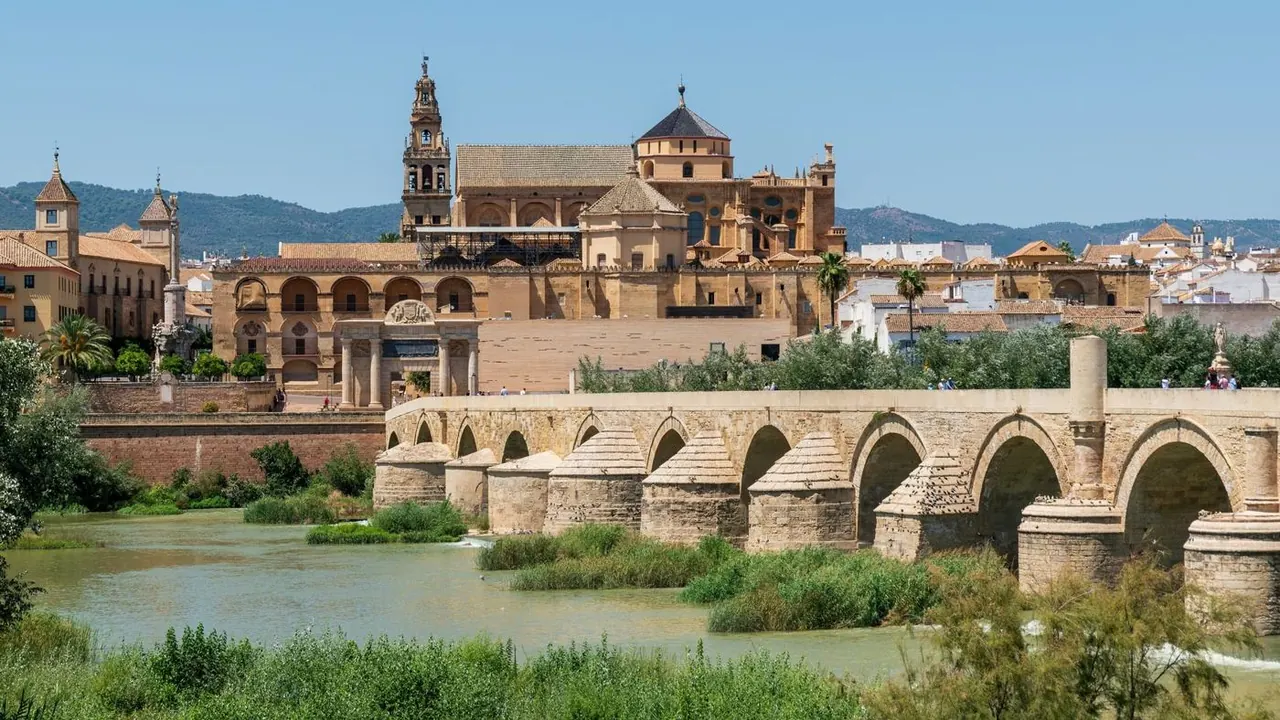
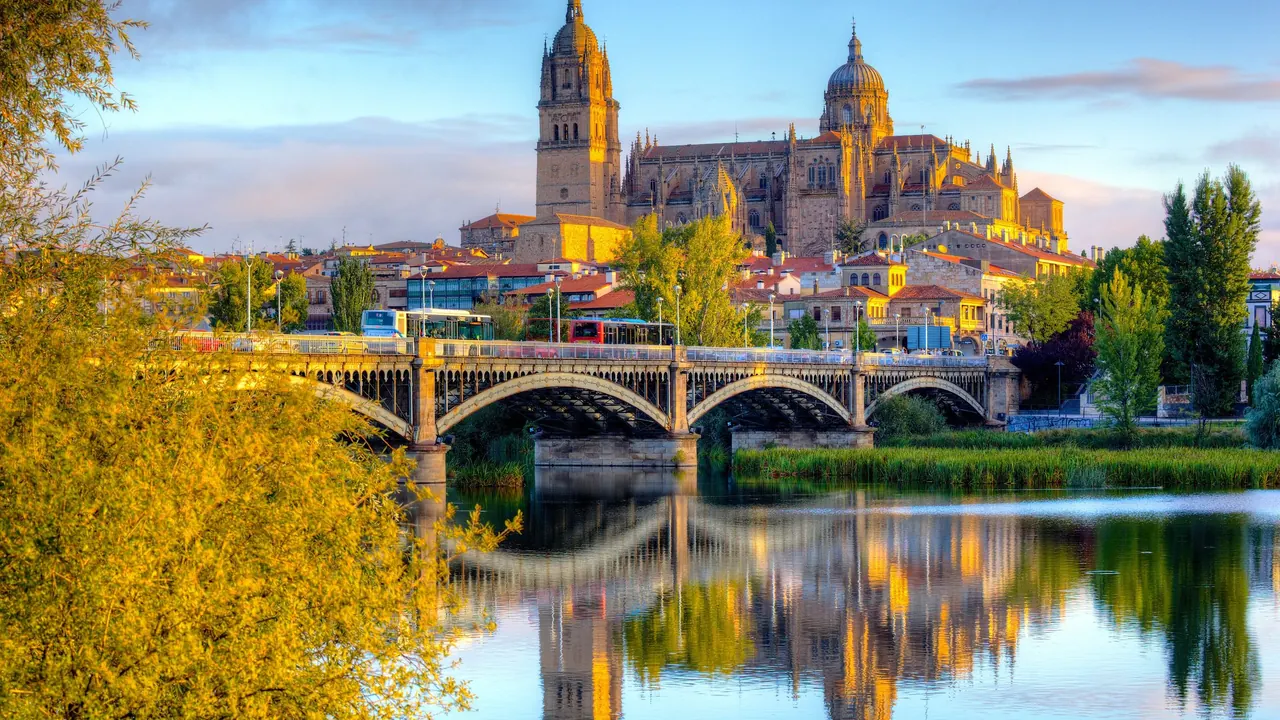
Photos: Cordoba by Jose María Ligero Loarte, CC BY-SA 4.0, cropped; Salamanca by Jiuguang Wang, CC BY-SA 3.0 ES, cropped.
Cordoba or Salamanca?
Our verdict in twelve categories, each scored against the same fixed benchmark cities, and the climate month by month, so you can choose for your trip.
Choose Cordoba for
- day trips
- live music and the arts
- beaches
Cordoba is the stronger choice if the monuments are the point of the trip. The Mezquita-Cathedral alone is worth the journey, and the Alcazar gardens, the Juderia and Medina Azahara make a deeper set of sights than Salamanca can offer. It is also the better base for exploring further: Seville, Granada and Malaga are all an easy train ride away, so a week here can take in much of Andalusia without changing hotel. Add serious flamenco and tabernas with tiled patios, and it suits travellers who want history by day and a long, slow dinner at night.
Choose Salamanca for
- nightlife
- nature and the outdoors
- getting around
Salamanca suits travellers who want an old city that is still lived in, with energy after dark. Its large student population fills the golden sandstone streets from Thursday to Saturday, and nights run late in a way they rarely do in Cordoba outside summer and the May fair. The walkable centre is even easier to get around, and the mountains of the Sierra de Francia and the Arribes canyon give it more to do outdoors. Its summers are milder too, which makes July and August far easier for walking the streets.
Scoreboard
Twelve categories on one fixed scale from 0 to 100. The shaded stretch is the gap between the two.
Your match
Pick a travel style or drag the sliders, and both match scores follow your weighting.
Too close to call, level with your weighting
Wins on day trips and live music and the arts with your weighting.
Wins on nightlife and nature and the outdoors with your weighting.
What matters to you?
Category by category
What the scores mean for a trip.
Beaches & swimming
Neither city is a place for the sea, but Cordoba at least makes a swim possible. The fast train reaches Malaga in about an hour, so a long beach day on the Costa del Sol can be done. Salamanca is a long drive from any coast. Its river beaches on the Tormes and the reservoirs of the province are the only open water nearby, pleasant for a summer afternoon and nothing more.
Food & drink
Both cities eat well and cheaply, but the cooking is different. Cordoba is southern and lighter: cold salmorejo, fried aubergine with cane honey and chilled Montilla-Moriles wine, eaten in old tabernas around Santa Marina and San Agustin.
Salamanca is Castilian and meaty: Guijuelo ibérico ham, hornazo, roast suckling pig and red wines from Toro and Ribera del Duero. Food here is eaten standing at the counter, and the student crowd keeps the portions large. Neither city is strong on fine dining or international food.
Culture & sights
Cordoba has the greater single monument. The Mezquita's forest of striped arches, with a cathedral built into its middle, is unlike anything else in Europe, and the Alcazar, the Juderia synagogue and the caliphal ruins of Medina Azahara add depth to it.
Salamanca's appeal lies more in the whole ensemble. A golden sandstone old town gathers around the baroque Plaza Mayor, the University façade and the twin cathedrals, and it glows when floodlit after dark. Its museums are modest beyond the Casa Lis. Both centres take two or three days to cover properly.
Nightlife
Salamanca is the clear choice for a night out. Students and language learners fill its bars and dance clubs from Thursday to Saturday, and nights there run past 3am in most of the year apart from high summer.
Cordoba's evenings are mostly late tapas on the terraces of the Corredera and Las Tendillas. It only really stays up all night in summer and during the May fair, and the club scene is small. Choose it if you prefer a long evening at the table to dancing.
Nature & outdoors
Salamanca has the better landscapes within reach. The chestnut forests of the Sierra de Francia, mountains above 2,000m and the granite canyon of the Arribes del Duero, with its boat trips, are all about an hour away.
Cordoba's countryside is gentler: the wooded hills of the Sierra Morena, Hornachuelos with its birds of prey, and the limestone gorges of the Subbeticas. Summer heat over 40°C rules out much of it for months at a time. You need a car to explore the countryside around either city.
Day trips
Cordoba is the stronger base by some distance. High-speed trains put Seville, Granada and the Alhambra, and Malaga within easy reach, so three of Spain's great cities become day trips. With a car you can add Ubeda and Baeza, Antequera's dolmens and the Montilla bodegas.
Salamanca has a good set of smaller places: walled Ávila, the Romanesque churches of Zamora, Ciudad Rodrigo and the half-timbered villages of La Alberca and Mogarraz. Many of them take a car, and nothing nearby compares with the Alhambra.
Good for families
For children, what sets the two apart is mainly the weather and the kind of distraction on offer. Cordoba has the fountains of the Alcazar gardens, the horse show at the royal stables, the castle at Almodovar del Rio and a small zoo. Its summer heat is hard on small children, though, so a family visit works far better in spring or autumn.
Salamanca turns its sights into a game: children hunt for the carved frog on the University façade and the astronaut on the New Cathedral, and they can climb the cathedral towers. It has no zoo, and its winters are bitterly cold. In either city, the safe, traffic-free centre and late evenings in the squares make a day or two easy, rather than a whole family vacation.
Getting around
Salamanca is slightly easier. Its pedestrian old town takes about 20 minutes to cross from the Plaza Mayor to the Roman bridge, the streets are wider and gently sloping, and there is little reason to use a bus.
Cordoba is compact too, but its lanes are narrower and more twisting, which makes them harder going with luggage. Medina Azahara needs a tourist bus or taxi. In return, its fast rail links across Andalusia are far better than Salamanca's trains to Madrid and Valladolid.
Shopping & style
Cordoba has the wider choice of workshop crafts. Alongside the silver filigree it is known for, there is embossed guadameci leather, ceramics and handmade guitars, and the best pieces come from specialist workshops rather than the souvenir stalls in the Juderia.
Salamanca shares the filigree tradition in its charro buttons and pendants, but its most worthwhile buys are edible: ibérico ham, sausages and cheese from the Mercado Central. For everyday shopping, Cruz Conde in Cordoba and Calle Toro and Calle Zamora in Salamanca have Spanish chains and a department store. Luxury boutiques are scarce in both.
Affordability
Both are cheap by Western European standards, and walkable centres keep transport costs low in each. The savings come in different ways. Salamanca's student economy keeps bar prices down, and a drink often comes with a free tapa, though the admission charges for cathedrals and towers add up. Cordoba is good value for most of the year, but May festivals push room prices up sharply. Rooms near the Mezquita also cost more.
Live music & performing arts
Cordoba gives you more to plan an evening around, and nearly all of it is flamenco. There are tablaos and peñas run by aficionados, a guitar festival, and the free all-night performances of the Noche Blanca. The Gran Teatro adds the city orchestra.
Salamanca's live music is more casual. Caped student tunas play under the Plaza Mayor arcades, university choirs sing in historic halls, and the Teatro Liceo hosts touring shows. There is no resident orchestra, so serious concertgoers will find little.
Wellness & relaxation
Rest in Cordoba means a shaded courtyard with fountains and orange trees, and in summer the midday shutdown makes everyone stop. If you want more than that, there are a few Arab-style bath houses under horseshoe arches and the spas of the better hotels, while the ruined Caliphal Baths recall a bathing culture that has long gone.
Salamanca has the same kind of bath houses and hotel spas, plus quiet cloisters to sit in at San Esteban and Las Dueñas. It can also offer real mineral springs. The old balneario at Ledesma is about half an hour away, and the Roman-era spa town of Baños de Montemayor is about an hour south. Even so, if spas are the main point of your trip, neither city will satisfy you.
When should you go?
Pick your month. The climate figures are measured averages, not a forecast.
Cordoba in July
Salamanca in July
Daytime high, °C
Rainfall in the month, mm
Temperature and rainfall are climate normals, averaged over the years shown. Cordoba: 1991-2020 normals, Cordoba / Aeropuerto (7.6 km from centre). Salamanca: 1991-2020 normals, Salamanca / Matacan (13.9 km from centre).
Cordoba is at its best in spring, from March to May, and again in late September and October, when days are warm without being punishing. July and August are fierce, with afternoon highs around 37°C, so sightseeing shrinks to the early morning and late evening. Rain arrives with the autumn and peaks in winter, with about 91mm in December, but winter days stay mild enough for walking and the sun still comes out often.
Salamanca runs about five or six degrees cooler all year. That makes high summer, at around 31°C, perfectly manageable for exploring on foot, while winter is cold, with January highs near 9°C. It is also the drier of the two, and May, June and September are its most comfortable months. In short, choose Cordoba for spring or a mild winter break and Salamanca for summer. Neither city is a beach destination in any season.
Which traveller are you?
On a culture and arts trip, Cordoba comes out ahead. The Mezquita-Cathedral, Medina Azahara and the Palacio de Viana's patios are a stronger set of sights than Salamanca's, and its flamenco peñas and guitar festival give the evenings more depth.
For a food and nightlife trip, Salamanca is the livelier pick. The eating is about as good in both cities, but its student crowd keeps the bars around the Plaza Mayor and Gran Vía packed well past 3am, while Cordoba's nights mostly end at the table.
On an outdoors trip, Salamanca has the edge. The Sierra de Francia, Las Batuecas and peaks above 2,000m in Béjar and Gredos are about an hour away, and its cooler summers leave more of the year comfortable for hiking than Cordoba's Sierra Morena allows.
Before you go
| Measure | Cordoba | Salamanca |
|---|---|---|
| Official language | Spanish | Spanish |
| Currency | Euro (EUR) | Euro (EUR) |
| Sockets | CF230 V, 50 Hz | CF230 V, 50 Hz |
| Driving side | Right | Right |
| Time zone | UTC+1, UTC+2 in summer | UTC+1, UTC+2 in summer |
| Emergency number | 112 | 112 |
| Elevation | 120 m | 798 m |
| Main airport | Córdoba Airport (ODB)8 km from centre3 non-stop destinations | Adolfo Suárez Madrid–Barajas Airport (MAD)184 km from centre239 non-stop destinations |
| Public holidays this year | 12 days | 12 days |
By the numbers
| Measure | Cordoba | Salamanca |
|---|---|---|
| City population | 323,262 | 146,110 |
| People per km² | 258 | 3,690 |
| Museums within 10 km | 16 | 13 |
| UNESCO World Heritage sites within 50 km | 2 | 1 |
Where else could you go?
Every comparison below shares a destination with this one, so you can follow Cordoba or Salamanca somewhere new.
- Sevillevs Cordoba
- Granadavs Cordoba
- Rondavs Cordoba
- Malagavs Cordoba
- Marbellavs Cordoba
- Madridvs Salamanca