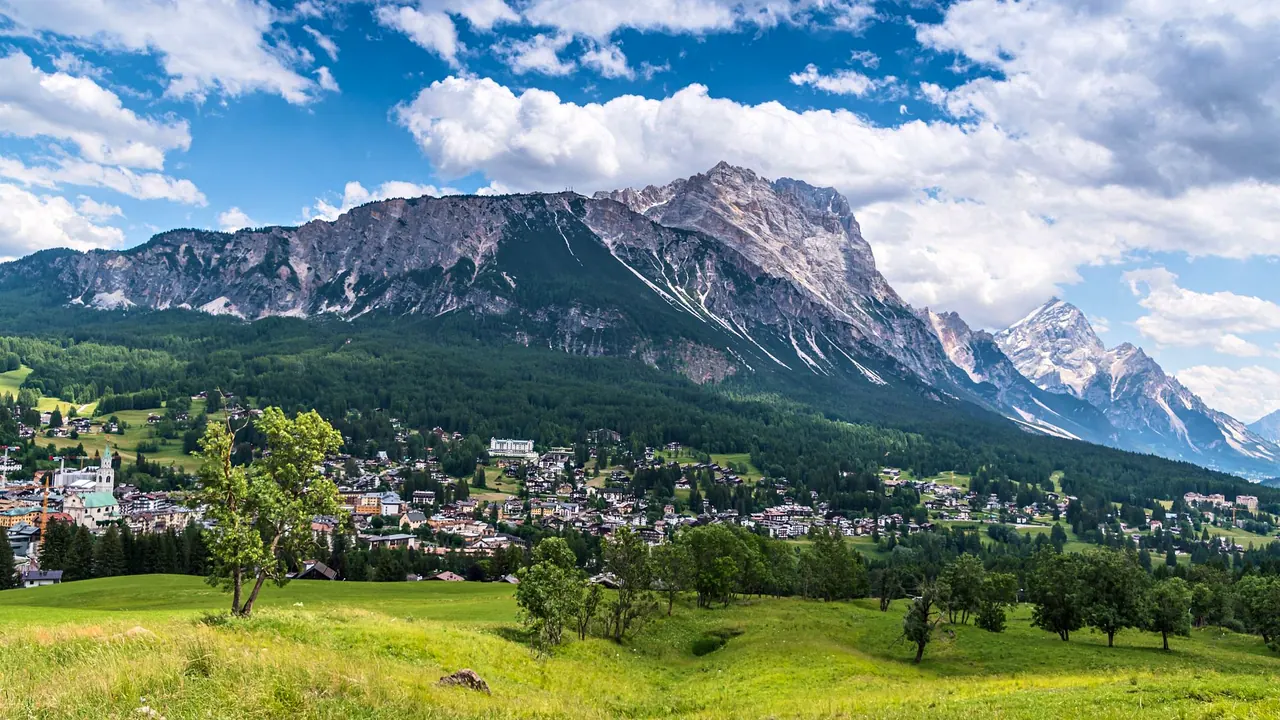
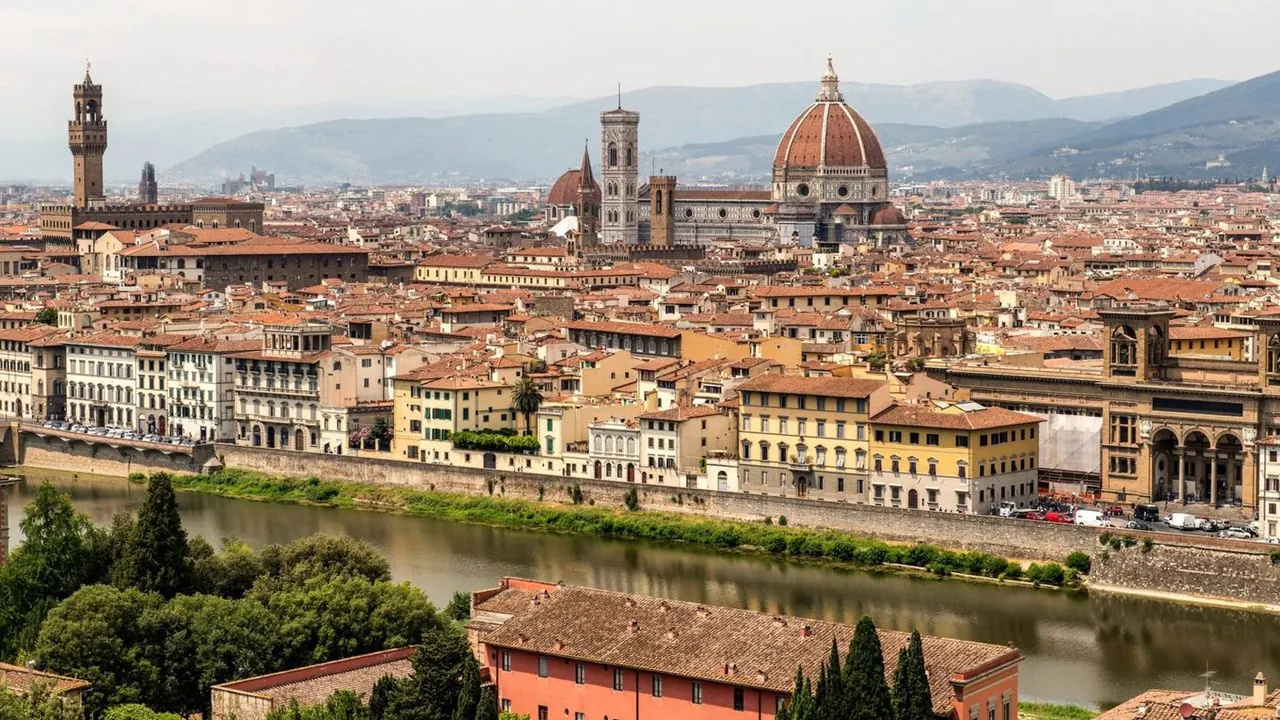
Photos: Cortina d'Ampezzo by Andreas Neubauer, Pexels License; Florence by Wolfgang Weiser, Pexels License.
Cortina d'Ampezzo or Florence?
Our verdict in twelve categories, each scored against the same fixed benchmark cities, and the climate month by month, so you can choose for your trip.
Choose Cortina d'Ampezzo for
- nature and the outdoors
- families
- wellness
Cortina d'Ampezzo is for travellers who come for the landscape and little else. The pale Dolomites ring the town, lifts climb from the streets onto the peaks, and the same valley gives you the Dolomiti Superski area in winter and hut-to-hut hiking, climbing and via ferrata in summer. You have to accept a small, quiet, very expensive resort with few sights and early evenings. If you do, few places in the Alps match it.
Choose Florence for
- culture and sights
- day trips
- live music and the arts
If you want a city that fills every day, pick Florence. The Uffizi, the Duomo and the Accademia are a short walk apart, the trattorie of the Oltrarno and the market stalls feed you well, and Siena, Pisa, Lucca and Bologna are an easy train or bus ride away. Its countryside is gentle hill country rather than high mountains, but for art, food and towns to visit, Cortina cannot compete.
Scoreboard
Twelve categories on one fixed scale from 0 to 100. The shaded stretch is the gap between the two.
Your match
Pick a travel style or drag the sliders, and both match scores follow your weighting.
Wins on nature and the outdoors and families with your weighting.
Wins on culture and sights and day trips with your weighting.
What matters to you?
Category by category
What the scores mean for a trip.
Beaches & swimming
Neither city is a beach destination, but Florence gives you a little more to work with. The sandy Versilia coast around Viareggio is about an hour and a half by train, so a day by the sea is possible, and there are public outdoor pools on the edge of the city.
From Cortina the Adriatic is more than two hours' drive away. The alpine lakes such as Ghedina and Pianozes are fed by snowmelt and too cold for more than a quick, bracing dip, so swimming mostly means a hotel pool.
Food & drink
Cortina eats better than a small resort usually does, thanks to its wealthy visitors. Ampezzan dishes such as casunziei with poppy seeds, polenta with game and barley soup are at their best on rifugio terraces. In the valley, though, the choice is narrow, and there is little street food and almost nothing cheap.
Florence has far more depth. There is bistecca and ribollita in the Oltrarno trattorie, lampredotto from street carts, and the Mercato Centrale and Sant'Ambrogio markets. Chianti Classico vineyards start just south of the city. You can eat well at every budget, as long as you avoid the set menus near the Duomo.
Culture & sights
There is no real contest here. Cortina has a pleasant centre with its basilica and Olympic ice stadium, plus the Rimoldi art collection and two small museums that fill a wet afternoon. Its most striking history is the First World War front on Lagazuoi and the Cinque Torri, which you reach by spending a day in the mountains.
Florence is where the Renaissance took shape. Brunelleschi's dome, the Uffizi, the David, the Bargello and the Pitti Palace are all within walking distance. Behind them come the Medici Chapels, the Brancacci Chapel and Santa Croce, and together they can fill a week.
Nightlife
Florence has the livelier evenings, though neither city is a place for dancing until dawn. Its nights run from aperitivo to wine bars, with crowds spilling across Piazza Santo Spirito, a more local scene around Sant'Ambrogio and outdoor bars along the Arno in summer.
Cortina's evenings are about après-ski drinks, the passeggiata on the Corso Italia and long dinners. Late bars and a club or two only open in the peak winter weeks, and for most of summer the town is asleep by late evening.
Nature & outdoors
This is where Cortina pulls far ahead. The Tofane, Cristallo and Cinque Torri rise around the valley, the lifts start in town, and the Tre Cime and the Fanes-Sennes-Braies park are close. You get skiing on the Dolomiti Superski area in winter and some of the oldest via ferrata routes in the Alps in summer.
Florence's outdoors is softer and more cultivated. There are olive terraces at Fiesole, cycling lanes through the Chianti hills, and the forests of the Casentino about an hour and a half away. It makes for lovely walking in spring and autumn, but it is not high-mountain country.
Day trips
Florence has one of the best choices of day trips anywhere. Siena, Pisa and Lucca are about an hour away, Bologna is under forty minutes by high-speed train, and San Gimignano, Volterra and the Val d'Orcia towns are within reach. You could fill a week without repeating a trip.
From Cortina, most outings head into the mountains. The towns within range are charming rather than essential: San Candido and Brunico in South Tyrol, Bolzano with the Iceman about two hours away, and Belluno or Lienz. Venice means a long day on the coach.
Good for families
The two are close for families, but they suit different kinds of family. Cortina works for active children: there are ski schools and beginner slopes at Socrepes, public skating at the Olympic stadium, a forest rope park and easy walks to huts with meadows to run around in. Wet days and the cost are the weak points.
Florence wins children over with climbs up the dome and bell tower, secret passages in Palazzo Vecchio, the Boboli Gardens and the Pinocchio park at Collodi. Its crowds and summer heat are harder on small legs than Cortina's mountain air.
Getting around
Florence is much easier. Its main sights are all within about twenty minutes' walk of each other, and trams link the airport and suburbs. Santa Maria Novella station sits in the centre for rail trips across Tuscany, and you only need a car for the hill villages.
Cortina's small centre is easy on foot, and ski buses and lifts work well in winter. The railway closed in 1964, though, so you arrive by coach from Venice or by a long drive. Buses up to the passes are limited, and most visitors end up hiring a car.
Shopping & style
Florence offers more, and most of it is made locally. There is leather from market stalls and small workshops, marbled paper, goldsmiths on the Ponte Vecchio, gilders and restorers in the Oltrarno, antiques on Via Maggio and fashion houses on Via de' Tornabuoni.
Cortina's shopping is one polished street, the Corso Italia, with luxury fashion, furriers and upmarket ski wear. The historic Cooperativa store, wood carving and filigree add some local character, but once you leave that strip there is little else.
Affordability
Neither is cheap, but Florence is the easier one to do on a budget. Hotels in the centre are expensive, and museum tickets add up. Street-stall lampredotto, market lunches and cheap house wine keep daily costs down, though, and you walk almost everywhere.
Cortina is among Italy's most expensive places to stay, with luxury prices in hotels and restaurants, plus lift passes and equipment hire. Rifugio meals and the quieter weeks of June and late September help. Even so, many budget travellers sleep in cheaper valleys nearby and drive in.
Live music & performing arts
Florence has a real season. Opera was more or less born here around 1600, and the Teatro del Maggio Musicale Fiorentino stages opera, concerts and ballet. The spring Maggio Musicale is one of Europe's oldest festivals, and the Pergola is a fine eighteenth-century theatre, although its plays are in Italian.
Cortina has no theatre season or regular venue. Its music comes from summer chamber and classical festivals in churches, halls and sometimes on the mountainsides, plus the odd concert around New Year.
Wellness & relaxation
Rest comes in different forms in these two places. Cortina's comes from its hotels, many with Alpine spas offering saunas, hay baths and indoor pools, and from the clear, calm air of June and September. Peak-season traffic spoils that calm.
Florence itself has little beyond hotel spas, and its summer crowds are not restful. Its strength is close by: Montecatini Terme is under an hour by train, the open-air sulphur pools at Saturnia and Bagno Vignoni lie further south, and you can slow right down with a few nights on a Tuscan farm.
When should you go?
Pick your month. The climate figures are measured averages, not a forecast.
Cortina d'Ampezzo in July
Florence in July
Daytime high, °C
Rainfall in the month, mm
Where the figures come from
Florence has no rain gauge within 25 km of the centre, so its rainfall comes from a gridded climate dataset read at the city rather than from a gauge further away.
Florence's sunshine is measured 71 km from the centre, at Pisa / S. Giusto.
Temperature and rainfall are climate normals, averaged over the years shown. Cortina d'Ampezzo: 1991-2020 normals, Dobbiaco (22.5 km from centre). Florence: 1995-2020 (sunshine 1991-2020, rainfall 1991-2020) normals, Firenze / Peretola (5.6 km from centre).
The two cities are at their best at different times of year. Cortina has two seasons. From December to March it is cold, with daytime highs around 0°C in January, and dry, which suits skiing. From June to September the valley is mild, with highs near 22°C in July and August, which is good for hiking. Summer is also the wettest time, though. July is the rainiest month at about 130mm, and June and August are not far behind. September is the better choice for walking: it is cooler, much drier than midsummer and still mild enough for the high trails. April, May, October and November fall between the two seasons and suit neither the slopes nor the high trails.
Florence is at its best in spring and early autumn, from April to early June and again in September, when it is warm and sunny enough for long days on foot. July and August are hot, with highs around 33°C. Even with the most sunshine of the year, they are hard work in the stone streets. The rain arrives in October and peaks in November at about 124mm, and winters are mild but grey. Florence's hottest weeks come just when Cortina is at its mildest.
Which traveller are you?
For an outdoors trip, Cortina is the clear choice. Lifts rise from town into the Dolomites, the Tre Cime and Misurina are close by, and the valley offers world-class skiing in winter and the Alta Via 1, via ferrata and climbing in summer.
On a culture and arts trip, Florence wins easily. The Renaissance fills its compact centre, from the Uffizi and the Bargello to Fra Angelico's cells at San Marco. Opera at the Maggio Musicale adds evenings that Cortina, with its handful of small museums, cannot offer.
For a food and nightlife trip, Florence again. Lampredotto carts, the Sant'Ambrogio market, Chianti by the glass and the bars around Piazza Santo Spirito make for long evenings. Cortina eats well at its mountain huts, but its range is narrow and its nights are quiet.
Before you go
| Measure | Cortina d'Ampezzo | Florence |
|---|---|---|
| Official language | Italian | Italian |
| Currency | Euro (EUR) | Euro (EUR) |
| Sockets | CFL230 V, 50 Hz | CFL230 V, 50 Hz |
| Driving side | Right | Right |
| Time zone | UTC+1, UTC+2 in summer | UTC+1, UTC+2 in summer |
| Emergency number | 112 | 112 |
| Elevation | 1,224 m | 50 m |
| Main airport | Venice Marco Polo Airport (VCE)116 km from centre103 non-stop destinations | Florence Airport, Peretola (FLR)6 km from centre46 non-stop destinations |
| Public holidays this year | 13 days | 13 days |
By the numbers
| Measure | Cortina d'Ampezzo | Florence |
|---|---|---|
| City population | 5,546 | 360,930 |
| People per km² | 22 | 3,528 |
| Museums within 10 km | 3 | 141 |
| UNESCO World Heritage sites within 50 km | 1 | 6 |
Where else could you go?
Every comparison below shares a destination with this one, so you can follow Cortina d'Ampezzo or Florence somewhere new.
- Sienavs Florence
- Luccavs Florence
- Pisavs Florence
- Bolognavs Florence
- Innsbruckvs Cortina d'Ampezzo
- La Speziavs Florence