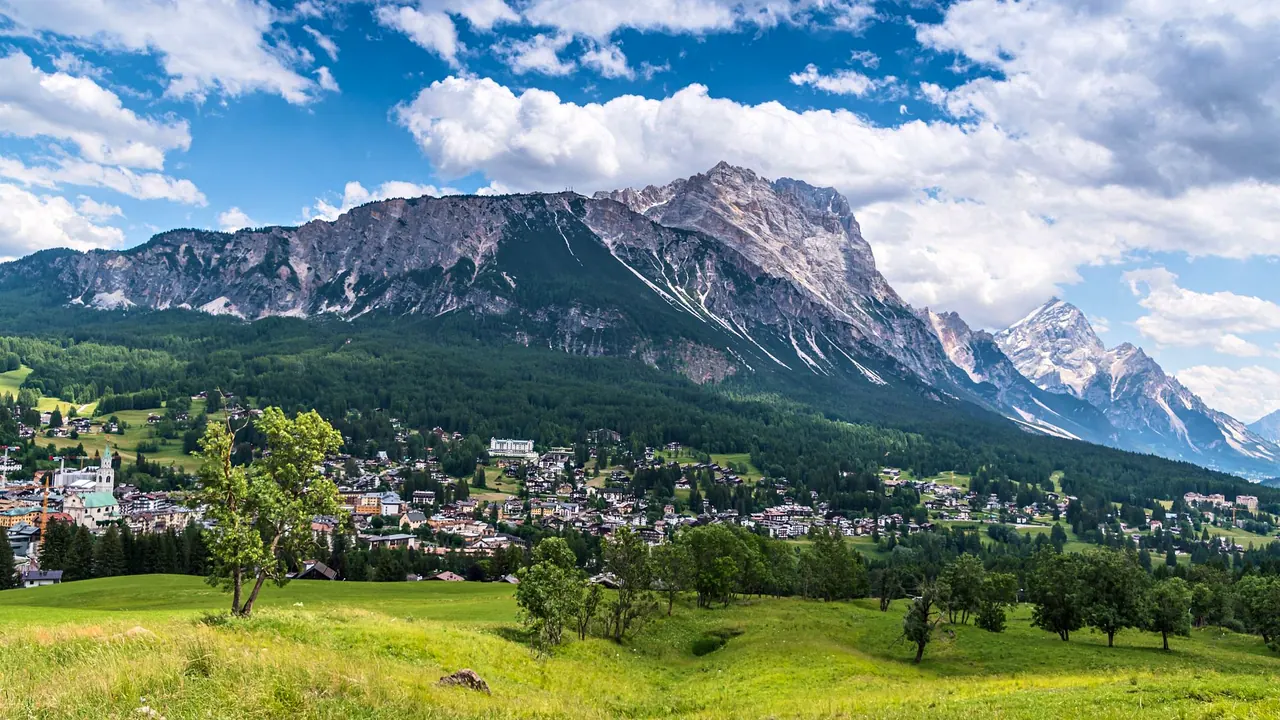
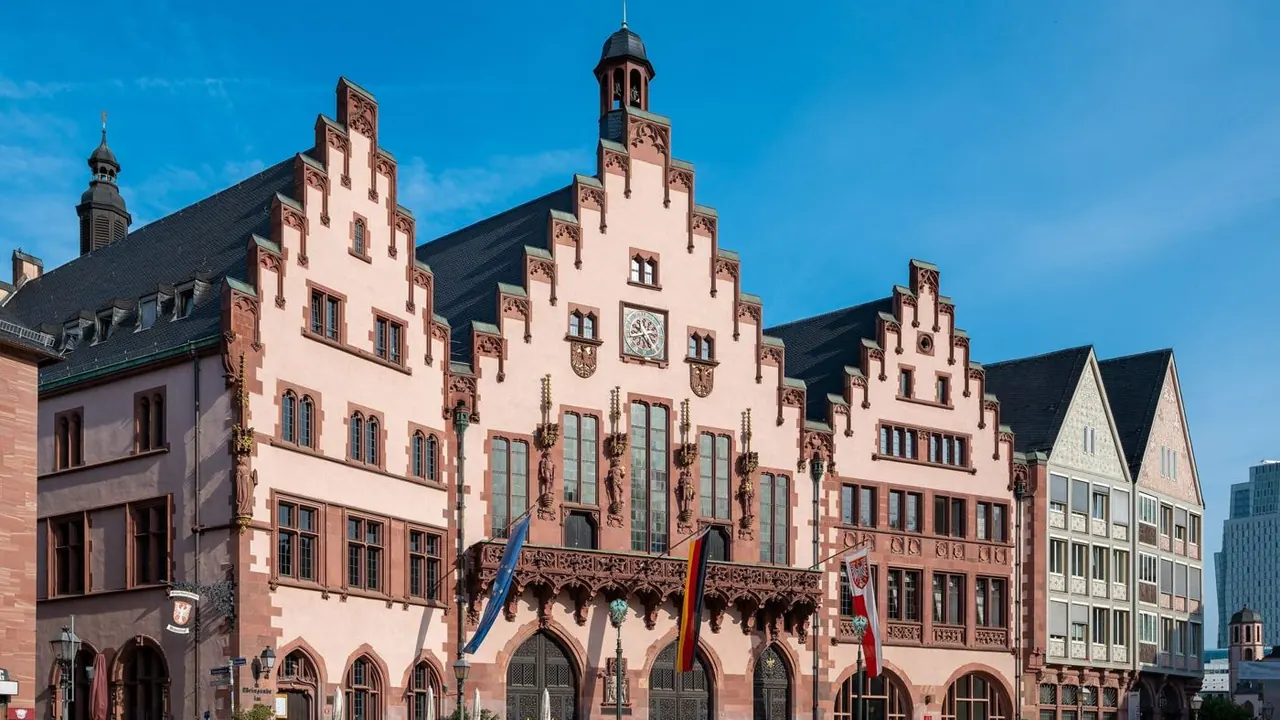
Photos: Cortina d'Ampezzo by Andreas Neubauer, Pexels License; Frankfurt by Thomas Wolf, CC BY-SA 3.0 DE, cropped.
Cortina d'Ampezzo or Frankfurt?
Our verdict in twelve categories, each scored against the same fixed benchmark cities, and the climate month by month, so you can choose for your trip.
Choose Cortina d'Ampezzo for
- nature and the outdoors
Cortina is the choice when the mountains are the whole point of the trip. The Dolomites rise straight from the town and lifts carry you onto the peaks. In winter you get one of the largest ski areas in the Alps, and in summer there are hut-to-hut trails and via ferrata routes. In return you accept high prices, a slow journey in and quiet evenings once dinner is over.
Choose Frankfurt for
- live music and the arts
- day trips
- culture and sights
Frankfurt suits travellers who want a city that fills both the days and the evenings, with the Städel and the Museumsufer, a highly respected opera house, apple-wine taverns and weekend techno. Its biggest advantage is its location. Heidelberg, the Rhine Gorge and Cologne are an easy train ride away, and you never need a car.
Scoreboard
Twelve categories on one fixed scale from 0 to 100. The shaded stretch is the gap between the two.
Your match
Pick a travel style or drag the sliders, and both match scores follow your weighting.
Wins on nature and the outdoors with your weighting.
Wins on live music and the arts and day trips with your weighting.
What matters to you?
Category by category
What the scores mean for a trip.
Beaches & swimming
Neither city is a beach destination. The difference lies in the fresh water you find instead. Cortina's lakes, Ghedina and Pianozes, are fed by snowmelt and stay cold even in midsummer, so swimming there mostly means a hotel pool. Frankfurt's gravel-pit lakes, such as the Langener Waldsee, have sandy shores and warm up properly in July and August, so a summer swim is a real option.
Food & drink
Cortina eats better than a town its size might suggest. Ampezzan cooking such as casunziei, polenta with game and barley soup is at its best on a rifugio terrace among the peaks. In the valley there are only a few good kitchens, and almost nothing is cheap or international.
Frankfurt gives you more choice. You can sit at the shared tables of the Sachsenhausen apple-wine taverns over Grüne Soße and Handkäs, shop for regional produce at the Kleinmarkthalle, or eat cheap Turkish and Asian food in the Bahnhofsviertel.
Culture & sights
This is one of the widest gaps between the two. Cortina offers a pleasant centre with the basilica's tall bell tower, the 1956 Olympic ice stadium and three small museums, the best of them the Rimoldi art collection. Its most striking history, the First World War tunnels on Lagazuoi, takes a day in the mountains to reach.
Frankfurt has enough for several days. The Museumsufer holds more than a dozen museums, led by the Städel. The rebuilt Römer, the cathedral, the Paulskirche and Goethe's birthplace stand close together beneath a skyline of towers unlike any other in Germany.
Nightlife
Evenings in Cortina begin with après-ski as the lifts close and a passeggiata along the Corso Italia, and they end over a long dinner. Only in the peak winter weeks do a few smart bars and a club or two stay open late. For most of summer the town is quiet by late evening.
Frankfurt gives you a proper night out, at least on Friday and Saturday. Together with Offenbach it has a long history in electronic music, and a small, serious club scene still plays techno and house. The Bahnhofsviertel has the most character, with cocktail bars and late kiosks. Sachsenhausen has rowdier pubs, and on summer evenings people sit drinking along the Main.
Nature & outdoors
Cortina is far ahead here. The Tofane, Cristallo and Cinque Torri rise around the valley, lifts climb from town to the peaks, and the Tre Cime and Lago di Misurina are under an hour away. Winter brings the Dolomiti Superski area, and summer brings the Alta Via 1 and some of the oldest via ferrata routes in the Alps.
Frankfurt's countryside is gentle and easy to reach. The Taunus and the Großer Feldberg are a short ride away by S-Bahn, the Stadtwald lies within the city, and flat cycle paths follow the Main. It suits walkers and cyclists, not climbers.
Day trips
From Cortina, most outings go further into the mountains. San Candido and Brunico are under an hour away and Bolzano, home of the Iceman, about two. Venice makes a long day by coach. The towns are pleasant rather than essential, and a car helps.
Frankfurt is at the centre of Germany's fastest rail network. Heidelberg, the castle-lined Rhine Gorge and Cologne are each about an hour away, and Mainz, Wiesbaden and Würzburg are also easy. A week of day trips would not run out of places to go.
Good for families
Cortina works for families who ski or hike. It has ski schools for all ages, beginner slopes at Socrepes, public skating at the Olympic stadium and easy walks to huts with meadows to play in. On a wet day there is little else to do, and the costs mount quickly.
Frankfurt has more for children in any weather. There is the dinosaur hall at the Senckenberg, the central zoo, the Palmengarten glasshouses and boat trips past the skyline, and trams and the S-Bahn take pushchairs without fuss.
Getting around
You can cross Cortina's centre on foot in minutes, but the valley has had no railway since 1964. You arrive by coach from Venice or after a long drive, and buses to the passes and the Tre Cime run only a limited service, so most visitors end up hiring a car.
In Frankfurt you never need one. A single integrated network of U-Bahn, S-Bahn and trams reaches Wiesbaden, Mainz and the Taunus, the airport is about a quarter of an hour from the centre by train, and the main station links to high-speed lines across Germany.
Shopping & style
Cortina's shopping is one short street, the Corso Italia, with luxury fashion, furriers, jewellers and smart mountain wear. Alongside it are the Cooperativa di Cortina, founded in 1893, and shops selling wood carving and filigree. Frankfurt has much more choice: department stores on the Zeil, luxury houses around Goethestraße, independent boutiques on Berger Straße and Schweizer Straße, and a Saturday flea market by the river.
Affordability
Neither city makes a cheap vacation, but Cortina is much harder on the wallet. Hotels and restaurants charge luxury-resort rates in winter and August, and lift passes and equipment hire add more. Meals at the rifugi and trips in early summer or late September bring some relief.
In Frankfurt the main expense is the hotel. Rates jump during trade fairs but fall at weekends and in summer. Eating out is reasonable, from Turkish grills to cider taverns, and the Museumsufer pass covers many museums at once.
Live music & performing arts
Cortina has no theatre season and no regular venue. Its music comes mostly from summer chamber and classical festivals in churches and halls, and sometimes out in the mountains, with the odd concert around Christmas and New Year.
Frankfurt is in another league. Its opera company is one of the most respected in Germany, and the Alte Oper is home to the regional radio symphony orchestra. The Schauspiel, Mousonturm and the cellar jazz clubs keep the season going from autumn to early summer. Through those same months Cortina offers only a few concerts at Christmas and New Year, so for evenings at the opera or theatre, Frankfurt is the only real choice.
Wellness & relaxation
In Cortina, relaxation happens inside the hotels, whose Alpine spas offer saunas, hay baths and indoor pools after a day on the slopes. The other pleasure is a slow afternoon on a hut terrace in June, September or a quieter winter week. The peak weeks bring traffic and crowds.
Frankfurt has no bathing tradition of its own, but the spa towns around it give it the edge for taking the waters. Bad Homburg's thermal baths and Wiesbaden's Art Nouveau Kaiser-Friedrich-Therme, fed by hot springs, are both an easy trip from the city.
When should you go?
Pick your month. The climate figures are measured averages, not a forecast.
Cortina d'Ampezzo in July
Frankfurt in July
Daytime high, °C
Rainfall in the month, mm
Temperature and rainfall are climate normals, averaged over the years shown. Cortina d'Ampezzo: 1991-2020 normals, Dobbiaco (22.5 km from centre). Frankfurt: 1991-2020 normals, Frankfurt Westend (2 km from centre).
Cortina has two seasons worth planning around. In midwinter the daytime highs sit near 0°C. That is cold for strolling but right for the ski months. Summer is mild rather than hot, with highs of about 22°C in July and August, which is good walking weather. It is also the wettest part of the year, with around 130mm of rain in July. June is a little drier than high summer, and September is drier still and mild, so both are good months for the trails. The alpine lakes stay cold all year.
Frankfurt is warmer through the year and reaches 26°C in July and August, warm enough for a swim in the lakes on the city's edge. Its rain is spread evenly across the months rather than gathered in summer. The best time for the streets and riverbanks is from late spring to early autumn, when June and July bring long sunny days. Winters are grey and short of sun rather than harsh, which suits museums and the opera.
Which traveller are you?
On an outdoors trip, Cortina wins easily. The Dolomites ring the valley and lifts start in town. Winter brings the Dolomiti Superski area, and summer brings the Alta Via 1, via ferrata and mountain biking. Frankfurt's Taunus hills are pleasant but gentle.
For a culture and arts trip, Frankfurt is the clear choice. The Städel and a dozen other museums line the Main, its opera company is among Germany's best, and Heidelberg and Cologne are an hour away by train. Cortina's museums fill a rainy afternoon at most.
On a tight budget, Frankfurt is the safer choice, although neither city is cheap. Hotel rates drop at weekends and outside the trade fairs, and Turkish grills and cider taverns cost little. Cortina charges luxury-resort prices, and many budget visitors sleep in cheaper valleys nearby.
Before you go
| Measure | Cortina d'Ampezzo | Frankfurt |
|---|---|---|
| Official language | Italian | German |
| Currency | Euro (EUR) | Euro (EUR) |
| Sockets | CFL230 V, 50 Hz | CF230 V, 50 Hz |
| Driving side | Right | Right |
| Time zone | UTC+1, UTC+2 in summer | UTC+1, UTC+2 in summer |
| Emergency number | 112 | 112 |
| Elevation | 1,224 m | 101 m |
| Main airport | Venice Marco Polo Airport (VCE)116 km from centre103 non-stop destinations | Frankfurt Main Airport (FRA)13 km from centre281 non-stop destinations |
| Public holidays this year | 13 days | 10 days |
By the numbers
| Measure | Cortina d'Ampezzo | Frankfurt |
|---|---|---|
| City population | 5,546 | 760,656 |
| People per km² | 22 | 3,063 |
| Museums within 10 km | 3 | 53 |
| UNESCO World Heritage sites within 50 km | 1 | 4 |
Where else could you go?
Every comparison below shares a destination with this one, so you can follow Cortina d'Ampezzo or Frankfurt somewhere new.
- Heidelbergvs Frankfurt
- Innsbruckvs Cortina d'Ampezzo
- Venicevs Cortina d'Ampezzo
- Veronavs Cortina d'Ampezzo
- Stuttgartvs Frankfurt
- Bledvs Cortina d'Ampezzo