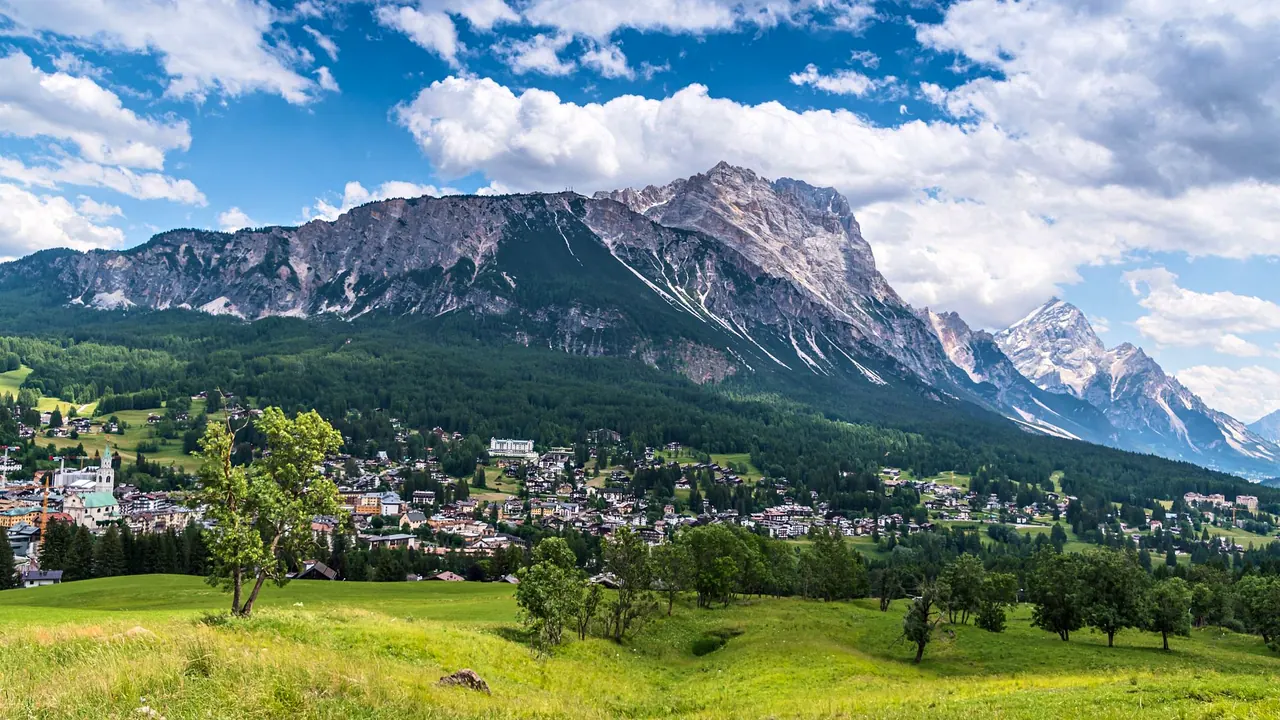
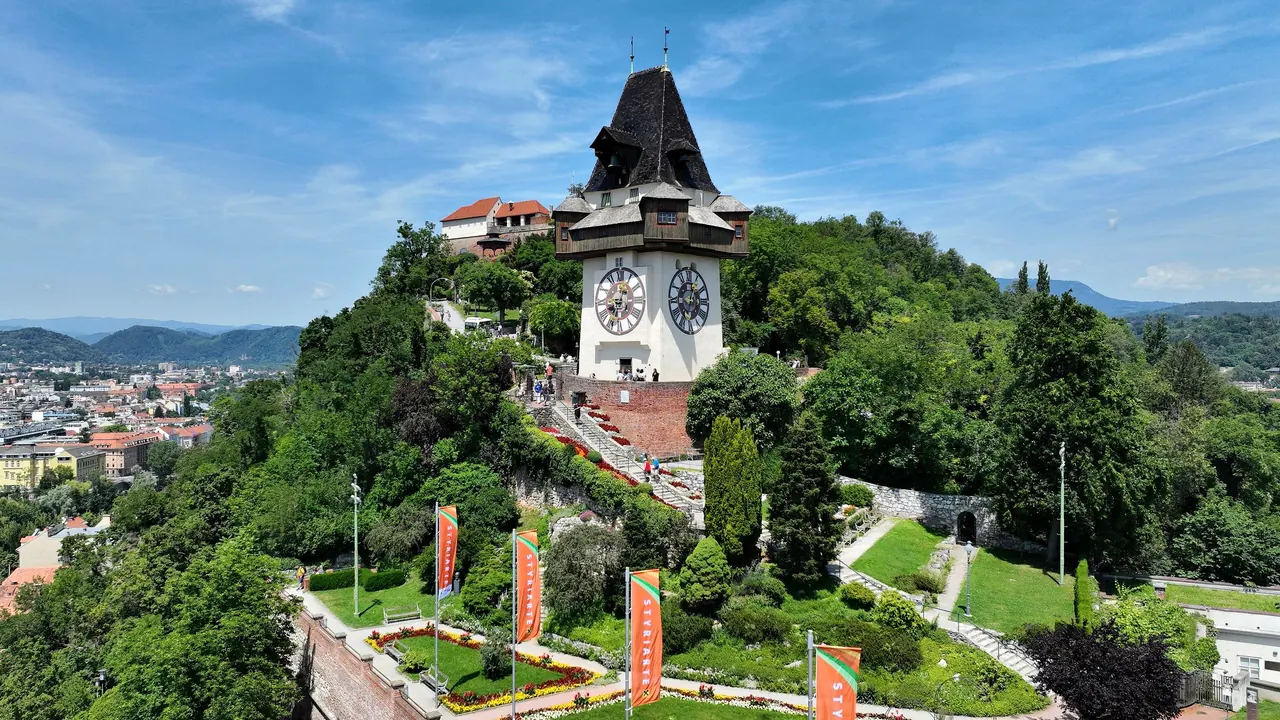
Photos: Cortina d'Ampezzo by Andreas Neubauer, Pexels License; Graz by C.Stadler/Bwag, CC BY-SA 4.0, cropped.
Cortina d'Ampezzo or Graz?
Our verdict in twelve categories, each scored against the same fixed benchmark cities, and the climate month by month, so you can choose for your trip.
Choose Cortina d'Ampezzo for
- nature and the outdoors
Cortina d'Ampezzo is the choice when the mountains are the whole point of the trip. Lifts rise straight from town into the Dolomites, the Tre Cime and the Alta Via 1 are close, and in winter the Dolomiti Superski network opens up beyond the valley. It suits skiers, hikers and climbers with a generous budget who are happy to spend their evenings over long dinners rather than at concerts or in bars.
Choose Graz for
- live music and the arts
- culture and sights
- getting around
For a rounded city trip at a fairer cost, Graz is the better pick. The arcaded old town, the armoury and Schloss Eggenberg fill the days, while the Opera and the festivals fill the evenings. Trams mean you never need a car, and Styrian food and wine country starts just outside the city. Its hills are pleasant rather than dramatic, so go for a city with green edges, not for high peaks.
Scoreboard
Twelve categories on one fixed scale from 0 to 100. The shaded stretch is the gap between the two.
Your match
Pick a travel style or drag the sliders, and both match scores follow your weighting.
Wins on nature and the outdoors with your weighting.
Wins on live music and the arts and culture and sights with your weighting.
What matters to you?
Category by category
What the scores mean for a trip.
Beaches & swimming
Neither city is anywhere near a sea, but Graz at least has proper summer swimming. The former gravel pits south of the city, the Schwarzlsee above all, have grassy banks and jetties, and they warm to about 23°C in high summer. Cortina's alpine lakes, such as Ghedina and Pianozes, are fed by snowmelt and suit a walk round the shore far better than a swim, so a hotel pool is the more likely option.
Food & drink
Graz eats better and more widely. The Styrian larder sets the tone: pumpkin seed oil on salads and even ice cream, cold fried chicken salad, and farmers' markets at Kaiser-Josef-Platz and Lendplatz six mornings a week. Crisp local Sauvignon Blanc is poured in the city and at Buschenschank taverns within an hour's drive.
Cortina's Ampezzan cooking has real character, with casunziei filled with beetroot and polenta with game. Its best meals come on rifugio terraces among the peaks. In the valley, though, the choice is narrow and rarely cheap, and street food is scarce.
Culture & sights
Cortina's sights are few and close together: the Basilica of Saints Philip and James with its tall bell tower, the painted Tyrolean-style houses, the ice stadium from the 1956 Winter Games and the Rimoldi collection of twentieth-century Italian art. Together they fill an afternoon. Its most striking history lies up on Lagazuoi and the Cinque Torri, where First World War tunnels and trenches survive, and reaching them takes a day in the mountains.
Graz has far more to see, and the city as a whole needs two or three days. The old town climbs from the Hauptplatz to the cathedral and Ferdinand II's domed mausoleum, with the Uhrturm clock tower on the Schlossberg above. The Landeszeughaus still holds thousands of suits of armour and Schloss Eggenberg is laid out on an astronomical plan. Across the river, the Kunsthaus and the Murinsel add modern shapes to the riverside.
Nightlife
Graz has the livelier evenings, thanks to its large student population. The Bermuda Triangle lanes around Mehlplatz fill with bar crowds, Lend has artier places and a few clubs open late at weekends. It is still a city for pub crawls rather than serious clubbing.
Evenings in Cortina mean après-ski drinks, a stroll along the Corso Italia and a long dinner. A glamorous late scene appears only in peak winter weeks. Note that in summer both places go quiet: Cortina by habit, and Graz once the students leave.
Nature & outdoors
Cortina has the stronger mountain scenery by a long way. The pale towers of the Tofane, Cristallo and Cinque Torri ring the valley, lifts climb straight onto them, and the Tre Cime, Lago di Misurina and the Fanes-Sennes-Braies park are all close. Skiing, the Alta Via 1 and classic via ferrata routes make it a destination in its own right.
Graz has green surroundings rather than drama. There is the cable car up the Schöckl, the Mur cycle path, the ladders of the Bärenschützklamm gorge and the soft South Styrian wine hills. For real alpine walls you need the two-hour trip to the Gesäuse.
Day trips
Graz has the more varied outings close at hand. The South Styrian Wine Road starts about forty minutes away, and Riegersburg castle stands on its volcanic crag. The Lipizzaners at Piber, the open-air museum at Stübing and Admont Abbey's huge library are all within reach, and Slovenian Maribor is an hour away by train.
From Cortina, most days out lead back into the mountains. The best town trips go north into South Tyrol, to San Candido, Brunico and Bolzano with its Iceman. Venice is possible but makes a long day by coach.
Good for families
Graz is the easier place for most families. Children can ride up the Schlossberg and come down the long underground slide, take the Märchenbahn through fairytale tunnels and spend a morning at the FRida & freD children's museum. The trams also take buggies.
Cortina works well when the whole family skis or hikes, with ski schools, beginner slopes at Socrepes, public skating and gentle walks to huts. On a wet day there is little else for young children to do, and the bills mount quickly.
Getting around
Graz is far simpler. The pedestrianised old town is compact and flat, trams and buses run on one ticket, and a funicular and a lift climb the Schlossberg, so no car is needed in the city.
Cortina's centre is also walkable in minutes, but reaching the town is harder: there has been no railway since 1964, so it means a coach from Venice or a long drive. Buses up to the passes are limited, and many visitors hire a car. In both places, the countryside is easier to explore by car.
Shopping & style
There is little between them, but they suit different shoppers. Cortina's Corso Italia is a short luxury strip of fashion, jewellers, furriers and upmarket ski wear, anchored by the Cooperativa di Cortina, founded in 1893. Graz has almost no luxury labels. Instead it offers high-street and traditional shops along the Herrengasse and Sporgasse, small design and vintage shops in Lend, and the best souvenirs to eat or drink: pumpkin seed oil, Schilcher rosé and Styrian wine.
Affordability
Cortina's costs follow the seasons. In the winter peak and in August, hotels and restaurants in town charge luxury-resort prices, and skiers pay for lift passes and equipment hire on top. Early summer and late September bring easier rates, and the rifugi serve meals that are better value than their setting suggests, but even then the town stays expensive.
In Graz, prices stay fairly steady through the year and rise only when a big festival or trade fair fills the hotels. Sightseeing costs little, since combined tickets cover many of the sights, including the Joanneum museums. That is a much smaller outlay than a week of lift passes. A sit-down dinner with wine costs the usual Austrian amount, so the city is fair rather than cheap, but it is much easier on the budget than Cortina.
Live music & performing arts
For evenings at the theatre or a concert, Graz is clearly the place. Its Opera, the second largest in Austria, runs a full season of opera, operetta and ballet, and the Musikverein hosts orchestral concerts. There is also Styriarte in early summer, steirischer herbst in autumn and a jazz scene fed by the music university.
Cortina has no theatre season and no regular venue. What it does have are summer chamber festivals, with concerts in churches and sometimes outdoors in the mountains.
Wellness & relaxation
The two are broadly level, but they relax you in different ways. In Cortina, wellness means hotel spas with saunas and Alpine hay baths, then clear air and a slow afternoon on a hut terrace in the quieter weeks. Graz has no spa tradition of its own, but the thermal villages of eastern Styria are about an hour away. Their warm pools, including Hundertwasser's Bad Blumau, are open to day visitors, and back in town the coffee houses and the Stadtpark keep the pace unhurried.
When should you go?
Pick your month. The climate figures are measured averages, not a forecast.
Cortina d'Ampezzo in July
Graz in July
Daytime high, °C
Rainfall in the month, mm
Temperature and rainfall are climate normals, averaged over the years shown. Cortina d'Ampezzo: 1991-2020 normals, Dobbiaco (22.5 km from centre). Graz: 1991-2020 normals, Graz Airport (7.9 km from centre).
Cortina has two distinct seasons. From December to February the days stay close to freezing. These are also its driest months, good for skiing and snowy walks but too cold for lingering in the streets. Summer is mild rather than hot, with highs of about 22°C in July and August, which suits hiking and via ferrata. It is also the wettest stretch, with about 130mm of rain in July, so start walks early. June is quieter and a touch cooler but still rainy, while September is both cool and noticeably drier.
Graz is several degrees warmer all year. July reaches about 27°C and is the sunniest month, warm enough to make the bathing lakes south of the city appealing, but summer rain is about as heavy as in Cortina. May, September and October are the best months for walking the old town and the wine hills. Winters are cold and grey, with only about 80 hours of sunshine in December, so it is not the season for sightseeing.
Which traveller are you?
On an outdoors trip, Cortina wins easily. You can hike from hut to hut on the Alta Via 1, climb some of the oldest via ferrata routes in the Alps and ski the Dolomiti Superski network, all straight from the valley. Graz's Schöckl and wine hills are gentle by comparison.
For a culture and arts trip, choose Graz. It has a beautifully preserved Renaissance and Baroque old town, the Landeszeughaus armoury, Schloss Eggenberg and the Kunsthaus, and in the evenings a full opera season and two well-known festivals. Cortina's few small museums fill one rainy afternoon at most.
On a trip with a tight budget, Graz is the realistic option. Hotels are fairly priced for Austria, student lunch menus are plentiful and one cheap tram ticket covers the city. Cortina is among Italy's most expensive resorts, and even careful visitors often stay in cheaper valleys nearby.
Before you go
| Measure | Cortina d'Ampezzo | Graz |
|---|---|---|
| Official language | Italian | German, Austrian Sign Language |
| Currency | Euro (EUR) | Euro (EUR) |
| Sockets | CFL230 V, 50 Hz | CF230 V, 50 Hz |
| Driving side | Right | Right |
| Time zone | UTC+1, UTC+2 in summer | UTC+1, UTC+2 in summer |
| Emergency number | 112 | 112 |
| Elevation | 1,224 m | 353 m |
| Main airport | Venice Marco Polo Airport (VCE)116 km from centre103 non-stop destinations | Graz Airport (GRZ)9 km from centre26 non-stop destinations |
| Public holidays this year | 13 days | 16 days |
By the numbers
| Measure | Cortina d'Ampezzo | Graz |
|---|---|---|
| City population | 5,546 | 306,971 |
| People per km² | 22 | 2,406 |
| Museums within 10 km | 3 | 29 |
| UNESCO World Heritage sites within 50 km | 1 | 1 |
Where else could you go?
Every comparison below shares a destination with this one, so you can follow Cortina d'Ampezzo or Graz somewhere new.
- Innsbruckvs Cortina d'Ampezzo
- Venicevs Cortina d'Ampezzo
- Bledvs Graz
- Ljubljanavs Graz
- Viennavs Graz
- Hallstattvs Graz