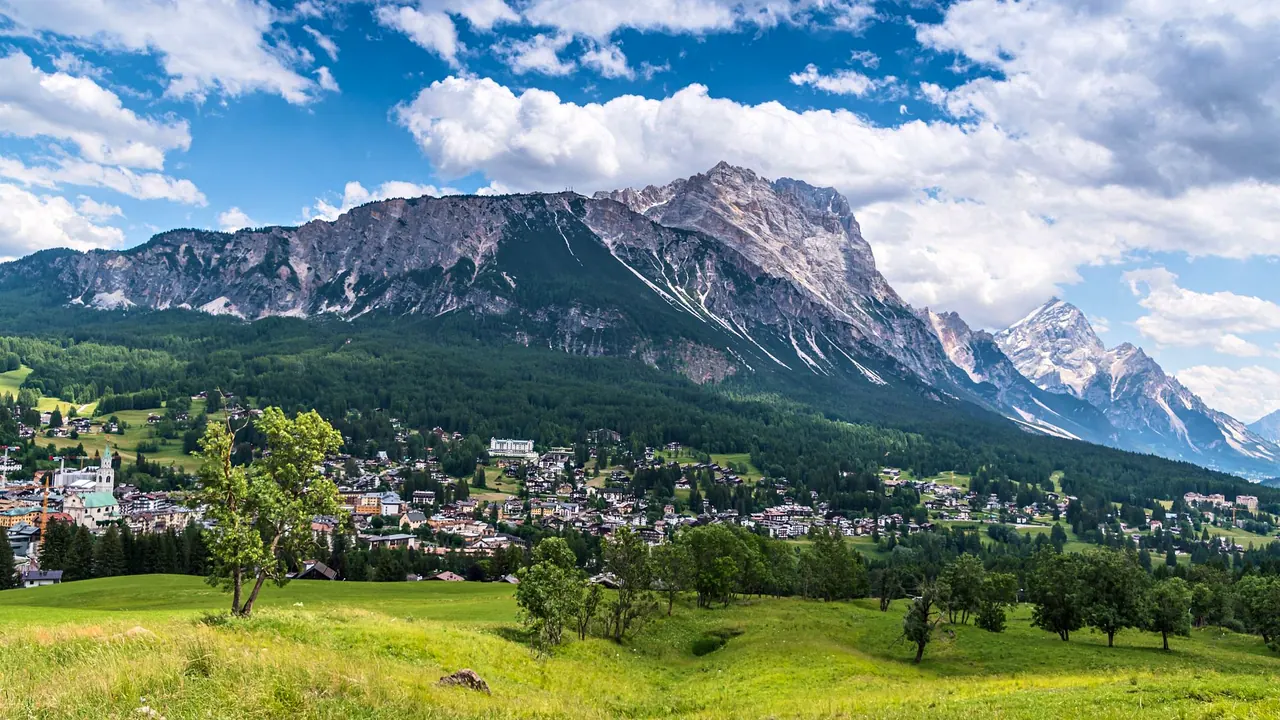
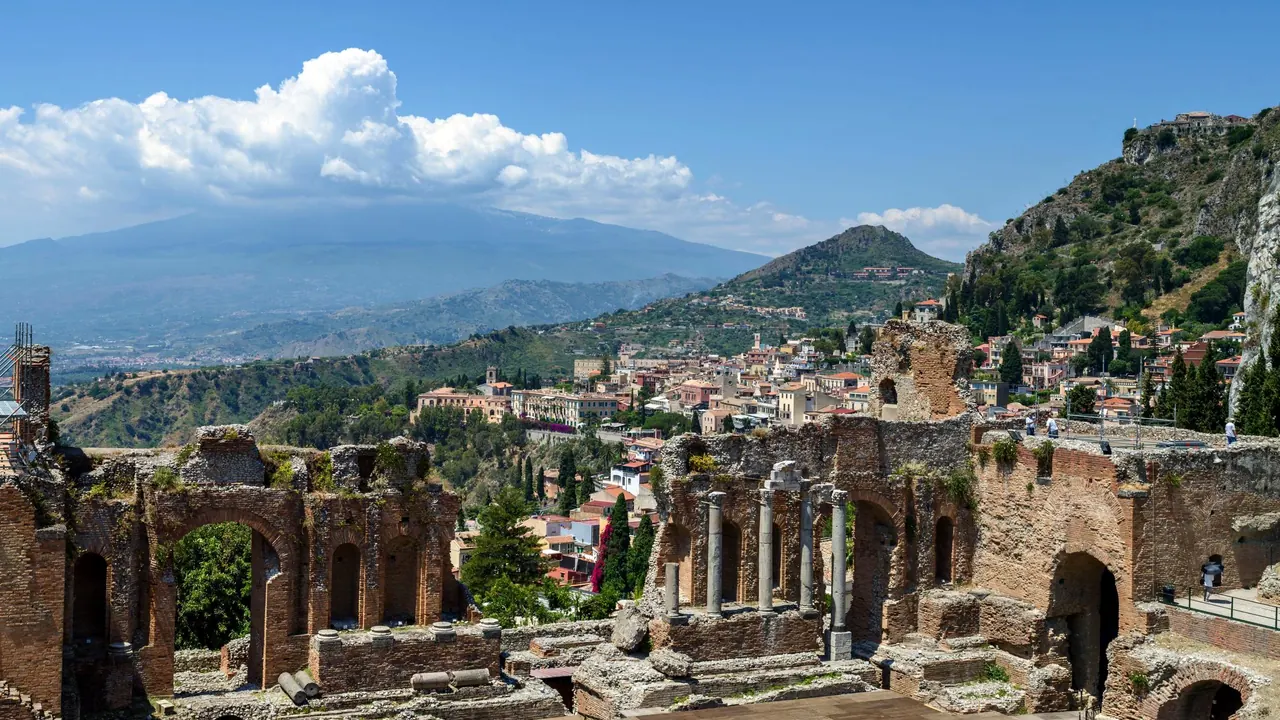
Photos: Cortina d'Ampezzo by Andreas Neubauer, Pexels License; Taormina by Reinhard Bruckner, Pexels License.
Cortina d'Ampezzo or Taormina?
Our verdict in twelve categories, each scored against the same fixed benchmark cities, and the climate month by month, so you can choose for your trip.
Choose Cortina d'Ampezzo for
- nature and the outdoors
- families
- shopping
Cortina d'Ampezzo is for travellers who want the mountains to be the whole point of the trip. Lifts climb from the edge of town into the Dolomites, so skiers in winter and hikers, climbers and via ferrata fans in summer have great terrain right on the doorstep. Families who ski or walk also find it easy going. In return you accept quiet evenings, few sights and some of the highest bills in Italy.
Choose Taormina for
- beaches
- day trips
- culture and sights
Taormina suits a warmer, more varied trip: the sea in the morning, the Greek theatre and Corso Umberto in the evening, and Etna, Syracuse and Catania on other days. It is stronger on beaches, sightseeing, food and excursions. It is no bargain either, but it costs less than Cortina and gives more to do once you put the hiking boots away.
Scoreboard
Twelve categories on one fixed scale from 0 to 100. The shaded stretch is the gap between the two.
Your match
Pick a travel style or drag the sliders, and both match scores follow your weighting.
Wins on nature and the outdoors and families with your weighting.
Wins on beaches and day trips with your weighting.
What matters to you?
Category by category
What the scores mean for a trip.
Beaches & swimming
These two could hardly be further apart here. Cortina sits in a high valley more than two hours from the Adriatic, and its lakes, Ghedina and Pianozes, are fed by snowmelt. Swimming realistically means a hotel pool.
Taormina has the Ionian Sea directly below the town. The pebble coves at Mazzarò and Isola Bella have glassy water for snorkelling, and Giardini Naxos and Letojanni offer longer sand and shingle. The coves are small and crowded in August, but this is a genuine seaside stay.
Food & drink
Taormina eats better, mostly because it draws on Sicily. Pasta alla Norma, swordfish, raw red prawns, cannoli and granita with brioche at breakfast give it a much wider range than Cortina, and Etna's Nerello Mascalese and Carricante wines are a real draw. Avoid the tourist menus on the Corso and look in the side streets.
Cortina's cooking is narrower but has its own appeal: casunziei with poppy seeds, polenta with game, and barley soup. The best meal of the trip is often lunch at a rifugio terrace high among the peaks rather than anything in the valley.
Culture & sights
Taormina has the real centrepiece in its Greek theatre, with Etna framed by the ruined stage. Around it, the Duomo, Palazzo Corvaja and Badia Vecchia show the town's Arab, Norman and Catalan layers, enough for a slow and rewarding day.
Cortina's centre is pretty, with the basilica's bell tower, painted houses and the 1956 Olympic ice stadium, and the Rimoldi art collection is worth a wet afternoon. Its most moving history, the First World War tunnels on Lagazuoi and the Cinque Torri, is up in the mountains and takes a full day's outing.
Nightlife
Neither town is a place for late nights, though Taormina keeps going a little longer. Summer evenings there run from aperitivo in Piazza IX Aprile to piano bars over the sea, with a few beach clubs at Mazzarò. Cortina's evenings are après-ski, a passeggiata on the Corso Italia and long dinners. Its smart bars and a club or two only stay open late in the peak winter weeks, so one town comes alive in summer and the other in winter.
Nature & outdoors
Cortina is ahead, and by a long way for anyone who lives for mountains. The ring of Dolomite peaks, lifts straight from town, the Fanes-Sennes-Braies park, Misurina and the Tre Cime give endless options for skiing, hiking, climbing, mountain biking and paragliding.
Taormina's outdoors still impresses: lava flows and craters on Etna, the basalt Alcantara gorges, paths up to Castelmola and diving in the Isola Bella reserve. It offers sea and volcano rather than a whole mountain range, and summer heat limits the hiking.
Day trips
Taormina makes a far better base for excursions. Catania is about an hour away, Syracuse with Ortigia and the Neapolis theatre about two, and Noto, the Etna wine villages and the hill towns of Savoca and Forza d'Agrò fill other days.
From Cortina, most outings are into the mountains themselves. South Tyrolean towns such as San Candido and Brunico are pleasant, Bolzano with the Iceman is about two hours away, and Venice is a long day by coach.
Good for families
Cortina works a little better for families, provided they ski or walk. It has ski schools for all ages, beginner slopes at Socrepes, public skating at the Olympic stadium and gentle trails to huts with meadows. The flat little centre is easy with a pushchair, though rainy days drag.
Taormina is welcoming, and Etna and snorkelling thrill older children. But the steep streets full of steps and the crowded pebble coves are hard work with small ones, and many families stay down in Giardini Naxos instead.
Getting around
Both centres are small enough to cross on foot, but Taormina is better connected. Its seaside station and regional coaches reach Catania airport, Messina and Syracuse, and a cable car runs down to the beach. Expect plenty of stairs in town, though.
Cortina has had no railway since 1964, so arrival means a coach from Venice or a long drive. The buses to the passes are limited, and most visitors hire a car to explore the Dolomites.
Shopping & style
Each town has one main shopping street, so the difference is in what they sell. Cortina's Corso Italia goes for luxury, with furriers, jewellers and upmarket ski wear, anchored by the old Cooperativa store. Taormina's Corso Umberto deals in coral, cameos, lace and Caltagirone ceramics, and the best things to take home are edible: Bronte pistachio cream, almond sweets and Etna wine.
Affordability
Neither is cheap, but Cortina is the harder one on the wallet. Peak-season hotels charge luxury-resort prices, and lift passes and ski hire add to the bill. Rifugio meals and late September are the main ways to save, and many people on a budget stay in neighbouring valleys instead.
Taormina is expensive for Sicily but easier to manage. Buses, bakery snacks and granita stay cheap, and sleeping in Giardini Naxos or Letojanni and coming up for the evening cuts costs noticeably.
Live music & performing arts
Taormina has the stronger summer programme. Concerts, opera, ballet and touring pop acts fill the Greek theatre, and a long-running film festival adds to the season. In winter, serious performances mean a trip to Catania's Teatro Massimo Bellini.
Cortina has no theatre season at all. It offers summer chamber and classical concerts in churches and occasionally on the mountainsides, plus a few around New Year.
Wellness & relaxation
Neither town has public baths, so in both, relaxing mostly means the hotel spa and a slower pace. The style differs: Cortina offers Alpine saunas, steam rooms and hay baths after a day on the slopes, while Taormina has terrace pools above the sea and treatments with volcanic mud, citrus and almond. Both are calmest in June and September and lose much of that calm in August.
When should you go?
Pick your month. The climate figures are measured averages, not a forecast.
Cortina d'Ampezzo in July
Taormina in July
Daytime high, °C
Rainfall in the month, mm
Where the figures come from
Taormina's temperatures are measured 45 km from the centre, at Messina.
Taormina has no rain gauge within 25 km of the centre, so its rainfall comes from a gridded climate dataset read at the city rather than from a gauge further away.
Temperature and rainfall are climate normals, averaged over the years shown. Cortina d'Ampezzo: 1991-2020 normals, Dobbiaco (22.5 km from centre). Taormina: 1991-2020 normals, Messina (45.1 km from centre).
Cortina has two seasons worth planning around. In July and August daytime highs reach about 22°C, with June and September a little cooler, which is ideal for walking, hut-to-hut hiking and climbing. Summer is also the wettest part of the year, though, with rain peaking at 130mm in July. From December to February the days stay around freezing, which suits skiing and little else. April, May, October and November fall awkwardly between the two seasons.
Taormina's year runs the other way. July and August are dry and very sunny, but highs of 31°C make it too hot to climb the town's steps or hike on Etna, though this is when the sea is warmest, at 26°C. June and September give swimmable water and gentler heat. October is still warm enough for the beach, but it also brings the rain. The wettest stretch runs from October to January, at around 100mm a month. February and March are noticeably drier, and spring warms steadily towards the long, sunny days of May. Even in winter, Taormina's mild days make it a pleasant base for walking and sightseeing while Cortina is under snow.
Which traveller are you?
For a beach and sun trip, Taormina is the clear pick. Clear coves at Isola Bella and Mazzarò, sandier stretches at Giardini Naxos and a warm Ionian Sea from June to October are all a cable car ride away. Cortina's lakes stay cold.
On an outdoors trip, Cortina comes out ahead. The Dolomites ring the valley, lifts start in town, and the Tre Cime, the Alta Via 1, historic via ferrata routes and Dolomiti Superski runs are all close. Etna is a superb single excursion by comparison.
On a culture and arts trip, Taormina gives far more. The Greek theatre, the medieval Corso and summer concerts with Etna behind the stage beat Cortina's three small museums, and Syracuse and Catania add whole days of baroque and ancient sights.
Before you go
| Measure | Cortina d'Ampezzo | Taormina |
|---|---|---|
| Official language | Italian | Italian |
| Currency | Euro (EUR) | Euro (EUR) |
| Sockets | CFL230 V, 50 Hz | CFL230 V, 50 Hz |
| Driving side | Right | Right |
| Time zone | UTC+1, UTC+2 in summer | UTC+1, UTC+2 in summer |
| Emergency number | 112 | 112 |
| Elevation | 1,224 m | 204 m |
| Main airport | Venice Marco Polo Airport (VCE)116 km from centre103 non-stop destinations | Catania-Fontanarossa Airport (CTA)47 km from centre96 non-stop destinations |
| Public holidays this year | 13 days | 13 days |
By the numbers
| Measure | Cortina d'Ampezzo | Taormina |
|---|---|---|
| City population | 5,546 | 10,471 |
| People per km² | 22 | 799 |
| Museums within 10 km | 3 | 5 |
| UNESCO World Heritage sites within 50 km | 1 | 2 |
| Swim season, months above 21 °C | - | 5 months |
Where else could you go?
Every comparison below shares a destination with this one, so you can follow Cortina d'Ampezzo or Taormina somewhere new.
- Cataniavs Taormina
- Syracuse, Sicilyvs Taormina
- Innsbruckvs Cortina d'Ampezzo
- Venicevs Cortina d'Ampezzo
- Paduavs Cortina d'Ampezzo
- Veronavs Cortina d'Ampezzo