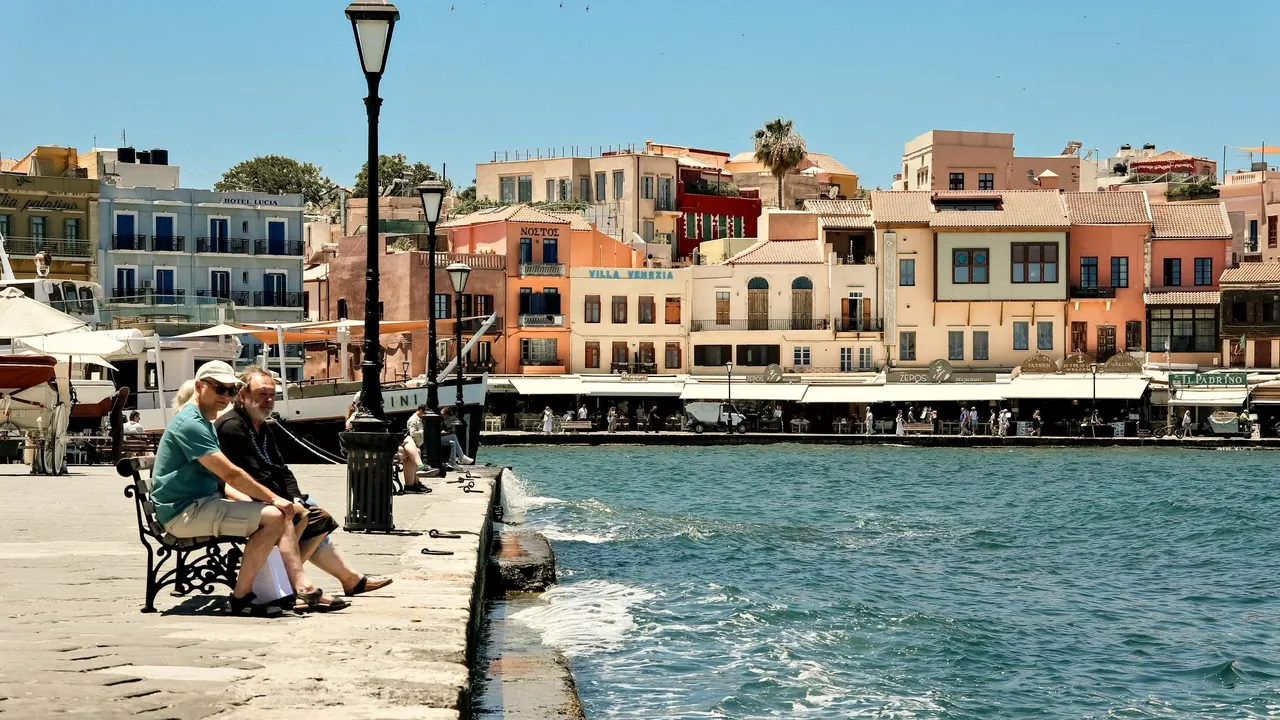
Photos: Crete by Piotr Baranowski, Pexels License.
Crete or Peloponnese?
Our verdict in twelve categories, each scored against the same fixed benchmark cities, and the climate month by month, so you can choose for your trip.
Choose Crete for
- nightlife
- families
- shopping
Crete is the better pick for a beach vacation with a bit of everything. Its beaches are the stronger set, from the lagoons of Elafonissi and Balos in the west to the long resort sands of the north coast, and it gives more to families, more to do after dark and a cuisine with a stronger identity of its own. Chania and Rethymno make lively old-town bases, and Knossos and the Heraklion museum cover the Minoan story in one day.
Choose Peloponnese for
- day trips
- culture and sights
- prices
The Peloponnese rewards the traveller who wants to move around and see the deep layers of Greek history. Olympia, Mycenae, Epidaurus, Mystras and Monemvasia make it the richer region for sights, and the day trips are more varied, with the car-free Saronic islands, the Nemea wine villages and the Mani all within reach. It also costs a little less and stays quieter, though its nights are early and the beach list, good as it is, is shorter.
Scoreboard
Twelve categories on one fixed scale from 0 to 100. The shaded stretch is the gap between the two.
Your match
Pick a travel style or drag the sliders, and both match scores follow your weighting.
Too close to call, 1 point apart
Wins on nightlife and families with your weighting.
Wins on day trips and culture and sights with your weighting.
What matters to you?
Category by category
What the scores mean for a trip.
Beaches & swimming
Crete has the deeper choice of beaches. The far west alone offers Elafonissi's pink sand and lagoons, the turquoise bay of Balos and the long sunset strand of Falassarna, and there is still the palm beach at Vai, the easy north-coast resorts and the boat-reached coves of the south coast such as Preveli.
The Peloponnese is very good rather than outstanding. Voidokilia's horseshoe bay and Navarino Bay in Messinia, the white sand of Elafonisos and the rocky coves of the Mani are lovely, and outside July and August many beaches are close to empty, which is quieter than Crete's famous western beaches at midday.
Food & drink
Crete edges ahead because its cooking feels more like a distinct regional cuisine: graviera and mizithra cheeses, dakos, snails and the free raki to end a meal, with the best eating in Chania's and Rethymno's backstreets and Heraklion's market street. Avoid the north-coast resort strips.
The Peloponnese eats simply and well, with Kalamata olives and oil, Mani cured pork and grilled fish at harbour tables. Its real strength is wine, with Nemea's reds and the Moschofilero whites of the Tripoli plateau, so it suits a winery-touring trip more than Crete does.
Culture & sights
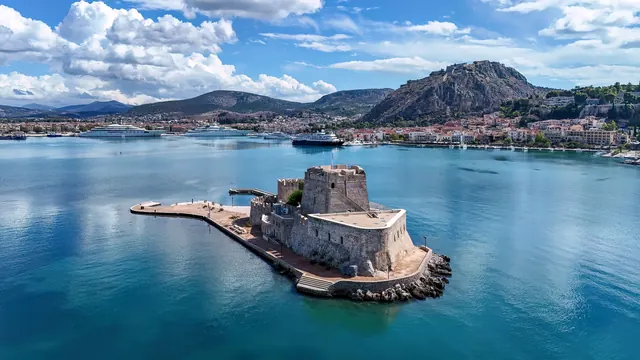
The Peloponnese has the broader set of sights. Olympia, Mycenae, Tiryns, Epidaurus, Ancient Corinth and Messene give it the classical and Bronze Age heavyweights, and Mystras, Monemvasia and the Venetian castles at Methoni and Koroni add a medieval layer of equal weight.
Crete's strength is narrower but deep: the Minoan world at Knossos, Phaistos and the Heraklion Archaeological Museum, plus the Venetian harbour of Chania and Rethymno's Ottoman balconies. Both regions require a lot of driving to see everything, though Nafplio puts the Argolid sites within an hour.
Nightlife
Crete offers far more after dark. Malia and Hersonissos run loud package-resort clubbing for young groups all summer, while Chania's harbour, Rethymno's waterfront and Heraklion's old-centre café-bars give a more grown-up night busy with Greek students.
In the Peloponnese an evening usually means dinner and a harbour-front drink in Nafplio or Kalamata. Only Patras, a university city on the north coast, has a real bar and club scene, and it lies far from most visitors' bases.
Nature & outdoors
Both are mountainous and equally rewarding for walkers, so the difference is in the kind of landscape. Crete's draw is its gorges, Samaria above all, cutting through the White Mountains down to the Libyan Sea, with the coast path between Loutro and Sfakia and climbing at Agiofarago.
The Peloponnese is greener inland, with the Lousios gorge and its cliffside monasteries, the waymarked Menalon Trail, Taygetos above Sparta and the dry Mani walking down to Cape Tainaron. It also adds birdwatching at the Gialova lagoon and winter skiing on Chelmos.
Day trips
The Peloponnese gives more varied outings from a single base. From Nafplio, Hydra and Spetses are a short ferry ride away, the Nemea wineries are close and Athens is about two hours by road, while Messinia offers Pylos, Methoni and the Mani villages.
On Crete the outings are mostly the island's other towns and its inland villages such as Anogia and Margarites, plus boat trips to Chrissi or Gramvousa. Its long-distance option is the fast ferry from Heraklion to Santorini, which makes a full, tiring day.
Good for families
Crete is the easier family destination. Gently shelving sands on the north coast and near Chania, resort hotels with children's clubs, several waterparks and the aquarium at Gournes give plenty of choice for hot days, and Elafonissi's shallow lagoon is ideal for small children.
The Peloponnese has good sandy bays at Tolo, in Messinia and on Elafonisos, but no theme parks, zoos or aquariums, and its shadeless ancient sites need early starts. Within the region, Nafplio is the easiest town to stroll with a pushchair, and families should expect long hours in the car.
Getting around
Both need a hire car, and neither is easy without one. Crete's advantage is a dependable bus line along the north coast linking its four main towns, but the steep roads south and the busy highway make driving tiring, and some south-coast villages are reachable only by summer boat.
The Peloponnese has fast motorways from the Corinth Canal to Kalamata and towards Olympia, so the main towns are quick to reach by car, but its buses rarely reach sites or beaches. Mountain and Mani roads are just as slow as Crete's.
Shopping & style
Neither is a shopping trip, but Crete offers more to browse. Chania's leather-makers' lane, knife-makers and covered market hall, and Heraklion's market street for cheeses, honey and raki, give it real craft shopping.
The Peloponnese is mainly for edible souvenirs: Kalamata olives and oil, mountain honey and wine bought at Nemea wineries, with Nafplio's lanes the best place for jewellery and ceramics.
Affordability
The Peloponnese is the cheaper of the two, especially in the Mani and Arcadian villages away from Nafplio and the Messinian resorts. Crete is still gentler than the Cyclades, with good-value village rooms and tavernas, but costs climb around Chania's old town, the western beaches and Elounda. In both, car hire is the cost you cannot avoid and summer pushes prices up.
Live music & performing arts
The Peloponnese has the one standout event: ancient drama on summer weekends in the theatre at Epidaurus, along with Kalamata's dance festival in July. Crete's live culture is more informal, built on lyra music and circle dances in Rethymno's and Chania's music tavernas, at village saints' day festivals and in Anogia, with summer festivals in Heraklion's and Chania's fortresses.
Wellness & relaxation
Both are restful mainly for their slow pace, and neither has a strong spa tradition. The Peloponnese does have actual thermal water, at Loutraki, on the Methana peninsula and in the sulphur-fed lake at Kaiafas, while Crete's best spas are resort spas around Elounda. For quiet escapes, Crete has Loutro, reached only by boat or on foot, and the Peloponnese has the stone villages of the Mani and Arcadia.
When should you go?
Pick your month. The climate figures are measured averages, not a forecast.
Crete in July
Peloponnese in July
Daytime high, °C
Rainfall in the month, mm
Where the figures come from
Peloponnese's temperatures are measured 89 km from the centre, at Kalamata Airport.
Peloponnese has no rain gauge within 25 km of the centre, so its rainfall comes from a gridded climate dataset read at the destination rather than from a gauge further away.
Temperature and rainfall are climate normals, averaged over the years shown. Crete: 1991-2020 normals, Heraklion Airport (3.6 km from centre). Peloponnese: 1991-2020 normals, Kalamata Airport (89 km from centre).
Both are swimming destinations from June to October, with the sea at its warmest in July and August, about 25°C off Crete and a touch more off the Peloponnese. Their summers feel different, though. In Crete's figures the daytime heat levels off at around 29°C, and June to August are almost completely dry, with the most sunshine of the two. The Peloponnese runs hotter, reaching 32°C in July and August, which makes long afternoons at Olympia or Mycenae hard going. On both, the mountains are cooler than the coast, so conditions vary across each region.
The wet season comes at different times. Crete's September stays dry, while the Peloponnese sees the first rain then. October brings showers to both, and from November to January Crete has its wettest weather, while the Peloponnese turns wettest in November and December. For walking the gorges or touring sites, May suits both. Late September and October are also good, with Crete the drier choice early in the autumn.
Which traveller are you?
For a culture and arts trip, Crete's Minoan sites fill a few days, but the Peloponnese can fill a fortnight. Split the stay between Nafplio and a second base in the west or south, and plan around a July or August weekend for Epidaurus.
On a family trip with young children, choose Crete and settle in one resort on the north coast or near Chania, so the days involve little driving. The Peloponnese suits families later, once the children enjoy ruins and long drives.
For a food and nightlife trip, choose Crete and stay in Chania's or Rethymno's old town, where dinner and a late drink are a short walk apart. A Peloponnese trip suits slow harbour dinners more than late nights.
Before you go
| Measure | Crete | Peloponnese |
|---|---|---|
| Official language | Greek | Greek |
| Currency | Euro (EUR) | Euro (EUR) |
| Sockets | CF230 V, 50 Hz | CF230 V, 50 Hz |
| Driving side | Right | Right |
| Time zone | UTC+2, UTC+3 in summer | UTC+2, UTC+3 in summer |
| Emergency number | 112 | 112 |
| Main airport | Heraklion International Nikos Kazantzakis Airport (HER)129 non-stop destinations | Athens Eleftherios Venizelos International Airport (ATH)176 non-stop destinations |
| Public holidays this year | 15 days | 15 days |
By the numbers
| Measure | Crete | Peloponnese |
|---|---|---|
| Population | 623,065 | - |
| People per km² | 75 | - |
| Swim season, months above 21 °C | 5 months | 5 months |
Where else could you go?
Every comparison below shares a destination with this one, so you can follow Crete or Peloponnese somewhere new.