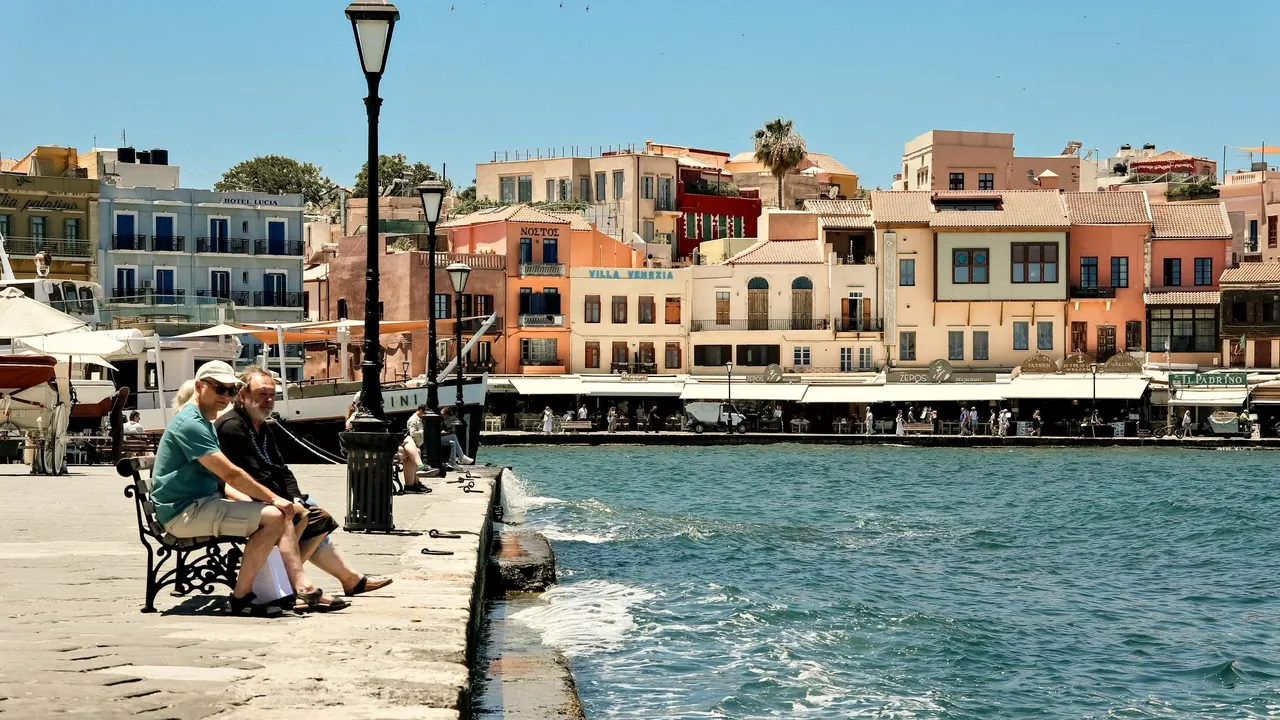
Photos: Crete by Piotr Baranowski, Pexels License.
Crete or Zakynthos?
Our verdict in twelve categories, each scored against the same fixed benchmark cities, and the climate month by month, so you can choose for your trip.
Choose Crete for
- culture and sights
- day trips
- food and drink
Crete is for travellers who want a beach vacation with a lot more around it. The Minoan palaces and the Heraklion museum, Venetian Chania, high mountains cut by long gorges and one of the Mediterranean's great regional cuisines all sit on the same island. It rewards a longer stay and a hire car, and it works best for people who like moving between towns, villages and very different stretches of coast.
Choose Zakynthos for
- nightlife
- prices
Zakynthos suits a simpler, compact sea-and-sun week. Its pleasures are the turtle beaches of Laganas Bay, boat trips past white cliffs and sea caves, and the view down to the Navagio wreck. Because the island is small, every drive is short. Young party groups come for the Laganas strip, and anyone avoiding it can stay on the quiet north-east coast or the Vasilikos peninsula. Travellers who want clear water, boat days and easy evenings, and who will not miss ancient sites, serious food or mountain walks, will be perfectly happy here.
Scoreboard
Twelve categories on one fixed scale from 0 to 100. The shaded stretch is the gap between the two.
Your match
Pick a travel style or drag the sliders, and both match scores follow your weighting.
Wins on culture and sights and day trips with your weighting.
Wins on nightlife and prices with your weighting.
What matters to you?
Category by category
What the scores mean for a trip.
Beaches & swimming
Both islands are first and foremost beach destinations, and they are about level. The difference is range against concentration. Crete's best sand is spread around a big coastline: the pink-tinged lagoons of Elafonissi, the turquoise bay at Balos and the long sunset beach of Falassarna in the west, the palm-backed bay at Vai in the east, and on the south coast, pebble coves on the Libyan Sea that you reach by boat or on foot.
Zakynthos packs its variety into a much smaller area. You have the sandy curve of Laganas Bay with the protected turtle beaches of Gerakas and Dafni, the coves of the Vasilikos peninsula and calm water at Tsilivi and Alykes. In the west, swimmers climb down from rocks at Porto Limnionas, and boats run to the Blue Caves. The famous Navagio wreck is something you look at from above, not a beach to spend the day on.
Food & drink
On Crete, food is a reason to come in its own right. The cooking is based on the island's olive oil, wild greens, graviera and mizithra cheeses, slow-cooked lamb and dakos, and a free glass of raki ends most meals. The best eating is in the backstreets of Chania and Rethymno and in the countryside tavernas, and the vineyards south of Heraklion add a serious wine culture.
Zakynthos feeds you well in a plainer way. Look for skordostoumbi, ladotyri cheese kept in oil and a glass of the local Verdea, ideally in the villages around Keri. In Laganas and Tsilivi, menus mostly cater to package visitors.
Culture & sights
This is where the two islands are furthest apart. Crete was the centre of Minoan civilisation. Knossos, Phaistos, Malia and the finest Minoan collection anywhere in the Heraklion Archaeological Museum would fill a week on their own, before you add Chania's Venetian harbour, the fortress at Rethymno, Spinalonga and Arkadi.
On Zakynthos, the 1953 earthquake destroyed most of the Venetian-era capital. What remains is a modest circuit: Solomos Square with its Byzantine and Solomos museums, the church of Agios Dionysios, the castle on Bochali hill and a few village churches. It is a pleasant break from the beach rather than a reason to go.
Nightlife
Both islands have a loud package-resort party strip, so the real difference is what else there is. On Zakynthos, going out means Laganas: foam parties, promoters and drinking until dawn, mostly for young British groups. Away from it, the island is quiet, with little more than waterfront cafés in town.
Crete has its own party pair in Malia and Hersonissos. It also has a more grown-up evening in Chania's harbour, on Rethymno's waterfront and in Heraklion's café-bar quarter, with cocktail bars full of Greek students and locals. If you want a mix of evenings, choose Crete. For one all-out party week, Laganas is the more single-minded choice.
Nature & outdoors
Crete's interior is real mountain country. The White Mountains and Psiloritis keep snow into spring, and gorges such as Samaria, Imbros and Aradena run down to the sea. The E4 long-distance path crosses the island, griffon vultures circle above, and wild kri-kri goats live in the west. Hikers, climbers and cyclists can fill a whole trip here.
On Zakynthos, the best scenery is the coast, seen from high cliffs at Keri and above Navagio, or from the water. Boat trips go to the Skinari sea caves and through the marine park in Laganas Bay, where loggerhead turtles nest, and the snorkelling and kayaking are good. Inland, the walking around Mount Vrachionas is gentle and rural rather than dramatic.
Day trips
Crete is big enough that its own towns make good days out: Chania, Rethymno, Heraklion and Agios Nikolaos are each worth a visit. There are also the wine villages around Peza and Archanes, the potters of Margarites, boat outings to Chrissi and Gramvousa, and the long but popular fast-ferry day to Santorini.
On Zakynthos, almost every outing beyond an island tour means a ferry. In summer, southern Kefalonia is a long day across the water. From Kyllini on the mainland, you can reach the Chlemoutsi castle or, with a very early start, ancient Olympia.
Good for families
Both islands suit a beach-based family vacation, and Crete has a little more to fill the days. Its north coast and the area around Chania have long, gently shelving sand. Elafonissi's warm lagoon is ideal for small children, and the waterparks and the large aquarium at Gournes are good for a day off the beach.
Zakynthos is simpler but easier to manage. The north-east beaches at Tsilivi, Planos and Alykes are calm and shallow, children love the turtle-spotting boats, and there is a large water park inland. Short journeys are its real advantage, compared with Crete's long, winding drives. Both islands get very hot in midsummer.
Getting around
Crete is a large, mountainous island, and distance is the real obstacle there. Reliable buses link Chania, Rethymno, Heraklion and Agios Nikolaos along the north coast and reach a few trailheads. The beaches, gorges and villages in the south mean steep, winding roads and drives that take longer than the map suggests.
Zakynthos is only about 40km long, so nothing is far, even though buses go only to the main resorts. The trouble there is the narrow, sometimes rough roads in the west and north, and the many beaches and caves you can only reach by boat. Excursions leave from most resorts, and the resort strips are easy to walk.
Shopping & style
Neither island is a shopping destination, but Crete gives you more to browse. Chania's leather-makers' lane, its knife-makers and its covered market hall are worth an hour, as are the cheeses and herbs on Heraklion's market street and the ceramics from Margarites.
On Zakynthos, the best souvenirs are edible: mantolato nougat, thyme honey and Verdea wine. Add some lace and weaving from around Volimes, and the local shops on Alexandrou Roma in town.
Affordability
Costs are much the same on both, mid-priced by Greek island standards, and on both the shoulder months of June and September give the best balance. On Crete, the savings are in village tavernas and family-run rooms, while car hire is the cost nobody escapes, and Elounda and the famous western beaches push prices up.
Zakynthos is built around package tourism, which keeps resort rooms moderate. Boat trips, sunbeds and car hire add up over a week, though, and secluded rooms in quiet coves cost more in August.
Live music & performing arts
Neither island has a theatre or concert season, but Crete's music is the more alive. The lyra, improvised mantinades verses and circle dances fill music tavernas in Rethymno and Chania and summer saints' festivals, Anogia is famous for its musicians, and summer festivals take over fortresses and open-air theatres.
Zakynthos has its own quieter tradition: kantades and arekia serenades with guitar and mandolin, which you might hear by chance in a taverna. There is also the town's old philharmonic band, and the omilies street theatre at carnival.
Wellness & relaxation
Crete has the stronger spa offer, with serious resort spas gathered around Elounda and the Gulf of Mirabello and more along the north coast near Chania and Heraklion. For real peace there are places like Loutro, which you can only reach by boat or on foot, and the hill villages among the olive groves.
Zakynthos has its spas mainly in the larger resort hotels, plus something Crete lacks: the cool sulphur springs bubbling into the sea at Xigia. The calmest bases are the hill villages around Keri and Agios Leon, well away from Laganas.
When should you go?
Pick your month. The climate figures are measured averages, not a forecast.
Crete in July
Zakynthos in July
Daytime high, °C
Rainfall in the month, mm
Temperature and rainfall are climate normals, averaged over the years shown. Crete: 1991-2020 normals, Heraklion Airport (3.6 km from centre). Zakynthos: 1991-2020 normals, Zakinthos / Agrilia (4.3 km from centre).
The two islands share a swimming season. The sea is warm enough from June to October and holds at about 25°C from July to September on both. Summer is hotter on Zakynthos, though, with August afternoons reaching around 33°C, while on Crete's main coast the heat levels off near 29°C. That makes Crete the more comfortable of the two for sightseeing and town walks in high summer, although neither is pleasant for long walks in the middle of a July day.
The bigger difference is the autumn rain. Crete stays almost dry into September and only turns properly wet in late autumn. Zakynthos sits on the greener Ionian side, so the rain comes back in September and builds to about 150mm in November, making its winter much wetter. For hiking or a quieter visit, May and October suit both islands, but late September and October are more reliable on Crete. Both get the long, very sunny days of a Greek summer.
Which traveller are you?
On a culture and arts trip, Crete is the clear pick. Knossos, Phaistos and the frescoes in the Heraklion museum, plus Venetian Chania and Ottoman Rethymno, give you days of real sightseeing. Zakynthos offers a pleasant half day in its rebuilt capital.
For an outdoors trip, choose Crete for its mountains above 2,400m, the walk down the Samaria gorge and the coast path from Loutro to Sfakia. Zakynthos is better for sea kayaking, snorkelling and turtle-spotting boat trips than for serious hiking.
On a food and nightlife trip, Crete wins on the plate, and Chania and Rethymno add relaxed late terraces where locals and students go out too. Zakynthos only makes sense if a non-stop party in Laganas is the whole plan.
Before you go
| Measure | Crete | Zakynthos |
|---|---|---|
| Official language | Greek | Greek |
| Currency | Euro (EUR) | Euro (EUR) |
| Sockets | CF230 V, 50 Hz | CF230 V, 50 Hz |
| Driving side | Right | Right |
| Time zone | UTC+2, UTC+3 in summer | UTC+2, UTC+3 in summer |
| Emergency number | 112 | 112 |
| Main airport | Heraklion International Nikos Kazantzakis Airport (HER)129 non-stop destinations | Zakynthos International Airport "Dionysios Solomos" (ZTH)69 non-stop destinations |
| Public holidays this year | 15 days | 15 days |
By the numbers
| Measure | Crete | Zakynthos |
|---|---|---|
| Population | 623,065 | 41,180 |
| People per km² | 75 | 102 |
| Swim season, months above 21 °C | 5 months | 5 months |
Where else could you go?
Every comparison below shares a destination with this one, so you can follow Crete or Zakynthos somewhere new.