Cuba
Trinidad, Cuba
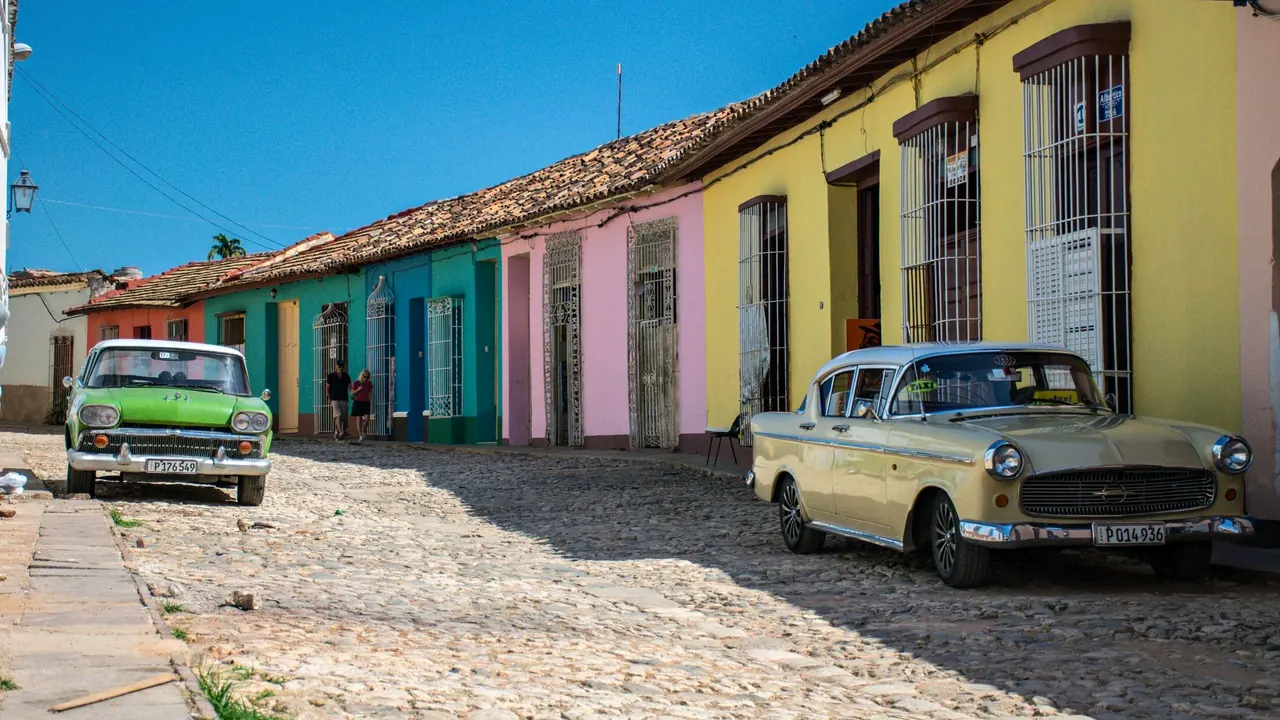
Classic cars on a cobbled street of colonial houses
- Beaches70
- Nature & outdoors68
- Affordable cities66
Photo: Ákos Helgert, Pexels License
Match
49
Every category weighted equally
- Beach & sun50
- Culture & arts49
- Food & nightlife46
- Family trip51
- Outdoors54
- Relax & unwind48
- Shopping & style44
- On a budget51
Trinidad, Cuba in twelve categories
Our verdict on each, scored 0 to 100 against the same fixed benchmark cities, so a score means the same thing on every page.
Beaches & swimming. Scores 70 out of 100.
Food & drink. Scores 32 out of 100.
Culture & sights. Scores 62 out of 100.
Nightlife. Scores 42 out of 100.
Nature & outdoors. Scores 68 out of 100.
Day trips. Scores 64 out of 100.
Good for families. Scores 34 out of 100.
Getting around. Scores 40 out of 100.
Shopping & style. Scores 30 out of 100.
Affordability. Scores 66 out of 100.
Live music & performing arts. Scores 52 out of 100.
Wellness & relaxation. Scores 26 out of 100.
Trinidad, Cuba category by category
Beaches & swimming
70Trinidad sits a few kilometres inland, and its beach is Playa Ancon, a long strip of pale sand on a narrow peninsula about 15 minutes away by taxi, tourist bus or bicycle. The Caribbean here is warm, clear and calm, around 28°C through the summer and rarely too cool even in winter, and there is good snorkelling off the reef. Nearer town, the fishing village of La Boca has a smaller, more local stretch of shore.
The choice is limited to these two, with a few resort hotels on Ancon and simple shade and drinks stalls elsewhere. Most visitors treat the beach as an afternoon or a day off between days in the old town rather than the reason for the stay.
Food & drink
32Eating in Trinidad means Cuban home cooking: rice and black beans, roast pork, ropa vieja, lobster and fish from the coast, served in paladares set in colonial houses and on rooftop terraces, or at the table of a casa particular, where breakfast and dinner are often the best meals of the stay. The local drink is the canchanchara, rum with honey and lime served in a clay cup, and the mojitos are everywhere.
The range is narrow and menus repeat from place to place, since supplies in Cuba are unpredictable. There is no street-food culture or market hall to speak of, and anyone who travels to eat will find it a pleasant but limited part of the trip.
Culture & sights
62The old town of Trinidad is a sugar-era colonial settlement preserved almost whole: cobbled streets, pastel single-storey houses with tall wooden grilles, red-tiled roofs and church towers, all listed by UNESCO together with the nearby sugar valley. The Plaza Mayor is the centrepiece, framed by the Iglesia de la Santisima Trinidad and former planters' mansions, one of which holds the Museo Romantico with its period furniture.
The Palacio Cantero, home to the municipal history museum, has a tower with the best view over the rooftops to the mountains, and the bell tower of the old San Francisco convent is the town's emblem. The museums are small and quickly seen. The pleasure lies in wandering the streets, and two or three days cover it well.
Nightlife
42Evenings gather on the broad stone steps beside the Plaza Mayor, where people drink rum cocktails under the sky and dance salsa well into the night. A handful of bars and courtyard venues nearby fill up after dinner, and the town's best-known late spot is a nightclub set inside a natural cave on the hill above town.
It is a warm, sociable scene with locals and travellers mixing, but it is small and every night follows much the same pattern. There are no districts to explore and little cocktail-bar or club variety, so a few nights are enough.
Nature & outdoors
68Behind the town rise the Escambray mountains, and the Topes de Collantes nature park, under an hour's drive up a steep road, is the main outdoor draw: forest trails lead down to the waterfall and pool of Salto del Caburni, and further in El Nicho and Guanayara offer cascades and coffee-farm country. Trails are steep and humid, and access is by taxi, tour or sturdy hired car.
Closer in, horse rides cross the green Valle de los Ingenios and up to small waterfalls, and the hill above town gives an easy evening walk. Off Playa Ancon there is snorkelling and diving on the reef. The dry months from December to April are the most comfortable for hiking.
Day trips
64The Valle de los Ingenios, part of the same UNESCO listing as the town, starts just outside it: ruined sugar mills, planters' houses and the tall Manaca Iznaga tower, reached by road or on the old steam-era tourist train when it runs. Further afield, Cienfuegos, a French-founded port with a grand neoclassical centre and bayfront, is about an hour and a half along the coast.
Sancti Spiritus, one of Cuba's oldest towns with a quiet colonial core and an old stone bridge, is a similar distance inland, and Santa Clara, with its Che Guevara memorial, is around two hours away. Public transport is sparse, so these trips are made by shared taxi, hired car or organised tour.
Good for families
34Children are welcomed warmly in Trinidad, the streets are calm and the beach at Ancon, with shallow, warm water, is the obvious family day. Horse rides in the valley and waterfall pools in the hills appeal to older children.
Beyond that there is little aimed at them: no zoo, parks or museums for young visitors. The cobblestones are large and uneven, so pushchairs are close to useless, the heat is draining, and power cuts and limited supplies of familiar foods and medicines make it hard work with small children.
Getting around
40Everything in the old town lies within a short walk, though the cobbles are rough, the streets slope and good shoes matter. Many lanes are closed to cars, which keeps the centre quiet.
Beyond that there is no public transport a visitor can rely on. The beach is reached by tourist shuttle, taxi, bicycle taxi or hired bike, and the mountains and other towns by taxi, hired car or tour. Long-distance tourist coaches connect Trinidad with Havana and other cities, but the journeys are slow and services thin.
Shopping & style
30Shopping here is crafts. Trinidad has a long tradition of hand embroidery and crochet, and tablecloths and blouses hang along the open-air craft market lanes near the centre, together with wood carvings, straw hats and jewellery. The town also has a pottery tradition, with family workshops shaping clay pieces at the wheel, and small galleries sell paintings by local artists.
There are no boutiques, department stores or brands, and what is for sale repeats from stall to stall. Rum and cigars are best bought at state shops rather than from street sellers.
Affordability
66Staying in a casa particular, a room in a family home, is the usual choice and costs little, with breakfast often included and dinner on offer at a fair price. Live music in the squares is free or costs a token cover, and the old town is all on foot.
What raises the bill is that much of the economy is priced for visitors: paladar meals cost more than locals would pay, and taxis to the beach and the mountains, guided tours and resort hotels on Ancon add up. Cash is essential, as cards are often not accepted.
Live music & performing arts
52Music is the soul of an evening in Trinidad. Every night, bands play son, salsa and bolero at the Casa de la Musica beside the Plaza Mayor and at the Casa de la Trova, where older musicians perform the traditional Cuban song. The Palenque de los Congos Reales hosts Afro-Cuban drumming and rumba rooted in the town's slave history, and smaller courtyards stage local groups.
The standard is high and the atmosphere is genuine, with locals dancing alongside visitors. What is missing is any formal stage: no theatre season, classical concerts or opera, so the offer is one tradition played in many forms rather than a broad scene.
Wellness & relaxation
26Trinidad has no spa or bathing tradition, and wellness is limited to massages offered in a few resort hotels near the beach. What it does have is a slow small-town rhythm: shaded courtyards in family homes, rocking chairs on doorsteps and long afternoons through the heat.
That calm is broken by roosters at dawn, horse carts on the cobbles and music playing until late, and power cuts can turn off fans and air conditioning. Visitors looking to rest do better at the beach or in the cooler hills.
When should you go?
Pick a month to see what it is like. The climate figures are measured averages, not a forecast.
Trinidad, Cuba in July
Daytime high, °C
Rainfall in the month, mm
The whole year
Shaded against this city’s own year: the deepest cell is its best month for that figure and the palest its weakest.
Where the figures come from
Trinidad, Cuba's temperatures are measured 59 km from the centre, at Cienfuegos, Las Villas.
Trinidad, Cuba has no rain gauge within 25 km of the centre, so its rainfall comes from a gridded climate dataset read at the city rather than from a gauge further away.
Temperature and rainfall are climate normals, averaged over the years shown. Trinidad, Cuba: 2014-2025 (rainfall 1991-2020) normals, Cienfuegos, Las Villas (59.3 km from centre).
Before you go
| Measure | Trinidad, Cuba |
|---|---|
| Official language | Spanish |
| Currency | Cuban Peso (CUP) |
| Sockets | AB110 V, 60 Hz |
| Driving side | Right |
| Time zone | UTC-5, UTC-4 in summer |
| Emergency number | Police 106, ambulance 104, fire 105 |
| Elevation | 60 m |
| Main airport | Abel Santamaria International Airport (SNU)77 km from centre1 non-stop destination |
| Public holidays this year | 9 days |
By the numbers
| Measure | Trinidad, Cuba |
|---|---|
| City population | 51,994 |
| People per km² | 45 |
| Museums within 10 km | 4 |
| UNESCO World Heritage sites within 50 km | 1 |
| Swim season, months above 21 °C | 12 months |
Compare Trinidad, Cuba with
Every comparison with a written verdict behind it.
- Antigua Guatemala
- Cartagena
- Fort Lauderdale
- Havana
- Key West
- Miami
- Miami Beach
- Montego Bay
- Negril
- Ocho Rios
- San Juan
- Varadero