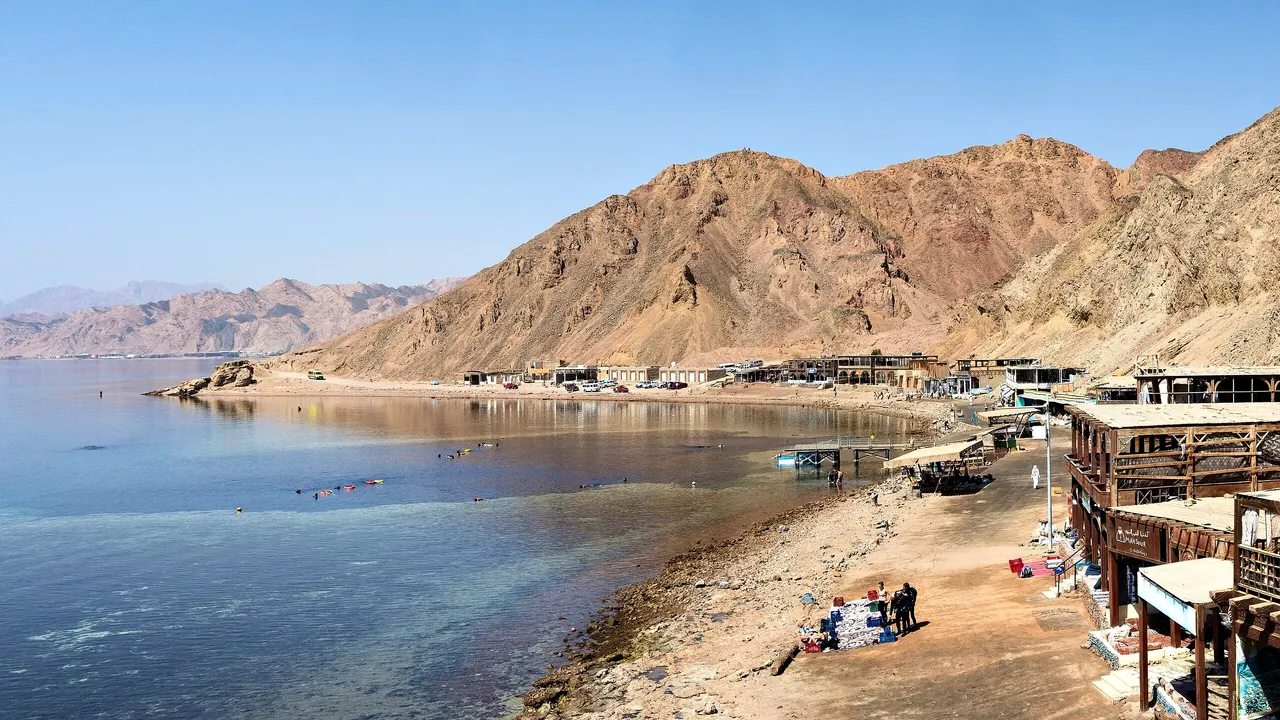
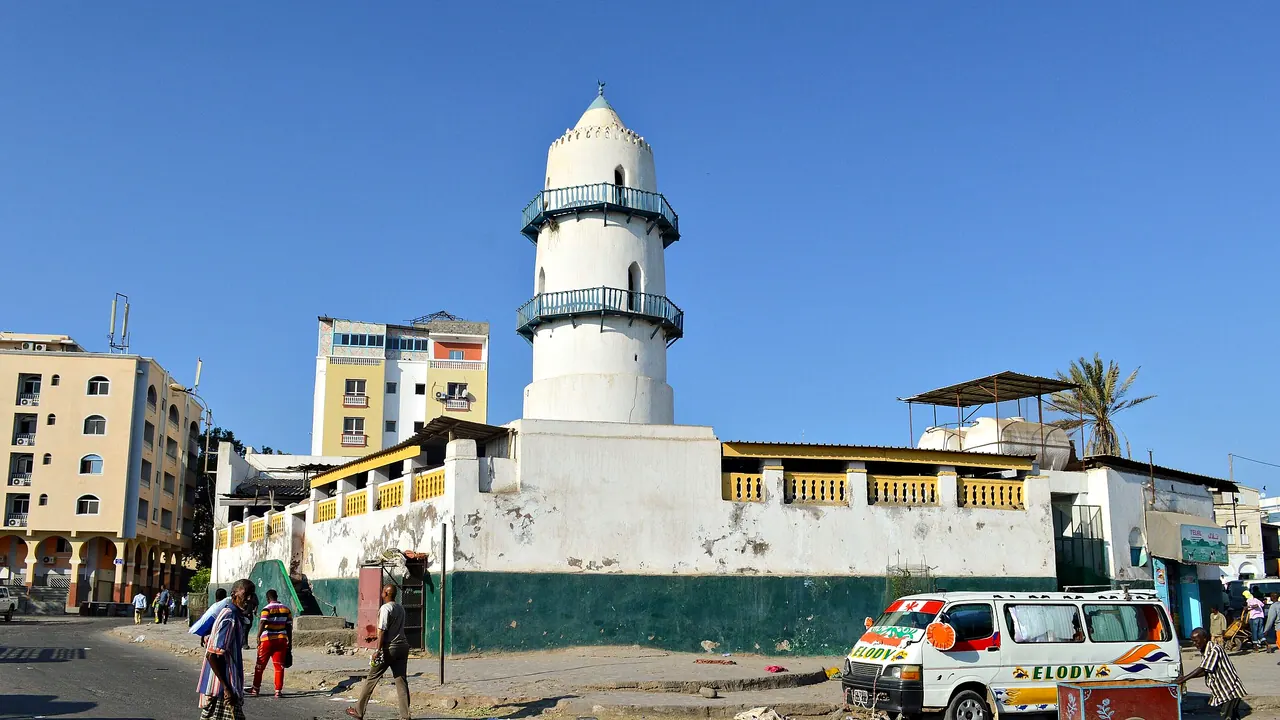
Photos: Dahab by Petar Milošević, CC BY-SA 4.0, cropped; Djibouti City by Francisco Anzola from United States, CC BY 2.0, cropped.
Dahab or Djibouti City?
Our verdict in twelve categories, each scored against the same fixed benchmark cities, and the climate month by month, so you can choose for your trip.
Choose Dahab for
- prices
- wellness
- nature and the outdoors
Dahab is the better choice for most people choosing between these two, and above all for anyone who wants the sea on their doorstep. You can walk off the promenade straight onto a coral reef, the freediving and yoga community sets a slow, sociable pace, and a long stay costs very little. It suits divers, snorkellers, kitesurfers and anyone happy to spend a week or a month on cushions by the water with the Sinai mountains behind them.
Choose Djibouti City for
- culture and sights
- nightlife
- shopping
Djibouti City is for the traveller who wants somewhere few people go and accepts the cost and effort that come with it. The city is only a base. The reward lies outside it, in snorkelling with whale sharks in the Gulf of Tadjoura, the salt flats of Lac Assal and the lava fields of the Ghoubbet. Go in the cooler months, with a bigger budget and a driver booked, and it offers a raw volcanic landscape that Dahab cannot match for strangeness.
Scoreboard
Twelve categories on one fixed scale from 0 to 100. The shaded stretch is the gap between the two.
Your match
Pick a travel style or drag the sliders, and both match scores follow your weighting.
Wins on prices and wellness with your weighting.
Wins on culture and sights and nightlife with your weighting.
What matters to you?
Category by category
What the scores mean for a trip.
Beaches & swimming
Dahab gives you the better swimming because the reef starts right at the edge of town. At the Lighthouse, Eel Garden and along the promenade you step off a jetty into clear water above the coral. The Lagoon to the south adds sand and calm shallows for anyone who just wants to wade.
Djibouti City has the warmer sea, but its own shore is mostly port and rocky foreshore. Its pale sand and gentle coral shallows are out on Moucha and Maskali, a boat ride across the bay. That makes every beach day an organised outing with little shade and basic facilities, not something you simply walk to.
Food & drink
Neither is a place to travel for food, and they come out about level. Dahab's signature meal is fish chosen from the ice and grilled, eaten on cushions by the bay. The cheap Egyptian staples in Assala, such as foul, falafel and koshary, are the more rewarding meals.
Djibouti City's cooking draws on more traditions. You can eat Yemeni fish baked against the wall of a clay oven, Somali and Ethiopian rice, goat and injera, and croissants from the French bakeries of the European quarter. In both places alcohol mostly stays inside hotels and tourist bars.
Culture & sights
Djibouti City has a little more to look at, though only enough for half a day. You can walk the faded arcaded colonial buildings around Place Menelik, see the white minaret of the Hamoudi mosque, and look at the old railway station and the presidential palace from outside. Dahab has no buildings or monuments to visit at all. Its interest lies in its Bedouin character, which you notice in Assala and around town but cannot really go and see.
Nightlife
Evenings are quiet in both, but in different ways. In Dahab you drink a beer or smoke a shisha by the water among divers and instructors, and most of the town is asleep before midnight because of early dives.
Djibouti City does have a few nightclubs in the European quarter that stay open late at weekends, along with hotel terraces facing the sea. Its crowd is mostly expatriates and military personnel, and the local evening is a family stroll along the seafront, not a bar scene.
Nature & outdoors
Dahab is one of the great dive and freedive bases, with deep blue water just a short swim from shore at the Canyon and the Blue Hole. The Lagoon's wind adds windsurfing and kitesurfing. Behind the town, the granite mountains of South Sinai offer wadi trips, the Coloured Canyon, the walk to Ras Abu Galum and the night climb of Mount Sinai.
Djibouti City's landscape is stranger but much harder to reach. You can swim with whale sharks in the gulf, see Lac Assal lying 155m below sea level and ringed with salt, and cross the black lava of the Ghoubbet. Almost all of it needs an off-road vehicle and a driver, and the further sights, such as Lac Abbe's chimneys, take overnight trips.
Day trips
Dahab has the one excursion with real weight. St Catherine's Monastery stands at the foot of Mount Sinai, about two hours inland, and is often combined with the climb to watch the sunrise. Otherwise the choice is thin: Sharm el-Sheikh is a resort town and Nuweiba is a quiet port.
From Djibouti City the only real place to visit is Tadjoura, the country's oldest town, with whitewashed houses and small mosques. It is reached by boat or a long drive. Arta in the hills is more a cool stop on the road west than an outing of its own.
Good for families
Dahab is the gentler choice with children. The Lagoon has sand and sheltered shallows, older children can snorkel straight from shore, and a camel ride is easy to arrange. Reef shoes and a careful eye on the coral are still needed.
In Djibouti City a family day usually means the hotel pool or a boat to the islands, with the whale sharks as a highlight for older children. Excursions involve long, rough, hot drives. In both places summer heat is very hard on small children and serious medical care is a distance away, but the drawbacks weigh more heavily in Djibouti.
Getting around
In Dahab almost everything happens along one flat, mostly car-free promenade about 2km long, so you can walk everywhere you need for days. Once you leave it there is no public transport. The Lagoon, Assala and the Blue Hole all mean a taxi, a pickup or a dive-centre transfer, and getting there means a road transfer of about an hour from Sharm el-Sheikh.
Djibouti City has its own airport and plenty of taxis instead, and in winter you can walk its compact centre, though the pavements are uneven and there is little shade. Leaving town is the hard part. The islands, the lakes and Tadjoura all need a hired boat or an off-road vehicle with a driver, usually booked through a hotel.
Shopping & style
Shopping is limited in both. Dahab's promenade stalls sell Bedouin embroidery, scarves, spices and jewellery, and dive and freediving equipment is the one thing worth buying there.
Djibouti City's buying is done in markets. The central market in the African quarter and the stalls of Les Caisses deal in fabrics, incense and imported goods. Woven baskets, Afar knives and silver jewellery are its distinctive crafts, though they are not easy to find.
Affordability
There is a wide gap here. Dahab is one of the cheapest places anywhere for a diving vacation. Simple rooms, Assala's Egyptian meals, town taxis and dive courses all cost little, which is why people stay for months.
Djibouti City is expensive for what it offers. Hotels are priced for business travellers and military contractors, and imported food is dear. The excursions that are the point of going, a 4x4 with a driver or a private boat, quickly add up. Street tea, grill houses and city taxis are the only real savings.
Live music & performing arts
Neither has a stage worth planning an evening around. The most you will find in Dahab is a band or DJ in a promenade bar, or Bedouin music around a fire at a desert camp. In Djibouti City, Somali and Afar music and dance belong mostly to weddings and national celebrations, with only the occasional concert at a cultural centre.
Wellness & relaxation
Dahab is the far more restful place. Long-stay travellers gather around yoga, breathwork and freediving, cheap massage is easy to find, and the days fall into a rhythm of seafront cushions and sunsets over the mountains. If you want spa pampering you will find little beyond the larger hotels.
Djibouti City offers hotel spas and pools, but the port city itself is hot, dusty and full of traffic. Real stillness comes only from a night at a desert camp out of town.
When should you go?
Pick your month. The climate figures are measured averages, not a forecast.
Dahab in July
Djibouti City in July
Daytime high, °C
Rainfall in the month, mm
Where the figures come from
Dahab has no weather station within reach, so its figures come from a gridded climate model rather than a measured record, and read a broad area rather than one spot.
Djibouti City has no weather station within reach, so its figures come from a gridded climate model rather than a measured record, and read a broad area rather than one spot.
Temperature and rainfall are climate normals, averaged over the years shown. Dahab: 1991-2020 normals, TerraClimate 4 km grid at the town, no weather station within 90 km. Djibouti City: 2001-2020 normals, NASA POWER reanalysis grid, no weather station within 90 km.
Both are desert coasts where rain hardly matters, so the season is set by heat. Dahab has a real winter. January highs of about 21°C are pleasant for walking but make the sea, at around 22°C, feel cool for long snorkels. Spring and autumn are the sweet spot, warm enough for swimming every day and still comfortable for the mountains. From June to September highs reach 37°C, which is fine in the water and hard work on land.
Djibouti City runs hotter all year and has a much shorter comfortable window. November to March brings highs around the high twenties and a sea that stays bath-warm, which is also the whale-shark season. By June the air reaches 39°C and the sea passes 31°C, and both outdoor trips and beach days become an ordeal. If your dates fall in midsummer, Dahab is the more bearable of the two. In midwinter, Djibouti's warmth makes it the better choice for anyone who wants a properly hot sea.
Which traveller are you?
On a trip on a tight budget, Dahab lets the money stretch. You can settle in for weeks, eat where locals eat and afford a dive course too. In Djibouti City the same sum covers a few nights, and the desert and islands stay out of reach.
For a relaxing and wellness trip, Dahab lets the days drift: a morning class, a swim off the jetty, then an afternoon by the water until dusk. In Djibouti City rest means staying within the hotel grounds while heat and port traffic carry on outside.
For snorkellers who want to swim with whale sharks, Djibouti City has what Dahab does not. In the cooler months the sharks gather in the Gulf of Tadjoura, and small boats take you out to swim beside them. Dahab's reefs are superb, but this encounter is not one of them.
Before you go
| Measure | Dahab | Djibouti City |
|---|---|---|
| Official language | Arabic | French, Arabic |
| Currency | Egyptian Pound (EGP) | Djibouti Franc (DJF) |
| Sockets | CF220 V, 50 Hz | CE220 V, 50 Hz |
| Driving side | Right | Right |
| Time zone | UTC+2, UTC+3 in summer | UTC+3 |
| Emergency number | Police 122, ambulance 123, fire 180 | Police 17, ambulance 19, fire 18 |
| Elevation | 21 m | 14 m |
| Main airport | Sharm El Sheikh International Airport (SSH)58 km from centre116 non-stop destinations | Djibouti-Ambouli Airport (JIB)5 km from centre10 non-stop destinations |
| Public holidays this year | 15 days | - |
By the numbers
| Measure | Dahab | Djibouti City |
|---|---|---|
| Population | 4,479 | 603,900 |
| People per km² | - | 3,020 |
| Museums within 10 km | 0 | 0 |
| UNESCO World Heritage sites within 50 km | 0 | 0 |
| Swim season, months above 21 °C | 12 months | 12 months |
Where else could you go?
Every comparison below shares a destination with this one, so you can follow Dahab or Djibouti City somewhere new.