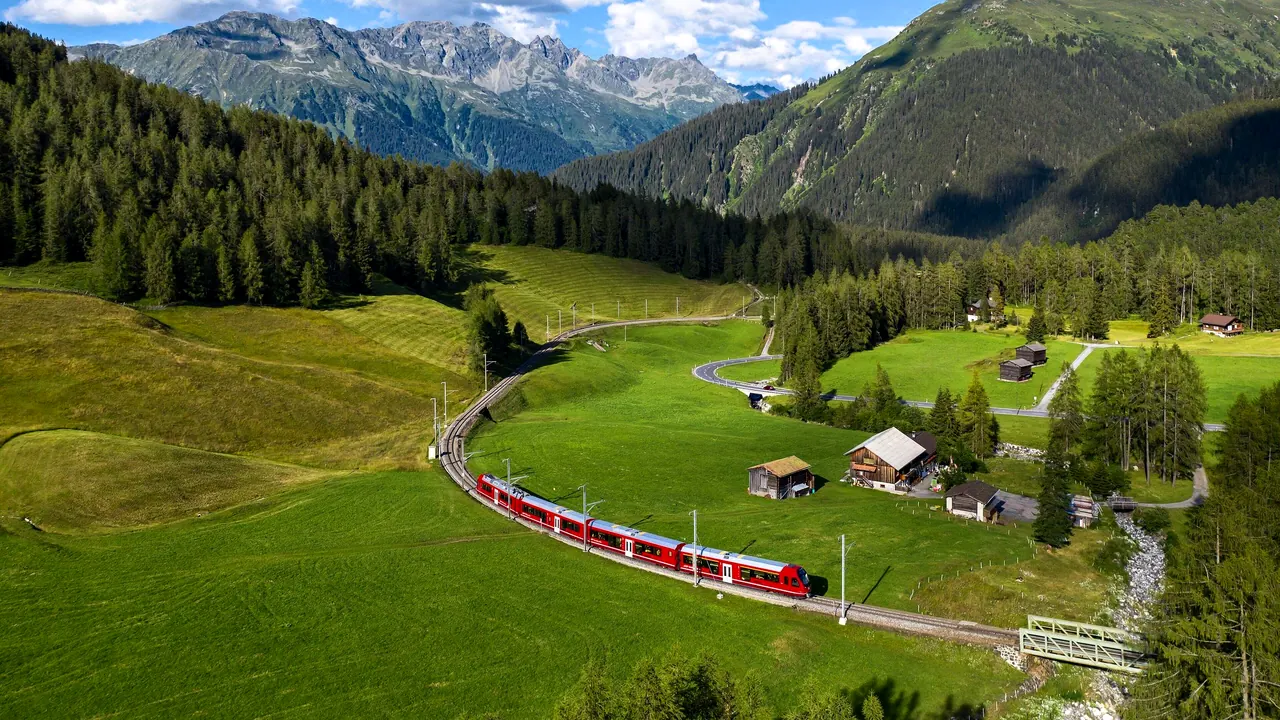
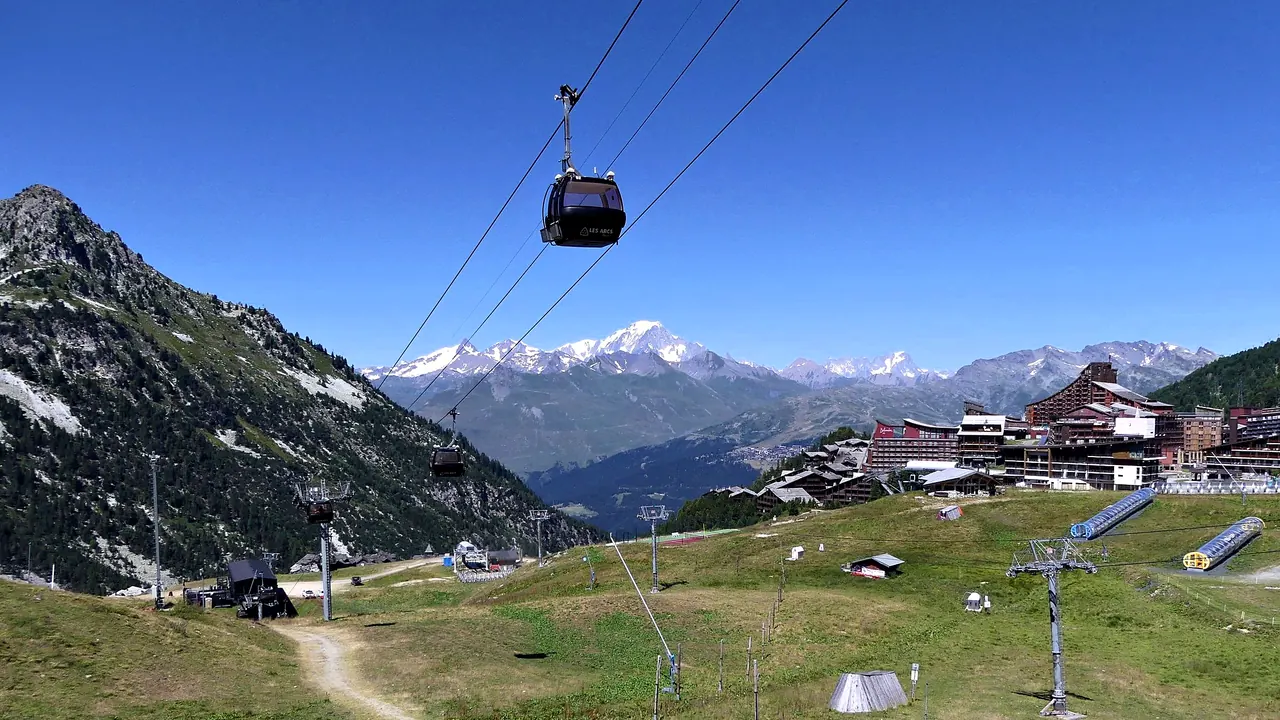
Photos: Davos by Kabelleger / David Gubler, CC BY-SA 4.0, cropped; Les Arcs by Florian Pépellin, CC BY-SA 4.0, cropped.
Davos or Les Arcs?
Our verdict in twelve categories, each scored against the same fixed benchmark cities, and the climate month by month, so you can choose for your trip.
Choose Davos for
- wellness
- getting around
- day trips
Davos suits travellers who want a real mountain town rather than a purpose-built resort. It has a railway, a lake and a sanatorium past, and the Kirchner collection is on your doorstep. Free buses and the Rhaetian trains mean you never need a car, and the Albula line opens up the Engadine. It is also the better place for a slow, restorative stay, with hotel spas in town and the baths at Scuol within reach, as long as your budget can take Swiss resort prices.
Choose Les Arcs for
- prices
- families
- live music and the arts
For a family ski week, Les Arcs is the more natural fit. Its car-free villages put apartments straight onto the snow and its ski schools take the smallest children. Self-catering keeps the bill a little more manageable than in Davos, though it is never cheap. Skiers who want mileage get the linked Paradiski area and the long descents from the Aiguille Rouge, and the Perriand architecture is a quiet bonus for anyone interested in design.
Scoreboard
Twelve categories on one fixed scale from 0 to 100. The shaded stretch is the gap between the two.
Your match
Pick a travel style or drag the sliders, and both match scores follow your weighting.
Too close to call, 2 points apart
Wins on wellness and getting around with your weighting.
Wins on prices and families with your weighting.
What matters to you?
Category by category
What the scores mean for a trip.
Beaches & swimming
Neither is a place to swim, but Davos at least has a lake in town. The lido on the Davosersee has lawns and a jetty for a brief, chilly summer swim, and there is an indoor leisure pool for other days. In Les Arcs swimming means a heated pool at your residence, and a real lake swim means driving about two hours to Annecy or Lac du Bourget.
Food & drink
Both towns serve hearty mountain food, but from different traditions. Davos cooks the Graubünden way: capuns, pizokel, barley soup, air-dried Bündnerfleisch and Engadiner Nusstorte, best eaten at huts on the runs or in the side valleys. In town, food is mostly hotel dining, and many places close between seasons.
Les Arcs is built around cheese. Tartiflette, raclette and fondue are made with Beaufort from the nearby valleys. With so many guests in apartments, a lot of the eating happens at home, and the cooperative and markets in Bourg-Saint-Maurice are where you buy the good produce.
Culture & sights
Davos has more to see. As a nineteenth-century tuberculosis resort it was the setting for The Magic Mountain, and the old sanatorium of the Schatzalp still shows that era. The Kirchner Museum holds the largest collection of the painter's work, and between them they fill a day or two of sightseeing.
In Les Arcs the main sight is the resort itself. The stepped blocks of Arc 1600 and Arc 1800 by Charlotte Perriand and her team will interest anyone who likes twentieth-century design, but there are no significant museums. The baroque chapels in the valley below take some effort to find.
Nightlife
Neither is a place for a big night out, and both revolve around après-ski, but the evening runs differently. In Davos the crowd moves from the bottom of the Jakobshorn and Parsenn runs to hotel bars, a few pubs and a couple of small clubs along the Promenade. At weekends in the busy winter weeks it can last past midnight. In summer, it is usually a drink on a terrace.
Les Arcs gets loud early and then goes quiet. When the lifts close, the terrace bars at the foot of the slopes fill up, and the liveliest have DJs and table-dancing. Arc 1800 has a late bar or two and a small club, but with so many families staying in apartments, most nights end soon after dinner.
Nature & outdoors
Davos spreads its skiing over five separate areas, while Les Arcs puts its weight behind one huge linked area. In Davos you can move between Parsenn, Jakobshorn, Rinerhorn and Madrisa, and more than 100km of cross-country trails run along the valley floor into the Sertig and Dischma valleys. In summer those quiet side valleys lead up to glaciers, and the Swiss National Park is close enough for a day trip.
Les Arcs gives you sheer size. Its lifts connect with La Plagne to form Paradiski, with long runs from the Aiguille Rouge above 3,200m all the way down to the valley, plus good off-piste skiing. In summer you can go rafting on the Isère, paragliding or onto a via ferrata, and trails lead into the Vanoise.
Day trips
From Davos the journey is part of the outing. The Rhaetian Railway crosses the Landwasser Viaduct and follows the UNESCO-listed Albula line to St Moritz. Medieval Chur and the painted houses of Guarda are each about an hour away, and you can do it all without a car.
From Les Arcs, most trips go to other mountain places, such as Val d'Isère, Tignes or the Beaufortain villages. Annecy and Chambéry are each about two hours by road. The trip into Italy over the Little St Bernard is only possible in summer, so the winter choice is much shorter.
Good for families
Les Arcs was designed for families on ski weeks, and it shows. The villages are largely car-free, apartments open straight onto the snow, ski schools take the very young, and themed fun slopes keep beginners entertained.
Davos also works for active families, with the long toboggan run down from the Schatzalp, the natural ice rink and an indoor pool with slides for bad days. Its hotels and longer town take more organising, though, and older children who don't like sport may get bored.
Getting around
Davos is easier to get around. It has stations at both Dorf and Platz, buses run its whole length and out into the side valleys, usually free with the guest card, and the Parsenn funicular and Jakobshorn cable car start in town.
Les Arcs also works without a car, thanks to the funicular up from the railway station at Bourg-Saint-Maurice. Once there, though, the four villages are spread along a winding road. The shuttles slow down in snow and walking between villages is not practical, so a car helps for trips down the valley.
Shopping & style
In both places shopping is mostly ski gear and rental. The Promenade in Davos adds Swiss watch and jewellery shops and delicatessens selling Bündnerfleisch and Nusstorte. In Les Arcs the things worth taking home are Beaufort, Savoyard charcuterie and génépi, best bought down in Bourg-Saint-Maurice rather than in the resort.
Affordability
Both are expensive, but Davos is in a class of its own. Hotels, restaurants and lift passes charge Swiss resort prices, the huts on the slopes cost even more, and rooms become scarce during the World Economic Forum each January.
Les Arcs costs less mostly because it is built of apartments rather than grand hotels. Cooking for yourself and choosing a quiet week in January or late March both make a real difference, and summer is noticeably cheaper.
Live music & performing arts
In both places, serious music means a summer classical festival. In Davos, young musicians play in churches, hotels and unusual places around the valley. In Les Arcs, a chamber music festival and academy that has run since the 1970s fills the halls and chapels for a few weeks in July. In winter, live music in Davos is mostly in hotel bars, and in Les Arcs it means bands at après-ski bars.
Wellness & relaxation
Davos is the better place to slow down. The town was founded on the healing power of its dry mountain air, the larger hotels have pools and treatment rooms, and the public leisure pool has a sauna area. The thermal baths at Scuol are an hour away through the Vereina tunnel.
Les Arcs offers spas in its residences, aimed at tired skiers, and the old spa towns of Brides-les-Bains and Salins-les-Thermes are about an hour down the valley. In winter the rhythm of ski week is energetic rather than restful.
When should you go?
Pick your month. The climate figures are measured averages, not a forecast.
Davos in July
Les Arcs in July
Daytime high, °C
Rainfall in the month, mm
Where the figures come from
Davos's temperatures are measured 53 km from the centre, at S. Valentino Alla Muta.
Davos has no rain gauge within 25 km of the centre, so its rainfall comes from a gridded climate dataset read at the destination rather than from a gauge further away.
Les Arcs's temperatures are measured 43 km from the centre, at Grand St. Bernard / Grand Saint Bernard.
Les Arcs's station stands 199 m above the city centre, so the centre is likely a little warmer than the figures say.
Les Arcs has no rain gauge within 25 km of the centre, so its rainfall comes from a gridded climate dataset read at the destination rather than from a gauge further away.
Temperature and rainfall are climate normals, averaged over the years shown. Davos: 1991-2020 normals, S. Valentino Alla Muta (53.4 km from centre). Les Arcs: 1991-2020 normals, Grand St. Bernard / Grand Saint Bernard (43.4 km from centre).
Davos has a proper summer. Afternoons reach about 20°C in July and August, which is good weather for hiking, biking and a cool dip in the Davosersee. Summer is also the wettest part of the year, with about 140mm in August, mostly as showers, so plan walks for the mornings. Winter days stay around freezing and are fairly dry, with February the driest month, which suits skiing and the clear mountain air.
Les Arcs is much colder all year. Daytime highs stay below freezing from November to March and reach only about 12°C in midsummer, so even July calls for layers on the trails. It gets a lot of precipitation, which peaks at 193mm in November and falls largely as snow in winter. July is the driest and sunniest month, while December has very little sun. For warm hiking weather Davos is the better choice in summer. Les Arcs is above all a winter destination.
Which traveller are you?
On a family trip with young children, Les Arcs keeps small children busier. Davos offers mountain playgrounds at the top stations and summer adventure trails, but it is a hotel town spread along a valley. Les Arcs adds kindergartens, snow play areas and, in summer, lakeside play areas and mountain-bike lessons.
For a relaxing and wellness trip, Davos is the better choice. The town grew up around rest and recovery, and its sanatorium balconies and big hotel spas still reflect that. In Les Arcs, the pools and hammams mostly serve tired skiers, and the calm comes only outside winter.
On a trip on a tight budget, Les Arcs is the cheaper of two expensive options. Davos charges Swiss prices for rooms, meals and lift passes, and its quieter seasons save some money but also close hotels and restaurants. Les Arcs lets you cook in an apartment, and its summers cost noticeably less.
Before you go
| Measure | Davos | Les Arcs |
|---|---|---|
| Official language | French, German, Italian, Romansh | French |
| Currency | Swiss Franc (CHF) | Euro (EUR) |
| Sockets | CJ230 V, 50 Hz | CE230 V, 50 Hz |
| Driving side | Right | Right |
| Time zone | UTC+1, UTC+2 in summer | UTC+1, UTC+2 in summer |
| Emergency number | 112 | 112 |
| Elevation | 1,559 m | 2,273 m |
| Main airport | Zürich Airport (ZRH)122 km from centre226 non-stop destinations | Geneva International Airport (GVA)92 km from centre150 non-stop destinations |
| Public holidays this year | 9 days | 11 days |
By the numbers
| Measure | Davos | Les Arcs |
|---|---|---|
| Population | 10,738 | - |
| People per km² | 38 | - |
| Museums within 10 km | 3 | 0 |
| UNESCO World Heritage sites within 50 km | 2 | 0 |
Where else could you go?
Every comparison below shares a destination with this one, so you can follow Davos or Les Arcs somewhere new.
- La Rosièrevs Les Arcs
- Klostersvs Davos
- Arosavs Davos
- La Plagnevs Les Arcs
- Tignesvs Les Arcs
- Val d'Isèrevs Les Arcs