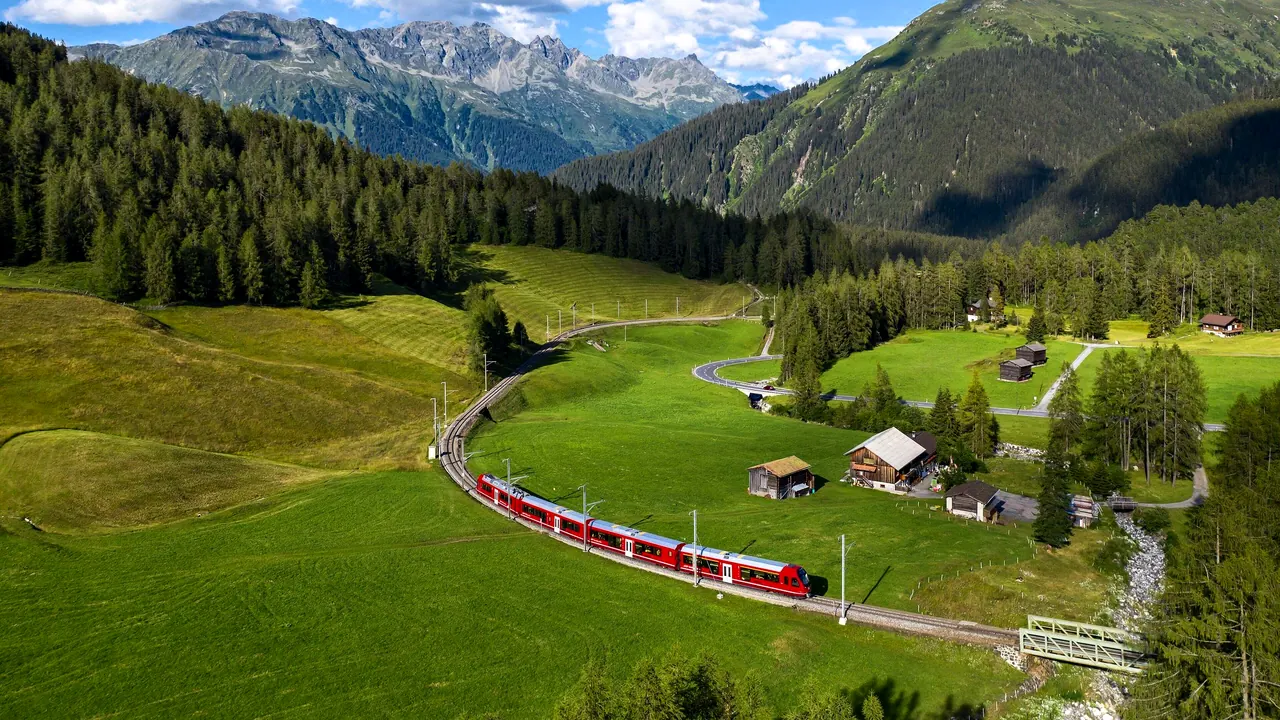
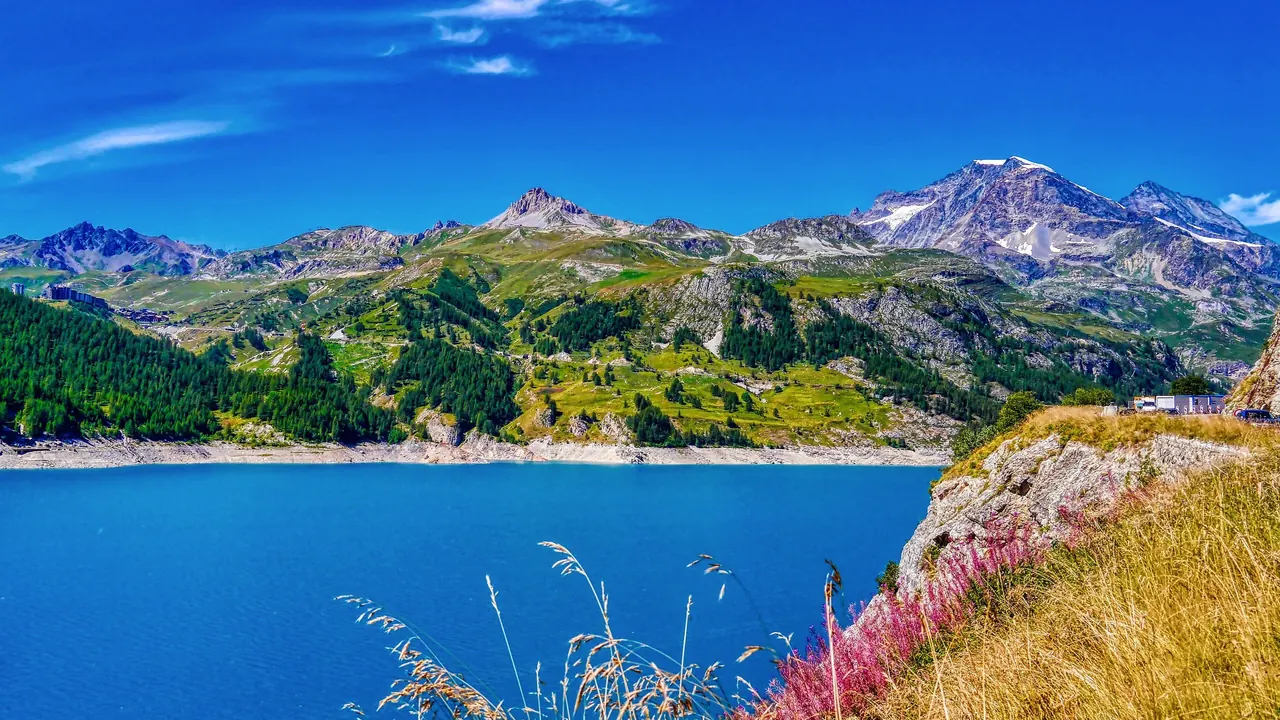
Photos: Davos by Kabelleger / David Gubler, CC BY-SA 4.0, cropped; Tignes by Zairon, CC BY-SA 4.0, cropped.
Davos or Tignes?
Our verdict in twelve categories, each scored against the same fixed benchmark cities, and the climate month by month, so you can choose for your trip.
Choose Davos for
- day trips
- getting around
- culture and sights
Davos suits travellers who want the mountains plus a life beyond them. It is a real town with two railway stations and buses that run its length, a museum devoted to Kirchner, and the sanatorium history behind The Magic Mountain. The Rhaetian Railway carries you over viaducts to St Moritz, Chur or the painted villages of the Engadine. It is also the calmer, more restorative choice, with hotel spas, dry air and Scuol's mineral baths within reach.
Choose Tignes for
- nightlife
- prices
- beaches
Tignes is for people who come to ski hard and go out afterwards. It sits higher, keeps its snow longer thanks to the Grande Motte glacier, and links with Val d'Isère into one vast ski area. Après-ski runs loud in Val Claret and Le Lac, and self-catering apartments make it somewhat less punishing on the wallet. Off the slopes, though, there is little to see and the valley road makes day trips hard work.
Scoreboard
Twelve categories on one fixed scale from 0 to 100. The shaded stretch is the gap between the two.
Your match
Pick a travel style or drag the sliders, and both match scores follow your weighting.
Wins on day trips and getting around with your weighting.
Wins on nightlife and prices with your weighting.
What matters to you?
Category by category
What the scores mean for a trip.
Beaches & swimming
Swimming is a bracing summer extra in both places, never a reason to come, and the water stays around 16°C in each. What differs is the setting. Davos has a lido on the Davosersee at the edge of town, with lawns and a jetty for lying in the sun.
Tignes has a supervised bathing area with a small sandy shore on its lake, right below Le Lac and some 500m higher. In both resorts most swimming happens indoors: Davos's leisure pool, or the lagoon pool and slides of Tignes's aquatic centre.
Food & drink
The two eat at much the same level, but in different regional styles. Davos serves Graubünden cooking: capuns, pizokel, barley soup and air-dried Bündnerfleisch, with Engadiner Nusstorte for dessert, at its best in huts on the runs and in the side valleys.
Tignes is built on Savoie cheese, so expect fondue, tartiflette and croziflette made with Beaufort and Reblochon, plus delicatessens selling charcuterie and Savoie wines. In both, menus repeat and many kitchens close between seasons.
Culture & sights
Davos has a real story to explore. Its sanatorium past survives in buildings such as the Schatzalp with its sun balconies, it is the setting of Thomas Mann's The Magic Mountain, and the Kirchner Museum holds the largest collection of the Expressionist's work. Add the winter sports museum and St Johann, and you have a short but rewarding day or two.
Tignes was built from scratch as a ski resort after the Chevril dam flooded the old village in 1952. The mural on the dam wall and a few chapels in Les Brévières and Les Boisses are about all there is to see.
Nightlife
In winter Tignes is the place to go out. Après-ski starts with music on the mountain terraces and moves into the bars of Val Claret and Le Lac, where seasonal workers and groups of young British, Scandinavian and French skiers dance in their boots until the small clubs close.
Davos is tamer and more hotel-based. Après-ski starts below the Jakobshorn and Parsenn, then moves to hotel bars, pubs and a couple of small clubs on the Promenade, and only really runs late at weekends and in peak weeks. Both go quiet in summer.
Nature & outdoors
These are two of the great Alpine bases, and the difference is in kind. Tignes is the high-altitude choice. It sits at about 2,100m with the Grande Motte glacier above it, links with Val d'Isère into a huge, snow-sure ski area with serious off-piste, and opens on the glacier in autumn. The Vanoise National Park is right on its doorstep.
Davos offers more variety. Its downhill skiing is spread over five separate areas, and it has over 100km of cross-country trails into the Sertig and Dischma valleys, which Tignes cannot match. In summer it adds dense mountain biking singletrack and a day trip to the Swiss National Park.
Day trips
Davos is much the better base for days out, and the journey is part of the pleasure. The Rhaetian Railway crosses the Landwasser Viaduct and follows the UNESCO-listed Albula line to St Moritz in about an hour and a half. It also reaches medieval Chur, and through the Vereina tunnel it takes you to the painted houses of Guarda and the spa town of Scuol. Klosters is only a short hop away.
Tignes sits at the head of a long valley, so there are fewer places to go. Val d'Isère and its older centre are a short bus ride away, and buses also run down to the market town of Bourg-Saint-Maurice. Beyond that you need a car, for the medieval hill village of Conflans or the cheese village of Beaufort. In summer, Aosta is about two hours' drive over the Little St Bernard Pass.
Good for families
Both work for families who like the outdoors and offer little else, with no zoos or theme parks in either. Tignes's strength is convenience on skis: beginner areas beside the villages and ski-in, ski-out apartments mean no carrying small skis through the streets, and the hamlets lower down keep you away from the bar noise.
Davos has more to do off the pistes, including the long toboggan run from the Schatzalp, the big natural ice rink and playgrounds at the top stations. Its lower altitude is also gentler on very young children than the 2,100m of Tignes.
Getting around
Davos is the easier place to reach and to use without a car. It has two Rhaetian Railway stations, trains from Zurich take a little over two hours, and with the guest card the buses usually cost nothing. The Parsenn funicular and the Jakobshorn cable car leave from town.
Within Tignes, free shuttles and the lifts link the villages and you can often ski to your door. Getting there is the problem: the nearest station is at Bourg-Saint-Maurice, about forty minutes below up a winding road, and anything beyond the valley means driving.
Shopping & style
Neither is a shopping destination, though Davos has a little more to browse. Along its Promenade, Swiss watch and jewellery stores and a few fashion boutiques sit among the gear shops. Tignes is purely practical, with ski hire, sportswear and supermarkets for self-caterers.
In both, the best thing to take home is food: Bündnerfleisch and Nusstorte from Davos, Beaufort, cured sausages and mountain honey from Tignes.
Affordability
Neither is cheap, but Davos is the harder hit. It charges Swiss resort prices for everything, and rooms become scarce and even dearer during the World Economic Forum in January.
Tignes is still expensive in peak winter weeks, but its resort is largely made up of self-catering apartments, which keep costs down. Early and late season weeks and summer bring lodging prices down noticeably, although eating out stays at resort levels all year.
Live music & performing arts
Davos has at least one real cultural event: a summer classical festival where young musicians play in churches, hotels and unusual places around the valley, plus occasional concerts at the congress centre. For anything more you go to Zurich.
In Tignes live music means bands in après-ski bars, DJs on mountain terraces and the odd free outdoor concert during resort events. There is no stage or programme of any kind.
Wellness & relaxation
Davos is the more restful place. It was built for recovery, and its dry mountain air, the hotel spas, the leisure pool's sauna area open to day visitors and the slow pace of summer all reflect that. Scuol's mineral baths are an hour away through the Vereina tunnel.
Tignes treats wellness as recovery after skiing: hammam, massage and hot tubs at the aquatic centre and in the residences, with Brides-les-Bains an hour down the valley. The resort itself runs on early lifts and late bars, and only calms down in summer.
When should you go?
Pick your month. The climate figures are measured averages, not a forecast.
Davos in July
Tignes in July
Daytime high, °C
Rainfall in the month, mm
Where the figures come from
Davos's temperatures are measured 53 km from the centre, at S. Valentino Alla Muta.
Davos has no rain gauge within 25 km of the centre, so its rainfall comes from a gridded climate dataset read at the destination rather than from a gauge further away.
Tignes has no weather station within reach, so its figures come from a gridded climate model rather than a measured record, and read a broad area rather than one spot.
Temperature and rainfall are climate normals, averaged over the years shown. Davos: 1991-2020 normals, S. Valentino Alla Muta (53.4 km from centre). Tignes: 2001-2020 normals, NASA POWER reanalysis grid, no weather station within 90 km.
Neither town has beach weather, and the gap between them through the year comes down to altitude. Davos is the milder of the two. Its summer highs reach about 20°C in July and August, which is pleasant for hiking and strolling the Promenade, but these are also its wettest months, with around 142mm in August, so afternoon showers are part of a summer stay. Spring arrives earlier too: by March the days are already well above freezing.
Tignes is colder all year. In winter daytime highs stay below freezing from December to February, about -4°C in January, and March barely gets above zero, which helps its snow last. Summer is short and cool, peaking at about 18°C in July, but noticeably drier than in Davos. May and November are cool and grey in both places.
Which traveller are you?
On a culture and arts trip, Davos is the clear pick. The Kirchner Museum, the old sanatoria such as the Schatzalp, the church of St Johann and a summer classical festival fill a day or two, while Tignes offers little beyond the story of its drowned village.
For a food and nightlife trip, Tignes wins on the nightlife side. Both kitchens are hearty, narrow and mountain-style, but Tignes goes out much harder, with terrace après-ski leading into bars and small clubs in Val Claret that stay loud past midnight.
On a relaxing and wellness trip, Davos is the better fit. The town grew up as a place to recover, its hotel spas and leisure pool sauna are well established, and quiet summer days suit slow walks, while Tignes runs on early lifts and late bars.
Before you go
| Measure | Davos | Tignes |
|---|---|---|
| Official language | French, German, Italian, Romansh | French |
| Currency | Swiss Franc (CHF) | Euro (EUR) |
| Sockets | CJ230 V, 50 Hz | CE230 V, 50 Hz |
| Driving side | Right | Right |
| Time zone | UTC+1, UTC+2 in summer | UTC+1, UTC+2 in summer |
| Emergency number | 112 | 112 |
| Elevation | 1,559 m | 1,440 m |
| Main airport | Zürich Airport (ZRH)122 km from centre226 non-stop destinations | Geneva International Airport (GVA)105 km from centre150 non-stop destinations |
| Public holidays this year | 9 days | 11 days |
By the numbers
| Measure | Davos | Tignes |
|---|---|---|
| Population | 10,738 | 1,919 |
| People per km² | 38 | 24 |
| Museums within 10 km | 3 | 0 |
| UNESCO World Heritage sites within 50 km | 2 | 0 |
Where else could you go?
Every comparison below shares a destination with this one, so you can follow Davos or Tignes somewhere new.
- Val d'Isèrevs Tignes
- Klostersvs Davos
- Arosavs Davos
- Les Arcsvs Tignes
- La Rosièrevs Tignes
- La Plagnevs Tignes