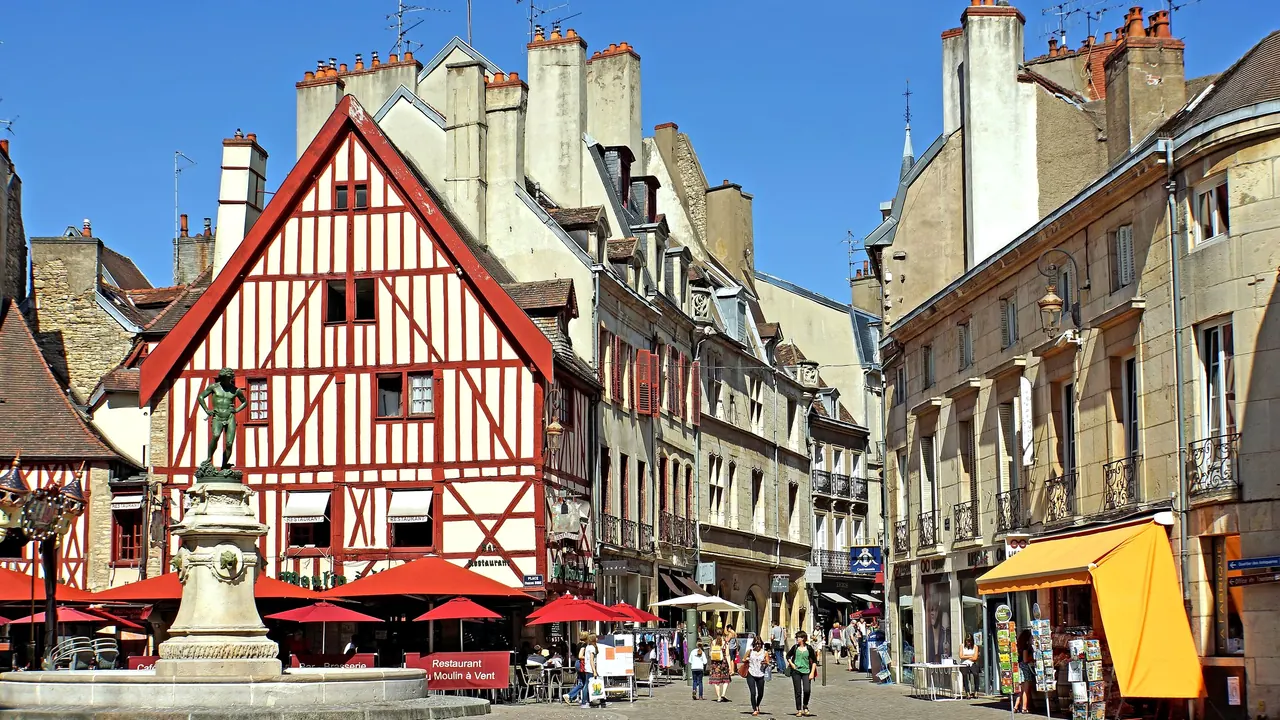
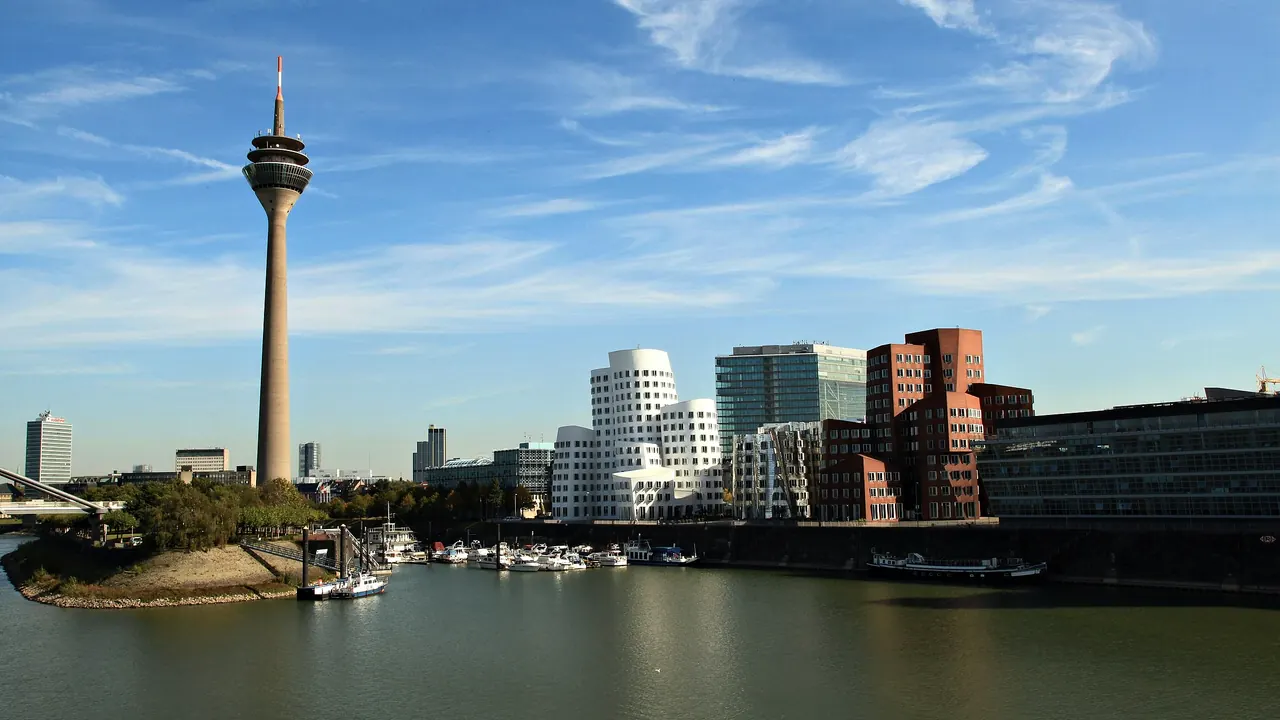
Photos: Dijon by Dennis G. Jarvis, CC BY-SA 2.0, cropped; Dusseldorf by Frank Vincentz, CC BY-SA 3.0, cropped.
Dijon or Dusseldorf?
Our verdict in twelve categories, each scored against the same fixed benchmark cities, and the climate month by month, so you can choose for your trip.
Choose Dijon for
- prices
- culture and sights
- food and drink
Dijon is the better choice when the trip is built around the table and the vineyard. The old capital of the dukes of Burgundy keeps an intact medieval and Renaissance centre you can cross on foot in minutes, Les Halles feeds the city's bistros, and the Route des Grands Crus starts at its southern edge. It costs a little less day to day, and its quiet evenings and long lunches suit couples and wine lovers who want a slow, well-fed few days.
Choose Dusseldorf for
- nightlife
- shopping
- families
Düsseldorf gives you a livelier, more urban stay. Its Altstadt brewhouses run on past midnight, the Königsallee and the department stores make it a real shopping city, and its opera, orchestra and theatre programme goes deeper. Families get more to do, and fast trains put Cologne, Bonn and Aachen within easy reach. The trade-off is a largely rebuilt old town and higher hotel bills.
Scoreboard
Twelve categories on one fixed scale from 0 to 100. The shaded stretch is the gap between the two.
Your match
Pick a travel style or drag the sliders, and both match scores follow your weighting.
Wins on prices and culture and sights with your weighting.
Wins on nightlife and shopping with your weighting.
What matters to you?
Category by category
What the scores mean for a trip.
Beaches & swimming
Neither city is a beach destination, and both send swimmers to a lake. Dijon has Lac Kir, a reservoir on its western edge with a supervised lawn-and-sand bathing area in summer.
Düsseldorf has Unterbacher See to the south-east and gravel-pit lakes around the region, because the inviting sandy banks of the Rhine are dangerous for swimming. The Dutch North Sea is a long day's journey away and cool even in July, while Dijon is several hours from any coast.
Food & drink
Dijon has the stronger claim on serious eaters. It sits at the head of Burgundy's kitchen, with boeuf bourguignon, jambon persillé, snails and gougères, its own mustard, pain d'épices and cassis, and Les Halles stocked with Bresse poultry and Époisses. Above all, the vineyards begin just south of town, so wine bars pour village Burgundies you rarely find by the glass anywhere else.
Düsseldorf offers two contrasting sides. One is the Altstadt brewhouse, with Altbier topped up until you cover your glass, sauerbraten and the Halve Hahn. The other is the Japanese quarter around Immermannstrasse, with ramen counters and izakaya. That gives it more variety than Dijon's strictly French regional table, but less depth.
Culture & sights
Dijon is the place for historic streets. The Palace of the Dukes houses the Musée des Beaux-Arts and the carved Valois tombs, and around it lies a web of half-timbered houses, Renaissance mansions and the gargoyled Notre-Dame with its lucky owl, all part of the UNESCO listing with the Burgundy vineyards. Add Sluter's Well of Moses at Champmol and you have two or three full days.
Düsseldorf's strength is modern art: Klee at K20, the net under K21's glass dome, the Kunstpalast, and the galleries that grew from its art academy. Wartime bombing left little old fabric, though, so its best historic sight is Benrath Palace, out in the suburbs.
Nightlife
Düsseldorf is far ahead here. The Altstadt crams a few hundred pubs and brewhouses between the Rhine and Heinrich-Heine-Allee, and on weekends the lanes become a street party well past midnight, stag groups included. Cocktail bars in Carlstadt and the Medienhafen offer something quieter, and Carnival takes over the whole city for days.
Dijon's evenings depend on its students. Rue Berbisey and the terraces around Place Émile Zola are good for wine, beer and a late dinner, but there are only a few clubs, and outside term time the streets are quiet by midnight.
Nature & outdoors
Both offer gentle country with no mountains, but the landscapes differ. Dijon has the more varied terrain close to town. The limestone combes to the west have trails and climbing cliffs, the canal towpath gives flat cycling, a signed route runs through the vineyards to Beaune, and the granite hills of the Morvan are about an hour and a half away.
Düsseldorf's outdoors centres on the river. Grassy Rhine meadows carry long cycle paths to Kaiserswerth, Grafenberg forest and the Neandertal give shaded walks, and the Bergisches Land hills begin within half an hour.
Day trips
Both make excellent bases for day trips, but for different kinds of outing. From Dijon you head into wine country and Cistercian heritage: Gevrey-Chambertin, Clos de Vougeot and walled Beaune to the south, Fontenay Abbey, Semur-en-Auxois and Alésia to the north-west. Most of the vineyards are easiest by car, bike or small tour.
From Düsseldorf you go city-hopping by train. Cologne cathedral is under half an hour away, with Bonn, the Brühl palaces, Zollverein, Aachen and Maastricht all on fast, frequent lines, and the Middle Rhine castles make a longer day.
Good for families
Düsseldorf gives children much more to do. The Aquazoo combines an aquarium with natural history, deer and wild boar come close in the Grafenberg game park, the Rhine meadows have playgrounds and river beaches, and Phantasialand and Movie Park are both within about an hour.
Dijon is safe, small and calm, with a planetarium at the Jardin de l'Arquebuse, the lawns of the Parc de la Colombière and paddling at Lac Kir. Beyond that, its tastings and fine-art museums are mostly for the adults.
Getting around
Both centres are compact and easy on foot, so the difference lies in their reach. In Dijon the station, Les Halles, the palace and the cathedral are minutes apart, two tram lines cover the outskirts, and regional trains run to Beaune. For wine villages away from the railway, though, you will need a car, a bike or a tour.
Düsseldorf adds trams, underground light rail and an airport just minutes from the centre by train. Its network is part of a regional system reaching Cologne and the Ruhr, so you can go a long way without a car, once you have worked out the fare zones.
Shopping & style
Düsseldorf is the clear choice for shoppers. The canal-lined Königsallee has luxury flagships, jewellers and arcades, Schadowstrasse and the Kö-Bogen cover the mainstream, and the trade-fair fashion business shows in its department stores. Flingern's design shops and the Japanese quarter's stationery and homeware add character.
In Dijon you mostly shop for things to eat and drink: mustards in dozens of flavours, crème de cassis, cellars of Burgundy and cheese around Les Halles. Rue de la Liberté has a department store and chains, but little for fashion.
Affordability
Dijon is easier on the budget. Hotel rooms are moderately priced for France, bistro set lunches are a fair way to eat well, and wine by the glass is cheaper than in most of the country. The bill climbs only once you add serious restaurants, cellar tastings and good bottles.
Düsseldorf's hotels are expensive for a city its size, and during the big trade fairs rooms become scarce and cost several times the usual rate. Brewhouse meals and Japanese noodle bars help, but overall it costs what a wealthy Western European city does.
Live music & performing arts
Düsseldorf has the deeper programme. The Deutsche Oper am Rhein stages opera and ballet by the Hofgarten, the symphony orchestra plays in the domed Tonhalle, and the Schauspielhaus is a leading theatre, though mainly for German speakers. As the birthplace of Kraftwerk, it also has a place in electronic music history, and its summer jazz festival fills the old town with stages.
Dijon's Opéra is good for a city its size, with the Grand Théâtre and the acoustically fine Auditorium. Its season follows the academic year, however, and thins to outdoor events in summer.
Wellness & relaxation
Düsseldorf has more for anyone who wants a proper soak. Saunas in public pools are part of local routine, mostly mixed and without swimwear, large thermal complexes lie within about an hour, and Aachen's hot springs are a little further. The Hofgarten and the Japanese garden in Nordpark add quiet walks.
Dijon has no bathing culture, and its spas amount to a few hotels, some offering grape-based treatments. Its rest comes from long lunches and slow afternoons among the vines.
When should you go?
Pick your month. The climate figures are measured averages, not a forecast.
Dijon in July
Dusseldorf in July
Daytime high, °C
Rainfall in the month, mm
Temperature and rainfall are climate normals, averaged over the years shown. Dijon: 1991-2020 normals, Dijon (7 km from centre). Dusseldorf: 1991-2020 normals, Düsseldorf (8.3 km from centre).
Both cities have cold, grey winters, with daytime highs around 6°C from December to February, so city walking then means short days and museum stops. Spring arrives at much the same pace in both, and May through September is the comfortable stretch for strolling and cycling. Dijon gets the warmer, brighter summer, with July highs near 27°C and far more sunshine than Düsseldorf, where July peaks around 25°C under cloudier skies. That makes Dijon better for long afternoons in the vineyards, and Düsseldorf more pleasant on a hot day.
Their wettest months fall at different times of year. In Dijon they are May and October to November, at around 77mm a month, so the early autumn harvest season is often drier than late autumn. In Düsseldorf the rain peaks in July and August, so bring a jacket even in high summer, while spring there tends to be a little drier.
Which traveller are you?
On a family trip with children, Düsseldorf is the easier pick. The Aquazoo, the Rheinturm's tilted windows, the free game park in Grafenberg forest and theme parks within about an hour give children far more than Dijon's planetarium and lakeside paddling.
For a shopping trip, choose Düsseldorf. The Königsallee has luxury flagships and jewellers, big department stores sit nearby, and Flingern and the Japanese quarter add design and homeware. Dijon's best buys are mustard, cassis and Burgundy, with little fashion beyond Rue de la Liberté.
For wine lovers, Dijon is the obvious base. The Côte de Nuits begins at the edge of town, so Gevrey-Chambertin, Vougeot and Beaune are an easy ride away, and the city's wine bars pour village Burgundies by the glass. Nothing near Düsseldorf compares.
Before you go
| Measure | Dijon | Dusseldorf |
|---|---|---|
| Official language | French | German |
| Currency | Euro (EUR) | Euro (EUR) |
| Sockets | CE230 V, 50 Hz | CF230 V, 50 Hz |
| Driving side | Right | Right |
| Time zone | UTC+1, UTC+2 in summer | UTC+1, UTC+2 in summer |
| Emergency number | 112 | 112 |
| Elevation | 220 m | 38 m |
| Main airport | Lyon Saint-Exupéry Airport (LYS)178 km from centre141 non-stop destinations | Düsseldorf Airport (DUS)7 km from centre182 non-stop destinations |
| Public holidays this year | 11 days | 11 days |
By the numbers
| Measure | Dijon | Dusseldorf |
|---|---|---|
| City population | 161,830 | 619,444 |
| People per km² | 3,890 | 2,849 |
| Museums within 10 km | 8 | 25 |
| UNESCO World Heritage sites within 50 km | 1 | 4 |
Where else could you go?
Every comparison below shares a destination with this one, so you can follow Dijon or Dusseldorf somewhere new.