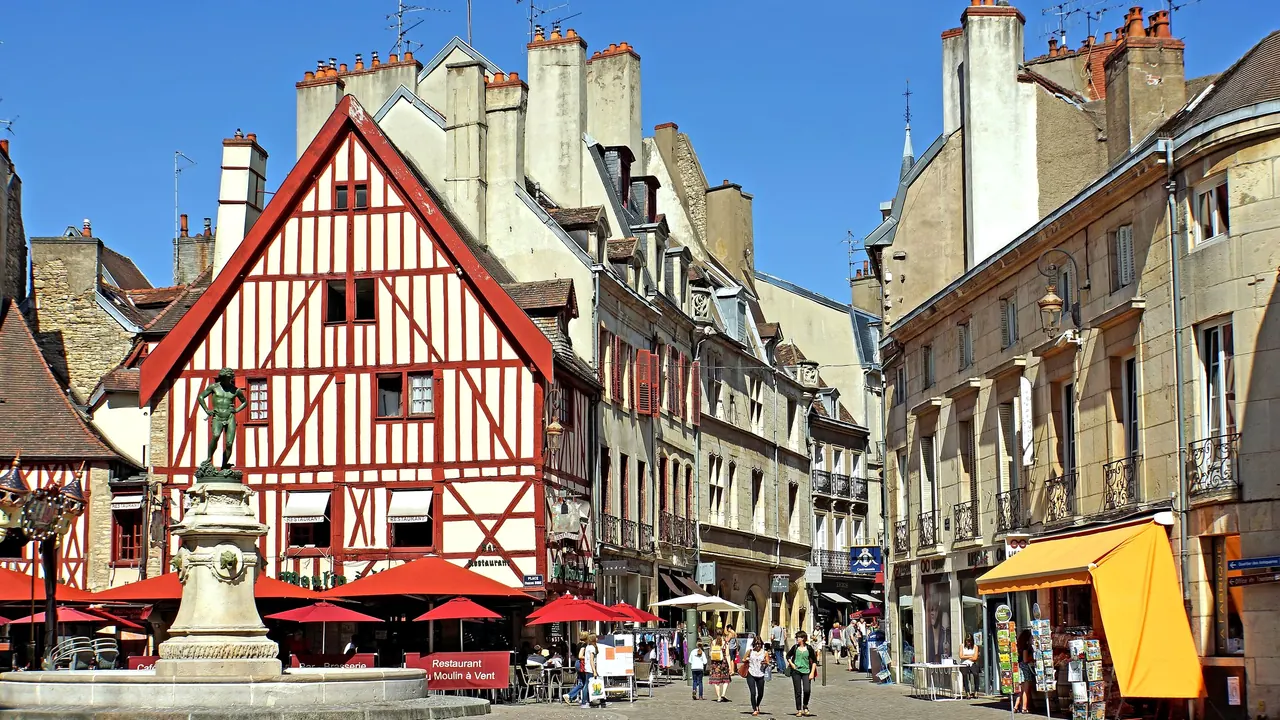
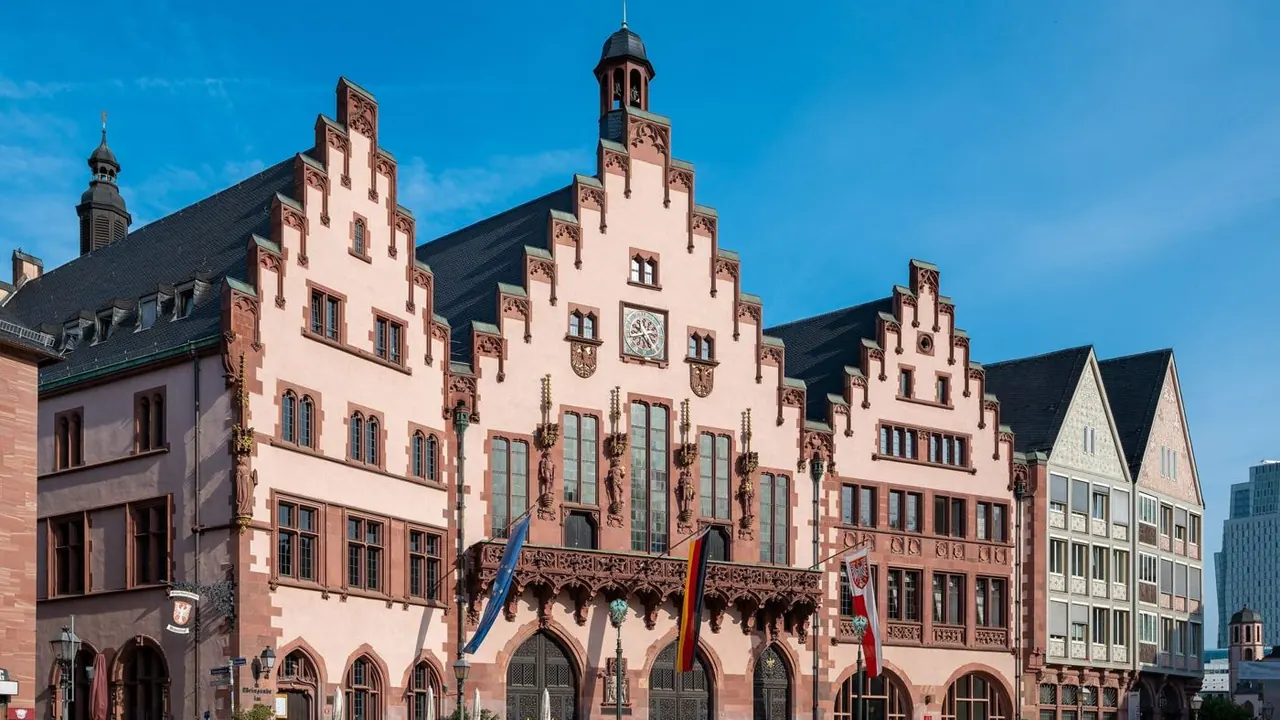
Photos: Dijon by Dennis G. Jarvis, CC BY-SA 2.0, cropped; Frankfurt by Thomas Wolf, CC BY-SA 3.0 DE, cropped.
Dijon or Frankfurt?
Our verdict in twelve categories, each scored against the same fixed benchmark cities, and the climate month by month, so you can choose for your trip.
Choose Dijon for
- food and drink
- prices
- culture and sights
Dijon is the choice when the trip is built around the table and the vine. Burgundian cooking, the market at Les Halles and wine bars that pour village Burgundies by the glass are all in a small, walkable medieval centre. The Route des Grands Crus starts at the edge of town. It is slower and quieter than Frankfurt and easier on the budget, which suits couples and food lovers more than anyone looking for late nights.
Choose Frankfurt for
- wellness
- live music and the arts
- families
Frankfurt suits travellers who want a bigger base with more going on. The opera and concert halls are stronger, the weekend clubs have real pedigree, there is more for children, and the trains reach Heidelberg, the Rhine Gorge and Cologne. The spa towns of the Taunus are close by. Hotels cost more, so it rewards people who plan their dates, and it works well for a mixed group whose members want different things.
Scoreboard
Twelve categories on one fixed scale from 0 to 100. The shaded stretch is the gap between the two.
Your match
Pick a travel style or drag the sliders, and both match scores follow your weighting.
Wins on food and drink and prices with your weighting.
Wins on wellness and live music and the arts with your weighting.
What matters to you?
Category by category
What the scores mean for a trip.
Beaches & swimming
Neither city has a coast, and both are hours from the sea, so swimming means a lake or a pool. The difference is in kind. Dijon's Lac Kir is a reservoir on the edge of town with a lawn-and-sand bathing area, supervised in summer and close enough for a spare afternoon. Frankfurt's gravel-pit lakes, such as the Langener Waldsee in the forest to the south, have sandy shores and feel more like a proper lake beach, but getting there takes more of a trip.
Food & drink
Dijon is clearly the better place to eat. It sits at the head of one of France's great food regions, so you get boeuf bourguignon, snails in garlic butter, gougères and the city's own mustard and cassis. Les Halles is stocked with Époisses and Bresse poultry, and the wine bars pour village Burgundies you seldom find by the glass anywhere else.
Frankfurt's own cooking is narrower. It means apple-wine taverns in Sachsenhausen, Grüne Soße and Handkäs at shared tables, plus the Kleinmarkthalle for regional produce. Where Frankfurt does better than Dijon is variety: good Turkish, Italian and Asian kitchens and cheap food from all over the world in the Bahnhofsviertel, none of which Dijon really offers.
Culture & sights
For sightseeing the two are broadly level, but they reward different kinds of visit. Dijon's history has survived in place. The Palace of the Dukes holds the Valois tombs with their carved mourners, and around it are half-timbered lanes, the gargoyles and lucky owl of Notre-Dame, and Sluter's Well of Moses. Walking the town is the main experience.
Frankfurt's strength is its galleries. The Museumsufer lines both banks of the Main, with the Städel as its star and the Senckenberg alongside. Its old town was largely rebuilt after 1944, so the Römer, the Paulskirche and Goethe's birthplace stand next to a skyline of towers. Choose Dijon for original streets and Frankfurt for days in museums.
Nightlife
Frankfurt has much more to offer after dark. Together with Offenbach it has a real place in techno and house history, and serious clubs still run at weekends. The Bahnhofsviertel has cocktail bars and late kiosks, Sachsenhausen has rowdier taverns and the Main banks fill with people on summer evenings.
In Dijon, a night out means student bars on Rue Berbisey, a glass of wine and a late dinner. Outside term time, the streets are quiet by around midnight.
Nature & outdoors
Both cities sit in gentle country rather than dramatic scenery, and Frankfurt has a slight edge. The Taunus forests and the Großer Feldberg at about 880m are under an hour away by S-Bahn and bus, the Stadtwald lies within the city, and the vineyard paths of the Rhine Gorge give the best views in the region.
Dijon's outdoors is more local: the wooded combes west of town with climbing cliffs, the flat Burgundy Canal towpath, and the Morvan further out. Its standout is the signed cycle route through the Côte de Nuits vineyards towards Beaune, which Frankfurt has nothing quite like.
Day trips
Both are fine bases for excursions, but Frankfurt's reach is wider. It sits at the centre of Germany's high-speed rail network, so Heidelberg, the castles of the Rhine Gorge, Cologne Cathedral and Würzburg's Residenz are all easy days by train, with Mainz, Wiesbaden, Worms and Speyer closer still.
Dijon's day trips centre on wine and Burgundian history: the Grands Crus villages, walled Beaune twenty minutes away by train, Fontenay Abbey and Semur-en-Auxois. For much of the wine country you will need a car, a bike or a tour.
Good for families
Frankfurt keeps children busier. The Senckenberg's dinosaur skeletons, the walkable zoo and the Palmengarten fill the city days, and a wildlife park and a fairy-tale amusement park in the Taunus make easy outings.
Dijon is safe and relaxed, with a pedestrian centre, the planetarium at the Jardin de l'Arquebuse, play areas in the Parc de la Colombière and paddling at Lac Kir. Beyond that there is little aimed at children, and the vineyards and art collections are really for adults.
Getting around
Both centres are compact enough to walk in a few minutes, and Frankfurt is slightly ahead because its network goes further. U-Bahn, S-Bahn and trams run as one system that covers the Taunus, Wiesbaden and Mainz, and the airport is about a quarter of an hour from the centre by train, although the zones take some learning.
Dijon is simpler: two tram lines, regional trains to Beaune and a TGV to Paris. The wine villages away from the railway, though, still need a car, a bike or a tour.
Shopping & style
Frankfurt is the better city for actual shopping. The Zeil has department stores and malls, Goethestraße has the luxury fashion and jewellery houses, and Berger Straße and Schweizer Straße have independent boutiques. On Saturdays there is a flea market by the river.
Dijon's strength is things to eat and drink: mustard in dozens of flavours, pain d'épices, cassis and Burgundy from the wine merchants. Rue de la Liberté adds little beyond chains.
Affordability
Dijon is the cheaper stay. Its hotels charge moderate regional-city rates, bistro set lunches are a good way to eat well, and wine by the glass costs less than in most of France. The bill mainly climbs on serious restaurants, cellar tastings and good bottles.
In Frankfurt, hotels are the problem. They are priced for business travellers and become very expensive and hard to find during the big trade fairs, while weekends and summer are often cheaper. Eating in cider taverns and Turkish grills costs little, and the Museumsufer pass helps.
Live music & performing arts
Frankfurt is clearly stronger on stage. Its opera company is among Germany's most respected and is known for adventurous productions. The Alte Oper hosts the radio symphony orchestra, the Schauspiel stages serious drama, Mousonturm presents contemporary dance, and jazz cellars keep up a post-war tradition.
Dijon does well for its size. The Opéra de Dijon performs in the old Grand Théâtre and the acoustically fine Auditorium, but there is much less choice night to night. In both cities the season thins out in summer.
Wellness & relaxation
Neither city has a bathing tradition of its own, but Frankfurt has spa towns within easy reach. Bad Homburg's thermal complex at the foot of the Taunus and Wiesbaden's Art Nouveau Kaiser-Friedrich-Therme make an easy day of taking the waters.
Dijon offers a few hotel spas, some with grape-based treatments. Its restfulness comes from the slow pace of long lunches, quiet squares and afternoons among the vines.
When should you go?
Pick your month. The climate figures are measured averages, not a forecast.
Dijon in July
Frankfurt in July
Daytime high, °C
Rainfall in the month, mm
Temperature and rainfall are climate normals, averaged over the years shown. Dijon: 1991-2020 normals, Dijon (7 km from centre). Frankfurt: 1991-2020 normals, Frankfurt Westend (2 km from centre).
Both cities are well inland and share a similar continental climate, so neither has a beach season. The most you get is a summer swim in a lake in July and August, when Dijon reaches about 27°C and Frankfurt 26°C. From late May to September it is warm and comfortable for walking old streets, vineyards and riverbanks, and both cities get their longest sunny days then. Winter is cold and grey in both, with highs near 6°C and very little sunshine, which suits museums and long lunches better than walks.
The main difference is rain. Dijon's wettest spells are May and then October to November, at around 77mm a month, so autumn trips to the vineyards there can be damp. Frankfurt is noticeably drier in spring, with April near 38mm, and its sunny days arrive sooner, which makes April a better month for Frankfurt than for Dijon. In high summer Dijon has slightly more sunshine.
Which traveller are you?
On a family trip with children, Dijon works for a calm weekend with toddlers, but its sights for children run out within a day or two. Frankfurt holds up better over a longer stay: pushchairs go easily on trams, scooters suit the river paths and larger theme parks lie further out.
For a relaxing and wellness trip, Dijon is restful in mood but offers little in the way of treatments. Frankfurt is better for anyone who wants saunas and warm thermal pools, because the old spa towns around it, such as Bad Nauheim and Bad Soden, are a short journey away.
On a tight budget, Dijon is the safer choice because its costs stay steady through the year, and many of its pleasures are free: wandering the old streets, a market picnic, a ride along the canal towpath. In Frankfurt, what you pay for a bed depends on whether your dates clash with a trade fair.
Before you go
| Measure | Dijon | Frankfurt |
|---|---|---|
| Official language | French | German |
| Currency | Euro (EUR) | Euro (EUR) |
| Sockets | CE230 V, 50 Hz | CF230 V, 50 Hz |
| Driving side | Right | Right |
| Time zone | UTC+1, UTC+2 in summer | UTC+1, UTC+2 in summer |
| Emergency number | 112 | 112 |
| Elevation | 220 m | 101 m |
| Main airport | Lyon Saint-Exupéry Airport (LYS)178 km from centre141 non-stop destinations | Frankfurt Main Airport (FRA)13 km from centre281 non-stop destinations |
| Public holidays this year | 11 days | 10 days |
By the numbers
| Measure | Dijon | Frankfurt |
|---|---|---|
| City population | 161,830 | 760,656 |
| People per km² | 3,890 | 3,063 |
| Museums within 10 km | 8 | 53 |
| UNESCO World Heritage sites within 50 km | 1 | 4 |
Where else could you go?
Every comparison below shares a destination with this one, so you can follow Dijon or Frankfurt somewhere new.