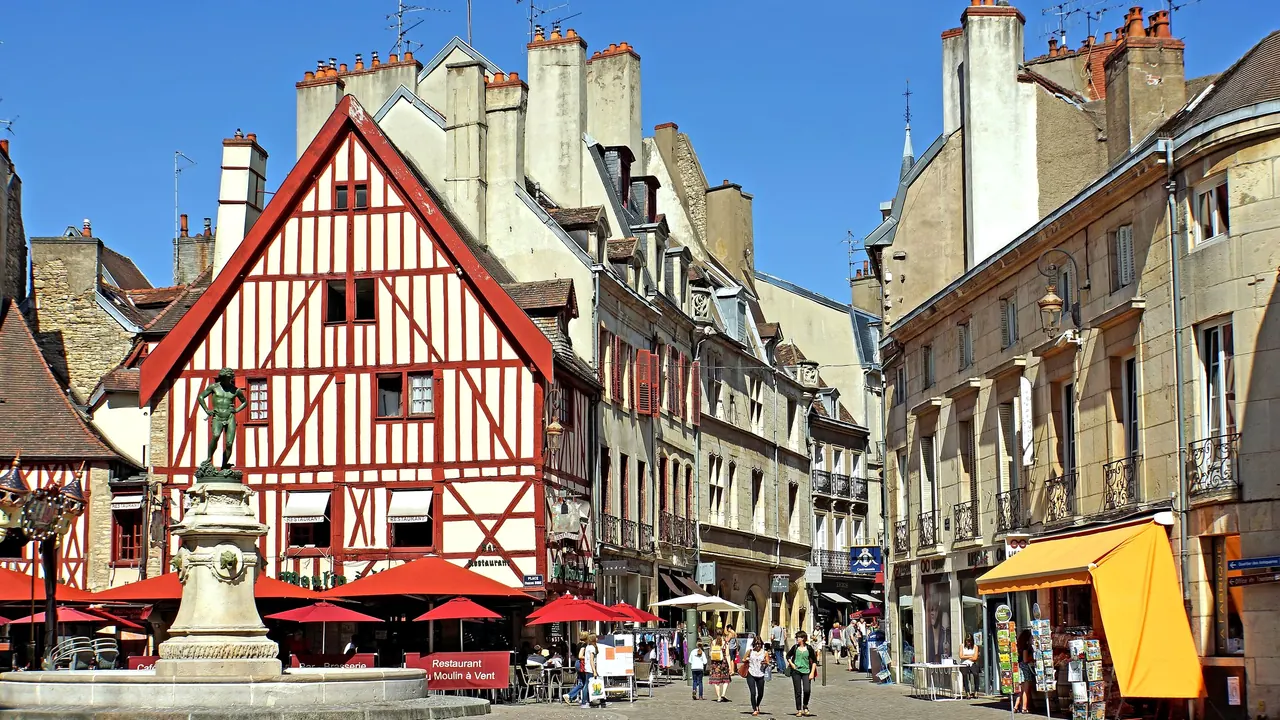
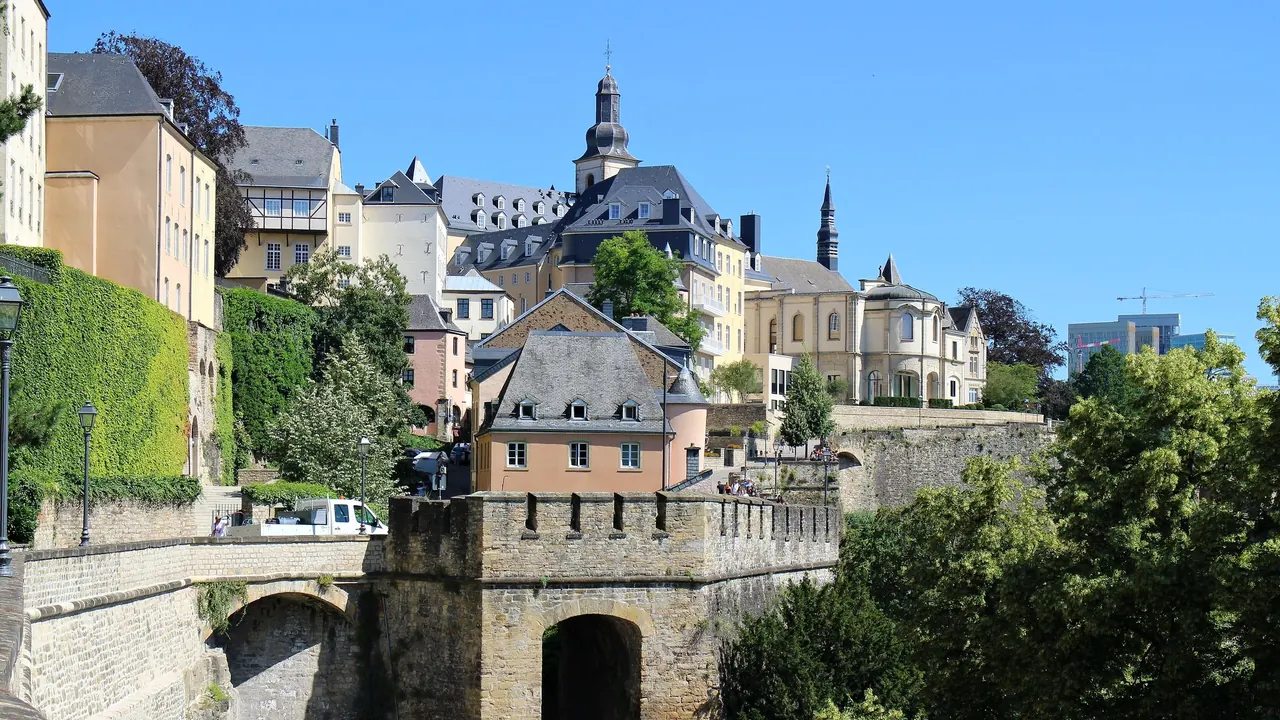
Photos: Dijon by Dennis G. Jarvis, CC BY-SA 2.0, cropped; Luxembourg by Suicasmo, CC BY-SA 4.0, cropped.
Dijon or Luxembourg?
Our verdict in twelve categories, each scored against the same fixed benchmark cities, and the climate month by month, so you can choose for your trip.
Choose Dijon for
- prices
- food and drink
- culture and sights
Dijon is the pick for travellers who plan their days around the table and the glass. It sits at the head of the Burgundy wine country, with Les Halles, village wines by the glass and the vineyard road to Beaune starting at the edge of town. It also costs a good deal less to stay and eat in, which matters on a longer trip. Its old centre of ducal palace, half-timbered lanes and gargoyled churches is a little richer to explore on foot.
Choose Luxembourg for
- wellness
- families
- getting around
Luxembourg makes more sense for a calm, easy few days in which the scenery and the logistics do much of the work. The fortress city above its gorges, free transport across the whole country, the sandstone gorges of the Müllerthal and the thermal baths at Mondorf give it the edge for walkers, families and anyone who wants to unwind. The catch is the bill, which runs far higher than in Dijon.
Scoreboard
Twelve categories on one fixed scale from 0 to 100. The shaded stretch is the gap between the two.
Your match
Pick a travel style or drag the sliders, and both match scores follow your weighting.
Too close to call, 1 point apart
Wins on prices and food and drink with your weighting.
Wins on wellness and families with your weighting.
What matters to you?
Category by category
What the scores mean for a trip.
Beaches & swimming
Neither city offers a real beach, and both rely on fresh water for a summer swim. The difference is distance: Dijon's Lac Kir sits on the edge of town and is easy for an afternoon by tram, while Luxembourg's better spots, the Upper Sûre reservoir and the Remerschen lakes, mean an outing of up to an hour but come with wooded shores and more space.
Food & drink
Dijon is the stronger food destination by some way. Boeuf bourguignon, jambon persillé, mustard, cassis and the stalls of Les Halles are the core of a visit, and the Côte de Nuits begins just south of the city, so the wine lists go deep into Burgundy.
Luxembourg eats well but more as a crossroads, with French fine dining, Belgian-style brasseries, Portuguese neighbourhood places and Moselle Riesling and crémant. Its own dishes are few, and casual eating is thinner and pricier than in Dijon.
Culture & sights
Dijon has a slight edge for sightseeing in the classic sense. The Palace of the Dukes, the Valois tombs in the Musée des Beaux-Arts, the owl on Notre-Dame and Sluter's Well of Moses fill a couple of days of old-town walking.
Luxembourg's appeal lies more in its setting than its interiors. The fortress, the Bock casemates and the view from the Chemin de la Corniche down to the Grund are the highlights, with MUDAM adding contemporary art on Kirchberg. Both are compact, two-day cities.
Nightlife
Evenings are equally modest in both, but they run on different rhythms. Dijon's nights belong to its students, with small bars along Rue Berbisey and terraces on Place Émile Zola, and they quieten outside term time. Luxembourg's crowd is young international professionals packed into the Rives de Clausen, the Grund's pubs and Hollerich, and its busy nights are Thursday and Friday rather than the weekend.
Nature & outdoors
Luxembourg has more to offer outdoors. Wooded gorges run right through the centre, the Müllerthal's mossy sandstone passages are half an hour away, and the Ardennes add steep hills and river loops further north.
Dijon's countryside is gentler: walking and climbing in the combes west of town, flat cycling on the Burgundy Canal towpath and the vineyard ride to Beaune. Its wildest scenery, the Morvan, needs a longer drive.
Day trips
Both cities make excellent bases, but they point in different directions. From Dijon the outings are mostly Burgundian: the Grands Crus villages, Beaune's Hospices, Fontenay Abbey and Semur-en-Auxois, much of it easiest by car or bike. Luxembourg looks across borders, with Roman Trier and Gothic Metz each under an hour by train, plus castles at Vianden and the Moselle wine villages, nearly all reachable without a car.
Good for families
Luxembourg suits children a little better, mainly because the fortress turns sightseeing into an adventure. Tunnels in the rock, ramparts and lifts down to the river keep younger visitors interested, and the Parc Merveilleux and the Müllerthal passages give extra days out.
Dijon is safe and relaxed, with a planetarium at the Jardin de l'Arquebuse and paddling at Lac Kir. Beyond that, its vineyards and fine-art museums are aimed squarely at the parents.
Getting around
Both centres are easy to walk, but Luxembourg is simpler overall because trams, buses and trains are free across the whole country, so even Vianden and Clervaux are a ticketless ride away. Its city is built on several levels, though, and you will use lifts and a funicular. Dijon is flat and compact, with trams and a quick train to Beaune, but the wine villages off the railway need a car, a bike or a tour.
Shopping & style
Neither is a serious shopping destination, and what each does well is quite different. Dijon is for edible souvenirs: mustard in dozens of flavours, pain d'épices, cassis and Burgundy from the cellars around Les Halles. Luxembourg's Grand-Rue leans towards luxury and premium fashion brands for a wealthy local crowd, with Villeroy & Boch porcelain and Moselle crémant as the local things to take home.
Affordability
Dijon costs much less. It is priced like a French regional city, with moderate hotels and good-value bistro lunches, and the main expense is wine tastings and fine dining if you choose them.
Luxembourg is one of the dearer stops in Western Europe, with hotels set for business travel and eating out well above the norm. Free transport and some free museums help, and some visitors sleep in Trier or Metz to keep costs down.
Live music & performing arts
Luxembourg has the slightly fuller stage. The Philharmonie on Kirchberg draws touring orchestras and soloists, and the Grand Théâtre and the Rotondes add opera, dance and concerts, mostly brought in from elsewhere. Dijon's programme is smaller but genuinely local: the Opéra de Dijon fills the old Grand Théâtre and the acoustically fine Auditorium, though it follows the academic year and thins out in summer.
Wellness & relaxation
For a restorative break, Luxembourg is clearly better placed. Mondorf-les-Bains, a thermal spa with mineral-spring pools in parkland, is half an hour away, and the quiet river walks of the Pétrusse valley suit an unhurried stay.
Dijon has no spa culture to speak of beyond a few hotels and vineyard treatments. Its relaxation comes from long lunches and slow afternoons among the vines.
When should you go?
Pick your month. The climate figures are measured averages, not a forecast.
Dijon in July
Luxembourg in July
Daytime high, °C
Rainfall in the month, mm
Temperature and rainfall are climate normals, averaged over the years shown. Dijon: 1991-2020 normals, Dijon (7 km from centre). Luxembourg: 1991-2020 normals, Luxembourg / Luxembourg (6.3 km from centre).
The two share a similar inland climate, so the best months are much the same: late spring to early autumn, when the days are long and sunny and the streets are pleasant to walk. Dijon runs a few degrees warmer all year, reaching about 27°C in July against Luxembourg's 24°C, so a high-summer afternoon in Burgundy can feel properly hot, while Luxembourg stays mild. Neither is a beach destination, but high summer is the only time warm enough for a lake swim in either place.
Winter is grey and cold in both, with highs around 4°C to 6°C and short, dull days. Dijon's rain comes mainly in May and again in October and November, when Luxembourg is about as wet. Dijon then stays fairly dry from late winter into spring. Luxembourg is clearly the wetter of the two from December to March, with December its dampest month at 89mm, so a midwinter city break there is more likely to be spent under an umbrella. September is a good choice in both: still warm, fairly dry, and harvest time in the Burgundy and Moselle vineyards.
Which traveller are you?
On a trip on a tight budget, Dijon is far easier on the wallet. Hotels are moderate, bistro set lunches are fair, the centre is walkable, and Beaune is a short, cheap train ride away, while Luxembourg's hotels and restaurants are priced for business travellers.
For a food and nightlife trip, Dijon wins on the food side, with Burgundian classics, Les Halles, Époisses and village wines poured by the glass. Evenings are similarly low-key in both cities, so the real draw is long dinners rather than late clubs.
On a relaxing and wellness trip, Luxembourg is the better base. The thermal baths at Mondorf-les-Bains are half an hour away, the river walks through the Grund are calm, and the city goes quiet at weekends, while Dijon offers only a few hotel spas.
Before you go
| Measure | Dijon | Luxembourg |
|---|---|---|
| Official language | French | French, German, Luxembourgish |
| Currency | Euro (EUR) | Euro (EUR) |
| Sockets | CE230 V, 50 Hz | CF230 V, 50 Hz |
| Driving side | Right | Right |
| Time zone | UTC+1, UTC+2 in summer | UTC+1, UTC+2 in summer |
| Emergency number | 112 | 112 |
| Elevation | 220 m | 300 m |
| Main airport | Lyon Saint-Exupéry Airport (LYS)178 km from centre141 non-stop destinations | Luxembourg-Findel International Airport (LUX)6 km from centre115 non-stop destinations |
| Public holidays this year | 11 days | 12 days |
By the numbers
| Measure | Dijon | Luxembourg |
|---|---|---|
| City population | 161,830 | 137,678 |
| People per km² | 3,890 | 2,663 |
| Museums within 10 km | 8 | 19 |
| UNESCO World Heritage sites within 50 km | 1 | 4 |
Where else could you go?
Every comparison below shares a destination with this one, so you can follow Dijon or Luxembourg somewhere new.
- Maastrichtvs Luxembourg
- Lausannevs Dijon
- Genevavs Dijon
- Colognevs Luxembourg
- Strasbourgvs Luxembourg
- Lyonvs Dijon