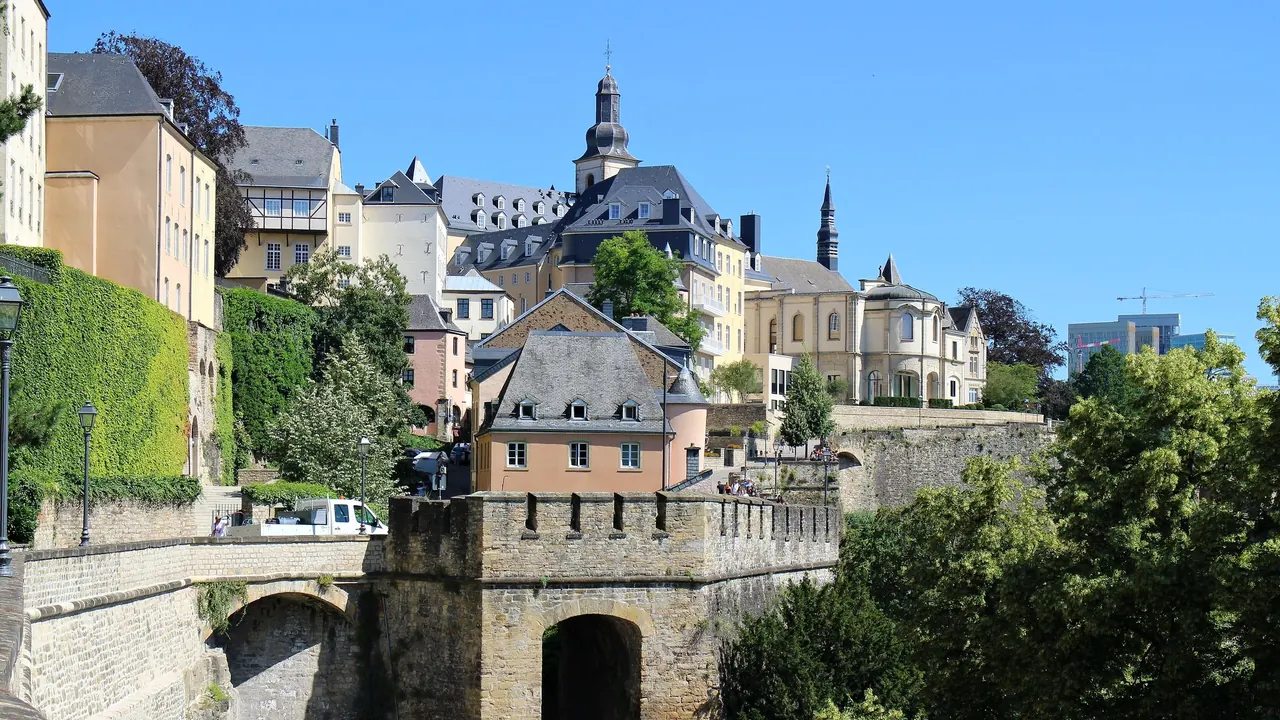
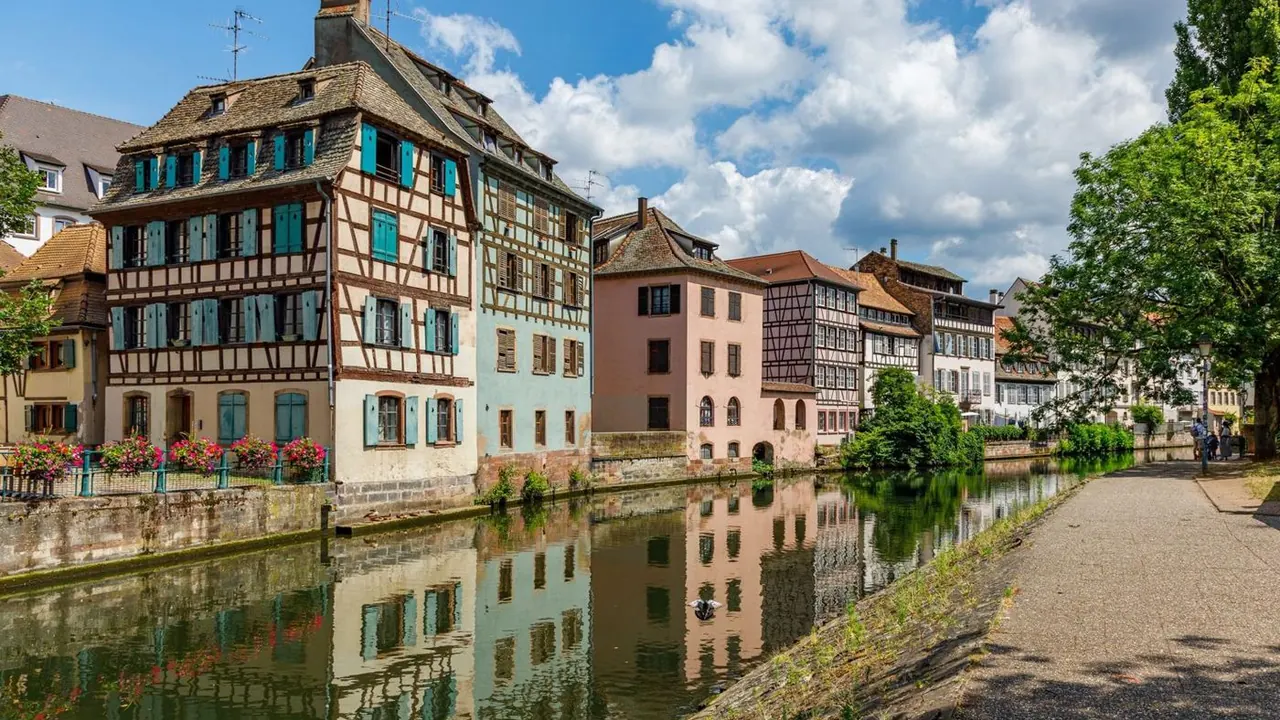
Photos: Luxembourg by Suicasmo, CC BY-SA 4.0, cropped; Strasbourg by Edoardo Colombo, Pexels License.
Luxembourg or Strasbourg?
Our verdict in twelve categories, each scored against the same fixed benchmark cities, and the climate month by month, so you can choose for your trip.
Choose Luxembourg for
- beaches
- getting around
Luxembourg suits a calm, well-heeled weekend built around a dramatic setting. The fortress city on its cliffs, with casemate tunnels and the Grund far below, can be seen in two days. Free trams, buses and trains make it easy to add Trier, Metz or the Müllerthal gorges. It is a place for travellers who want quiet evenings, a glass of Moselle crémant and a serious dinner, and who don't mind paying well for them.
Choose Strasbourg for
- prices
- food and drink
- families
Strasbourg is the better all-round trip, and the clear pick on a budget. It has a richer old town and more museums, a regional kitchen of its own in the winstubs, and more for children, including a science centre in town and Europa-Park within reach. The Alsace wine route and the Black Forest give it the same easy reach as Luxembourg, and the bills are noticeably lighter.
Scoreboard
Twelve categories on one fixed scale from 0 to 100. The shaded stretch is the gap between the two.
Your match
Pick a travel style or drag the sliders, and both match scores follow your weighting.
Wins on beaches and getting around with your weighting.
Wins on prices and food and drink with your weighting.
What matters to you?
Category by category
What the scores mean for a trip.
Beaches & swimming
Neither city has a beach, so in both a swim means a lake on a hot summer afternoon. Strasbourg's gravel-pit lakes, the Baggersee above all, are on the city's edge, a tram ride away, and lifeguarded in July and August.
Luxembourg's best swimming takes more effort. The wooded reservoir of the Upper Sûre is about an hour north, though it is the more scenic setting. The Remerschen pits in the Moselle valley are the easier option.
Food & drink
Strasbourg has the stronger table because it has a cuisine of its own. Choucroute, baeckeoffe and tarte flambée are served in wood-panelled winstubs with Alsace Riesling, and there are markets for Munster and charcuterie. Its weak spot is the run of tourist menus around the cathedral.
Luxembourg eats mostly borrowed food: French in the smart restaurants, Portuguese and Italian in the neighbourhood places, and only a handful of local dishes. Its strengths are an unusually serious fine-dining tier and Moselle crémant poured everywhere. Casual, cheap eating is harder to find than in Strasbourg.
Culture & sights
Luxembourg's draw is its setting. The UNESCO-listed fortress wraps a plateau above two gorges, you can walk through the Bock casemates, and the Corniche looks down on the Grund. The museums, such as MUDAM and the national history and art museum, are good but few.
Strasbourg has more to see. The pink cathedral with its astronomical clock, the timber-framed Grande Ile and Petite France, and the German-built Neustadt make a larger historic ensemble. Behind them stand the three museums of the Palais Rohan and the Oeuvre Notre-Dame. Allow an extra unhurried day compared with Luxembourg.
Nightlife
Evenings end early in both cities, but Strasbourg's large student population gives it a bit more life. The Krutenau and the streets around Place Saint-Étienne are full of beer cellars and student bars, and in summer the riverside terraces stay busy.
Luxembourg's going out is smaller and depends more on the working week. Its international office crowd fills the Rives de Clausen and the Grund pubs on Thursdays and Fridays, then many of them leave for the weekend. Neither city suits anyone after serious clubbing.
Nature & outdoors
Both put good walking within an hour, though the landscapes differ. Luxembourg has wooded gorges running through the city centre and the mossy rock passages of the Müllerthal half an hour away. The Ardennes hills further north are reachable by free train.
Strasbourg itself is flat and best seen by bike along the Rhine and the canals. The bigger country lies around it: the Vosges ridges and castle ruins to the west and the higher fir forests of the Black Forest to the east. A car helps more here than in Luxembourg.
Day trips
Both are excellent bases, and Nancy is within reach of each. Luxembourg's strength is crossing borders. Roman Trier and Metz's Gothic cathedral are each under an hour by train, and at home there are Vianden castle and the Moselle villages.
Strasbourg pairs a wine region with a second country. Colmar and the villages of the Alsace wine route lie to the south, while Baden-Baden, Freiburg and Heidelberg are across the Rhine. Expect to need a bike or car for the vineyards.
Good for families
Strasbourg is the better choice with children. It has a flat, mostly car-free centre and boat trips through Petite France, and the Orangerie has storks, playgrounds and rowing boats. Le Vaisseau science centre is built for children, and Europa-Park makes a day out that families plan whole trips around.
Luxembourg is safe and calm, and the casemate tunnels feel like an adventure, but there is little else made for children. The Parc Merveilleux and the castles help, though with no zoo or theme park it is best kept to a few days.
Getting around
Both are easy without a car, in different ways. Luxembourg's trams, buses and trains are free across the whole country, which takes the cost and thought out of day trips. Its hilly layout is handled by public lifts and a funicular.
Strasbourg is flat. Its island centre can be crossed on foot in twenty minutes, and the dense network of cycle lanes makes a bike the natural way about. A tram line even runs over the Rhine to Kehl.
Shopping & style
Strasbourg is more rewarding for browsing. The lanes by the cathedral have independent delicatessens and bookshops, and its regional goods include Soufflenheim pottery, printed linens and kougelhopf moulds. In December the Christmas market adds crafts, though not all of them are handmade.
Luxembourg's Grand-Rue is the place for luxury and premium fashion, which Strasbourg largely lacks. Beyond that and the Villeroy & Boch outlet there is little independent or local to find, apart from bottles of Moselle crémant.
Affordability
Strasbourg is far kinder to the wallet. Meals cost what they would in a French regional city, many of the main sights are free, and the one real expense is hotels during the Christmas market and Parliament weeks.
In Luxembourg, rooms and restaurants are priced for business travellers and the EU institutions. Free transport, free museums and set lunches help, and some visitors sleep in Trier or Metz and come in by train.
Live music & performing arts
The two arts calendars are close in strength but different in kind. Luxembourg's highlight is the Philharmonie on Kirchberg, with its fine acoustics. Most of what plays there and at the Grand Théâtre has toured in from elsewhere.
Strasbourg has its own institutions. The Opéra national du Rhin, the Théâtre National de Strasbourg and the autumn Musica festival of contemporary music give its season a character of its own.
Wellness & relaxation
Both cities rely on a nearby spa town. For Luxembourg it is Mondorf-les-Bains, half an hour away, where thermal pools sit in a landscaped park. Strasbourg is under an hour from Baden-Baden's Friedrichsbad and Caracalla baths, the grander tradition of the two.
Strasbourg also has the tiled Bains municipaux in town. Luxembourg's advantage is its quiet, especially at weekends, when the river walks through the Grund feel almost empty.
When should you go?
Pick your month. The climate figures are measured averages, not a forecast.
Luxembourg in July
Strasbourg in July
Daytime high, °C
Rainfall in the month, mm
Temperature and rainfall are climate normals, averaged over the years shown. Luxembourg: 1991-2020 normals, Luxembourg / Luxembourg (6.3 km from centre). Strasbourg: 1991-2020 normals, Strasbourg (9.1 km from centre).
Both cities follow the same pattern: grey, cold winters and warm, pleasant summers that make walking easy from May to September. Strasbourg is a little warmer all year and reaches 26°C in July and August, against about 24°C in Luxembourg. July and August are the only months when the lakes around either city are warm enough for a swim. Neither gets hot enough to make sightseeing uncomfortable.
Their rainfall differs more. Strasbourg's winters and early springs are fairly dry, and most of its rain comes from May through the summer. Luxembourg is damp in every month, and wettest in December at 89mm. Luxembourg gets slightly more summer sunshine, with about 258 hours in July. Strasbourg is the better choice for a dry, crisp winter trip, while late spring and early autumn suit both.
Which traveller are you?
On a trip on a tight budget, Luxembourg is a strain, since free transport saves little when beds and dinners cost this much. Strasbourg is the sensible pick, with filling regional cooking and rooms that cost far less outside its busiest weeks.
On a family trip with children, Luxembourg is fine for a quiet couple of days but soon runs short of things built for the young. Strasbourg can keep a family busy for a full week, with attractions both in town and across the border.
For a short city break, Luxembourg is the neater fit. Its dramatic setting gives a weekend a clear focus, the main sights fit into two days and the evenings are calm. Strasbourg's larger old town and museums repay a longer stay.
Before you go
| Measure | Luxembourg | Strasbourg |
|---|---|---|
| Official language | French, German, Luxembourgish | French |
| Currency | Euro (EUR) | Euro (EUR) |
| Sockets | CF230 V, 50 Hz | CE230 V, 50 Hz |
| Driving side | Right | Right |
| Time zone | UTC+1, UTC+2 in summer | UTC+1, UTC+2 in summer |
| Emergency number | 112 | 112 |
| Elevation | 300 m | 132 m |
| Main airport | Luxembourg-Findel International Airport (LUX)6 km from centre115 non-stop destinations | Strasbourg Airport (SXB)10 km from centre43 non-stop destinations |
| Public holidays this year | 12 days | 11 days |
By the numbers
| Measure | Luxembourg | Strasbourg |
|---|---|---|
| City population | 137,678 | 293,771 |
| People per km² | 2,663 | 3,752 |
| Museums within 10 km | 19 | 21 |
| UNESCO World Heritage sites within 50 km | 4 | 3 |
Where else could you go?
Every comparison below shares a destination with this one, so you can follow Luxembourg or Strasbourg somewhere new.
- Baden-Badenvs Strasbourg
- Colmarvs Strasbourg
- Freiburgvs Strasbourg
- Stuttgartvs Strasbourg
- Baselvs Strasbourg
- Heidelbergvs Strasbourg