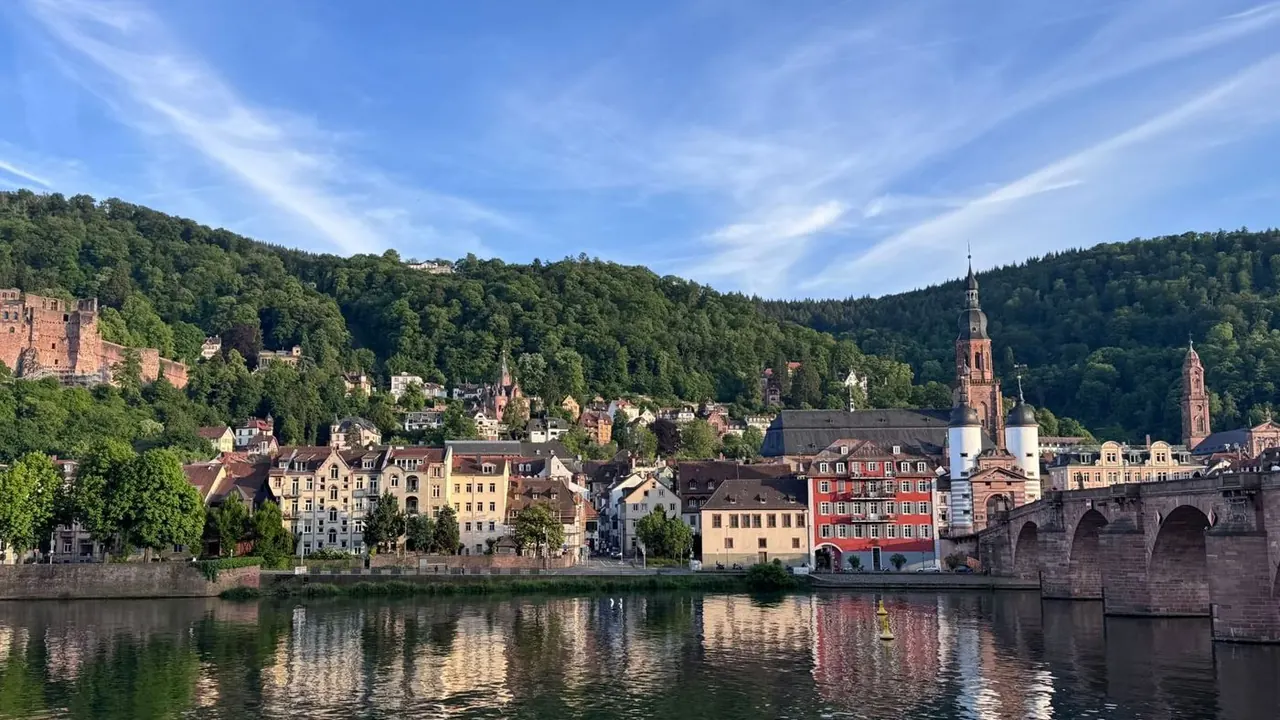
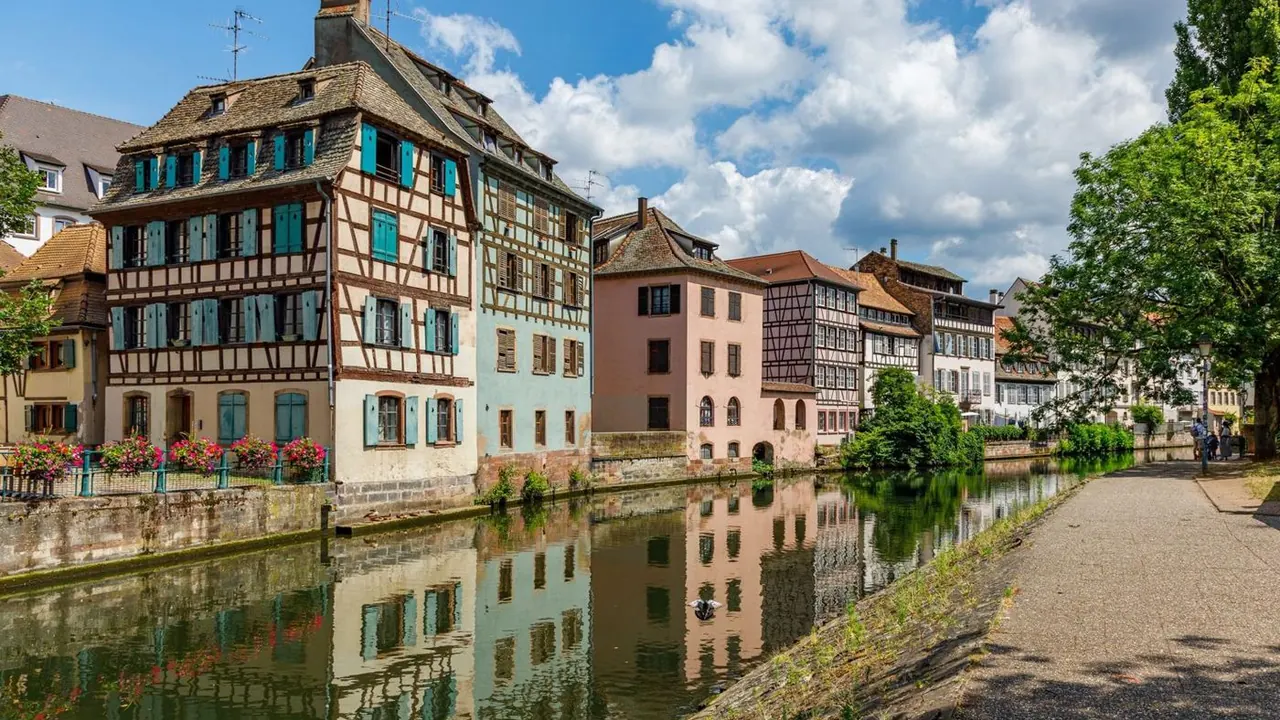
Photos: Heidelberg by Kuanling Chen, Pexels License; Strasbourg by Edoardo Colombo, Pexels License.
Heidelberg or Strasbourg?
Our verdict in twelve categories, each scored against the same fixed benchmark cities, and the climate month by month, so you can choose for your trip.
Choose Heidelberg for
Heidelberg does not lead in any category we score.
Heidelberg suits a traveller who wants a compact, romantic old town with the forest on its doorstep. The castle ruin, the university quarter and the Old Bridge fit into a day or two, the Königstuhl and the Philosophers' Walk start almost from the Altstadt, and the evenings in student taverns and Bergstrasse wine taverns are easy. It works best as a short break, or as a base for the cathedrals and river towns of the Upper Rhine.
Choose Strasbourg for
- food and drink
- culture and sights
- shopping
Strasbourg is the richer choice for anyone who wants more to eat, see and hear. The winstub cooking and Alsace wines are a reason to go in themselves, the cathedral, Petite France and the Palais Rohan museums fill two or three days, and the opera, theatre and festival calendar is more serious. A flat, car-free centre with trams and cycle lanes makes it the easier city to settle into for a longer stay.
Scoreboard
Twelve categories on one fixed scale from 0 to 100. The shaded stretch is the gap between the two.
Your match
Pick a travel style or drag the sliders, and both match scores follow your weighting.
Has no clear advantage with the weighting you have chosen.
Wins on food and drink and culture and sights with your weighting.
What matters to you?
Category by category
What the scores mean for a trip.
Beaches & swimming
Neither city is a place to swim in the sea. Each has only freshwater gravel-pit lakes for hot days. In Heidelberg they are scattered across the Rhine plain about half an hour out, and the town's outdoor pools are the closer option. Strasbourg's lakes are a little easier to get to: the Baggersee is on the tram line, and several lakes have lifeguards in July and August.
Food & drink
Both cities serve hearty Rhineland cooking with good white wine, but Strasbourg is clearly the better place to eat. Alsace gives it choucroute, baeckeoffe, foie gras and the winstub as a ready-made setting for a long meal, and it has a real fine-dining tier in the city and the nearby villages. Its covered market, cheese and charcuterie make it a place worth eating your way through.
Heidelberg's strength is wine more than cooking. Bergstrasse and Palatinate Rieslings, white asparagus in spring and Schäufele make good meals, but the best ones are in Neuenheim, the side streets and the village taverns, not on the Hauptstrasse. In both towns the tourist streets right beside the main sights are the places to avoid.
Culture & sights
Heidelberg's appeal is one famous view: the red castle ruin above a baroque old town, with the oldest university in Germany and its graffiti-covered Student Prison adding character. It is photogenic and compact, but once you have seen the castle, the Old University and the Kurpfälzisches Museum, you have seen most of it.
Strasbourg has more, and on a grander scale. Its cathedral is one of the great Gothic buildings of Europe. Petite France and the German-built Neustadt show two different faces of the city, and the Palais Rohan, the Oeuvre Notre-Dame and the modern art museum give it a museum life Heidelberg cannot match. The European institutions add a present-day political side as well.
Nightlife
Evenings are much alike in both cities, shaped by students and quiet by midnight on weeknights. Heidelberg's going out is concentrated in the Untere Strasse, where small pubs and old fraternity taverns fill up in term time. Strasbourg's is spread across the Krutenau and Place Saint-Étienne, and in summer the riverside terraces make it more of an outdoor evening. In both, a proper club night means going somewhere else.
Nature & outdoors
The two cities are about equal for the outdoors, but in different ways. In Heidelberg the woods start at the edge of the old town. The Philosophers' Walk, the Königstuhl and the Celtic ramparts on the Heiligenberg can all be reached on foot or by funicular, with no transport needed.
Strasbourg is flat, so its own green space is parkland and Rhine riverside forest, best explored by bike. The bigger outdoors lies about an hour away on either side: the Vosges with their castle ruins and Mont Sainte-Odile, and the higher ridges of the Black Forest. Both are easiest to reach by car.
Day trips
Both cities are excellent bases, and each appears on the other's list of outings, though as a long day out. From Heidelberg the trips are about imperial and monastic history: Speyer's Romanesque cathedral, Worms, Lorsch and Maulbronn, the castles along the Neckar, and the Palatinate Wine Route. The shared regional fare system makes most of them easy without a car.
Strasbourg's trips centre on Alsace: Colmar and the Isenheim Altarpiece, the wine villages of Riquewihr and Eguisheim, and Haut-Koenigsbourg on its ridge. Across the Rhine are Baden-Baden and Freiburg, with Basel further south. Trains cover the cities, but the wine villages are much easier with a car or a bike.
Good for families
Both cities are easy with children, and each has a large theme park within about an hour. Heidelberg's best family outings involve the hill: the funicular up to the Königstuhl and its small fairy-tale park, plus the zoo and the climb-aboard aircraft of the Technik Museum Speyer. The cobbled, sloping Altstadt is hard work with a pushchair.
Strasbourg's flat, mostly car-free centre is gentler on small legs and wheels. Canal boat trips, the storks and rowing boats in the Orangerie, and the Le Vaisseau science centre fill the days, and Europa-Park is the big outing.
Getting around
Strasbourg is the easier city to get around. Its old town island takes about twenty minutes to cross on foot, trams link it directly to the station and the outskirts, one line even runs into Germany, and separated cycle lanes make a bike the quickest way about.
Heidelberg works well enough, but its station is some way west of the long, narrow Altstadt, so most visitors arrive by tram or bus. The streets around the castle are cobbled and steep. Where it does well is the regional network beyond the town, with one fare covering trips across the Rhine-Neckar area.
Shopping & style
Strasbourg is the more rewarding place to shop, mostly for regional crafts and food: Soufflenheim pottery, printed linens, kougelhopf moulds, gingerbread and foie gras, plus delicatessens and independent shops in the lanes by the cathedral.
Heidelberg's shopping runs along a single long pedestrian street, with chains at one end and steins, cuckoo clocks and Studentenkuss chocolates at the other. A bottle of Bergstrasse wine is the most worthwhile thing to take home. Neither city has much in the way of fashion or luxury.
Affordability
Costs are much the same in both cities, and in both hotels are the main expense. Heidelberg has a small stock of rooms, so many visitors stay in Mannheim and come in by train. In Strasbourg the thing to plan around is timing, because rooms get much more expensive during the Christmas market and the weeks when the European Parliament sits. Eating is reasonable in both, through student cafés in one and winstub plates with a pichet of wine in the other.
Live music & performing arts
Strasbourg has the stronger arts life. The Opéra national du Rhin, the Théâtre National de Strasbourg and the Musica festival of contemporary music give it a national reputation, and jazz and experimental theatre broaden the programme.
Heidelberg does well for a town its size. Its municipal theatre and orchestra, the Heidelberger Frühling chamber festival and frequent church concerts give it a steady programme. The summer castle festival, with performances in the ruined courtyard, has no equivalent in Strasbourg, and Mannheim's larger opera house is about twenty minutes away by train.
Wellness & relaxation
Strasbourg has the edge for a relaxing stay. Its early twentieth-century Bains municipaux give it a tiled bathhouse with a hammam right in town, and the great baths of Baden-Baden are less than an hour away.
Heidelberg has no baths of its own beyond hotel spas, so a proper soak means a trip to the Kraichgau thermal complexes or a longer journey to Baden-Baden. For unwinding, it relies on evenings on the Neuenheim meadows and the forest paths above the Philosophers' Walk.
When should you go?
Pick your month. The climate figures are measured averages, not a forecast.
Heidelberg in July
Strasbourg in July
Daytime high, °C
Rainfall in the month, mm
Temperature and rainfall are climate normals, averaged over the years shown. Heidelberg: 1991-2020 normals, Heidelberg (4.5 km from centre). Strasbourg: 1991-2020 normals, Strasbourg (9.1 km from centre).
The two cities share almost the same climate, as you would expect of neighbours on the Rhine plain. Daytime highs climb from about 5°C in January to 26°C in July and August, and May to September is the comfortable season for walking the old towns, with the most sunshine from May to August. Only July and August are reliably warm enough for an afternoon at the gravel-pit lakes. From November to February the days are cold, grey and short, so this is the season for indoor sights and taverns rather than hills and riverbanks.
The main difference is rain. Heidelberg is wetter in summer, peaking at around 80mm in July. Strasbourg's wettest month is May at about 77mm, and its winters and early spring are noticeably drier, with only about 35mm in January. That gives Strasbourg a slight edge for a winter or March visit. September is a good month in both: still warm, drier than midsummer, and fine for walking among the vineyards.
Which traveller are you?
On a culture and arts trip, Strasbourg is the better choice. The cathedral with its astronomical clock, the UNESCO-listed Grande Ile and Neustadt, and several major museums give more depth than Heidelberg's castle and university, and the opera and national theatre add evenings to match.
For a food and nightlife trip, Strasbourg also wins, mainly at the table. Its winstubs, foie gras, covered market and fine dining go further than Heidelberg's hearty Baden cooking. After dinner the two are similar: student bars and riverside terraces rather than big club nights.
For a short city break, Heidelberg makes more sense. The castle, the Altstadt and the Old Bridge sit in one walkable strip that you can see in a day or two, and the funicular and the Philosophers' Walk give a weekend its views without any planning.
Before you go
| Measure | Heidelberg | Strasbourg |
|---|---|---|
| Official language | German | French |
| Currency | Euro (EUR) | Euro (EUR) |
| Sockets | CF230 V, 50 Hz | CE230 V, 50 Hz |
| Driving side | Right | Right |
| Time zone | UTC+1, UTC+2 in summer | UTC+1, UTC+2 in summer |
| Emergency number | 112 | 112 |
| Elevation | 114 m | 132 m |
| Main airport | Frankfurt Main Airport (FRA)69 km from centre281 non-stop destinations | Strasbourg Airport (SXB)10 km from centre43 non-stop destinations |
| Public holidays this year | 12 days | 11 days |
By the numbers
| Measure | Heidelberg | Strasbourg |
|---|---|---|
| City population | 156,092 | 293,771 |
| People per km² | 1,433 | 3,752 |
| Museums within 10 km | 17 | 21 |
| UNESCO World Heritage sites within 50 km | 4 | 1 |
Where else could you go?
Every comparison below shares a destination with this one, so you can follow Heidelberg or Strasbourg somewhere new.