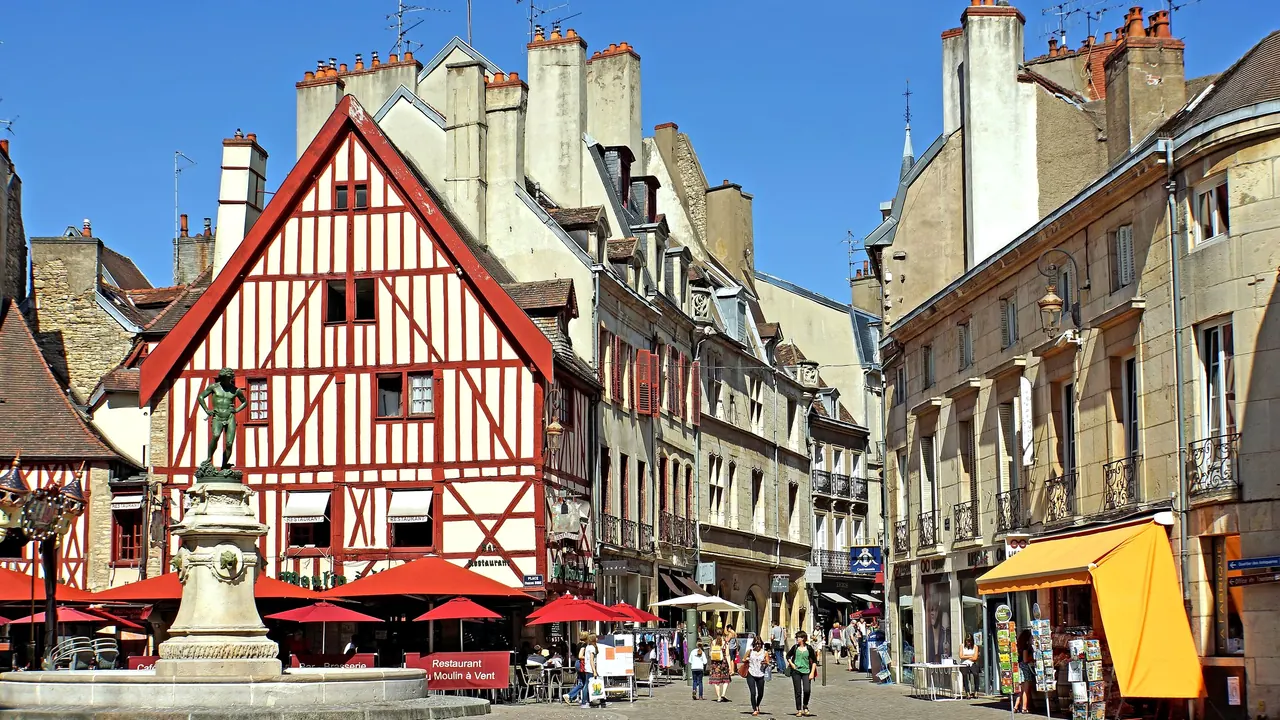
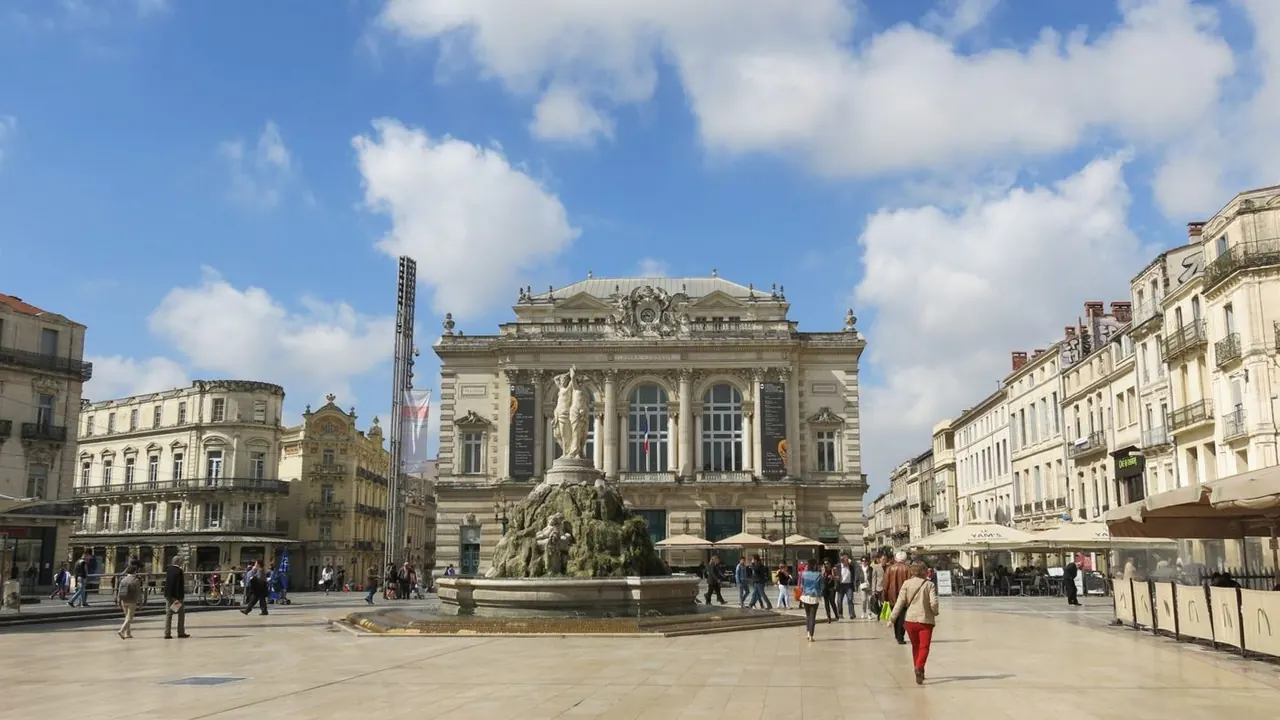
Photos: Dijon by Dennis G. Jarvis, CC BY-SA 2.0, cropped; Montpellier by Peter, CC BY 2.0, cropped.
Dijon or Montpellier?
Our verdict in twelve categories, each scored against the same fixed benchmark cities, and the climate month by month, so you can choose for your trip.
Choose Dijon for
- food and drink
- culture and sights
- prices
Dijon suits a slower, more focused trip built around the table and the vineyards. The ducal palace, the half-timbered old streets and Les Halles fit into a couple of easy days on foot, and then the Côte de Nuits begins at the edge of town. Choose it if your idea of a good evening is a Burgundy by the glass and a long dinner rather than a late night, and if you are happy to give up a beach and summer heat.
Choose Montpellier for
- beaches
- nightlife
- families
Montpellier is the broader choice, and the warmer one. It gives you a medieval old town and the Musée Fabre, and it adds sandy beaches a tram and bus ride away, flamingo lagoons, the gorges of the Hérault and Roman Nîmes and Arles within reach. A large student crowd keeps the evenings going and summer brings dance and music festivals. Families, sun-seekers and anyone wanting a mix of town, coast and hills will get more out of it.
Scoreboard
Twelve categories on one fixed scale from 0 to 100. The shaded stretch is the gap between the two.
Your match
Pick a travel style or drag the sliders, and both match scores follow your weighting.
Wins on food and drink and culture and sights with your weighting.
Wins on beaches and nightlife with your weighting.
What matters to you?
Category by category
What the scores mean for a trip.
Beaches & swimming
Dijon is no place for a beach trip. Swimming there means Lac Kir's supervised lawn-and-sand area on a hot afternoon, or a pool.
Montpellier has real sea within about 11km. Fine sand runs from Palavas and Carnon past La Grande-Motte to the wild dunes of l'Espiguette, and the shelving water is easy for swimmers. It is a flat, sandy coast that gets crowded in high summer, but it makes beach days a natural part of the stay.
Food & drink
The two eat equally well, but in different regions. Dijon offers classic Burgundian cooking, boeuf bourguignon, snails, jambon persillé and Époisses, with mustard, cassis and village Burgundies poured by the glass, and a more serious fine-dining tier.
Montpellier leans towards the Mediterranean, with Thau oysters and mussels, Sète's tielle, Pic Saint-Loup wines and a lot of cheap, casual student eating. Its market halls, including Laissac's eat-in counters, are good for grazing, while Dijon's Les Halles is more a place to shop for a picnic.
Culture & sights
Both reward two or three days, and neither has one sight of world rank. Dijon's appeal is ducal: the palace of the Dukes of Burgundy, the carved Valois tombs in the Musée des Beaux-Arts, the gargoyles and lucky owl of Notre-Dame, and Sluter's Well of Moses.
Montpellier's old town has hidden courtyards, the formal Peyrou terrace with its aqueduct and France's oldest botanical garden. The Musée Fabre is the stronger picture gallery, and Bofill's Antigone adds twentieth-century architecture that has no counterpart in Dijon.
Nightlife
Both are university towns, but Montpellier's student population is much larger and you can feel the difference after dark. Its terraces around Place Jean-Jaurès and the Écusson fill on weeknights, and the crowd moves on to clubs towards Lattes and the coast in the small hours.
In Dijon, evenings centre on Rue Berbisey's small bars, wine and a late dinner. There are only a few clubs, and outside term time the streets are quiet by midnight.
Nature & outdoors
Dijon's countryside is gentle: the wooded combes west of town for short walks and climbing, the flat Burgundy Canal towpath and the vineyard cycle route to Beaune, with the Morvan the wildest landscape within reach.
Montpellier has more variety close by. There are flamingo lagoons and the Camargue to the south, Pic Saint-Loup to climb, and the Hérault gorges for canoeing, with the Cirque de Navacelles beyond. The windy coast also brings kitesurfing, which Dijon cannot offer.
Day trips
Dijon's outings mostly follow one theme, wine. The Route des Grands Crus runs south through Gevrey-Chambertin and Vougeot to walled Beaune, about twenty minutes by train, and on to Meursault. Fontenay Abbey, Semur-en-Auxois and Alésia make a second kind of day to the north-west, and Besançon's citadel is an hour away by rail.
Montpellier covers more history and more scenery. Trains reach Roman Nîmes in about half an hour, Arles and Avignon's papal palace in about an hour and Carcassonne's citadel in about an hour and a half. The Pont du Gard is a short drive beyond Nîmes. Sète, Aigues-Mortes and Saint-Guilhem-le-Désert are closer still. Around both cities, the smaller villages are far easier with a car.
Good for families
Dijon is calm and safe with children, with a planetarium and natural history museum at the Arquebuse and paddling at Lac Kir. Still, most of what fills a visit, from tastings to fine-art museums, is aimed at adults.
Montpellier gives children much more. The Lunaret zoo is set in woodland, Odysseum has an aquarium and planetarium, and gently shelving beaches suit small swimmers. Plan around the summer heat with mornings at the beach and afternoons indoors.
Getting around
Dijon is the easier city to cover on foot. Its compact, mostly pedestrian centre puts the station, Les Halles, the palace and the cathedral a few minutes apart. Two tram lines and the buses cover the outskirts, with a bus out to Lac Kir, and regional trains run down the wine route to Beaune.
Montpellier's Écusson is just as free of cars, but it sits on a low hill with slopes and uneven paving. The city spreads wider, so its larger tram network does more of the work, linking the station with Antigone, Port Marianne and Odysseum. Reaching the beach means a tram and then a bus, which is slow in summer. Outside town, Dijon's wine villages and Montpellier's gorges and Camargue are both far simpler with a car.
Shopping & style
In both cities the best things to buy are edible, but Montpellier has a little more range otherwise. It has boutiques and bookshops in the Écusson lanes, plus the Polygone and Odysseum malls for big brands.
Dijon's shopping is mostly mustard, pain d'épices, cassis and Burgundy from the cellars. Rue de la Liberté has a department store and chains, and the side lanes have antiques. Neither city suits a luxury spree.
Affordability
Costs are much the same, typical of a French regional city, and the bill grows for different reasons. In Dijon it is cellar tastings, wine tours and fine bottles of Burgundy, though bistro lunch menus and wine by the glass stay fair.
In Montpellier, student counters and markets keep everyday eating cheap, but rooms in town and on the coast cost noticeably more in July and August.
Live music & performing arts
Montpellier has the stronger stage, especially for dance. The Montpellier Danse festival and the national choreographic centre are well known across Europe, and summer adds the Radio France festival's many free concerts and outdoor theatre at the Domaine d'O.
Dijon's opera company has a solid season at the Grand Théâtre and the acoustically fine Auditorium. It follows the academic year, though, so summer visitors find little beyond outdoor events.
Wellness & relaxation
Neither is a spa destination, but Montpellier has proper thermal water nearby. Balaruc-les-Bains on the Thau lagoon is about half an hour away and takes day visitors.
Dijon offers only a few hotel spas, some with grape-based treatments in the wine villages. Its restfulness comes from quiet squares and slow vineyard afternoons, and it is calmer than Montpellier's lively student centre.
When should you go?
Pick your month. The climate figures are measured averages, not a forecast.
Dijon in July
Montpellier in July
Daytime high, °C
Rainfall in the month, mm
Temperature and rainfall are climate normals, averaged over the years shown. Dijon: 1991-2020 normals, Dijon (7 km from centre). Montpellier: 1991-2020 normals, Montpellier (7.8 km from centre).
Dijon has a continental climate, so its season is short. Days are pleasant for walking from May to September, and July is the warmest at about 27°C, warm enough for Lac Kir but never really hot. Winters are grey and cold, with days around 6°C and very little sun, and rain falls fairly evenly through the year, a little more in May and in autumn. Late spring and early autumn, with the harvest in the vineyards, are the best times for walking and cycling.
Montpellier is Mediterranean, milder in winter and much sunnier all year. July and August are hot, near 30°C, and that is too warm for long afternoons in the stone streets but right for the beach, where the sea reaches about 22°C in August and summer is almost dry. The rain comes in autumn, with September and October the wettest months by a clear margin. Spring and early summer are the best all-round months, and even midwinter gives mild, bright days for sightseeing when Dijon is at its dullest.
Which traveller are you?
For a beach and sun trip, Montpellier is the only real choice. Long sandy beaches with shallow, warm water lie a short trip away, and summers are hot and dry. Dijon is far inland and offers only a lakeside lawn at Lac Kir.
On a food and nightlife trip, Montpellier comes out ahead. The two cities eat equally well, Burgundian classics against Languedoc seafood and market cooking, but Montpellier's big student population fills terraces and bars every night, while Dijon's scene stays small.
For a short city break, Dijon works especially well. The flat, pedestrian centre puts the ducal palace, Notre-Dame and Les Halles minutes apart, the TGV from Paris takes well under two hours, and a vineyard ride to Beaune fits easily into a weekend.
Before you go
| Measure | Dijon | Montpellier |
|---|---|---|
| Official language | French | French |
| Currency | Euro (EUR) | Euro (EUR) |
| Sockets | CE230 V, 50 Hz | CE230 V, 50 Hz |
| Driving side | Right | Right |
| Time zone | UTC+1, UTC+2 in summer | UTC+1, UTC+2 in summer |
| Emergency number | 112 | 112 |
| Elevation | 220 m | 7 m |
| Main airport | Lyon Saint-Exupéry Airport (LYS)178 km from centre141 non-stop destinations | Montpellier-Méditerranée Airport (MPL)8 km from centre41 non-stop destinations |
| Public holidays this year | 11 days | 11 days |
By the numbers
| Measure | Dijon | Montpellier |
|---|---|---|
| City population | 161,830 | 310,240 |
| People per km² | 3,890 | 5,452 |
| Museums within 10 km | 8 | 14 |
| UNESCO World Heritage sites within 50 km | 1 | 2 |
| Swim season, months above 21 °C | - | 2 months |
Where else could you go?
Every comparison below shares a destination with this one, so you can follow Dijon or Montpellier somewhere new.