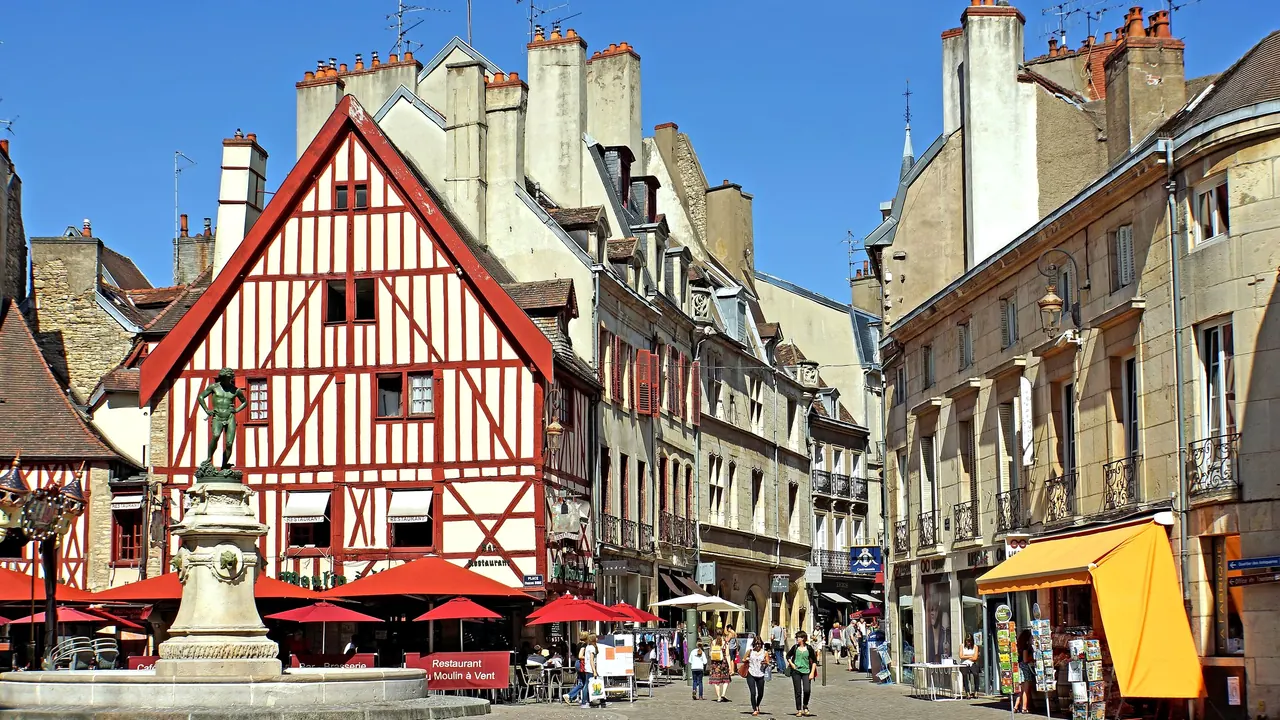
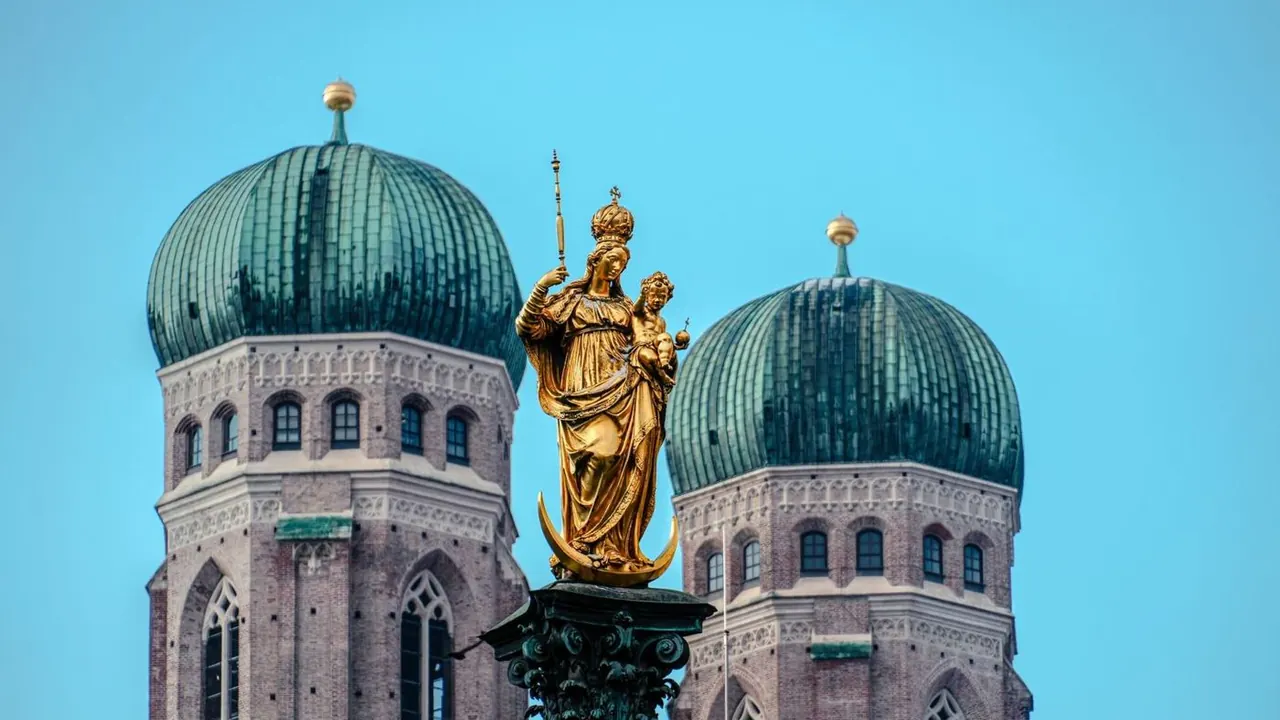
Photos: Dijon by Dennis G. Jarvis, CC BY-SA 2.0, cropped; Munich by 0xd1ma, Pexels License.
Dijon or Munich?
Our verdict in twelve categories, each scored against the same fixed benchmark cities, and the climate month by month, so you can choose for your trip.
Choose Dijon for
- prices
- food and drink
Dijon is for travellers who want to eat, drink and walk at an easy pace. The town is small and you can cover it on foot. Burgundy's vineyards start at its southern edge, and it is the cheaper of the two for rooms and set lunches. It suits couples and wine lovers who would rather spend the evening over a long dinner than go out late.
Choose Munich for
- live music and the arts
- families
- wellness
Munich is the bigger trip in almost every way. It has the major art collections, a world-class opera house and orchestras, the Alps on the horizon, lakes you can reach by train and a city that is easy with children. Choose it if you want a lot of variety and can live with higher prices, especially for hotels.
Scoreboard
Twelve categories on one fixed scale from 0 to 100. The shaded stretch is the gap between the two.
Your match
Pick a travel style or drag the sliders, and both match scores follow your weighting.
Wins on prices and food and drink with your weighting.
Wins on live music and the arts and families with your weighting.
What matters to you?
Category by category
What the scores mean for a trip.
Beaches & swimming
Neither city is a beach destination, but Munich gives a summer swimmer much more. Dijon has one supervised lawn-and-sand area at Lac Kir and, beyond that, pools.
Munich has the gravel banks of the Isar at the Flaucher and, under an hour away by S-Bahn, the clear water of the Starnberger See and the Ammersee, with jetties and lawns. The water is fresh rather than warm, but a lake day fits easily into a summer trip.
Food & drink
Dijon has the edge for food. Classic Burgundian cooking, such as boeuf bourguignon, jambon persillé and snails, comes with village wines poured by the glass. The iron market hall of Les Halles, with its Époisses and Bresse poultry, is the centre of the city's eating.
Munich's food is built around beer. You eat pork with crackling and white sausage in chestnut-shaded beer gardens, graze at the open-air Viktualienmarkt and take afternoon cake seriously. It is hearty and sociable, while Dijon is refined but narrow. Neither city offers much international range.
Culture & sights
Munich has far more to see. The Kunstareal alone holds the Alte Pinakothek's old masters, the Glyptothek and the Blue Rider painters of the Lenbachhaus. Add the Residenz, Nymphenburg and the vast Deutsches Museum, and you have a week of sightseeing.
Dijon has a more intact old town, while much of Munich's centre was rebuilt after the war. Dijon's half-timbered streets, the gargoyles of Notre-Dame and the ducal tombs in the Palace of the Dukes are rewarding, but they fill two or three days rather than a week.
Nightlife
Munich has more going on after dark. Beer halls fill early, the Glockenbachviertel has dense rows of cocktail and gay bars, and a few techno clubs run until morning at weekends. Oktoberfest takes over the city for two weeks each autumn.
Dijon's evenings rely on its students. A night out means small bars along Rue Berbisey, wine and a late dinner, and outside term time the streets are quiet by around midnight.
Nature & outdoors
This is one of the widest gaps between the two. From Munich, trains reach real alpine country around Garmisch and the Zugspitze for summer hiking and winter skiing. Closer to town, the Five Lakes are good for sailing and cycling, and in the city the English Garden has surfers riding the Eisbach wave.
Dijon's countryside is gentle and pleasant rather than dramatic. It has the limestone combes west of town for short walks and climbing, the flat canal towpath, the vineyard cycle route to Beaune and the Morvan's granite hills further off.
Day trips
Both cities make excellent bases, and Munich has slightly more range. Within two hours by train you can reach Salzburg, Nuremberg, Regensburg and Innsbruck, plus the royal castles at Neuschwanstein and Herrenchiemsee. Most of it is easy without a car.
Dijon's day trips are more concentrated and more about wine: the Grand Cru villages, walled Beaune with the Hospices, then Fontenay Abbey and Semur-en-Auxois to the north-west. You will need a car, a bike or a tour for much of it.
Good for families
Munich is much easier with children. It has a large zoo along the Isar, children's sections at the Deutsches Museum, the transport museum, an aquarium in the Olympic Park and beer gardens with playgrounds, all on transport that takes pushchairs.
Dijon is safe and small, with the planetarium at the Jardin de l'Arquebuse and paddling at Lac Kir. But a trip built on tastings and fine-art museums will appeal to parents more than to their children.
Getting around
Both cities have walkable old centres, so the difference shows once you leave them. In Dijon the station, the market, the palace and the cathedral are a few minutes apart on foot, and two tram lines and a bus network cover the outskirts. Regional trains run down the wine route to Beaune, and the TGV reaches Paris in well under two hours, so you can arrive and leave without a car.
Munich's network goes further. The U-Bahn, S-Bahn, trams and buses run as one system out to the museums, Nymphenburg, the lakes and the airport, and a car is more of a burden than a help in town. The flat streets and riverside paths also make it the better city for cycling, though delays on the central S-Bahn line are the usual irritation.
Shopping & style
Munich is the shopping city. Maximilianstrasse has the luxury houses, Kaufingerstrasse the department stores, and Glockenbach and Schwabing the independent designers. It also has a distinctive buy in hand-tailored Tracht.
In Dijon, shopping mostly means things to eat and drink: mustard in dozens of flavours, cassis, pain d'épices and Burgundy from the wine merchants. Rue de la Liberté has a department store and some chains, but there is little for fashion.
Affordability
Dijon is the cheaper city. Hotel rooms are moderate and bistro set lunches are good value. The bill only rises once you book serious restaurants, tastings and good bottles.
Munich is Germany's most expensive city, and you feel it most in hotel rates, which climb steeply during Oktoberfest and trade fairs. Picnics in beer gardens, the free parks and lakes, and token Sunday museum fees help, but it remains the bigger outlay.
Live music & performing arts
For music lovers this is a big gap. Munich's Bavarian State Opera is among the world's leading companies and plays most of the year. The city also has three orchestras of real standing, chamber opera in the rococo Cuvilliés Theatre, and operetta at the Gärtnerplatztheater.
Dijon does well for a city its size, with the Opéra performing in both the old Grand Théâtre and the acoustically fine Auditorium. Its season follows the academic year, though, and thins out in summer.
Wellness & relaxation
Munich has a real bathing culture. There is the Art Nouveau Müller'sches Volksbad with its Roman-style steam bath, and public saunas with infusion rituals. The huge thermal complex at Erding is forty minutes away, and the spa towns of Bad Tölz and Bad Reichenhall lie towards the mountains.
Dijon has no bathing tradition and only a few hotel spas, some offering grape-based treatments. What it offers instead is a slow pace: long lunches, quiet squares and lazy afternoons among the vines.
When should you go?
Pick your month. The climate figures are measured averages, not a forecast.
Dijon in July
Munich in July
Daytime high, °C
Rainfall in the month, mm
Temperature and rainfall are climate normals, averaged over the years shown. Dijon: 1991-2020 normals, Dijon (7 km from centre). Munich: 1991-2020 normals, München (1.9 km from centre).
Dijon and Munich have the same inland pattern of cold, grey winters and warm summers. Both are at their best for walking the streets from May to September. Dijon is a little warmer, reaching about 27°C in July against 25°C in Munich. It is also the drier of the two in summer, with about 65mm a month. Its wetter spells come in late spring and again in October and November. Summer is Munich's wettest season, with about 120mm a month from May to August, so expect plenty of rainy days even in the warmest weeks.
Summer is the only time for an outdoor swim in either city, at Lac Kir in Dijon or on the Isar banks and the lakes near Munich. Dijon gets slightly more sunshine in July, which suits cycling through the vineyards. Winter is cold in both and a little colder in Munich, where January highs are near 4°C. Snow in the nearby Alps does give Munich a ski season that Dijon cannot match. September is a good month in both cities. It is mild in each, and in Munich it is noticeably less rainy than the summer months before it.
Which traveller are you?
On a trip on a tight budget, Dijon goes further. Hotels are moderately priced, set bistro lunches are a fair way to eat well, wine by the glass is cheap and the centre is walkable. Munich's hotels are expensive all year.
On a family trip with children, Munich is the clear choice. It has the Hellabrunn zoo, the hands-on Deutsches Museum, playgrounds in beer gardens and lake beaches you can reach by S-Bahn. Dijon is safe and relaxed, but beyond its parks and planetarium there is little made for children.
For wine lovers, Dijon is the obvious pick. The Route des Grands Crus starts at the edge of town and runs through Gevrey-Chambertin and Vougeot to Beaune. Wine bars pour village Burgundies by the glass. Munich's drinking culture is about beer.
Before you go
| Measure | Dijon | Munich |
|---|---|---|
| Official language | French | German |
| Currency | Euro (EUR) | Euro (EUR) |
| Sockets | CE230 V, 50 Hz | CF230 V, 50 Hz |
| Driving side | Right | Right |
| Time zone | UTC+1, UTC+2 in summer | UTC+1, UTC+2 in summer |
| Emergency number | 112 | 112 |
| Elevation | 220 m | 519 m |
| Main airport | Lyon Saint-Exupéry Airport (LYS)178 km from centre141 non-stop destinations | Munich Airport (MUC)29 km from centre210 non-stop destinations |
| Public holidays this year | 11 days | 12 days |
By the numbers
| Measure | Dijon | Munich |
|---|---|---|
| City population | 161,830 | 1,505,036 |
| People per km² | 3,890 | 4,844 |
| Museums within 10 km | 8 | 74 |
| UNESCO World Heritage sites within 50 km | 1 | 1 |
Where else could you go?
Every comparison below shares a destination with this one, so you can follow Dijon or Munich somewhere new.