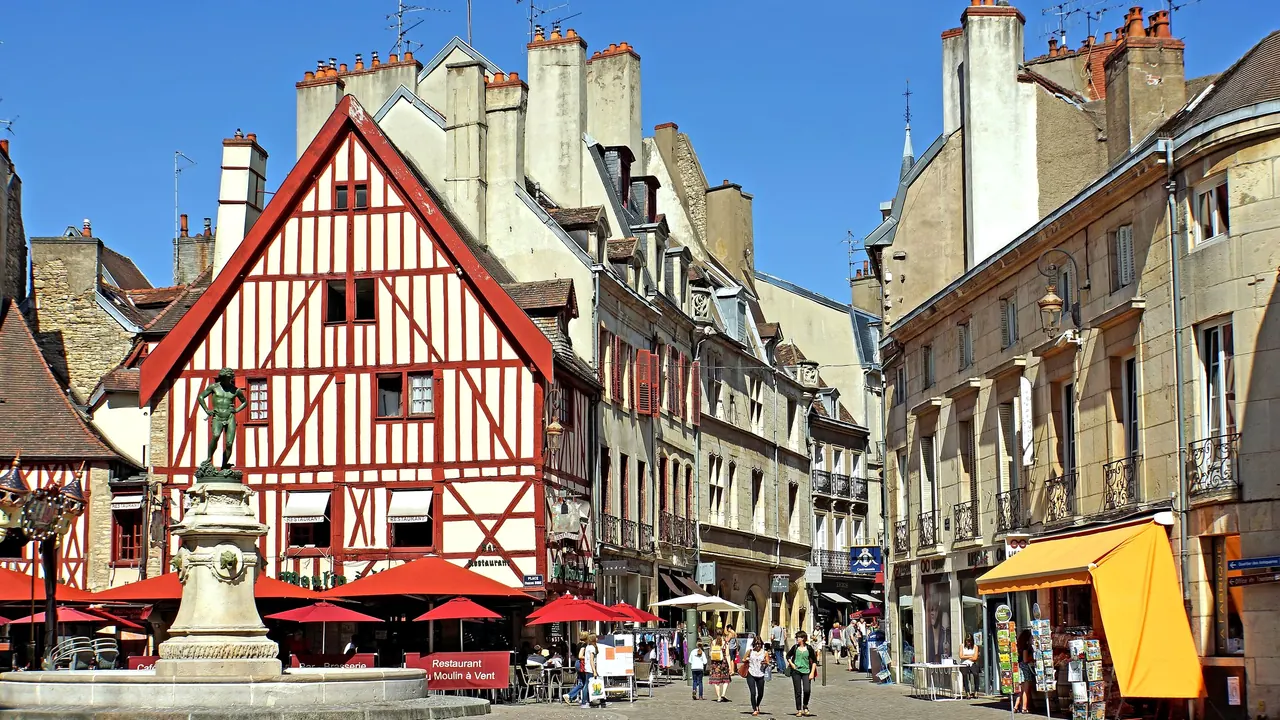
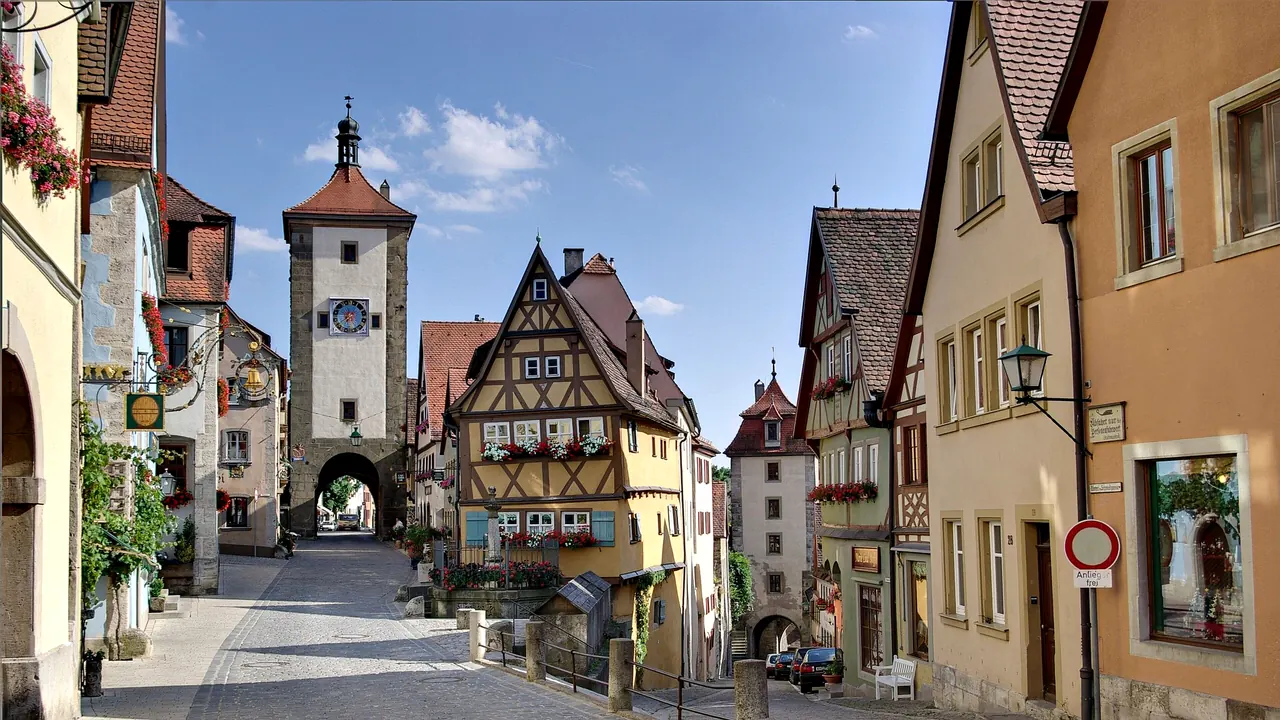
Photos: Dijon by Dennis G. Jarvis, CC BY-SA 2.0, cropped; Rothenburg ob der Tauber by Berthold Werner, Public domain.
Dijon or Rothenburg ob der Tauber?
Our verdict in twelve categories, each scored against the same fixed benchmark cities, and the climate month by month, so you can choose for your trip.
Choose Dijon for
- food and drink
- live music and the arts
- nightlife
Dijon is the choice if eating and drinking are the point of your trip. It sits at the head of Burgundy's wine country, with Les Halles and village Burgundies poured by the glass. Evenings are livelier too, with student bars and an opera house, and the vineyards towards Beaune are on the doorstep. With fast trains from Paris and trams across town, it also works well for a few easy days without a car.
Choose Rothenburg ob der Tauber for
- wellness
- families
Rothenburg ob der Tauber rewards a slower, quieter stay. The draw is one walled medieval town, almost untouched inside its ramparts, and it is at its best early in the morning and after the coach groups leave. Thermal baths are within an hour's drive. Come with a car, spend a night or two and add the Romantic Road towns, but don't expect much nightlife or a varied choice of food.
Scoreboard
Twelve categories on one fixed scale from 0 to 100. The shaded stretch is the gap between the two.
Your match
Pick a travel style or drag the sliders, and both match scores follow your weighting.
Wins on food and drink and live music and the arts with your weighting.
Wins on wellness and families with your weighting.
What matters to you?
Category by category
What the scores mean for a trip.
Beaches & swimming
Neither is a place to swim, as both are far inland. Dijon at least has Lac Kir on the western edge of town, with a lawn-and-sand bathing area supervised in summer. In Rothenburg you have the town's outdoor pool, or an hour's drive to the bathing lawns of the Franconian lakes such as the Altmühlsee.
Food & drink
Food is the biggest difference between the two. Dijon is one of France's great food cities, with boeuf bourguignon, jambon persillé, Époisses and Bresse poultry from the stalls at Les Halles, plus its own mustard and cassis. The wine country starts at the edge of town, and there is serious fine dining for a special meal.
Rothenburg eats more simply, with roast pork, Schäufele and dumplings, washed down with Silvaner or local beer. Many kitchens around the Marktplatz cook for the coach parties, so the better meals are in family-run guesthouses and wine taverns away from the square. The Schneeball pastry is more fun to look at than to eat.
Culture & sights
The two are about level, but what you see is quite different. Dijon is a former ducal capital with real institutions. The Palace of the Dukes houses one of France's oldest fine art museums, and there are the mourners around the Valois tombs, the Romanesque crypt of Saint-Bénigne and Sluter's Well of Moses at Champmol.
In Rothenburg, the town itself is the sight. You walk the covered wall, stand at the Plönlein and take in a medieval town with almost nothing modern inside it. Riemenschneider's Holy Blood Altar and the Medieval Crime Museum are the highlights, and the town takes less time to see than Dijon's two or three days.
Nightlife
Dijon has a large university, so it has a modest night out to offer: small bars along Rue Berbisey, terraces on Place Émile Zola and a few clubs, though it goes quiet outside term time. Rothenburg has almost nothing after dark beyond wine taverns and the night watchman's lantern tour. For anything livelier you would have to go to Würzburg or Nuremberg.
Nature & outdoors
Both sit in gentle country, but Dijon has more variety close by. The wooded combes just west of town have trails and climbing cliffs, the Burgundy Canal towpath is flat and easy for cycling, and the Morvan's granite hills and lakes are about an hour and a half away.
From Rothenburg, paths drop straight from the walls into the Tauber valley, past mills and meadows to the Topplerschlösschen. The Tauber valley cycle path is a classic family ride, and the scenery is at its best in spring blossom and autumn colour.
Day trips
Dijon has the edge, and wine is the reason. The Route des Grands Crus leads through Gevrey-Chambertin and Vougeot to Beaune, which is also a short train ride away. Fontenay Abbey, Semur-en-Auxois and Vézelay fill longer days, and Besançon's citadel is about an hour by train.
Rothenburg sits on the Romantic Road, so the trips are mostly to other historic towns. Dinkelsbühl and Nördlingen, ringed by its crater, are the closest matches, with Würzburg's Residenz and Nuremberg's castle about an hour away by car.
Good for families
For children, the two work out about the same. Dijon has the planetarium and natural history museum at the Jardin de l'Arquebuse, play areas in the Parc de la Colombière and paddling at Lac Kir. Rothenburg feels like a storybook. Children can walk the ramparts, follow the night watchman, and older ones tend to love the torture devices in the Crime Museum. The cobbles and steep valley paths, though, are hard going with a pushchair.
Getting around
Both centres are easy to walk, but Dijon is better connected. The station, market and palace are a few minutes apart, two tram lines reach the outskirts, and the TGV gets to Paris in under two hours.
Rothenburg's walled town is just as walkable, though the cobbles and the climb back up from the valley take some effort. The trouble starts when you leave. The town is at the end of a branch line, most journeys need a change at Steinach, and regional buses are sparse, so a car makes things much easier.
Shopping & style
Shopping in Dijon is mostly about food and drink to take home: mustard in dozens of flavours, cassis, cheese from around Les Halles and Burgundy from the wine merchants. Rue de la Liberté adds a department store and French chains. Rothenburg's shops are dominated by Christmas, with baubles, nutcrackers and Erzgebirge carvings all year and a Christmas market on the Marktplatz. Beyond that there are mostly souvenirs, and very little fashion or everyday shopping.
Affordability
Dijon is a little easier on the budget. Bistro set lunches are a good-value way to eat well and wine by the glass is cheap, though tastings, wine tours and good bottles add up quickly. Rothenburg charges a tourist premium for rooms and meals inside the walls, especially in December and on summer weekends. Sleeping outside the gates or in a nearby village saves a good deal.
Live music & performing arts
Dijon has a proper cultural season. The Opéra de Dijon stages opera, concerts and dance at the Grand Théâtre and the Auditorium, which is known for its acoustics, and there is also a national drama centre. Things quieten down in summer. In Rothenburg, performance mostly means the costumed Meistertrunk play, summer open-air theatre and organ and choral concerts in St Jakob's.
Wellness & relaxation
Rothenburg is the better place to unwind. Its emptied lanes at dawn and dusk are very quiet, and real thermal bathing is about an hour away: you can float in the salt-water pool of the Franken-Therme at Bad Windsheim or visit the old spa town of Bad Mergentheim. Dijon offers long lunches and slow afternoons in the vineyards, but for spas there are only a few hotels, some with grape-based treatments.
When should you go?
Pick your month. The climate figures are measured averages, not a forecast.
Dijon in July
Rothenburg ob der Tauber in July
Daytime high, °C
Rainfall in the month, mm
Where the figures come from
Rothenburg ob der Tauber's sunshine is measured 27 km from the centre, at Feuchtwangen-heilbronn.
Temperature and rainfall are climate normals, averaged over the years shown. Dijon: 1991-2020 normals, Dijon (7 km from centre). Rothenburg ob der Tauber: 1991-2020 normals, Rothenburg ob der Tauber (0.9 km from centre).
Both towns are at their best from May to September, and neither has a beach season. Dijon is a few degrees warmer all year, with July highs around 27°C against 25°C in Rothenburg. Summer walking is comfortable in both, and Dijon has slightly more sunshine. Spring arrives a little earlier in Dijon, but its wettest months are May, October and November, at about 77mm. Rothenburg's rain is spread more evenly, and April is its driest month, which makes it a good time for the orchards in the Tauber valley.
Winter is cold and grey in both places, with very little sun from November to January. Rothenburg is the chillier of the two, with January highs near 3°C, so wrap up warmly for the ramparts.
Which traveller are you?
On a food and nightlife trip, Dijon is the clear choice. It has Burgundian cooking, a market hall at its centre and wine bars pouring village Burgundies. In the evening, Rue Berbisey's student bars carry on well after Rothenburg's lanes have gone quiet around eleven.
For a relaxing and wellness trip, Rothenburg suits better. Once the day visitors leave, the walls and the Tauber valley are very quiet, and the salt-water pool at Bad Windsheim and the spa town of Bad Mergentheim are both within an hour. Dijon offers only hotel spas.
On a culture and arts trip, Dijon offers more for a longer stay. It has the ducal palace with its fine art museum, the Valois tombs and Sluter's Well of Moses, and in the evening the opera and concerts. Rothenburg's walled town is lovely, but you will have seen it in a day.
Before you go
| Measure | Dijon | Rothenburg ob der Tauber |
|---|---|---|
| Official language | French | German |
| Currency | Euro (EUR) | Euro (EUR) |
| Sockets | CE230 V, 50 Hz | CF230 V, 50 Hz |
| Driving side | Right | Right |
| Time zone | UTC+1, UTC+2 in summer | UTC+1, UTC+2 in summer |
| Emergency number | 112 | 112 |
| Elevation | 220 m | 430 m |
| Main airport | Lyon Saint-Exupéry Airport (LYS)178 km from centre141 non-stop destinations | Nuremberg Airport (NUE)66 km from centre56 non-stop destinations |
| Public holidays this year | 11 days | 12 days |
By the numbers
| Measure | Dijon | Rothenburg ob der Tauber |
|---|---|---|
| City population | 161,830 | 11,331 |
| People per km² | 3,890 | 272 |
| Museums within 10 km | 8 | 6 |
| UNESCO World Heritage sites within 50 km | 1 | 2 |
Where else could you go?
Every comparison below shares a destination with this one, so you can follow Dijon or Rothenburg ob der Tauber somewhere new.
- Nurembergvs Rothenburg ob der Tauber
- Bambergvs Rothenburg ob der Tauber
- Stuttgartvs Rothenburg ob der Tauber
- Heidelbergvs Rothenburg ob der Tauber
- Frankfurtvs Rothenburg ob der Tauber
- Lausannevs Dijon