Dordogne or French Alps?
Our verdict in twelve categories, each scored against the same fixed benchmark cities, and the climate month by month, so you can choose for your trip.
Choose Dordogne for
- culture and sights
- prices
- food and drink
Pick the Dordogne for a slow summer in the countryside built around the past and the table. The painted caves of the Vézère valley, the castles facing each other across the river and Sarlat's golden-stone old town give it far more to see than the Alps. Days end with duck confit on a village terrace, and rural French prices go further than anything in a ski resort. It suits couples and families who are happy to drive between sights and then do very little in the evening.
Choose French Alps for
- nightlife
- nature and the outdoors
- wellness
The French Alps are a trip for people who want to be on the mountain. Mont Blanc, the Vanoise and the great linked ski areas of the Tarentaise give it a landscape the Dordogne cannot approach, and the lakes, spa towns and après-ski add swimming, thermal baths and real winter nights out. You pay for it, especially in the ski season, and the old towns are a pleasant extra rather than the point.
Scoreboard
Twelve categories on one fixed scale from 0 to 100. The shaded stretch is the gap between the two.
Your match
Pick a travel style or drag the sliders, and both match scores follow your weighting.
Wins on culture and sights and prices with your weighting.
Wins on nightlife and nature and the outdoors with your weighting.
What matters to you?
Category by category
What the scores mean for a trip.
Beaches & swimming
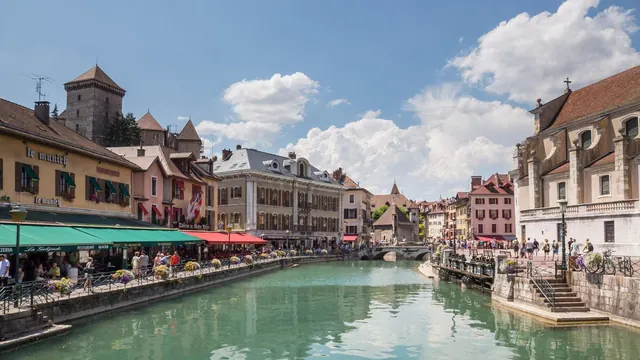
Neither has a sea coast, but the Alps give you much better swimming. Lake Annecy is clear and warm in high summer, with grassy public beaches and jetties at Sévrier, Talloires and Menthon-Saint-Bernard, and Évian and Thonon have pebbly lidos looking across Lake Geneva to Switzerland.
In the Dordogne you swim from gravel banks in the river below Beynac or La Roque-Gageac, with canoes passing by, or at small lakes such as Rouffiac. After rain the rivers turn high and brown, and most visitors end up using the pool at their rented house.
Food & drink
The Dordogne eats slightly better, and food is a bigger part of the trip there. Duck and goose, foie gras, walnuts, cèpes and winter truffles fill the markets of Sarlat and Périgueux, and Bergerac's estates add reds and the sweet whites of Monbazillac.
The Alps answer with melted cheese: fondue, tartiflette, Beaufort and Reblochon from the farm, plus perch from the lakes and Savoie whites. Their top end is stronger, with highly decorated kitchens around Lake Annecy, Megève and Courchevel. Both menus get repetitive within a week.
Culture & sights
This is where the Dordogne pulls clearly ahead. The Vézère valley holds the Lascaux replica, the original painted cave at Font-de-Gaume and the National Museum of Prehistory in the cliff at Les Eyzies. Add Sarlat, the castles of Beynac and Castelnaud and the bastide of Monpazier, and the region is a sightseeing trip in its own right.
The Alps have good things to see, including Annecy's canals and island prison, the dukes' château at Chambéry, Grenoble's fine-arts museum and Briançon's Vauban walls. They fill rainy days, but nobody plans an Alpine trip around them.
Nightlife
The Alps win, but only in winter. From December to April, Val Thorens, Val d'Isère and Méribel dance on tables at the slope restaurants and move on to clubs until the small hours. In summer the life moves down to Annecy's lakeside terraces and Grenoble's student bars.
The Dordogne has nothing comparable at any season. A summer night market with communal tables and a dance floor in the square is about as late as it gets, and the villages are quiet by eleven.
Nature & outdoors
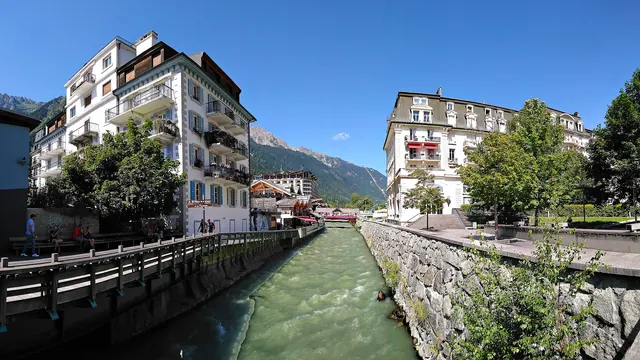
These are very different landscapes, and the Alps are among the great ones. You can ride from Chamonix to the Aiguille du Midi among the glaciers, walk the Tour du Mont Blanc, watch ibex in the Vanoise or ski the Trois Vallées. Paragliding over Lake Annecy and cycling over the Galibier fill the summer.
The Dordogne is soft, farmed country of limestone cliffs, walnut orchards and wide rivers. Its best day out is a canoe trip past La Roque-Gageac, with Marqueyssac's gardens above. It is lovely for gentle walking and cycling, but it has nothing for a serious hiker.
Day trips
Both are well placed for day trips, though the outings are different. From the Dordogne they are more of the same countryside done beautifully: Domme on its clifftop, Rocamadour about an hour from Sarlat, Saint-Cirq-Lapopie in the Lot, and Saint-Émilion or Bordeaux from the Bergerac side.
The Alps cross borders. Geneva is under an hour from Annecy, ferries run from Évian to Lausanne and the Lavaux terraces, and the Mont Blanc tunnel puts Aosta within reach of Chamonix. In the deep Tarentaise ski valleys, though, the choice thins out.
Good for families
The Alps suit more ages. French ski schools take children from snow-garden age, car-free resorts such as Avoriaz and Flaine let families walk to the slopes, and summer brings the rack railway to the Mer de Glace, marmots and shallow beaches on Lake Annecy. Altitude, cold mornings and ski kit wear out the smallest children, though.
The Dordogne is a classic summer for eight-to-fourteen-year-olds, with siege engines and armour at Castelnaud, cave visits and canoeing. Toddlers get less from it, and pushchairs struggle on the castle steps.
Getting around
You will want a car in both, so this is close, but the Alps have more alternatives. Trains run well to Annecy, Chambéry and Grenoble and climb to Bourg-Saint-Maurice and Chamonix, and in a ski resort the lifts link whole valleys. The weak points are the Saturday changeover queues and the need for snow chains.
In the Dordogne, buses into the valleys are sparse and the sights are scattered, but the roads are quiet for most of the year. In high summer the riverside road through Beynac jams and Sarlat's car parks fill on market day.
Shopping & style
The Alps have more to shop for, though most of it is specialist. Chamonix is one of Europe's best places for technical climbing and ski gear, Courchevel and Megève carry luxury fashion and jewellery, and Opinel knives and Beaufort make good things to take home.
The Dordogne's shopping is the food you put in the car boot: foie gras, walnut oil and Bergerac wine from the markets at Sarlat, Issigeac and Ribérac. Summer brocantes add some antiques, but there is no fashion shopping.
Affordability
The Dordogne is plainly the cheaper trip. Prices are those of rural France, and set lunches, market produce and simple gîtes keep a week reasonable. The main extras are summer houses with pools near Sarlat and the entry fees that add up for a family.
A ski week in the Alps costs far more once you add lift passes, ski hire, ski school and on-mountain lunches, and Courchevel or Val d'Isère are among Europe's costliest places to stay. Summer, smaller villages and towns such as Grenoble bring prices back down.
Live music & performing arts
Neither is a destination for performances, but they differ in timing. The Dordogne's live arts come almost entirely in summer: Sarlat's theatre festival in the old-town squares, Périgueux's mime and street-theatre festival, and classical concerts in Romanesque churches.
The Alps have a year-round base in Grenoble, with a large arts centre and a chamber orchestra, and in summer there is chamber music at Évian and concerts in mountain churches. In ski season, the entertainment is mostly bands at the après-ski bars.
Wellness & relaxation
The Alps have a real spa tradition, and the Dordogne has none. Aix-les-Bains and Évian are grand old thermal towns, Saint-Gervais has baths in a gorge below Mont Blanc, and smaller spa towns such as Brides-les-Bains exist for the cure itself. Ski hotels add hot tubs facing the snow.
The Dordogne relaxes you through its pace instead: long lunches, a farmhouse pool and quiet villages, best in the Périgord Vert and in September. In August, the crowds around Sarlat undo much of that calm.
When should you go?
Pick your month. The climate figures are measured averages, not a forecast.
Dordogne in July
French Alps in July
Daytime high, °C
Rainfall in the month, mm
Where the figures come from
French Alps's temperatures are measured 35 km from the centre, at Bourg-St-Maurice.
French Alps's station stands 179 m below the place it is measured for, so that place is likely a little cooler than the figures say.
French Alps has no rain gauge within 25 km of the centre, so its rainfall comes from a gridded climate dataset read at the destination rather than from a gauge further away.
Temperature and rainfall are climate normals, averaged over the years shown. Dordogne: 1991-2020 normals, Gourdon (21.2 km from centre). French Alps: 1999-2020 (rainfall 1991-2020) normals, Bourg-St-Maurice (35.1 km from centre).
The Dordogne is drier and milder for most of the year. Late May, June and September are the sweetest months: warm, sunny and good for walking the castle paths and canoeing. July and August reach about 28°C, which is right for the river beaches and the pool but heavy going on steep old-town streets at midday. Rain is spread evenly and modest, rarely much above 80mm in a month, and winter is grey and cool rather than harsh.
The Alps figures are taken where most visitors stay, in the lower valleys and lake towns, and they show a much wetter climate, with up to 169mm in December. Summer there is almost as warm as in the Dordogne, about 27°C in July, so June to early September is the season for lake swimming and high walks. Winter is colder, around 5°C by day in January in the valleys and well below that on the slopes, and that cold and wet is what brings the snow the ski resorts depend on. Spring and late autumn are the dullest times in the Alps, with the snow gone and the lake water still cold.
Which traveller are you?
On a culture and arts trip, the Dordogne is the clear choice. The prehistoric caves and rock shelters of the Vézère, Sarlat's medieval centre and the riverside castles fill a week. The Alps offer Annecy, Chambéry and Grenoble's museum, but as half days.
For an outdoors trip, the French Alps win by a distance. Mont Blanc, the Tour du Mont Blanc, the Écrins and Vanoise parks and some of the largest ski areas anywhere outclass the Dordogne's gentle canoeing and lanes, which have no mountains or wild country.
On a trip on a tight budget, the Dordogne goes further. Village set lunches, market food, wine bought from the grower and simple campsites keep costs at rural French levels. The Alps in ski season are some of Europe's costliest places, though summer is cheaper.
Before you go
| Measure | Dordogne | French Alps |
|---|---|---|
| Official language | French | French |
| Currency | Euro (EUR) | Euro (EUR) |
| Sockets | CE230 V, 50 Hz | CE230 V, 50 Hz |
| Driving side | Right | Right |
| Time zone | UTC+1, UTC+2 in summer | UTC+1, UTC+2 in summer |
| Emergency number | 112 | 112 |
| Main airport | Bergerac Dordogne-Périgord airport (EGC)9 non-stop destinations | Geneva International Airport (GVA)150 non-stop destinations |
| Public holidays this year | 11 days | 11 days |
By the numbers
| Measure | Dordogne | French Alps |
|---|---|---|
| Population | 417,614 | - |
| People per km² | 46 | - |
Where else could you go?
Every comparison below shares a destination with this one, so you can follow Dordogne or French Alps somewhere new.
- Swiss Alpsvs French Alps
- Lake Comovs French Alps
- Black Forestvs French Alps
- French Rivieravs French Alps
- Provencevs French Alps
- Loire Valleyvs Dordogne