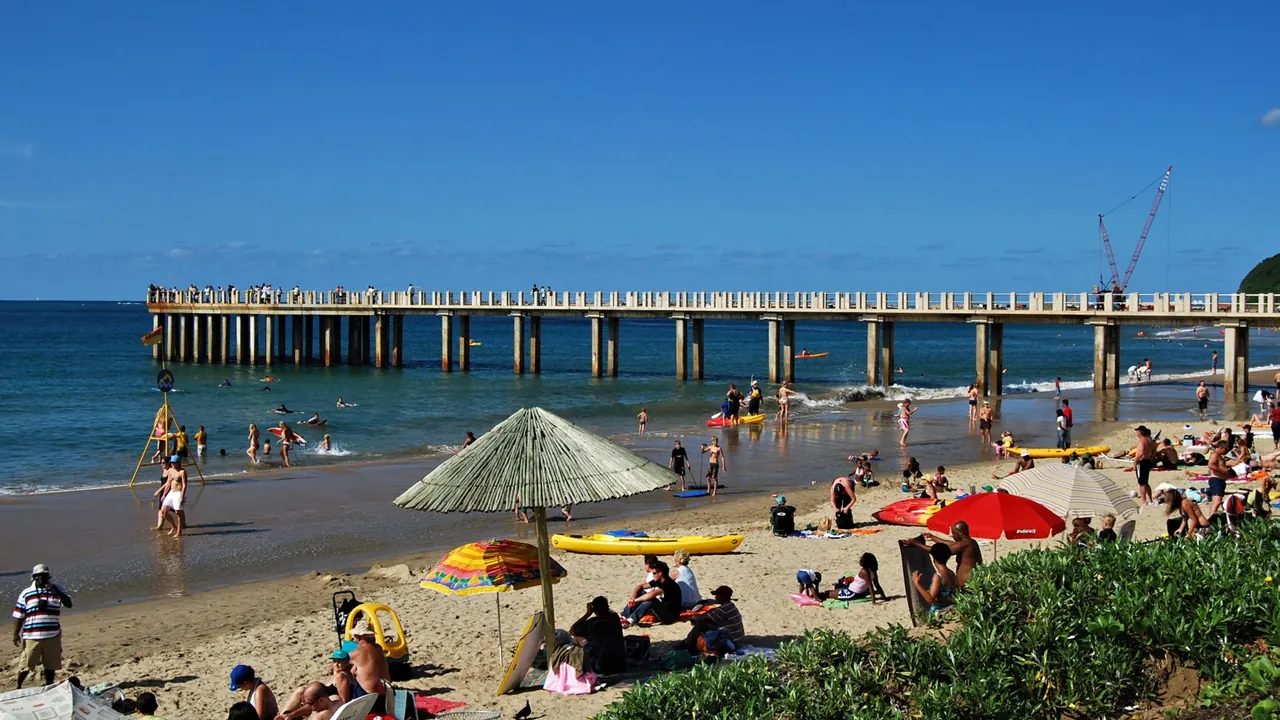
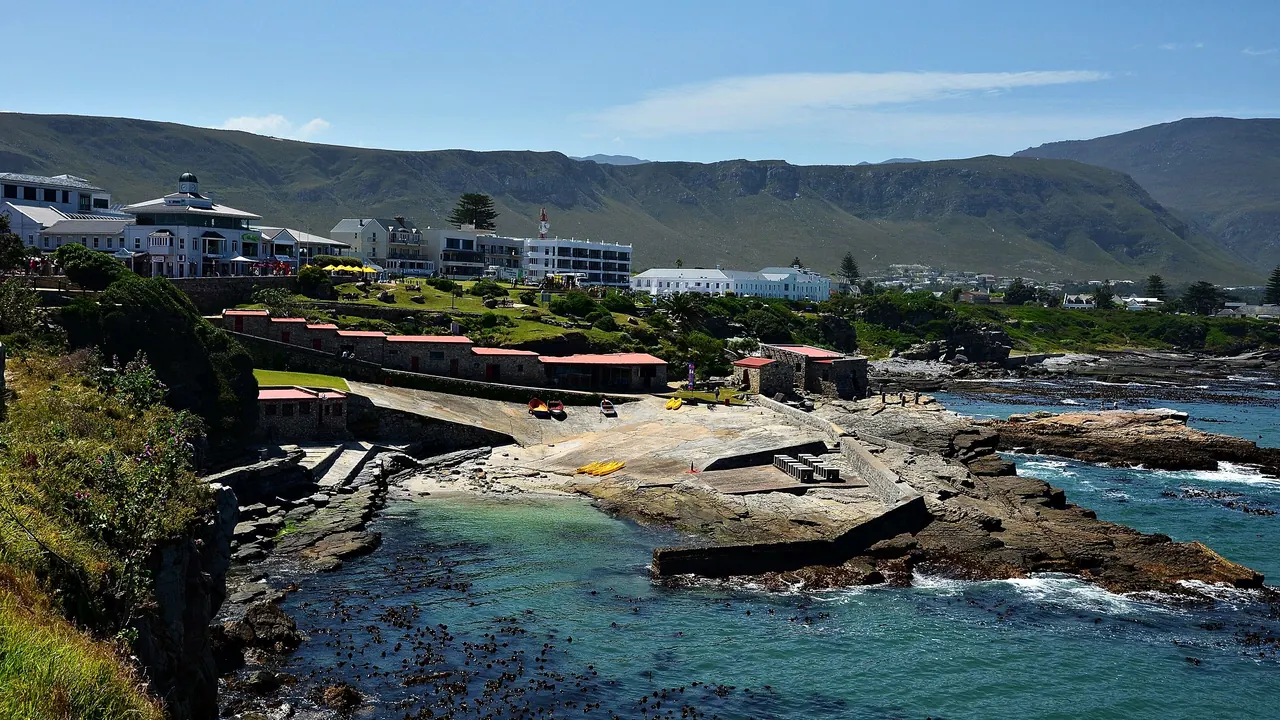
Photos: Durban by Ossewa, CC BY-SA 4.0, cropped; Hermanus by Pavel Špindler, CC BY 3.0, cropped.
Durban or Hermanus?
Our verdict in twelve categories, each scored against the same fixed benchmark cities, and the climate month by month, so you can choose for your trip.
Choose Durban for
- beaches
- nightlife
- live music and the arts
Durban is the choice for a warm-water beach trip with a city attached. The Indian Ocean stays swimmable all year, the Golden Mile has lifeguards and shark nets, and in the evenings there are fiery curries, a few bar streets and a stage programme. It suits families, and anyone who wants sand, surf and spice more than scenery. You will be getting around by car or ride-hailing.
Choose Hermanus for
- day trips
- nature and the outdoors
- wellness
Hermanus suits travellers who come for the landscape and a slower pace. Whales calve within sight of the cliff path, fynbos-covered trails climb straight out of town, and long lunches at the Hemel-en-Aarde wine estates fill the afternoons. It also makes a good base for driving to Cape Town, the Winelands and Cape Agulhas. Expect a cold sea and early nights.
Scoreboard
Twelve categories on one fixed scale from 0 to 100. The shaded stretch is the gap between the two.
Your match
Pick a travel style or drag the sliders, and both match scores follow your weighting.
Wins on beaches and nightlife with your weighting.
Wins on day trips and nature and the outdoors with your weighting.
What matters to you?
Category by category
What the scores mean for a trip.
Beaches & swimming
The real difference is the water. Durban's Indian Ocean is in the mid-20s through summer and only drops to about 21°C in the coolest months, so you can stay in for an afternoon, and the swimming areas along the city shore are patrolled and protected by shark nets. The Golden Mile gives you kilometres of sand right in front of the hotels, and Umhlanga, Ballito and the south coast offer quieter stretches nearby. The hazards are the rips, so keep to the patrolled zones, and the river mouths after a summer downpour.
Hermanus has beautiful beaches. Grotto is a broad white strand reaching east towards De Kelders, and Voëlklip and Kammabaai are smaller coves. What it lacks is warmth: Walker Bay stays several degrees cooler than Durban's water even in midsummer, and the wind can make it colder still. Here the beach is for walking, sunbathing and watching the surfers more than for swimming. Families with small children usually settle by the still lagoon behind Grotto.
Food & drink
Durban has the more distinctive cooking, built on Africa's largest Indian community. A bunny chow from a takeaway counter and a bag of masala from the Victoria Street Market are reasons to go in themselves. Outside curry and seafood the choice narrows.
Hermanus eats from the sea and the vineyards. There are line fish and abalone near the Old Harbour, and the Hemel-en-Aarde estates serve lunches with Pinot Noir and long views. It is pleasant rather than a place to explore a cuisine.
Culture & sights
Neither is a sightseeing destination, but Durban gives you a full day's worth. The Edwardian City Hall and its gallery, the Juma Masjid on Grey Street, the KwaMuhle Museum on the pass laws and Gandhi's Phoenix Settlement tell the story of a mixed and divided city.
In Hermanus the sights are the stone slipways of the Old Harbour, a small museum and the Whale House Museum, which you can see in an afternoon before heading back to the coast.
Nightlife
Durban at least has places to go. Florida Road's terraces fill at weekends, Umhlanga has polished hotel lounges, and the township shisanyama scene is loud on Sunday afternoons, though it is best visited with a local. Expect to move between venues by car.
Hermanus has a few pubs and wine bars that fill for sundowners, and then it goes quiet. For a proper night out you would drive to Cape Town.
Nature & outdoors
Hermanus is one of the best places in the world to watch whales from land. Southern right whales calve below the cliff path, and Fernkloof's fynbos trails, the lagoon and the coast road past the Kogelberg reserve and the Stony Point penguins are all close by.
Durban's strengths are under water. You can dive with ragged-tooth sharks on Aliwal Shoal, surf all year and watch the winter sardine run, and hike in the Valley of a Thousand Hills or Krantzkloof. The Drakensberg and the big game parks are too far for a day.
Day trips
Hermanus makes the better base for outings by car. Cape Town is reached along a dramatic coastal road, and Stellenbosch and Franschhoek are under two hours away. Closer in are Stanford, thatched Greyton and Elim, and Cape Agulhas at Africa's southern tip.
From Durban the choices are gentler. You can visit Pietermaritzburg's Victorian streets, the craft studios of the Midlands Meander and the Mandela Capture Site sculpture. The Zulu War battlefields, the region's major heritage sites, need an overnight stay.
Good for families
Durban has more that is built for children. uShaka Marine World puts an aquarium and water park on the beach, and the cable car over Moses Mabhida Stadium and the Umhlanga Sharks Board add more days, with warm, lifeguarded water in between. Parents need a car and should keep to busy, well-known areas.
Hermanus is calmer but has fewer attractions. Children can spot whales from the path, poke around rock pools and paddle in the shallow Grotto lagoon, but there is no aquarium or park, and the sea is too cold for long swims.
Getting around
Both places expect you to drive. Durban is a spread-out city where visitors use ride-hailing every day, and the beachfront promenade and its small bus are the only easy stretch without a car. The airport is about 30km north.
Hermanus has a walkable village centre and cliff path, but the town runs for kilometres along the coast and has no public transport you can rely on.
Shopping & style
Durban offers more, though little of it is stylish. The huge Umhlanga Ridge mall covers the brands. The better buys are spices from the Victoria Street Market and Zulu beadwork, baskets and telephone-wire bowls from the beachfront sellers.
In Hermanus there are a few galleries, boutiques and a weekend market. The best thing to take home is wine bought at the Hemel-en-Aarde cellar doors.
Affordability
Both are good value for visitors from abroad, with cheap local wine and moderate rooms. In Durban, the cheap meal is a curry or bunny chow and the extra cost is daily ride-hailing. Umhlanga is the expensive pocket.
In Hermanus, self-catering cottages give you plenty of space for the money. Rates rise in the December and January vacation and in whale season, and a hire car and boat trips take a large share of the budget.
Live music & performing arts
Durban has a real, if modest, calendar. There is theatre and dance at the Playhouse, the KwaZulu-Natal Philharmonic plays in the City Hall, and the Jomba dance festival and the film festival are the highlights. The local gqom and maskandi scenes are worth seeking out with a guide.
Hermanus offers a yearly arts festival, outdoor stages at the whale festival and the odd pub singer. For concerts or theatre, people go to Cape Town.
Wellness & relaxation
Hermanus is the more restful place, because of its pace rather than its spas. Days are spent walking the cliff path, watching the bay and lingering over wine-farm lunches, with a cold morning dip in a tidal pool. There are a few spas and some yoga.
Durban is noisy, and its wellness means good-value resort spas in Umhlanga and towards Ballito. People who really want to slow down go inland to the country spa hotels of the Midlands.
When should you go?
Pick your month. The climate figures are measured averages, not a forecast.
Durban in July
Hermanus in July
Daytime high, °C
Rainfall in the month, mm
Where the figures come from
Hermanus's temperatures are measured 77 km from the centre, at Cape Town Airport.
Hermanus has no rain gauge within 25 km of the centre, so its rainfall comes from a gridded climate dataset read at the city rather than from a gauge further away.
Temperature and rainfall are climate normals, averaged over the years shown. Durban: 1991-2020 normals, Durban, Durban International Airport (14.1 km from centre). Hermanus: 1991-2020 normals, Cape Town Airport (76.8 km from centre).
The two places have their wet seasons at opposite ends of the year. Durban is warm in every month and wet in summer. From October to March afternoon storms bring heavy rain, peaking at about 131mm in January, and the air is hot and humid. May to August is dry, sunny and mild, which makes it the best time for walking and hiking. Even then the sea rarely falls below 21°C, so swimming is possible all year.
Hermanus has a Mediterranean pattern. December to February is dry and very sunny, the best months for the beach, although the water rarely gets past 19°C. From June to August the town is cool and wet, with highs around 18°C and close to 100mm of rain a month. That is also when the whales are in the bay, so a winter visit means bringing a rain jacket. Spring and autumn give mild, settled walking weather.
Which traveller are you?
On a beach and sun trip, Durban is the clear pick. Its long, lifeguarded sand faces a warm Indian Ocean you can swim in for as long as you like. Hermanus has fine beaches, but in Walker Bay a swim is a quick, cold dip.
For an outdoors trip, choose Hermanus. You can watch whales from land, hike Fernkloof's flowering fynbos, paddle on the lagoon and see penguins at Stony Point, all close to town. Durban's best outdoors is diving and surfing, and its big parks are hours away.
On a food and nightlife trip, Durban gives you more to do. There is bunny chow and red curry from city-centre counters, terraces along Florida Road and Sunday shisanyama. In Hermanus you get seafood and wine-estate lunches, and then the town is asleep by eleven.
Before you go
| Measure | Durban | Hermanus |
|---|---|---|
| Official language | English, Zulu, Xhosa, Afrikaans, Venda, Northern Sotho, Swazi, Tswana, Tsonga, Sesotho, Southern Ndebele, South African Sign Language | English, Zulu, Xhosa, Afrikaans, Venda, Northern Sotho, Swazi, Tswana, Tsonga, Sesotho, Southern Ndebele, South African Sign Language |
| Currency | Rand (ZAR) | Rand (ZAR) |
| Sockets | CMN230 V, 50 Hz | CMN230 V, 50 Hz |
| Driving side | Left | Left |
| Time zone | UTC+2 | UTC+2 |
| Emergency number | 112 | 112 |
| Elevation | 22 m | 27 m |
| Main airport | King Shaka International Airport (DUR)29 km from centre13 non-stop destinations | Cape Town International Airport (CPT)77 km from centre45 non-stop destinations |
| Public holidays this year | 13 days | 13 days |
By the numbers
| Measure | Durban | Hermanus |
|---|---|---|
| City population | 595,061 | - |
| People per km² | 2,634 | - |
| Museums within 10 km | 1 | 0 |
| UNESCO World Heritage sites within 50 km | 1 | 0 |
| Swim season, months above 21 °C | 12 months | None |
Where else could you go?
Every comparison below shares a destination with this one, so you can follow Durban or Hermanus somewhere new.
- Stellenboschvs Hermanus
- Cape Townvs Hermanus
- Knysnavs Hermanus
- Johannesburgvs Durban
- Knysnavs Durban
- Stellenboschvs Durban