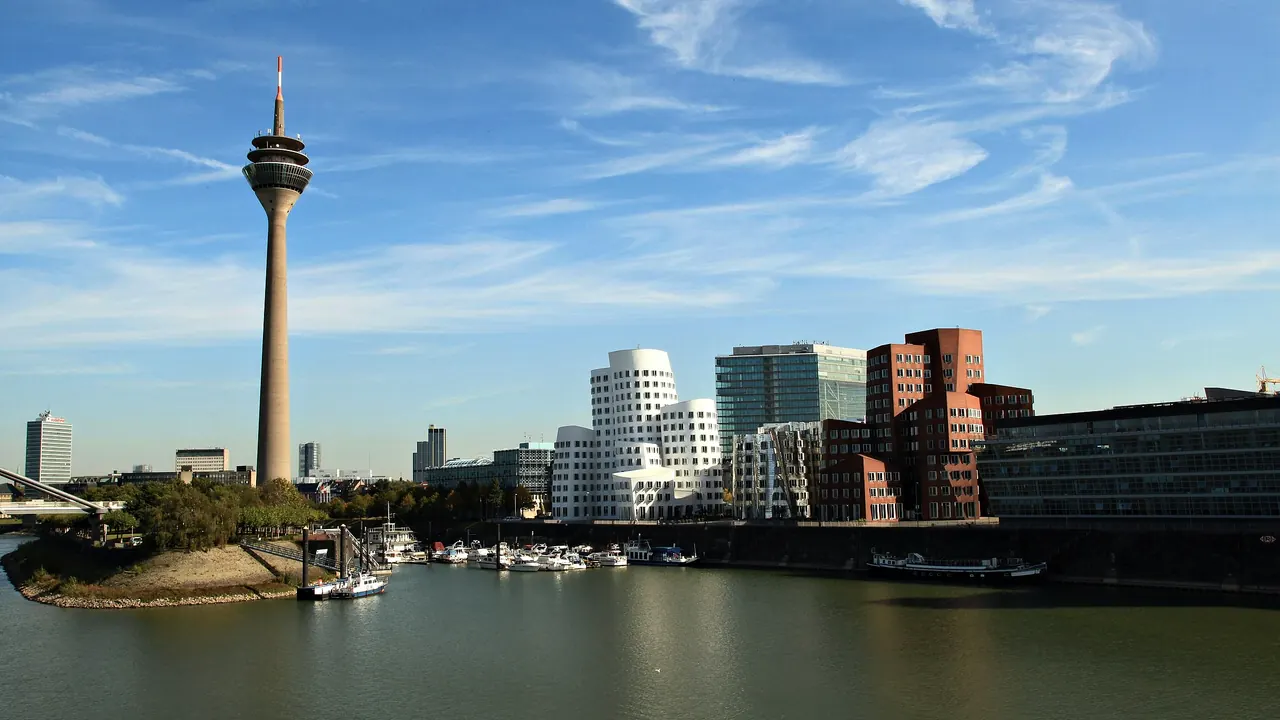
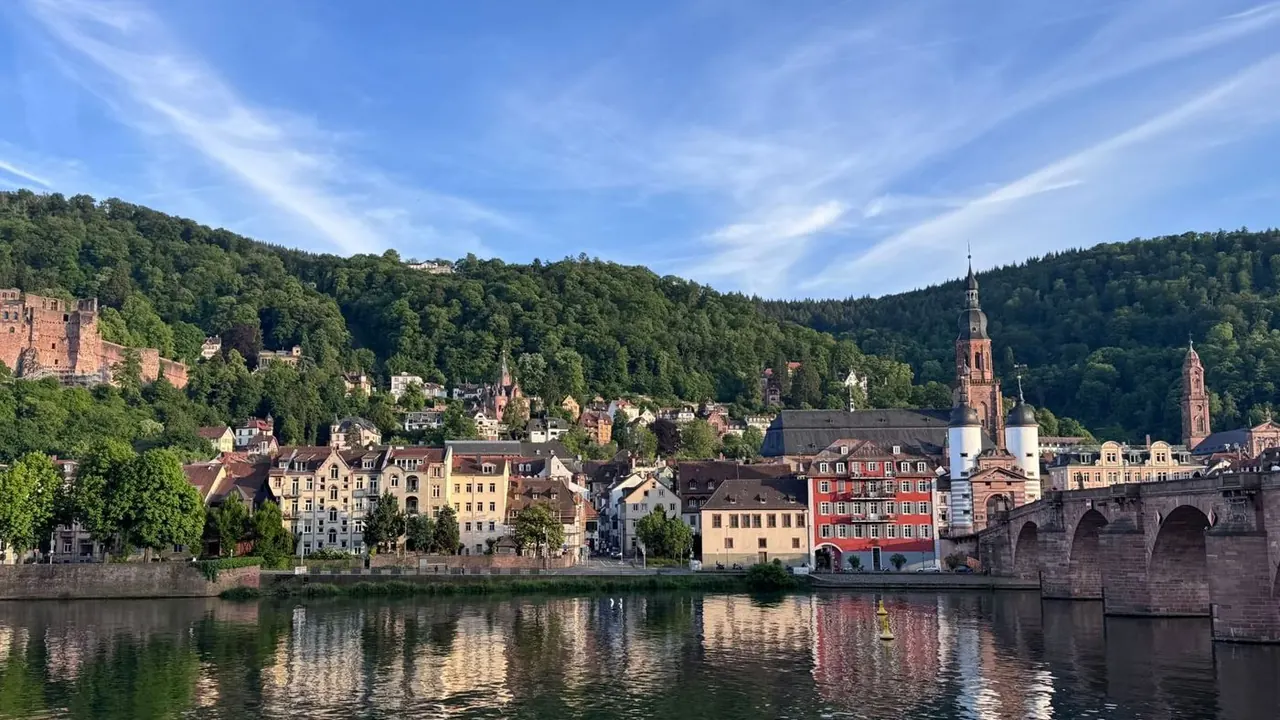
Photos: Dusseldorf by Frank Vincentz, CC BY-SA 3.0, cropped; Heidelberg by Kuanling Chen, Pexels License.
Dusseldorf or Heidelberg?
Our verdict in twelve categories, each scored against the same fixed benchmark cities, and the climate month by month, so you can choose for your trip.
Choose Dusseldorf for
- shopping
- nightlife
- food and drink
Düsseldorf suits travellers who want a proper city around them in the evening. Its Altstadt brewhouses and the Japanese quarter around Immermannstrasse give it a wider table, the bar streets stay full long after dark, and the Königsallee makes it the obvious pick for anyone who wants to shop. Add opera, a major orchestra and serious modern art collections, and it rewards a long weekend spent mostly indoors and out at night.
Choose Heidelberg for
- nature and the outdoors
- culture and sights
Heidelberg is the better fit for a slower, more scenic trip. The castle ruin above a well-preserved baroque old town, the Philosophers' Walk and forest trails that start at the edge of the Altstadt make it the place for walkers, cyclists and anyone who wants a picture-book German town. Evenings are quieter and the food is simpler, but wine from the surrounding hills and the Neckar valley make up for much of that.
Scoreboard
Twelve categories on one fixed scale from 0 to 100. The shaded stretch is the gap between the two.
Your match
Pick a travel style or drag the sliders, and both match scores follow your weighting.
Wins on shopping and nightlife with your weighting.
Wins on nature and the outdoors and culture and sights with your weighting.
What matters to you?
Category by category
What the scores mean for a trip.
Beaches & swimming
Neither city is a place for a beach vacation, and neither river is safe to swim in. Düsseldorf has the slight edge because Unterbacher See, a lake with lawns and bathing areas, lies within the city boundary.
Heidelberg's swimmers use its outdoor pools or drive about half an hour to gravel-pit lakes on the Rhine plain. In both cases the sea is a long journey away, so plan any time by the water elsewhere.
Food & drink
Düsseldorf gives you more to eat. Alongside the Altstadt brewhouses with sauerbraten, Halve Hahn and the city's sharp mustard, it has one of Europe's largest Japanese communities, so ramen, izakaya and Japanese bakeries make a genuine second cuisine, and Carlsplatz market adds snacks and produce.
Heidelberg's kitchen is hearty Baden and Kurpfalz cooking, from Maultaschen to spring asparagus, and its real strength is wine from the Bergstrasse and Palatinate villages close by. Choose carefully, though, as the places on the Hauptstrasse aimed at day-trippers are uneven and the better meals are in side streets, in Neuenheim or in village taverns.
Culture & sights
These two are evenly matched but offer very different things. Düsseldorf is a city of art collections: K20 with its Klee holdings, K21 with the net slung under its dome, the Kunstpalast and galleries shaped by the art academy. Its old town is largely rebuilt, so Benrath Palace and the Gehry buildings in the Medienhafen do most of the architectural work.
Heidelberg is the opposite case, with less art and far more old fabric. The red sandstone castle ruin, the Old Bridge, a baroque Altstadt and Germany's oldest university with its graffiti-covered Student Prison make a compact, photogenic set that suits anyone who wants historic streets more than galleries.
Nightlife
Düsseldorf is the livelier night out by a wide margin. Hundreds of pubs and brewhouses packed into the Altstadt spill onto the lanes at weekends, there are calmer cocktail bars in Carlstadt and the Medienhafen, and Carnival turns the whole city into a party for days.
Heidelberg's evenings centre on the Untere Strasse and a few historic student taverns with carved tables. They are fun in term time, but the town goes quiet early otherwise, and locals wanting a real club night head to Mannheim or Frankfurt.
Nature & outdoors
Heidelberg has the better outdoors because the Odenwald forest starts right at the edge of town. You can climb the Philosophers' Walk for the castle view, ride the funicular up the Königstuhl at 568m, or explore the Celtic ramparts on the Heiligenberg, with the Neckar cycle path and the Palatinate Forest further out.
Düsseldorf's green space is flatter and gentler: Rhine meadows with long cycle paths to Kaiserswerth, Grafenberg forest and the Neandertal valley. It is pleasant for a stroll or a ride, but it can't offer forest walks straight from the old town.
Day trips
Both are excellent bases, so the choice comes down to which region you want to see. From Düsseldorf, Cologne cathedral is under half an hour away, with Bonn, the Brühl palaces, the Ruhr's industrial heritage at Zollverein, Aachen and Dutch Maastricht all easy by fast trains.
Heidelberg looks towards the Upper Rhine and its Romanesque and medieval sites: Speyer's cathedral, Schwetzingen's gardens, Worms, Lorsch and Maulbronn. It also has gentler outings to castle villages up the Neckar and the wine villages of the Palatinate, although some of these are easier by car.
Good for families
Düsseldorf's flat, compact centre and trams that take buggies without fuss make it the easier place to push a pram, and most of its treats are in town: the aquarium and natural history displays of the Aquazoo Löbbecke Museum, the tilted windows high up the Rheinturm, and wild boar and deer coming close in the free Grafenberg game park. Phantasialand and Movie Park Germany are each about an hour away.
Heidelberg's cobbled, sloping Altstadt is harder going with a pushchair, but its outings feel more like adventures. The funicular climbs to the Königstuhl and its small fairy-tale park, the compact zoo sits by the Neckar, and boat trips run upriver past castles. Within half an hour, the Technik Museum Speyer lets children climb into a space shuttle and a submarine.
Getting around
Both are easy to manage without a car, but Düsseldorf is a little smoother. Its centre is compact and flat, the main districts are all within walking distance, and the airport is only minutes away by train.
Heidelberg's sights line up neatly along the pedestrianised Hauptstrasse, but the station is a tram ride west of the old town and the castle approach is steep and cobbled, which the funicular helps with. Both cities belong to large regional fare networks, Rhine-Ruhr and Rhine-Neckar, which make day trips simple.
Shopping & style
Düsseldorf is the shopping city of the two, thanks to the Königsallee, where luxury flagships and jewellers line the canal. Department stores on Schadowstrasse, design shops in Flingern and stationery and homeware in the Japanese quarter add variety.
Heidelberg's Hauptstrasse is long, but it moves from chain stores to souvenirs, cuckoo clocks and beer steins. Apart from a few bookshops and boutiques in the side lanes, the best buys there are Bergstrasse wine and Studentenkuss chocolates.
Affordability
Costs are much the same, and in both cities the hotel is the expensive part. Düsseldorf's room rates jump during its trade fairs, while Heidelberg's limited supply of rooms fills up with congresses, graduations and summer weekends, so many visitors stay in Mannheim instead.
Eating out is reasonable in both: brewhouse meals and noodle bars in Düsseldorf, and student cafés and simple taverns in Heidelberg.
Live music & performing arts
Düsseldorf has more on stage. The Deutsche Oper am Rhein stages opera and ballet, the Tonhalle is home to a symphony orchestra in a former planetarium, and the Schauspielhaus is a leading theatre. On top of that come political cabaret, small jazz venues and the city's place in electronic music history as the birthplace of Kraftwerk.
Heidelberg makes up in setting what it lacks in scale. Its municipal theatre and philharmonic play through the season, the Heidelberger Frühling brings chamber music in spring, and summer plays and concerts are staged in the castle courtyard. For bigger opera productions, people take the short train ride to Mannheim.
Wellness & relaxation
Neither town has thermal springs of its own, and both rely on nearby spas. From Düsseldorf you can reach large thermal complexes and Aachen's hot springs, and its public pools have the mixed, swimwear-free saunas that are standard in Germany.
Heidelberg is within reach of the saline pools of the Kraichgau and of Baden-Baden. The way you relax differs too: in Düsseldorf it means walks along the Rhine and the Japanese garden in Nordpark, while in Heidelberg it means forest paths and slow evenings in wine taverns.
When should you go?
Pick your month. The climate figures are measured averages, not a forecast.
Dusseldorf in July
Heidelberg in July
Daytime high, °C
Rainfall in the month, mm
Temperature and rainfall are climate normals, averaged over the years shown. Dusseldorf: 1991-2020 normals, Düsseldorf (8.3 km from centre). Heidelberg: 1991-2020 normals, Heidelberg (4.5 km from centre).
The two share a similar inland German climate, with cold, grey winters and mild summers, and in both the best walking weather runs from May to September. Heidelberg is a touch warmer and noticeably sunnier through the summer, reaching about 26°C in July and August with more sunny hours than Düsseldorf, which makes its riverside lawns and hill walks especially pleasant then. Neither city gets too hot for sightseeing, and summer is also the wettest stretch in both, mostly in short showers.
Winter is where they differ a little more. Düsseldorf stays damper from November to February, with around 64mm of rain in January, while Heidelberg is drier early in the year at about 46mm and turns pleasant sooner, with spring blossom on the Bergstrasse. Both are dark and chilly in December and January, at around 6°C, so that season suits museums and taverns rather than long walks.
Which traveller are you?
For a food and nightlife trip, Düsseldorf is the clear choice. Its Altbier brewhouses, Japanese ramen counters and izakaya offer far more range, and the Altstadt bar streets run past midnight, while Heidelberg's student lanes quieten early outside term.
On an outdoors trip, Heidelberg wins easily. Forest trails begin right above the old town, a funicular climbs the Königstuhl, and the Neckar valley cycle path leads past castles, whereas Düsseldorf offers flat Rhine meadows and walking country further out.
For a shopping trip, Düsseldorf is far stronger. The Königsallee has luxury flagships and arcades, department stores sit nearby, and Flingern adds independent boutiques. Heidelberg's Hauptstrasse mixes high-street chains with souvenirs, and serious shoppers there take the train elsewhere.
Before you go
| Measure | Dusseldorf | Heidelberg |
|---|---|---|
| Official language | German | German |
| Currency | Euro (EUR) | Euro (EUR) |
| Sockets | CF230 V, 50 Hz | CF230 V, 50 Hz |
| Driving side | Right | Right |
| Time zone | UTC+1, UTC+2 in summer | UTC+1, UTC+2 in summer |
| Emergency number | 112 | 112 |
| Elevation | 38 m | 114 m |
| Main airport | Düsseldorf Airport (DUS)7 km from centre182 non-stop destinations | Frankfurt Main Airport (FRA)69 km from centre281 non-stop destinations |
| Public holidays this year | 11 days | 12 days |
By the numbers
| Measure | Dusseldorf | Heidelberg |
|---|---|---|
| City population | 619,444 | 156,092 |
| People per km² | 2,849 | 1,433 |
| Museums within 10 km | 25 | 17 |
| UNESCO World Heritage sites within 50 km | 4 | 4 |
Where else could you go?
Every comparison below shares a destination with this one, so you can follow Dusseldorf or Heidelberg somewhere new.