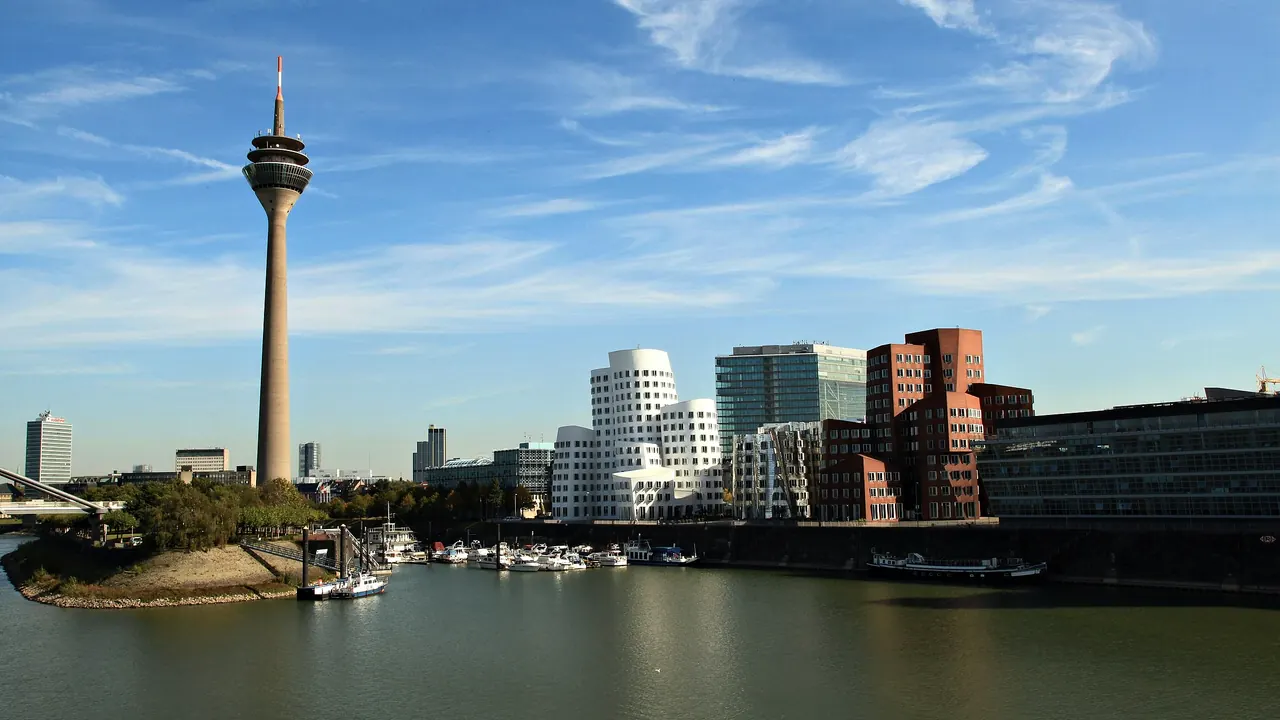
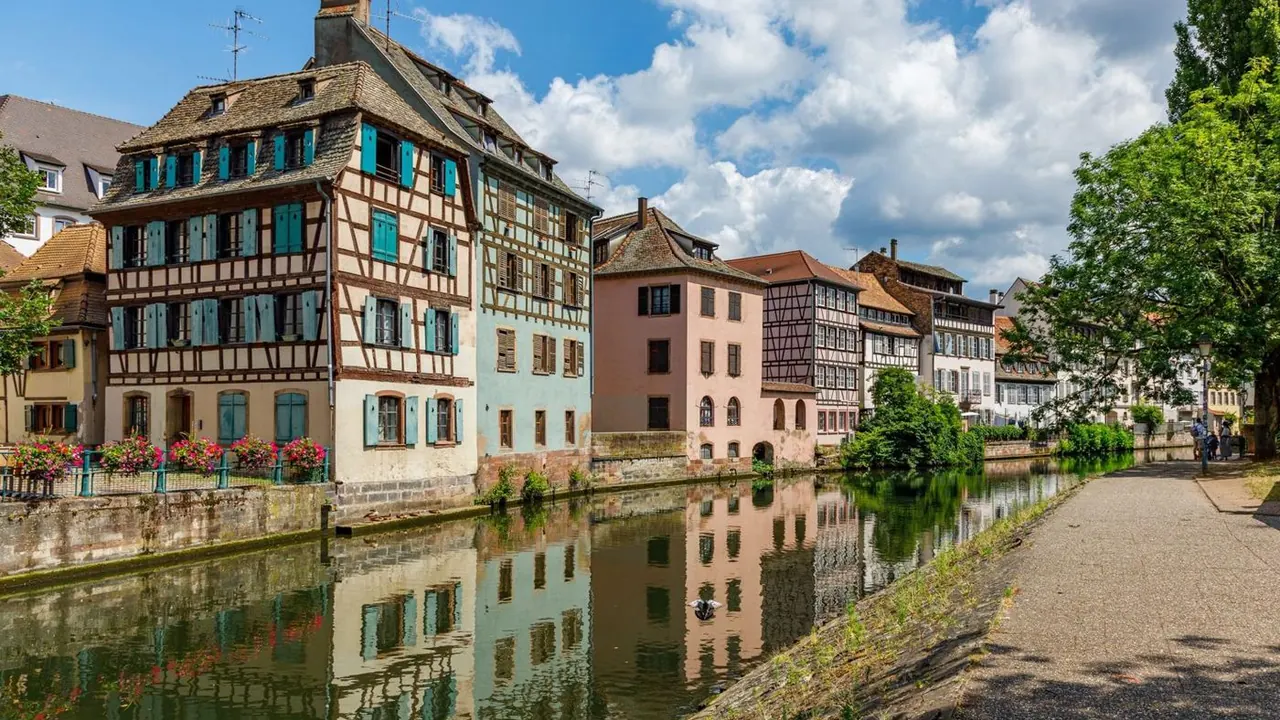
Photos: Dusseldorf by Frank Vincentz, CC BY-SA 3.0, cropped; Strasbourg by Edoardo Colombo, Pexels License.
Dusseldorf or Strasbourg?
Our verdict in twelve categories, each scored against the same fixed benchmark cities, and the climate month by month, so you can choose for your trip.
Choose Dusseldorf for
- nightlife
- shopping
- live music and the arts
Düsseldorf suits travellers who want a livelier, more urban stay. You get evenings in the Altstadt brewhouses, shopping on the Königsallee, a strong opera and concert programme, and a Japanese quarter that gives the city a second cuisine. It is also a practical base for a mixed trip taking in Cologne, Bonn and the industrial Ruhr.
Choose Strasbourg for
- nature and the outdoors
- culture and sights
- wellness
For a slower, more picturesque trip, Strasbourg is the better pick. Its cathedral and the half-timbered lanes of Petite France give it the historic core that Düsseldorf lost in the war. The Vosges and the Black Forest are close enough for a day's walking, and Baden-Baden's baths are near at hand. Nights end earlier, which suits travellers who would rather linger over a winstub dinner.
Scoreboard
Twelve categories on one fixed scale from 0 to 100. The shaded stretch is the gap between the two.
Your match
Pick a travel style or drag the sliders, and both match scores follow your weighting.
Too close to call, 1 point apart
Wins on nightlife and shopping with your weighting.
Wins on nature and the outdoors and culture and sights with your weighting.
What matters to you?
Category by category
What the scores mean for a trip.
Beaches & swimming
Neither city is a beach destination, and in both the Rhine is unsafe for swimming, so people swim in lakes instead. Düsseldorf's main choice is Unterbacher See, with lawns and bathing areas on the south-eastern edge of the city. The cool Dutch North Sea is a long day's travel away.
Strasbourg has no sea within reach at all, but it has more lifeguarded gravel-pit lakes, and the tram runs to the Baggersee. Either city will do for a hot afternoon, but neither works for a sun-and-sand vacation.
Food & drink
Both cities are rewarding places to eat, but the two kitchens are very different. Düsseldorf is built around beer: Altbier in small brewhouse glasses with sauerbraten and the city's spicy mustard. The ramen counters and izakaya around Immermannstrasse give it a variety Strasbourg lacks.
Strasbourg builds its meals around wine and Alsatian cooking, eaten in wood-panelled winstubs with a pichet of Riesling. It has the richer tradition of foie gras and fine dining in the nearby villages. On the other hand, there is little choice of other cuisines, and the tourist menus around the cathedral are best skipped.
Culture & sights
Strasbourg is the stronger city for sightseeing. The cathedral, the Grande Ile and Petite France form a medieval ensemble that survived, and the German-built Neustadt adds a second historic layer. The Palais Rohan museums and the European institutions add more on top.
Düsseldorf was heavily bombed and its Altstadt is largely rebuilt, so its draw is art rather than old streets: the Klee collection at K20, the net under K21's glass dome and the Kunstpalast. Benrath Palace is its finest historic building. Art lovers will be busy, but for historic streets Strasbourg is the stronger choice.
Nightlife
Düsseldorf is clearly the place for a night out. On weekends the Altstadt's few hundred bars and brewhouses spill out into the lanes and stay busy well past midnight. Carnival brings the whole city out for days, and the Medienhafen and Flingern have calmer bars.
Strasbourg's evenings centre on the student bars of the Krutenau and the summer terraces along the river. It has few clubs, and much of the city is quiet by midnight on weeknights. It suits a drink after dinner more than a late night.
Nature & outdoors
Strasbourg has far better countryside within easy reach. The Vosges rise to the west with forest trails, sandstone castle ruins and the ridge at Mont Sainte-Odile, and the Black Forest to the east has higher, more serious hiking. In the city itself, level cycle routes run along the Rhine and the canals.
Düsseldorf's surroundings are gentler: grassy Rhine meadows with flat cycle paths, Grafenberg forest and the wooded Neandertal, with the Bergisches Land hills about half an hour out. They are pleasant for a walk but cannot compare with the Vosges.
Day trips
Both make excellent bases, but for different kinds of trip. From Düsseldorf most outings are to towns and cities: Cologne cathedral in under half an hour, Bonn, the Brühl palaces, the Zollverein colliery and Aachen. Fast trains reach all of them, so you never need a car.
From Strasbourg the pull is the countryside: the Alsace wine villages, Colmar and Haut-Koenigsbourg on one side, and Baden-Baden, Freiburg and Heidelberg across the Rhine. Trains serve the towns well, but the wine route is easier by car or bike.
Good for families
Both cities are safe, compact and easy with a buggy, so the choice comes down to the outings. Düsseldorf has the Aquazoo Löbbecke, the Rheinturm's tilted windows and the free game park in Grafenberg, with Phantasialand and Movie Park within about an hour.
Strasbourg has boat trips through Petite France, storks and rowing boats in the Orangerie, and the hands-on Le Vaisseau science centre, with Europa-Park an hour away across the border. Its weak spot is museums aimed mostly at adults. In Düsseldorf, the rowdy Altstadt on weekend nights is the thing to avoid.
Getting around
Both are easy without a car, with a walkable centre and trams to fill the gaps. Düsseldorf's strength is how far its transport reaches: it belongs to a regional network running to Cologne and the Ruhr, and trains reach the airport in minutes. The fare zones take some getting used to.
Strasbourg's island centre is smaller and mostly pedestrianised. Its separated cycle lanes often make a bike the quickest way about, which Düsseldorf's busier inner roads cannot match. One tram line even crosses the Rhine to Kehl.
Shopping & style
Düsseldorf is the better shopping city by some way. Luxury flagships and jewellers line one bank of the Königsallee's canal, while the department stores and the Kö-Bogen cover mainstream shopping. Flingern's boutiques and the Japanese quarter's stationery and homeware shops add independent options.
Strasbourg has little luxury or fashion of note. What it offers instead is regional goods: Alsace wine, Soufflenheim pottery, printed linens and gingerbread. December, during the Christmas market, is the peak season for crafts.
Affordability
Neither city is cheap, and in both the hotel is the main expense while everyday eating is fair. In Düsseldorf, avoid the trade fair weeks, when rooms can cost several times the usual rate. Brewhouse plates and Japanese noodles keep meals down.
In Strasbourg, the expensive times are the Christmas market and the weeks when the European Parliament sits. Winstub dinners and wine by the pichet are reasonable, and the cathedral and the old town cost nothing to see.
Live music & performing arts
Düsseldorf has the slightly broader year-round programme. It has the Deutsche Oper am Rhein, the symphony orchestra in the domed Tonhalle and the Schauspielhaus, plus political cabaret and its place in music history as Kraftwerk's home. Small jazz venues in the Altstadt and Flingern add more casual evenings.
Strasbourg is just as serious but narrower in range. The Opéra national du Rhin, the Philharmonic and the Théâtre National are all strong, and the autumn Musica festival gives it a particular standing in contemporary music. Evenings there take more planning around the season.
Wellness & relaxation
Strasbourg is the better choice for a restful stay. It has its own early twentieth-century public baths, the Bains municipaux, with tiled pools, a hammam and saunas. Baden-Baden's Friedrichsbad and Caracalla baths are under an hour away, and canal walks and long winstub lunches set an unhurried pace.
Düsseldorf has no springs of its own. Its saunas are inside public pools, mostly mixed and without swimwear, and the large thermal complexes and Aachen's hot springs mean a longer trip. The Rhine meadows and the Japanese garden in Nordpark still make for calm walks.
When should you go?
Pick your month. The climate figures are measured averages, not a forecast.
Dusseldorf in July
Strasbourg in July
Daytime high, °C
Rainfall in the month, mm
Temperature and rainfall are climate normals, averaged over the years shown. Dusseldorf: 1991-2020 normals, Düsseldorf (8.3 km from centre). Strasbourg: 1991-2020 normals, Strasbourg (9.1 km from centre).
The two cities share a cool central European pattern. The warm months run from late May to mid September. Winters are grey and chilly, better for museums than for long walks. Neither has a sea, so swimming means the local lakes, and those are comfortable only in July and August.
Strasbourg is a little warmer and clearly sunnier in summer, reaching 26°C in July and August, but May is its wettest month at 77mm. Its winters are drier, with about 35mm in January and February. Düsseldorf has steady rain all year, heaviest in July and August, peaks at 25°C in July and gets less summer sun. June to August is its best time for the riverbanks. In Strasbourg, September stays pleasantly warm for walking.
Which traveller are you?
For a food and nightlife trip, Düsseldorf is the livelier pick. The Altstadt brewhouses serve Altbier and hearty plates until late, the Japanese quarter adds ramen and izakaya, and weekends and Carnival keep the streets full well past midnight.
On a culture and arts trip, Strasbourg comes out ahead for its sights. The cathedral, Petite France and the Neustadt make up an old city of a kind Düsseldorf lost to wartime bombing. Düsseldorf's K20, K21 and opera still suit lovers of modern art.
For an outdoors trip, Strasbourg is the better base. The Vosges and the Black Forest are each about an hour away for proper hiking, and long, level cycle routes follow the Rhine. Düsseldorf has only gentle river meadows and low wooded hills.
Before you go
| Measure | Dusseldorf | Strasbourg |
|---|---|---|
| Official language | German | French |
| Currency | Euro (EUR) | Euro (EUR) |
| Sockets | CF230 V, 50 Hz | CE230 V, 50 Hz |
| Driving side | Right | Right |
| Time zone | UTC+1, UTC+2 in summer | UTC+1, UTC+2 in summer |
| Emergency number | 112 | 112 |
| Elevation | 38 m | 132 m |
| Main airport | Düsseldorf Airport (DUS)7 km from centre182 non-stop destinations | Strasbourg Airport (SXB)10 km from centre43 non-stop destinations |
| Public holidays this year | 11 days | 11 days |
By the numbers
| Measure | Dusseldorf | Strasbourg |
|---|---|---|
| City population | 619,444 | 293,771 |
| People per km² | 2,849 | 3,752 |
| Museums within 10 km | 25 | 21 |
| UNESCO World Heritage sites within 50 km | 4 | 1 |
Where else could you go?
Every comparison below shares a destination with this one, so you can follow Dusseldorf or Strasbourg somewhere new.