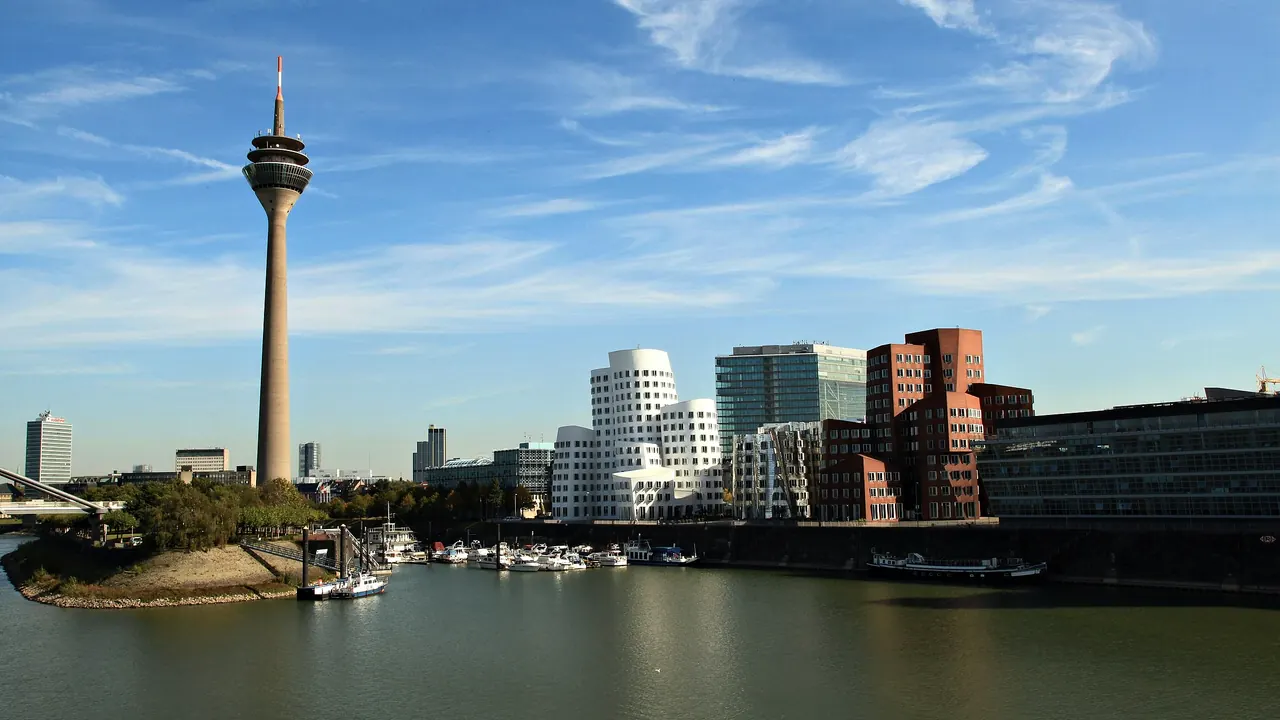
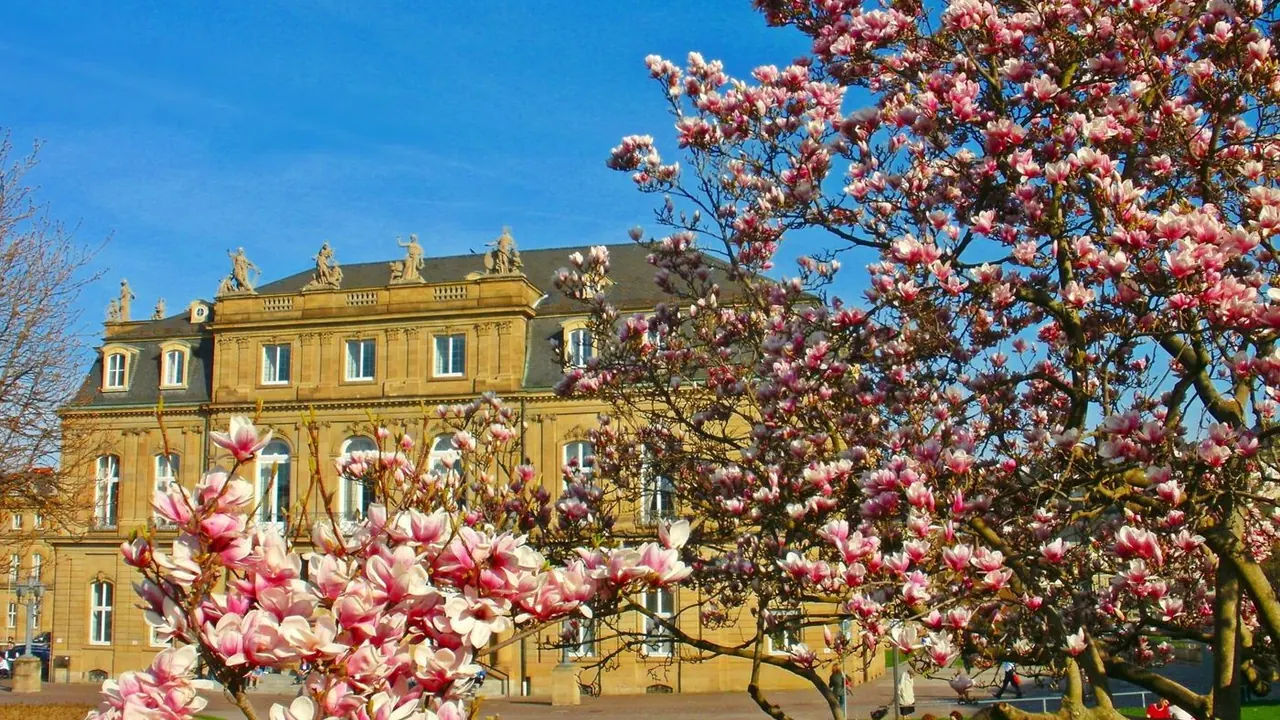
Photos: Dusseldorf by Frank Vincentz, CC BY-SA 3.0, cropped; Stuttgart by Baden de, CC BY 3.0, cropped.
Dusseldorf or Stuttgart?
Our verdict in twelve categories, each scored against the same fixed benchmark cities, and the climate month by month, so you can choose for your trip.
Choose Dusseldorf for
- nightlife
- shopping
- getting around
Düsseldorf suits travellers who want their evenings to count. The Altstadt's packed brewhouse lanes and the days of Carnival give it a going-out life Stuttgart cannot match. Daytime brings the Königsallee, the modern art of K20 and K21 and lunch in the Japanese quarter, all within a flat centre you can cover on foot. It is the better pick for a sociable city break with shopping and a few rounds of Altbier.
Choose Stuttgart for
- wellness
- nature and the outdoors
- live music and the arts
Stuttgart rewards a slower, more cultivated trip. Its ballet and opera are among the best in Europe, and warm mineral springs feed public baths in the middle of the city. Vineyards and forest start at the edge of the basin, with the Swabian Jura and the Black Forest close by. Choose it for evenings at the theatre, afternoons in the pools and days on the trails, with the car museums as a bonus.
Scoreboard
Twelve categories on one fixed scale from 0 to 100. The shaded stretch is the gap between the two.
Your match
Pick a travel style or drag the sliders, and both match scores follow your weighting.
Too close to call, 1 point apart
Wins on nightlife and shopping with your weighting.
Wins on wellness and nature and the outdoors with your weighting.
What matters to you?
Category by category
What the scores mean for a trip.
Beaches & swimming
Neither city offers any beach life, and neither river is safe for swimming. The difference is where locals swim instead. In Düsseldorf it is Unterbacher See, a lake with lawns and bathing areas on the edge of the city. Stuttgart has outdoor pools, some of them fed by its mineral springs, and its nearest open water worth the trip, Lake Constance, is more than two hours away.
Food & drink
The two cities are close for eating, but the flavours could hardly be more different. Düsseldorf's table has two sides. One is the Altbier brewhouses of the Altstadt, with pork knuckle and the city's spicy brown mustard. The other is the ramen counters, izakaya and Japanese bakeries around Immermannstrasse, home to one of Europe's largest Japanese communities, which give it more international choice than Stuttgart.
Stuttgart's cooking is Swabian through and through: Maultaschen, Käsespätzle and roast beef heaped with onions in the wine taverns. Here the drink is wine rather than beer. It comes from vineyards inside the city limits and is poured with onion tart in the seasonal Besen taverns that growers open in their own houses.
Culture & sights
Both centres were heavily bombed in the war, so in either city the interest lies more in museums and modern buildings than in old streets. Düsseldorf is the art specialist. K20 holds its Klee collection, at K21 you can walk on a net slung under a glass dome, and the Kunstpalast covers old masters to glass. Benrath Palace and the Gehry buildings of the Medienhafen add architecture.
Stuttgart has slightly more range. The Mercedes-Benz and Porsche museums are of international standing even for visitors with no interest in cars, the Staatsgalerie has a fine run of European painting, and the Weissenhof Estate's Le Corbusier houses are part of a UNESCO listing.
Nightlife
Going out is one of Düsseldorf's strengths. The Altstadt, known as the longest bar in the world, turns into a street party at weekends, with crowds drinking Altbier outside until well past midnight. Carnival keeps the whole city out in costume for days.
Stuttgart's nights are sociable but quieter. Most of the action is on the Theodor-Heuss-Strasse bar strip and in a few basement clubs, and on weekdays the city settles down early. Its big nights come with the Cannstatter Volksfest and the late-summer wine village.
Nature & outdoors
Stuttgart has much better access to the outdoors. The city sits in a basin of vineyards and forest, so a walk from the centre soon climbs onto wine trails or into the Rotwildpark. The limestone cliffs and caves of the Swabian Jura and the fir-covered ridges of the Black Forest are both within about an hour.
Düsseldorf's countryside is flat and mild. There are long cycle paths along the Rhine meadows, shaded walks in Grafenberg forest and the wooded Neandertal valley. The Bergisches Land offers hills, but nothing here compares with what lies around Stuttgart.
Day trips
Both cities are excellent bases for day trips, but the trips are of different kinds. From Düsseldorf you reach large cities and industrial heritage: Cologne Cathedral in under half an hour, Bonn and the Brühl palaces, the Zollverein colliery in Essen, and Aachen or Dutch Maastricht for a longer day.
From Stuttgart the trips lead to smaller historic towns and castles. Options include the baroque palace at Ludwigsburg, the steep lanes of Tübingen, Heidelberg's castle by fast train, Hohenzollern on its hilltop and the monastery at Maulbronn, with Strasbourg in reach across the French border.
Good for families
With a pushchair, Düsseldorf is the easier of the two. Its centre is flat and the trams take buggies without fuss. The Aquazoo and the tilted windows of the Rheinturm are the main attractions in town, and Phantasialand and Movie Park Germany are both within about an hour for a bigger day out.
Stuttgart has the best single family day in either city: Wilhelma, a zoo and botanical garden among Moorish-style pavilions. The narrow-gauge railway on Killesberg and the rack railway are extra treats. The hills make for harder work with a pushchair, though, and for a big theme park you have to leave the city.
Getting around
Düsseldorf is slightly easier to get around. Its centre is flat from the Altstadt to the Japanese quarter, the riverside path makes walking a pleasure, and trains reach the airport in minutes. The regional network also takes you on to Cologne and the Ruhr without a change of system.
Stuttgart's core is just as compact, but beyond it the streets climb steeply. Light rail, a rack railway, a funicular and the public stairways called Stäffele take you up the hills, all on one ticket. This is good fun, but it means more climbing than in Düsseldorf.
Shopping & style
Düsseldorf is the stronger fashion city. The Königsallee, with luxury flagships along a tree-lined canal, has no real equal in Stuttgart. The Japanese quarter's stationery and homeware shops and the boutiques of Flingern add things you would not find at home.
Stuttgart is mostly about familiar brands. Königstrasse is a long pedestrian high street, and Breuninger is the main stop for designer labels. Many visitors save their spending for the outlet village at Metzingen, about half an hour away.
Affordability
Both are prosperous business cities with similar costs, and in both, hotel rooms become much dearer and harder to find during the big trade fairs. In Düsseldorf, Japanese noodle bars and brewhouse meals are the cheapest ways to eat well. In Stuttgart, hotels are noticeably cheaper at weekends, and the taverns serve generous portions for what they charge.
Live music & performing arts
Stuttgart has the stronger stage. Its ballet has been among Europe's most respected companies since John Cranko's era, the Staatsoper is known for bold productions, and the Liederhalle carries a strong Bach tradition. Book early for the ballet, as tickets are hard to get.
Düsseldorf's programme is reliable rather than exceptional: opera and ballet at the Deutsche Oper am Rhein and concerts in the domed Tonhalle. It also has political cabaret and a special place in electronic music as the birthplace of Kraftwerk.
Wellness & relaxation
This is one of the clearest differences between the two cities. Stuttgart sits on some of Europe's most productive mineral springs, and you can soak in naturally carbonated warm water at the Mineralbad Cannstatt or the Mineralbad Leuze without leaving the city.
Düsseldorf has no springs of its own. Relaxing there means the sauna areas of public pools, a trip of about an hour to a large thermal complex, or long walks in the Hofgarten and the Japanese garden in Nordpark.
When should you go?
Pick your month. The climate figures are measured averages, not a forecast.
Dusseldorf in July
Stuttgart in July
Daytime high, °C
Rainfall in the month, mm
Temperature and rainfall are climate normals, averaged over the years shown. Dusseldorf: 1991-2020 normals, Düsseldorf (8.3 km from centre). Stuttgart: 1991-2020 normals, Stuttgart / Neckartal (2.8 km from centre).
The two cities have almost the same temperatures through the year. Winters are grey and cold, with January highs of about 6°C, so December to February is better for museums than for long walks. The best months for walking the streets are May to September. Neither city gets uncomfortably hot: summer highs reach about 25°C in Düsseldorf and a degree more in Stuttgart.
The real difference is sun and rain. Düsseldorf's rain is spread evenly across the year, with a little more in late summer, so pack an umbrella whatever the month. Stuttgart is much drier in winter, with about 35mm in January against Düsseldorf's 64mm. Its rain peaks in early summer, when it is as wet as Düsseldorf, and it is noticeably sunnier from spring to autumn. Neither city is a beach destination in any month.
Which traveller are you?
For a food and nightlife trip, Düsseldorf is the clear choice. The Altstadt's few hundred bars and brewhouses fill the lanes on weekend nights. Between rounds you can eat sauerbraten and Halve Hahn in the old town or ramen near Immermannstrasse.
On a relaxing and wellness trip, go to Stuttgart. The mineral springs of Bad Cannstatt and Berg feed warm, naturally carbonated baths indoors and out, and there are vineyard walks close to the centre. Düsseldorf has saunas but no springs of its own.
For an outdoors trip, Stuttgart again has the advantage. Wooded hills and wine trails begin where the city ends, and both the cliff-edge paths of the Swabian Jura and the ridges of the northern Black Forest are about an hour away. Düsseldorf's countryside is gentle and flat.
Before you go
| Measure | Dusseldorf | Stuttgart |
|---|---|---|
| Official language | German | German |
| Currency | Euro (EUR) | Euro (EUR) |
| Sockets | CF230 V, 50 Hz | CF230 V, 50 Hz |
| Driving side | Right | Right |
| Time zone | UTC+1, UTC+2 in summer | UTC+1, UTC+2 in summer |
| Emergency number | 112 | 112 |
| Elevation | 38 m | 245 m |
| Main airport | Düsseldorf Airport (DUS)7 km from centre182 non-stop destinations | Stuttgart Airport (STR)10 km from centre124 non-stop destinations |
| Public holidays this year | 11 days | 12 days |
By the numbers
| Measure | Dusseldorf | Stuttgart |
|---|---|---|
| City population | 619,444 | 609,365 |
| People per km² | 2,849 | 2,938 |
| Museums within 10 km | 25 | 42 |
| UNESCO World Heritage sites within 50 km | 4 | 3 |
Where else could you go?
Every comparison below shares a destination with this one, so you can follow Dusseldorf or Stuttgart somewhere new.