Ecuador
Cuenca, Ecuador
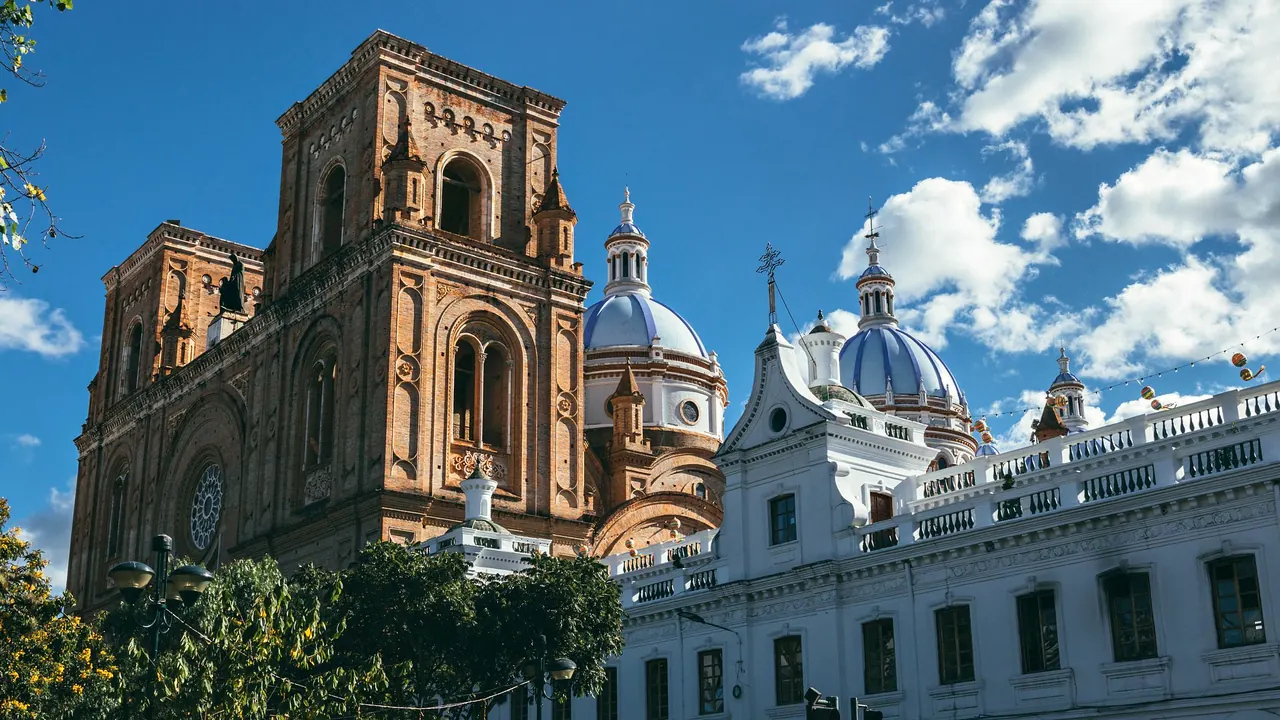
The New Cathedral's blue domes by Parque Calderón
- Affordable cities84
- Nature & outdoors72
- Culture & sights64
Photo: Charly Chacon, Pexels License
Match
49
Every category weighted equally
- Beach & sun46
- Culture & arts52
- Food & nightlife47
- Family trip51
- Outdoors53
- Relax & unwind49
- Shopping & style49
- On a budget53
Cuenca, Ecuador in twelve categories
Our verdict on each, scored 0 to 100 against the same fixed benchmark cities, so a score means the same thing on every page.
Beaches & swimming. Scores 4 out of 100.
Food & drink. Scores 47 out of 100.
Culture & sights. Scores 64 out of 100.
Nightlife. Scores 30 out of 100.
Nature & outdoors. Scores 72 out of 100.
Day trips. Scores 50 out of 100.
Good for families. Scores 42 out of 100.
Getting around. Scores 63 out of 100.
Shopping & style. Scores 44 out of 100.
Affordability. Scores 84 out of 100.
Live music & performing arts. Scores 33 out of 100.
Wellness & relaxation. Scores 55 out of 100.
Cuenca, Ecuador category by category
Beaches & swimming
4Cuenca is a highland city at about 2,500m, and the Pacific coast is a long drive west over the Andes, too far for a day out. Nobody plans a stay here around swimming. A hotel pool, or the warm pools at the thermal springs on the edge of town, is as close as you get. If beach time matters, give it separate days on the coast.
Food & drink
47Andean highland cooking is at the heart of eating here. Whole roast pork (hornado) is carved to order in the market halls, especially the Mercado 10 de Agosto and the Mercado 9 de Octubre. You also find mote pillo, maize scrambled with egg, fresh cheese and soups such as locro de papa. Roast guinea pig (cuy) is a weekend outing, cooked on spits in the villages on the edge of town, Ricaurte in particular.
Around the old centre there are plenty of cafés, bakeries and set-lunch places, plus a small choice of international and modern Ecuadorian restaurants. On cold evenings people drink canelazo, a hot spiced cane spirit, and colada morada appears around the Day of the Dead. It is satisfying, honest food, but the range is narrow and there is little high-end cooking to explore.
Culture & sights
64The historic centre is a UNESCO World Heritage Site. It is a grid of colonial and republican streets with whitewashed walls, wooden balconies, carved doors and churches every few blocks. Its landmark is the New Cathedral of the Immaculate Conception on Parque Calderón, a huge brick building whose blue-tiled domes are seen all over the city. The Old Cathedral stands across the square.
The best museum is Pumapungo, which has ethnographic collections and the excavated remains of the Inca city of Tomebamba, with terraces running down to the river. The Museo de las Conceptas, in a working convent, and the small museums of Panama-hat weaving and pre-Columbian art fill out a pleasant two or three days. Much of the pleasure lies in walking the streets and El Barranco, the riverside escarpment, rather than in any single great sight.
Nightlife
30Going out happens mainly along Calle Larga and the streets running down to the river. There you find small bars, a few craft-beer places and some salsa and reggaeton dance spots, busiest on Thursday to Saturday nights with students and expats. Midweek is quiet, and the cool highland evenings send most people home early. It suits a drink after dinner, not a city to choose for its nights.
Nature & outdoors
72The great draw is Cajas National Park, which starts less than an hour west of the city. It is a high, windswept páramo of cushion plants, granite ridges and more than two hundred glacial lakes, rising past 4,000m. Marked trails run from easy lakeshore loops to full-day routes. Patches of twisted polylepis forest shelter hummingbirds and other highland birds. The weather turns quickly and mornings are the clearest.
In the city, four rivers run through green banks with long walking and cycling paths, the Tomebamba being the prettiest. Further out, the valleys towards Gualaceo and the southern Andes give quieter hiking and horse riding. The altitude takes a day or two to get used to before strenuous walks.
Day trips
50The headline trip is Ingapirca, about two hours north. It is Ecuador's largest Inca site, with an oval temple of finely fitted stone set among farmland. The other classic outing is a loop east through the valley towns. Gualaceo has a busy market, Chordeleg is known for silver filigree jewellery, and Sígsig is a weaving town for toquilla straw hats. Smaller colonial towns and adobe villages such as Susudel lie to the south. Together they make a good few days, but beyond these the choice thins quickly.
Good for families
42Cuenca is calm, easy to walk at a gentle pace and friendly to children, with families out in the squares and along the riverside parks at weekends. Bioparque Amaru, a wildlife park just outside town with Andean condors, spectacled bears and other native animals, is the main attraction made for children. The thermal pools at Baños also go down well. Beyond that, there is little aimed at children. The altitude can tire small children for the first days, and the cobbles are hard work with a pushchair.
Getting around
63Most of what a visitor wants lies within the compact grid of the historic centre and along the river just below it, so walking is the natural way to see the city. The pavements are narrow, and the altitude makes the steps down to the river feel steeper than they look. A tram line crosses the city from the airport side through the centre, and taxis are plentiful and easy to flag. Buses reach Baños and the outlying villages, but the routes are hard to follow at first. For Cajas and the valley towns, most people take a bus from the terminal or hire a driver for the day.
Shopping & style
44The signature buy is the so-called Panama hat. It is woven from toquilla straw in this region, finished and blocked in workshops around the city, and sold in every grade from everyday to superfine. Cuenca also has a long ceramics tradition, embroidered textiles and the flower market beside the New Cathedral. The craft stalls around Plaza San Francisco and the market halls are good for browsing. Silver filigree comes from nearby Chordeleg. Beyond crafts there is little: a few malls on the outskirts and no fashion or design scene to speak of.
Affordability
84Cuenca is a very inexpensive place to stay. Guesthouses and restored colonial hotels in the old centre cost little, and the set lunches in small family restaurants and the cooked food in the market halls are among the cheapest good meals a traveller will find. Taxis, buses and the tram add little to a day, and most museums and churches charge little or nothing to enter.
The exceptions are anything imported. Wine, foreign spirits, branded goods and the international-style restaurants around the old centre cost more than local food and drink. A visitor who eats and drinks as the city does will find a comfortable stay easy on a modest budget.
Live music & performing arts
33The city's main formal offer is the Cuenca Symphony Orchestra. Its regular concerts, many of them free, are held in the old theatres and churches of the centre. Teatro Sucre and a few cultural centres put on a modest season of theatre, dance and folk music. Andean groups sometimes play in the squares. The great street spectacle is the Pase del Niño Viajero on Christmas Eve, a long procession of costumed children, decorated horses and music. Otherwise this is a small, local scene with no big-name stages.
Wellness & relaxation
55The village of Baños, a short taxi or bus ride southwest of the centre, sits on natural hot springs. Locals have bathed there for generations. The village has simple public pools and several thermal spa complexes with steam rooms, mineral pools and mud treatments, which make an easy half day.
The city itself sets a restorative pace. Life is unhurried, the riverside paths are made for slow evening walks, and the cool mountain climate and quiet nights make for good sleep. Massage and day spas are easy to find and inexpensive, though there is no deep spa culture beyond the springs.
When should you go?
Pick a month to see what it is like. The climate figures are measured averages, not a forecast.
Cuenca, Ecuador in July
Daytime high, °C
Rainfall in the month, mm
The whole year
Shaded against this city’s own year: the deepest cell is its best month for that figure and the palest its weakest.
Where the figures come from
Cuenca, Ecuador has no weather station within reach, so its figures come from a gridded climate model rather than a measured record, and read a broad area rather than the city itself.
Temperature and rainfall are climate normals, averaged over the years shown. Cuenca, Ecuador: 2001-2020 normals, NASA POWER reanalysis grid, no weather station within 90 km.
Before you go
| Measure | Cuenca, Ecuador |
|---|---|
| Official language | Spanish, Shuar, Northern Quichua |
| Currency | US Dollar (USD) |
| Sockets | AB120 V, 60 Hz |
| Driving side | Right |
| Time zone | UTC-5 |
| Emergency number | 911 |
| Elevation | 2,550 m |
| Main airport | Mariscal Lamar Airport (CUE)2 km from centre3 non-stop destinations |
| Public holidays this year | 11 days |
By the numbers
| Measure | Cuenca, Ecuador |
|---|---|
| City population | 361,524 |
| People per km² | 5,121 |
| Museums within 10 km | 4 |
| UNESCO World Heritage sites within 50 km | 2 |
Compare Cuenca, Ecuador with
Every comparison with a written verdict behind it.