Ecuador
Guayaquil
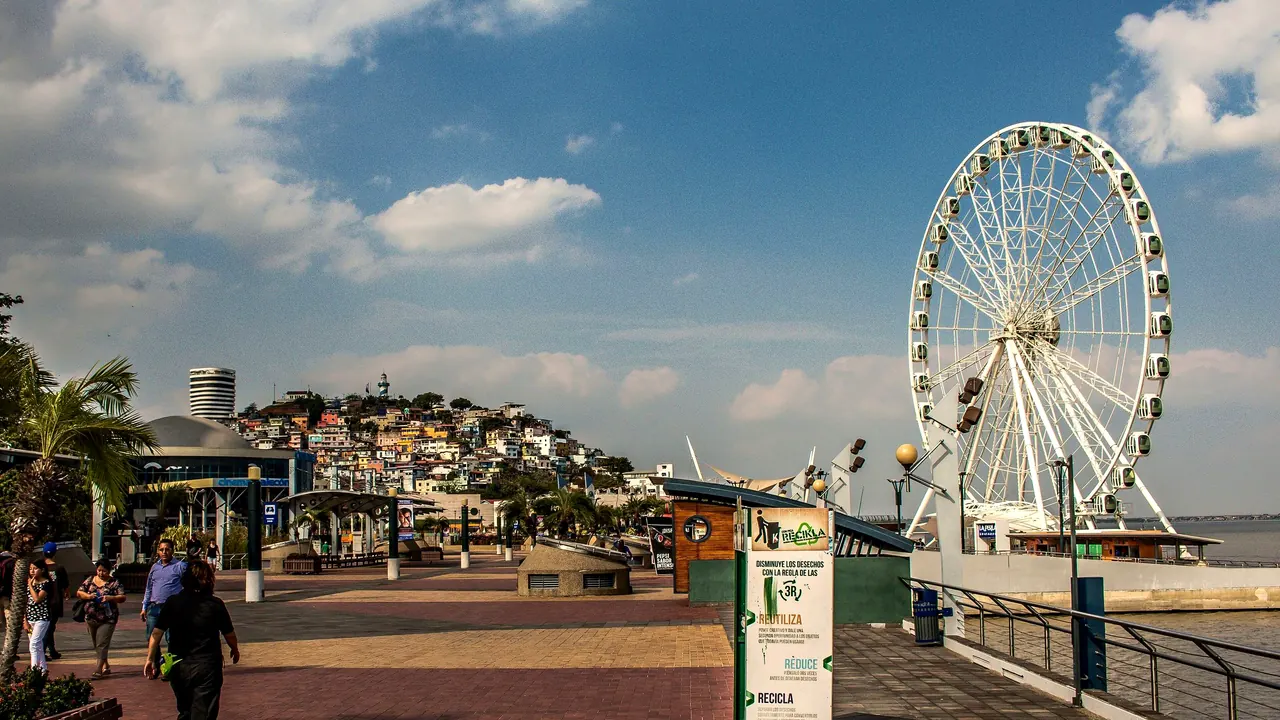
The Malecón with the Cerro Santa Ana behind
- Affordable cities72
- Food & drink60
- Nature & outdoors48
Photo: Paulakindsvater, CC BY-SA 4.0, cropped
Match
39
Every category weighted equally
- Beach & sun39
- Culture & arts40
- Food & nightlife42
- Family trip41
- Outdoors40
- Relax & unwind37
- Shopping & style40
- On a budget43
Guayaquil in twelve categories
Our verdict on each, scored 0 to 100 against the same fixed benchmark cities, so a score means the same thing on every page.
Beaches & swimming. Scores 22 out of 100.
Food & drink. Scores 60 out of 100.
Culture & sights. Scores 38 out of 100.
Nightlife. Scores 40 out of 100.
Nature & outdoors. Scores 48 out of 100.
Day trips. Scores 28 out of 100.
Good for families. Scores 38 out of 100.
Getting around. Scores 38 out of 100.
Shopping & style. Scores 38 out of 100.
Affordability. Scores 72 out of 100.
Live music & performing arts. Scores 32 out of 100.
Wellness & relaxation. Scores 18 out of 100.
Guayaquil category by category
Beaches & swimming
22Guayaquil is a port on the brown, tidal Guayas River, not a seaside city, and there is nowhere to swim in town apart from hotel pools. The coast starts at Playas, about an hour and a half away by road, a plain working beach town with a long grey-sand shore. Salinas, with its high-rise seafront on a sheltered bay, and the surf villages further north such as Montañita and Olón are two hours or more away.
The sea is warmest from January to April, at around 25°C, when the coastal season peaks and the city empties at weekends. From June to November the water is cooler and the skies are often overcast. A beach day here means an early start and a long drive, so if beaches are what you want, it makes more sense to stay on the coast.
Food & drink
60Guayaquil is where Ecuador's coastal cooking is at its best, and locals take it seriously. Mornings start with encebollado, a tuna, yuca and onion broth said to cure hangovers, or with a bolón, a fried ball of green plantain with cheese or pork crackling. At lunch there is ceviche of shrimp or shellfish, coconut encocados, seco de chivo and arroz con menestra. Crab houses, where you crack whole mangrove crabs with a wooden mallet at long tables, are a city ritual.
The cheapest and most typical eating is at simple neighbourhood comedores and markets. Urdesa and Samborondón have the smarter restaurants and the modern Ecuadorian cooking that makes use of local cacao and tropical fruit. There is little wine or café culture, and international cooking is limited outside the malls.
Culture & sights
38Guayaquil is a commercial port rather than a heritage city. Fires, above all the great fire of 1896, destroyed most of its colonial wooden town. What visitors see is concentrated along the river. The Malecón Simón Bolívar runs for about 2.5km past the Moorish clock tower and the Rotonda monument, and at its north end is Las Peñas, a hillside of restored painted wooden houses where 444 steps climb Cerro Santa Ana to a lighthouse and a view over the estuary.
Inland, Parque Seminario has land iguanas that wander among the benches below the neo-Gothic cathedral. The MAAC museum covers pre-Columbian coastal cultures and the Museo Municipal covers city history. The marble tombs of the Cementerio General are also worth seeing. A day or two covers it all.
Nightlife
40People in Guayaquil go out late and loudly, especially from Thursday to Saturday, but the scene is spread out and mostly local. Las Peñas has small bars and terraces on the hill above the river, which is the easiest area for a visitor. Urdesa's main avenue has bars and pubs, and the suburb of Samborondón across the river has the bigger clubs and the polished lounges where the city's better-off crowd dances to reggaeton and salsa until the early hours.
Moving between areas is a matter of taxis, and street crime means a night out here takes more planning than in a walkable city. It is a fun night if you go with locals, but nobody visits for it.
Nature & outdoors
48Guayaquil's landscape is flat, hot and wet: a delta of rivers, mangroves and tropical dry forest. On the western edge of the city, the Bosque Protector Cerro Blanco has trails through kapok and dry forest, with howler monkeys and great green macaws. Across the river, Isla Santay is reached on foot or by bicycle over a long footbridge and has boardwalks through wetland and mangroves.
About an hour south, the Manglares Churute reserve and the fishing village of Puerto El Morro offer boat trips through mangrove channels, where you can see bottlenose dolphins and frigatebird colonies. Birdlife is rich all year. Serious mountains are a long drive up into the Andes, and the humid heat of the rainy season, from January to April, makes long walks hard going.
Day trips
28Guayaquil works better as a gateway than as a base for day trips. The coastal towns of the Santa Elena peninsula, Salinas and Santa Elena itself, are about two hours west. Santa Elena's Amantes de Sumpa museum displays an embrace burial thousands of years old. Inland, several old cacao haciendas offer visits that follow the fine-aroma cacao from pod to chocolate, and the country towns of Daule and Samborondón show the rice-growing Guayas basin.
The places most visitors really want to see, such as colonial Cuenca in the Andes, the surf coast around Montañita and the Galápagos Islands, are a long drive or a flight away and deserve an overnight stay or more.
Good for families
38Children tend to enjoy the easy things here: feeding the iguanas in Parque Seminario, the playgrounds and riverboats along the Malecón, and climbing the steps of Las Peñas to the lighthouse. The Parque Histórico in Samborondón combines a small wildlife area of native animals with reconstructed old Guayaquil houses. The big air-conditioned malls provide relief from the heat.
That is close to the full list. There is no major zoo, aquarium or theme park. The humid heat is tiring for small children, especially from January to April, and most journeys mean a taxi rather than a stroll. Families mostly pass through on their way to the Galápagos or the coast and spend a day or two here.
Getting around
38The part of Guayaquil that visitors use most, the Malecón, the downtown grid, Parque Seminario and Las Peñas, is compact, flat and easy to cover on foot, though the heat is draining. Beyond that, the city is a sprawl of wide avenues. The Metrovía bus rapid transit lines are cheap but crowded and not built around visitors. The Aerovía cable car crosses the river to Durán, and it is more of a ride with a view than a practical link for most visitors.
In practice, visitors rely on taxis booked through an app to reach Urdesa, Samborondón, the airport and the bus terminal. Both of those are close to the city and well run. A car only becomes useful for trips out to the coast.
Shopping & style
38Shopping in Guayaquil is mostly done in large air-conditioned malls, in the north of the city and across the river in Samborondón, which carry international chains and Ecuadorian brands. For crafts there is a covered artisans' market downtown, selling toquilla straw hats (the hats sold abroad as Panama hats), tagua-nut carvings, textiles from the highlands and chocolate made from the region's own cacao. The Bahía street market is a crowded mass of cheap clothing and electronics and is interesting mainly as a scene.
There is no luxury street or boutique quarter to wander. The finest hats and crafts are made elsewhere in the country, so serious buyers often wait for Cuenca or Montecristi.
Affordability
72Guayaquil is a cheap city to spend time in. A set lunch of soup, rice and stew at a comedor, an encebollado breakfast or a plate of shrimp ceviche costs little. Buses and app-booked taxis are inexpensive, and most of the main sights are free: the Malecón, the steps of Las Peñas, the iguana park and the cemetery.
Accommodation costs more. The hotels lean towards business hotels in the centre and the northern districts, which are priced for corporate travellers. Imported wine and spirits, and meals in the international restaurants of Samborondón, cost about the same as in North America. A visitor who eats local food will find their money goes a long way.
Live music & performing arts
32Guayaquil has a modest year-round stage. The Teatro Centro de Arte and the Teatro Sánchez Aguilar in Samborondón put on plays, dance, Latin American touring acts and concerts, and the city's symphony orchestra gives regular performances. Musically, the city's heritage is the pasillo, the bittersweet Ecuadorian ballad. Julio Jaramillo, its most famous singer, was born here and has a museum in Las Peñas. In some bars you can still hear the music played live.
There is no opera season or theatre district, and big concerts mainly mean visiting Latin pop and reggaeton stars at the stadiums. Few visitors plan their evenings around a performance.
Wellness & relaxation
18Guayaquil is not a place to slow down. It is hot, humid and loud, with heavy traffic, and there is no local bathing or spa tradition. Wellness here means the spas in the larger business hotels and day spas in the suburbs, where you can book a massage or a facial after the airport run.
The calmest hours are in the shade of the gardens along the Malecón in the early evening, when the river breeze picks up, or in the quiet gated suburbs across the river. Visitors looking for rest usually head to the coast or up to the cooler Andean valleys.
When should you go?
Pick a month to see what it is like. The climate figures are measured averages, not a forecast.
Guayaquil in July
Daytime high, °C
Rainfall in the month, mm
The whole year
Shaded against this city’s own year: the deepest cell is its best month for that figure and the palest its weakest.
Temperature and rainfall are climate normals, averaged over the years shown. Guayaquil: 1991-2020 (rainfall 1981-2010) normals, Guayaquil / Simon Bolivar (4.5 km from centre).
Before you go
| Measure | Guayaquil |
|---|---|
| Official language | Spanish, Shuar, Northern Quichua |
| Currency | US Dollar (USD) |
| Sockets | AB120 V, 60 Hz |
| Driving side | Right |
| Time zone | UTC-5 |
| Emergency number | 911 |
| Elevation | 4 m |
| Main airport | José Joaquín de Olmedo International Airport (GYE)4 km from centre16 non-stop destinations |
| Public holidays this year | 11 days |
By the numbers
| Measure | Guayaquil |
|---|---|
| City population | 2,650,288 |
| People per km² | 7,476 |
| Museums within 10 km | 6 |
| UNESCO World Heritage sites within 50 km | 0 |
| Swim season, months above 21 °C | 12 months |
Compare Guayaquil with
Every comparison with a written verdict behind it.