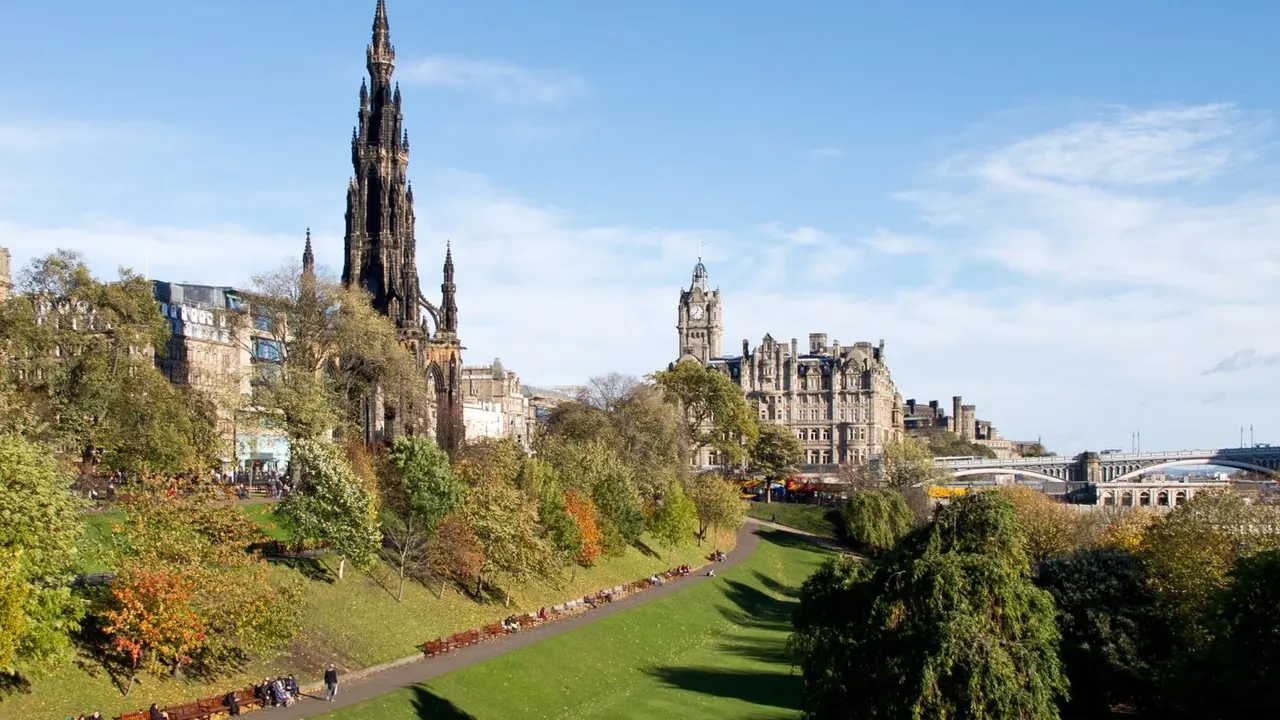
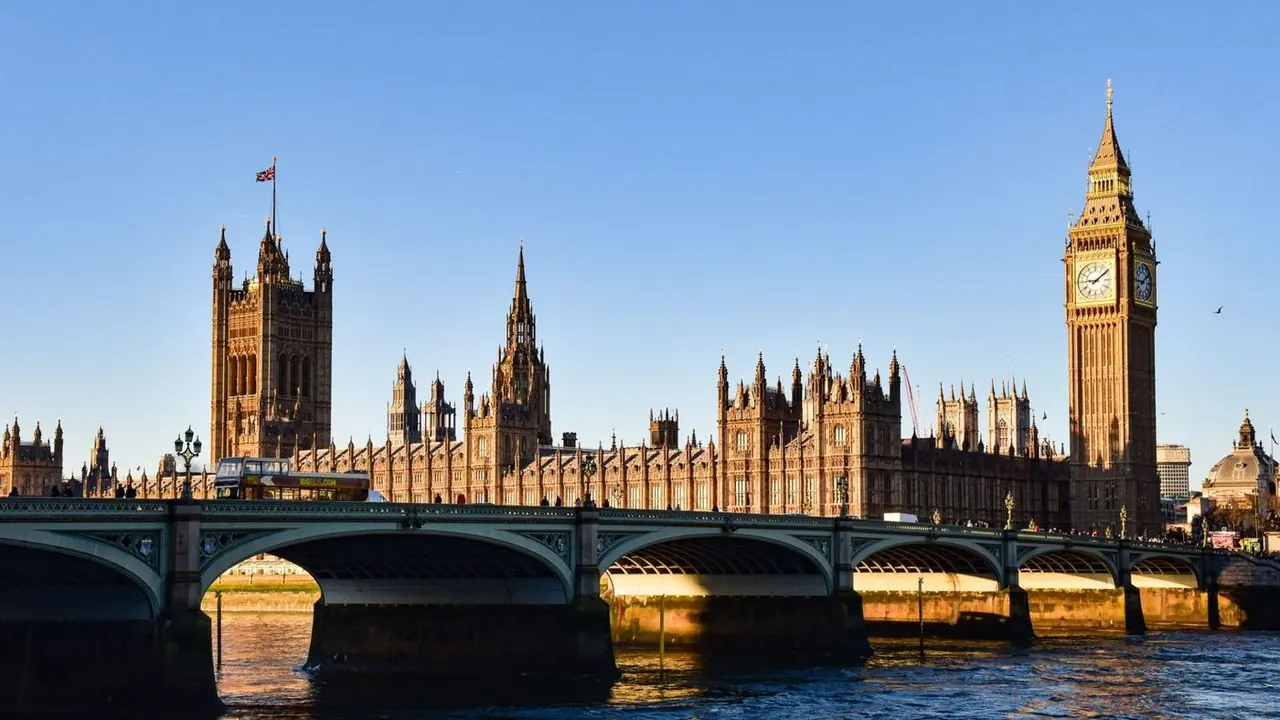
Photos: Edinburgh by Carlos Delgado, CC BY-SA 3.0, cropped; London by AXP Photography, Pexels License.
Edinburgh or London?
Our verdict in twelve categories, each scored against the same fixed benchmark cities, and the climate month by month, so you can choose for your trip.
Choose Edinburgh for
- nature and the outdoors
- prices
Edinburgh suits a traveller who wants a compact, dramatic capital to explore on foot over a few days. It has a medieval Old Town and a Georgian New Town side by side, a volcanic hill to climb before lunch, and the edge of the Highlands within reach. It is the better pick for walkers, for anyone planning around the August festivals, and for those who would rather pay a little less for a room than London asks.
Choose London for
- shopping
- nightlife
- food and drink
London is the choice when depth matters more than scenery. Its museums, theatres, restaurants and shops go far beyond Edinburgh's, so a week barely touches them. Its nights out, its attractions for children and its range of day trips by rail are all broader too. Come for variety and a full programme every evening, and accept higher costs and longer journeys across a much bigger city.
Scoreboard
Twelve categories on one fixed scale from 0 to 100. The shaded stretch is the gap between the two.
Your match
Pick a travel style or drag the sliders, and both match scores follow your weighting.
Wins on nature and the outdoors and prices with your weighting.
Wins on shopping and nightlife with your weighting.
What matters to you?
Category by category
What the scores mean for a trip.
Beaches & swimming
Neither city is a reason to pack swimwear. The difference is in the kind of water. Edinburgh has its own sandy beach at Portobello, a bus ride from the centre, with wider East Lothian sands further along the coast, but the North Sea stays cold and most people walk on the beach rather than swim.
London has no shore of its own. Brighton's pebbles are an hour away by train. Swimming in London happens in fresh water instead, at the outdoor lidos and the Hampstead Heath ponds, which draw crowds on warm days.
Food & drink
London is by far the better place to eat. Its strength is range: Bangladeshi cooking on Brick Lane, Cantonese food in Chinatown, Punjabi food in Southall, and Caribbean and West African cooking south of the river. Borough Market and the weekend food markets make browsing a pleasure in itself.
Edinburgh's food is narrower and more local. It is built on Scottish seafood, game and beef, cooked well in a handful of dining rooms in Leith and Stockbridge. Its most distinctive draw is whisky, with bars that will guide you through a proper tasting, but cheap street food is hard to find.
Culture & sights
Both cities are rich in history, but London goes much deeper. The British Museum, the National Gallery, the V&A and the two Tates are each worth a full day. The landmarks run from the Tower and Westminster Abbey to St Paul's and Greenwich.
Edinburgh's appeal is how well it holds together rather than how much it has. The Old Town and New Town form one World Heritage townscape you can take in on foot, and the National Museum and the Scottish National Gallery add a solid core. A few days covers Edinburgh well, while London rewards a week or more.
Nightlife
London's night out is far bigger. Soho runs late in the centre, the east from Shoreditch to Dalston has the club and warehouse scene, and Brixton and Peckham add big venues, so you can plan a weekend district by district.
Edinburgh is a pub city. It has fine Victorian bars on Rose Street and in the Grassmarket, a short student strip in the Cowgate and only a few clubs. It goes to bed fairly early, except in August, when the festivals keep the centre up into the small hours.
Nature & outdoors
Here Edinburgh has the edge. Arthur's Seat, an extinct volcano, climbs to 251m a short walk from the Royal Mile. The Pentland Hills on the city's southern edge give real ridge walking, and the edge of the Highlands is about two hours away.
London's green spaces are gentler: the royal parks, the open heath at Hampstead and the deer of Richmond Park, with chalk downs an hour out by train. The walking is pleasant, but there is nothing wild or high.
Day trips
Both cities make good bases, but London reaches further. Oxford, Cambridge, Windsor and Bath are all easy by train. Add Canterbury, Stonehenge, Brighton and the Cotswolds, and a week can hold several outings without repeating a theme.
Edinburgh's list is shorter but distinctly Scottish: Glasgow and Stirling in under an hour, then St Andrews, the Borders abbeys and Rosslyn Chapel. Waverley station sits right in the centre, which makes rail trips very simple.
Good for families
London gives children more to do, and much of it is free: the dinosaurs at the Natural History Museum, the Science Museum's hands-on galleries and the pirate-ship playground in Kensington Gardens. Legoland and the Harry Potter studio tour are outside the city. The price is its size, with long journeys and Tube stations full of stairs that make a buggy hard work.
Edinburgh is easier to manage and fills a few days well, with the castle, the National Museum, Dynamic Earth and the zoo. Its drawbacks are steep cobbles, weather that changes quickly and no theme park.
Getting around
London's transport is the more complete system. The Underground, the Elizabeth line, the buses and the Thames riverboats reach almost anywhere on one contactless card, which matters in a city this spread out, even if rush-hour trains are hot and crowded.
Edinburgh needs less of a network, because most sights lie within about 2km of each other. The hills, stairways and cobbles make walking harder than it looks on the map, though. Buses and a single tram line cover the rest.
Shopping & style
This is where London is furthest ahead of Edinburgh. It has Bond Street and Sloane Street for luxury, Savile Row for bespoke tailoring, department stores that are sights in their own right, and markets from Portobello Road to Camden. It is worth visiting for the shopping alone.
Edinburgh is pleasant for an afternoon on Victoria Street and in Stockbridge. It is best for Scottish goods: cashmere, tweed, tartan and single malt. Beyond those it has little luxury shopping.
Affordability
Neither city is cheap, but Edinburgh is easier on the wallet. Its hotel rooms are expensive and the price jumps sharply in August and at Hogmanay. Outside those weeks, especially in late autumn and winter, a stay costs noticeably less than in London.
London's rooms are among the dearest in Europe and smaller for the money, and meals and theatre tickets add up fast. Both cities soften the bill with free national museums and parks. In London, daily caps on contactless fares also help.
Live music & performing arts
London has a serious choice every night of the year. There is the West End, the National Theatre and the Globe, the Royal Opera House, five major orchestras, and the Proms at the Royal Albert Hall.
Edinburgh's case rests on August, when the Fringe and the International Festival make it the busiest stage anywhere for a month. The rest of the year it has solid orchestras, Scottish Opera and Scottish Ballet, the Traverse and the Lyceum, and folk sessions in pubs that are easy to join. It has nothing like London's depth all year round.
Wellness & relaxation
Edinburgh's ways to unwind are few and local. The Victorian Turkish baths at the Portobello swim centre survive under their old tiles, and the cold-water swimmers warm up in saunas on the shore at Portobello and Wardie Bay. Out of season, a walk along the Water of Leith or a morning in the Botanic Garden is quietly calming, but in August the centre is too crowded and loud for rest.
London gives a little more choice. It has its own surviving Turkish baths in Bayswater and at Ironmonger Row in Islington, full spas in the grand hotels of Mayfair and Knightsbridge, and cold dips at the lidos and the Hampstead ponds. The city itself moves fast, but Bath's thermal waters are about an hour and a half away by train for anyone who wants to take the waters properly.
When should you go?
Pick your month. The climate figures are measured averages, not a forecast.
Edinburgh in July
London in July
Daytime high, °C
Rainfall in the month, mm
Temperature and rainfall are climate normals, averaged over the years shown. Edinburgh: 1991-2020 (sunshine 1981-2010, rainfall 1981-2010) normals, Edinburgh Airport (10 km from centre). London: 1992-2020 (sunshine 1991-2020, rainfall 1991-2020) normals, London Weather Centre (1.3 km from centre).
Neither city is warm enough for a beach trip in any month. London is the warmer of the two, with highs around 23°C in July against 18°C in Edinburgh, and it is also drier and sunnier through the summer. Edinburgh's best spell is May, when it gets as much sun as London. After that its rain builds through July and August and peaks in October at 80mm. The North Sea there is still cold at its warmest, about 14°C in August, so the sand is for walking rather than swimming.
For walking the streets, both cities are pleasant from late April to September, and neither ever gets too hot. Winters in both are grey and short on daylight. Edinburgh's are a degree or two colder, and its days are just as dim.
Which traveller are you?
For an outdoors trip, Edinburgh wins clearly. Arthur's Seat rises from the middle of the city, the Pentland Hills offer ridge walks within half an hour, and Loch Lomond and the Trossachs make a day out. London's countryside is gentle downland by comparison.
On a shopping trip, London is in a different league. Bond Street's luxury houses, the great department stores, Savile Row tailoring and weekend markets from Portobello Road to Columbia Road far outweigh Edinburgh, where the best buys are cashmere, tweed and whisky.
For a food and nightlife trip, London is the stronger choice. It eats from every community it holds, from Brick Lane curries to Turkish grills on Green Lanes, and Soho, Shoreditch and Brixton keep weekends going late. In Edinburgh a night out mostly means a good pub and an early finish.
Before you go
| Measure | Edinburgh | London |
|---|---|---|
| Official language | English | English |
| Currency | Pound Sterling (GBP) | Pound Sterling (GBP) |
| Sockets | G230 V, 50 Hz | G230 V, 50 Hz |
| Driving side | Left | Left |
| Time zone | UTC, UTC+1 in summer | UTC, UTC+1 in summer |
| Emergency number | 112 or 999 | 112 or 999 |
| Elevation | 47 m | 4 m |
| Main airport | Edinburgh Airport (EDI)11 km from centre163 non-stop destinations | London Heathrow Airport (LHR)23 km from centre224 non-stop destinations |
| Public holidays this year | 10 days | 8 days |
By the numbers
| Measure | Edinburgh | London |
|---|---|---|
| City population | 488,050 | 8,799,728 |
| People per km² | 1,884 | 5,598 |
| Museums within 10 km | 32 | 216 |
| UNESCO World Heritage sites within 50 km | 3 | 4 |
| Swim season, months above 21 °C | None | - |
Where else could you go?
Every comparison below shares a destination with this one, so you can follow Edinburgh or London somewhere new.
- St Andrewsvs Edinburgh
- Glasgowvs Edinburgh
- Brightonvs London
- Cambridgevs London
- Oxfordvs London
- Aberdeenvs Edinburgh