
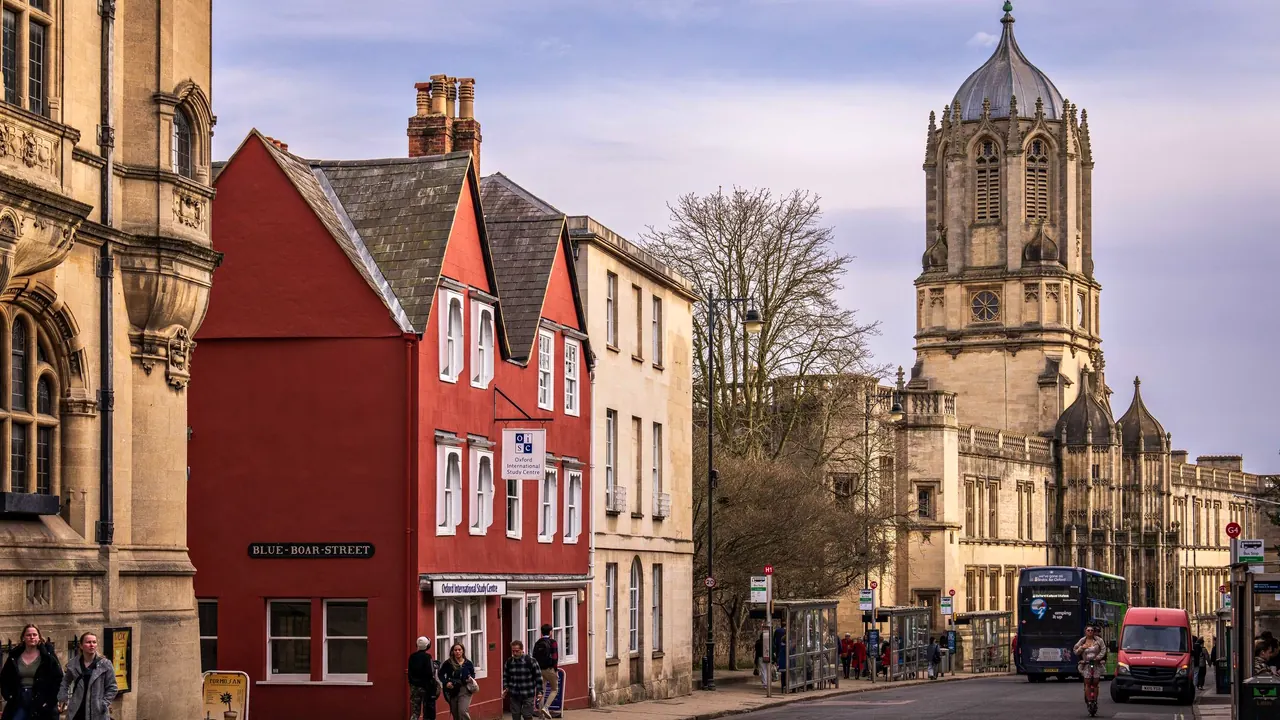
Photos: Edinburgh by Carlos Delgado, CC BY-SA 3.0, cropped; Oxford by Mark Stebnicki, Pexels License.
Edinburgh or Oxford?
Our verdict in twelve categories, each scored against the same fixed benchmark cities, and the climate month by month, so you can choose for your trip.
Choose Edinburgh for
- nature and the outdoors
- live music and the arts
- nightlife
Edinburgh suits travellers who want a capital with some weight to it: a castle on a volcanic rock, a wild hill you can climb before lunch, a proper sandy shore at Portobello and better eating, built on Scottish seafood, game and whisky. It also has the livelier evenings and the bigger stage, above all in August, when the festivals take over the whole centre. Families get more to do here too, as long as they can cope with the steep steps and cobbles.
Choose Oxford for
- day trips
- shopping
Oxford is the better pick for a quieter, more concentrated trip: college quadrangles, Evensong in a candlelit chapel and a riverside pub at the end of the day, all on a flat centre you can cross on foot. Its real advantage is what lies around it. Blenheim, the Cotswold villages, Stratford, Bath and London are all within easy reach, so it works best for travellers who want a calm base and a different outing each day.
Scoreboard
Twelve categories on one fixed scale from 0 to 100. The shaded stretch is the gap between the two.
Your match
Pick a travel style or drag the sliders, and both match scores follow your weighting.
Wins on nature and the outdoors and live music and the arts with your weighting.
Wins on day trips and shopping with your weighting.
What matters to you?
Category by category
What the scores mean for a trip.
Beaches & swimming
Edinburgh at least has real sand. Portobello's long beach and promenade are a short bus ride from the centre, and the broad East Lothian beaches at Gullane and North Berwick make a fine walk on a clear summer day. The cold North Sea means that only the hardy swim, though.
Oxford has no coast within easy reach. Swimming there means a summer dip in the Thames at Port Meadow, the Cherwell or the open-air pool at Hinksey. Visitors to either city who want a beach vacation should plan it separately.
Food & drink
Edinburgh is the better place to eat. It draws on the Scottish larder: west-coast shellfish, Highland beef, venison and summer fruit, cooked in modern dining rooms in Leith, Stockbridge and the New Town. Whisky gives a meal out a character that Oxford cannot match.
Oxford eats around the pub, with a Sunday roast by the Thames and lunch stalls in the old Covered Market. Its one advantage is cheap variety: Cowley Road's Middle Eastern, South Asian and Caribbean food fills a gap that Edinburgh, short on street food, leaves open. Even so, few would plan a trip around the table in either city.
Culture & sights
The two are close in depth, but they feel very different. In Edinburgh the heritage is the whole townscape: the medieval Royal Mile running from castle to palace, and the Georgian crescents of the New Town across the gardens, backed by the free national collections.
Oxford packs its riches into a few streets of honey-coloured colleges, chapels and libraries that are still in daily use. The Ashmolean and the Pitt Rivers are stronger than a city of its size would lead you to expect. Either one rewards two or three full days.
Nightlife
Both cities go out to the pub, but Edinburgh offers more choice. There are Victorian bars on Rose Street, old drinking dens in the Grassmarket, cocktail basements around George Street and the Cowgate's late clubs, and in August the whole centre stays out into the small hours.
Oxford's evenings follow the university calendar. Its taverns fill in term time and empty out over the summer vacation, Cowley Road holds the only real late scene, and it suits a drink after dinner rather than a big night out.
Nature & outdoors
Edinburgh has wilder country much closer to hand. Arthur's Seat climbs to 251m above Holyrood Park, the Pentlands offer ridge walks and mountain biking within half an hour, and boats from North Berwick go out to the gannets on the Bass Rock. Loch Lomond and the edge of the Highlands are within about two hours.
Oxford's outdoors is tamer: cattle grazing on Port Meadow, punting on the Cherwell, flat towpath rides, and longer, gentle walks in the Cotswolds, the Chilterns and along the Ridgeway.
Day trips
Oxford has the richer choice of day trips. Blenheim Palace is about twenty minutes away, the Cotswold villages are within the hour, and London, Stratford, Warwick, Windsor and Bath are all comfortably reachable. The catch is that the smaller Cotswold villages are far easier with a car or a tour.
Edinburgh is still a very good base, and most of its outings are simple by rail from Waverley. Glasgow and Stirling are each under an hour away, St Andrews and the Borders abbeys make full days, and Rosslyn Chapel and the Forth Bridges fill easy half-days.
Good for families
Edinburgh gives children more to do in the city itself. There are the castle's cannons, the hands-on galleries of the National Museum, Dynamic Earth, the illusions of Camera Obscura and a hillside zoo, plus Portobello's sands for a run. Parents should be ready for steep closes, fast-changing weather and heavy August crowds.
Oxford is calmer and flatter. The dinosaur skeletons and the Pitt Rivers' masks, an afternoon on a punt and the Harry Potter echoes at Christ Church all go down well, but much of the rest is aimed at adults, and the wildlife park and Blenheim's maze both need a trip out of town.
Getting around
Both centres are easy to explore on foot, but the ground underfoot is very different. Edinburgh's sights lie within about 2km of each other, though they are spread across ridges, bridges and stairways. A dense bus network and a tram to the airport and Leith fill the gaps.
Oxford is small and mostly flat, with traffic-free streets and bicycles everywhere, and its station is a short walk from the colleges. In both cities a car is best left outside town.
Shopping & style
Neither is a shopping destination, and what is worth buying differs. In Edinburgh it is Scottish goods: cashmere, tweed, tartan from specialist kiltmakers and single malts, along with the independent shops of curving Victoria Street.
Oxford's appeal is in the detail: small traders in the Covered Market, antique maps and prints, and Blackwell's vast bookshop on Broad Street. For designer labels, the outlet village at Bicester is about twenty minutes away.
Affordability
Both are expensive places to sleep, for similar reasons and at different moments. Edinburgh's rooms climb to extreme levels during the August festivals and at Hogmanay, and late autumn and winter are the kinder time to go.
Oxford's prices track graduations, conferences and summer, and many visitors simply come for the day from London. Free museums in both cities soften the cost. Oxford's Cowley Road keeps meals cheaper, while Edinburgh's best views from Arthur's Seat cost nothing.
Live music & performing arts
Edinburgh is far ahead, and in August nowhere compares. The Fringe fills hundreds of venues, the International Festival brings leading orchestras and opera, and the Tattoo plays on the castle esplanade. The rest of the year it has two national orchestras, Scottish Opera and Ballet, the Traverse and easy folk sessions in the pubs.
Oxford's great live experience is quieter: Evensong sung by the choirs of Christ Church, Magdalen and New College, and chamber music in the historic Holywell Music Room. Its theatre is mostly touring productions.
Wellness & relaxation
Neither city is built for a spa break. Edinburgh has a curiosity in the tiled Victorian Turkish baths at Portobello, and a cold-water swimming crowd with saunas on the shore.
Oxford has no bathing tradition at all, but it is better at simple quiet: the Botanic Garden, the walled college gardens, Addison's Walk and a slow afternoon on a punt. Edinburgh is calm out of season, but in August it is no place to rest.
When should you go?
Pick your month. The climate figures are measured averages, not a forecast.
Edinburgh in July
Oxford in July
Daytime high, °C
Rainfall in the month, mm
Where the figures come from
Oxford's temperatures are measured 37 km from the centre, at Fairford Royal Air Force Base.
Oxford has no rain gauge within 25 km of the centre, so its rainfall comes from a gridded climate dataset read at the city rather than from a gauge further away.
Oxford's sunshine is measured 57 km from the centre, at Lyneham.
Temperature and rainfall are climate normals, averaged over the years shown. Edinburgh: 1991-2020 (sunshine 1981-2010, rainfall 1981-2010) normals, Edinburgh Airport (10 km from centre). Oxford: 1961-1990 (sunshine 1991-2020, rainfall 1991-2020) normals, Fairford Royal Air Force Base (37 km from centre).
Neither city has a beach climate, and both are at their best for walking from late spring to early autumn. Edinburgh stays cool all year, with highs that only reach about 19°C in July and August. The North Sea peaks at 14°C, so the shore is for walking, not swimming. Late spring is often its brightest time, with May sunnier than high summer. September and October are among the wettest months, so the festival season comes just before the autumn rain.
Oxford gets a little warmer in summer, around 22°C in July, and it is clearly sunnier from May to August, with about 208 hours of sun in July. That makes it the more pleasant of the two for long afternoons on the river or in the meadows. Its winters are just as grey and slightly colder, with January highs of about 5°C, and the wettest stretch runs from October into December. In both cities a winter visit means short days spent mostly indoors.
Which traveller are you?
For an outdoors trip, Edinburgh is the stronger choice. Arthur's Seat rises right beside the Old Town, the Pentland Hills offer real ridge walking, and the Highlands are close enough for a day out. Oxford's meadows and Cotswold footpaths are gentler and much less dramatic.
On a food and nightlife trip, Edinburgh comes out ahead. It has Scottish scallops, langoustines and game, dining rooms in Leith, whisky bars with deep selections, and late nights in the Cowgate. Oxford is mostly about pubs, and its centre tends to be quiet by midnight.
For a short city break, Oxford is the easier option. The Radcliffe Camera, the Bodleian, Christ Church and the Ashmolean are all a few minutes apart on flat streets, and London is about an hour away by train. In Edinburgh, the hills and stairways make a quick visit harder work.
Before you go
| Measure | Edinburgh | Oxford |
|---|---|---|
| Official language | English | English |
| Currency | Pound Sterling (GBP) | Pound Sterling (GBP) |
| Sockets | G230 V, 50 Hz | G230 V, 50 Hz |
| Driving side | Left | Left |
| Time zone | UTC, UTC+1 in summer | UTC, UTC+1 in summer |
| Emergency number | 112 or 999 | 112 or 999 |
| Elevation | 47 m | 73 m |
| Main airport | Edinburgh Airport (EDI)11 km from centre163 non-stop destinations | London Heathrow Airport (LHR)63 km from centre224 non-stop destinations |
| Public holidays this year | 10 days | 8 days |
By the numbers
| Measure | Edinburgh | Oxford |
|---|---|---|
| City population | 488,050 | 147,500 |
| People per km² | 1,884 | 3,235 |
| Museums within 10 km | 32 | 11 |
| UNESCO World Heritage sites within 50 km | 3 | 1 |
| Swim season, months above 21 °C | None | - |
Where else could you go?
Every comparison below shares a destination with this one, so you can follow Edinburgh or Oxford somewhere new.
- St Andrewsvs Edinburgh
- Glasgowvs Edinburgh
- Londonvs Oxford
- Bathvs Oxford
- Bristolvs Oxford
- Cambridgevs Oxford