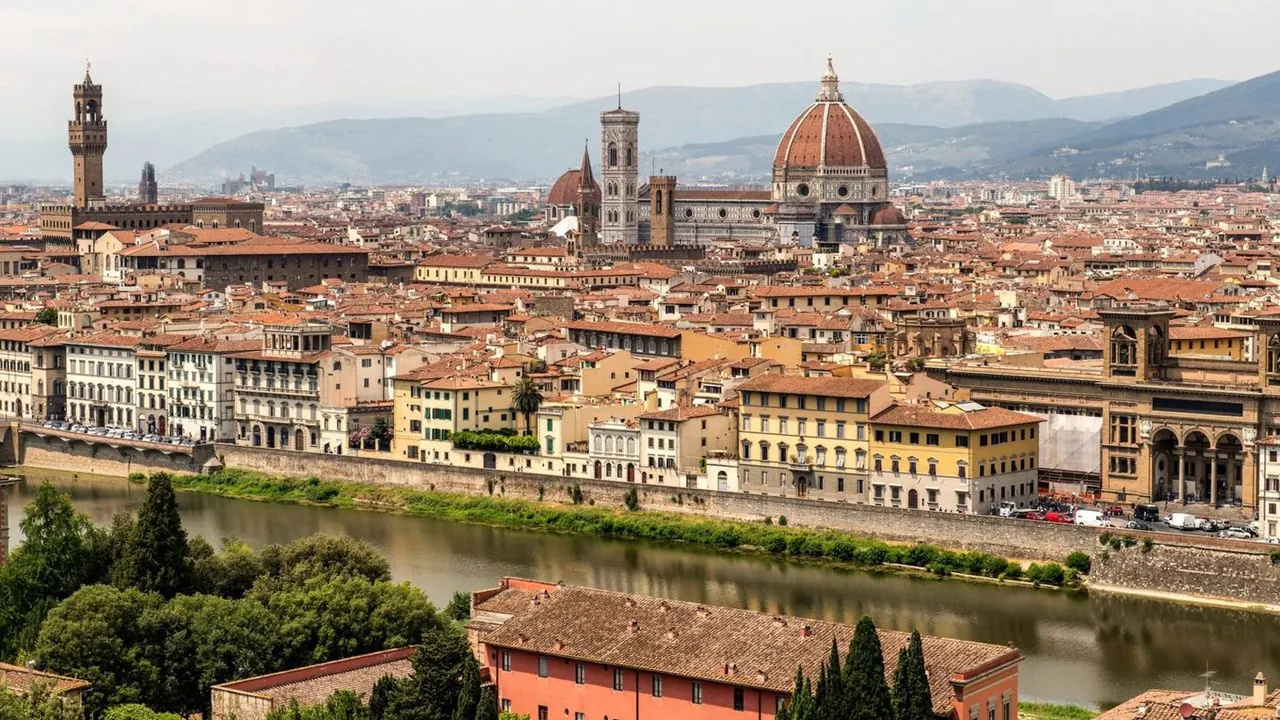
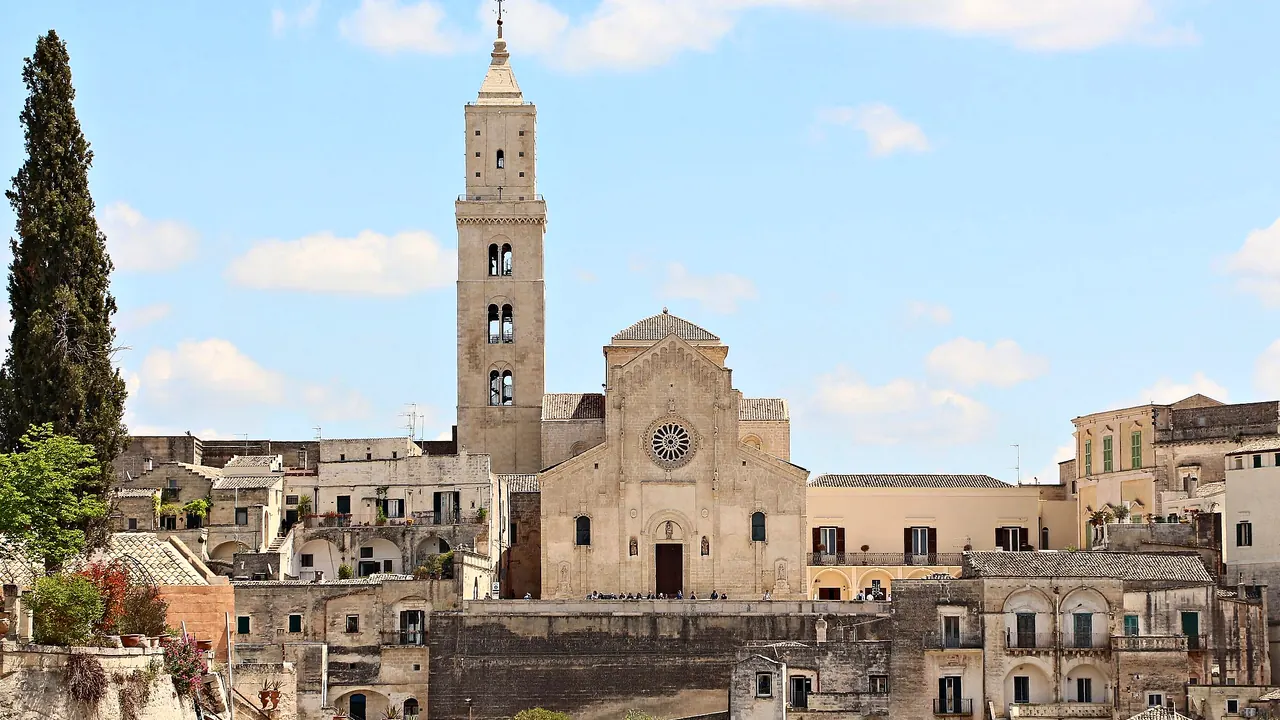
Photos: Florence by Wolfgang Weiser, Pexels License; Matera by Bernard Gagnon, CC BY 4.0, cropped.
Florence or Matera?
Our verdict in twelve categories, each scored against the same fixed benchmark cities, and the climate month by month, so you can choose for your trip.
Choose Florence for
- shopping
- live music and the arts
- getting around
Florence is the choice for a first serious look at Italian art, and for a trip that mixes museums, long trattoria dinners and day trips by train. The Uffizi, the Accademia and the Duomo are all within a short walk of each other, and Siena, Pisa and Bologna are easy rail outings. The evenings also offer more to buy, hear and drink.
Choose Matera for
- beaches
- prices
- nature and the outdoors
Travellers who would rather know one extraordinary place well than tick off a long list of masterpieces will find Matera rewarding, ideally with a hire car. The cave districts of the Sassi above the Gravina gorge are unlike anything in Tuscany, the Murgia walks start at the edge of town, the Ionian beaches are closer and meals cost less. Expect quiet evenings and plenty of driving.
Scoreboard
Twelve categories on one fixed scale from 0 to 100. The shaded stretch is the gap between the two.
Your match
Pick a travel style or drag the sliders, and both match scores follow your weighting.
Wins on shopping and live music and the arts with your weighting.
Wins on beaches and prices with your weighting.
What matters to you?
Category by category
What the scores mean for a trip.
Beaches & swimming
Neither city is a beach destination, but Matera is closer to the sea. From Florence the coast means the Versilia, an hour and a half away by train, with beaches of rented loungers and umbrellas, so most visitors make do with a pool.
Matera's Ionian shore at Metaponto and Policoro is about half that distance by car. It has wide sandy beaches backed by pine woods and calm, shallow water that suits children. The catch is that without a car it is hard to get there, while Florence's coast is at least on the railway.
Food & drink
Both cities cook plain regional food, but Florence gives you far more to choose from. There is bistecca, ribollita and lampredotto from the street carts, the Mercato Centrale and Sant'Ambrogio markets, Chianti by the glass and serious gelato, so you can eat anything from a quick lunch to fine dining.
Matera's cooking is narrower and more rustic: pane di Matera, crapiata, cavatelli, crackling peperoni cruschi and Aglianico to drink. It is well worth tasting, but there is no market or street-food culture, and after a few days the menus start to repeat.
Culture & sights
Florence is the place where the Renaissance happened: Brunelleschi's dome, Botticelli in the Uffizi, David in the Accademia, the Bargello's sculpture and the Pitti Palace. There is enough here for a full week of galleries and churches.
Matera's sights take two or three days, but they are unlike anything in Tuscany. There are the cave dwellings of Sasso Caveoso and Sasso Barisano, frescoed rock churches such as Santa Maria de Idris, and the Palombaro Lungo cistern under the main square. The town itself is the sight, more than anything in its museums.
Nightlife
Neither city is for dancing until dawn, but Florence has more going on after dark. People gather with drinks around Piazza Santo Spirito, Sant'Ambrogio has bars where locals drink, students fill the pubs near the centre, and in summer bars open along the Arno.
In Matera the evening means the passeggiata on Via del Corso, dinner, and a drink on a terrace above the lit-up Sassi, plus a few cave bars that stay open late in summer. Outside the warm months the town goes quiet soon after dinner.
Nature & outdoors
The countryside is about as close in both cities, but it feels different. Around Florence it is farmed and gentle: olive terraces at Fiesole, Chianti lanes for cycling, and the Casentino forests further out.
Matera's countryside is wilder and begins right below the town. A path drops into the Gravina gorge and climbs to the Murgia plateau, past abandoned rock churches and Neolithic sites, and the Lucanian Dolomites and the Pollino can be reached by car. In both places, avoid long walks on summer afternoons.
Day trips
Both cities make good bases, but Florence has more places within reach, and they are easier to get to. Siena, Pisa, Lucca and Bologna are each about an hour or less by train or bus, and San Gimignano, Volterra and the Chianti villages are easy with a car or on a tour.
Matera's outings are excellent too, from the trulli of Alberobello and the white towns of the Valle d'Itria to Castel del Monte, ghostly Craco and Castelmezzano among the peaks. Almost all of them need a hire car.
Good for families
Neither city is built for children, but Florence is the easier of the two. Climbing the dome, the secret-passage tours at Palazzo Vecchio, the globes at the Museo Galileo and the Boboli Gardens all give children something hands-on, and the Pinocchio park at Collodi is about an hour away.
In Matera, older children enjoy the caves, the cistern and the gorge. But the steep stone steps of the Sassi rule out pushchairs, there is little shade, and nothing is aimed at families. If you have a car, the sandy Ionian beaches are a real plus.
Getting around
Florence's centre is flat and compact, and the main sights are about twenty minutes apart on foot. Trams run to the airport, and Santa Maria Novella station sits in the middle of town for rail day trips.
Matera is walkable too, but you reach the Sassi by steep stairways, and leaving town is the hard part. The town is off the national rail network, the narrow-gauge line to Bari is slow and buses are sparse. In Florence a car is a burden, while in Matera it is close to essential.
Shopping & style
Florence is a real shopping city. It has leather workshops and the San Lorenzo stalls, marbled paper, goldsmiths on the Ponte Vecchio, Oltrarno artisans and the fashion houses of Via de' Tornabuoni. It pays to look closely, as some of the leather is mass-produced.
Matera has a few souvenir workshops in the Sassi selling cuccù whistles, tufa carvings and ceramics, plus ordinary high-street shops on Via del Corso. The best things to take home are edible: dried peppers, local pasta and Aglianico.
Affordability
Florence is the dearer of the two, and the gap shows most in where you sleep and what you see. The art you came for sits behind admission fees, and central rooms stay expensive from spring to autumn. Sleeping across the Arno or near the station, or coming in winter, cuts the bill more than anything else. Street stalls and simple trattorias then keep the daily spend on food reasonable.
In Matera the biggest cost is one you choose, a night in a cave room in the Sassi, and guesthouses in the newer town cost much less only a short walk away. Meals are cheaper than in Florence and the sights charge little. The one cost Florence spares you is transport: its day trips run by rail, while Matera's beaches and outings mean paying for a hire car.
Live music & performing arts
Florence, where opera was born around 1600, has a proper season. The Teatro del Maggio Musicale Fiorentino has its own orchestra and stages opera and ballet, the Maggio Musicale festival runs in spring, and the Pergola puts on theatre, though almost always in Italian.
Matera offers little beyond conservatory concerts, a summer jazz festival and open-air events set against the Sassi. Its one big night is the Festa della Bruna, with its procession and the papier-mâché float torn apart at the end.
Wellness & relaxation
Neither city has much spa culture within its own streets, so the difference is in what lies nearby. From Florence, the thermal halls of Montecatini Terme are under an hour by train, and the sulphur pools of Bagno Vignoni and Saturnia or a farm stay in the hills make a longer escape.
Matera has no bathing tradition and no spa town nearby to match those. What it has is cave hotel spas with pools cut into the rock, quiet mornings in the Sassi, and evenings watching dusk fall over the gorge, which feel calmer than Florence's centre in high season.
When should you go?
Pick your month. The climate figures are measured averages, not a forecast.
Florence in July
Matera in July
Daytime high, °C
Rainfall in the month, mm
Where the figures come from
Florence has no rain gauge within 25 km of the centre, so its rainfall comes from a gridded climate dataset read at the city rather than from a gauge further away.
Florence's sunshine is measured 71 km from the centre, at Pisa / S. Giusto.
Matera has no rain gauge within 25 km of the centre, so its rainfall comes from a gridded climate dataset read at the city rather than from a gauge further away.
Temperature and rainfall are climate normals, averaged over the years shown. Florence: 1995-2020 (sunshine 1991-2020, rainfall 1991-2020) normals, Firenze / Peretola (5.6 km from centre). Matera: 2005-2025, 10 years observed (rainfall 1991-2020) normals, Matera / Martella (4.8 km from centre).
Both cities are at their best for walking in late spring and early autumn. Florence warms up sooner, reaching about 20°C in April, and from June to August its stone streets get very hot, peaking around 33°C. Those are also its sunniest months. Autumn brings the rain, heaviest in October and November, and winter is cool and damp, better suited to museums than long walks.
Matera stays a little cooler in spring, at about 17°C in April, so May and late September suit it best. Its summers are drier than Florence's but just as hot on the bare plateau. This is also when the nearby Ionian sea is warm enough to swim in, from June to September, reaching about 26°C in August. Its wettest months are October and November, the same as Florence, and winters there are too chilly for the gorge walks to be much fun.
Which traveller are you?
On a culture and arts trip, Florence is the clear pick. The Uffizi, Accademia, Bargello and San Marco hold a week of Renaissance art, and the opera and concerts of the Maggio Musicale add evenings that Matera, with its small but remarkable rock churches, cannot match.
For a beach and sun trip, Matera is the better of these two inland bases. The wide, shallow sandy beaches at Metaponto and Policoro are under an hour away by car, while from Florence the Versilia coast takes up a whole day.
On a trip on a tight budget, Matera makes the money go further. Upper-town trattorias are cheaper, walking the Sassi and the Murgia costs nothing, and plain guesthouses sit close to the old districts. In Florence, central hotels and museum tickets add up quickly.
Before you go
| Measure | Florence | Matera |
|---|---|---|
| Official language | Italian | Italian |
| Currency | Euro (EUR) | Euro (EUR) |
| Sockets | CFL230 V, 50 Hz | CFL230 V, 50 Hz |
| Driving side | Right | Right |
| Time zone | UTC+1, UTC+2 in summer | UTC+1, UTC+2 in summer |
| Emergency number | 112 | 112 |
| Elevation | 50 m | 401 m |
| Main airport | Florence Airport, Peretola (FLR)6 km from centre46 non-stop destinations | Bari Karol Wojtyła International Airport (BRI)54 km from centre104 non-stop destinations |
| Public holidays this year | 13 days | 13 days |
By the numbers
| Measure | Florence | Matera |
|---|---|---|
| City population | 360,930 | 59,685 |
| People per km² | 3,528 | 152 |
| Museums within 10 km | 141 | 8 |
| UNESCO World Heritage sites within 50 km | 6 | 1 |
| Swim season, months above 21 °C | - | 5 months |
Where else could you go?
Every comparison below shares a destination with this one, so you can follow Florence or Matera somewhere new.