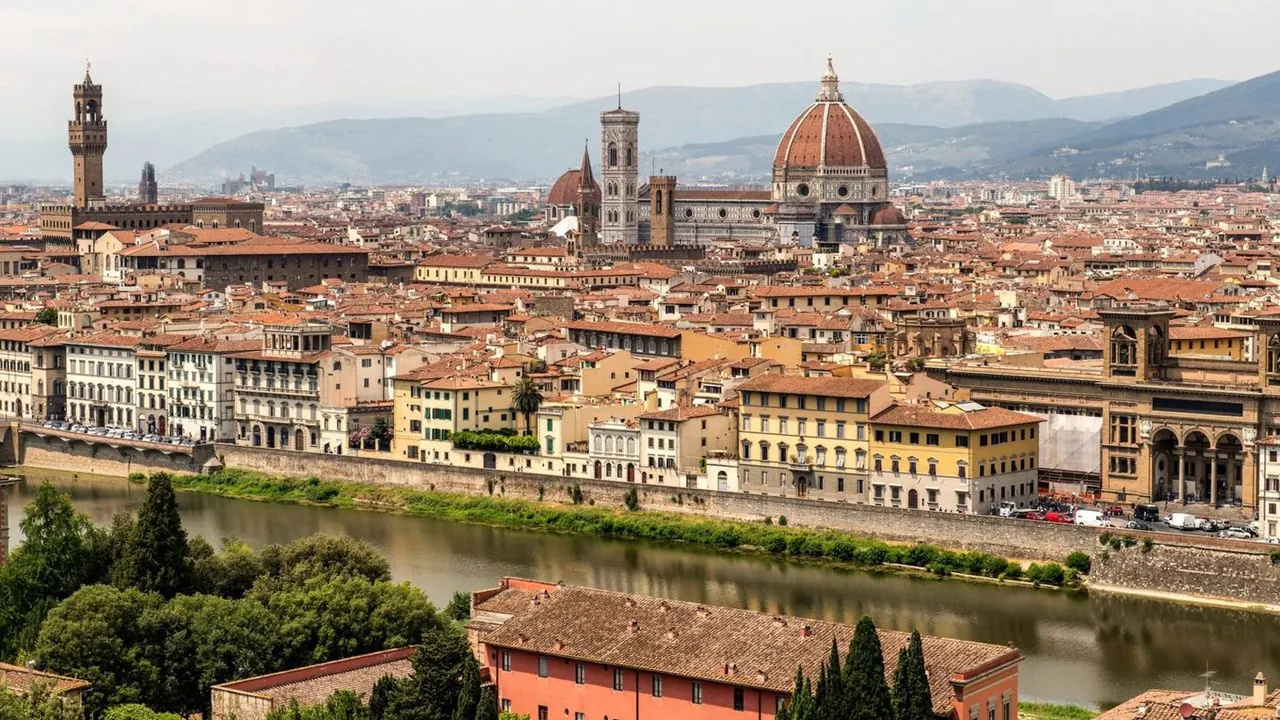
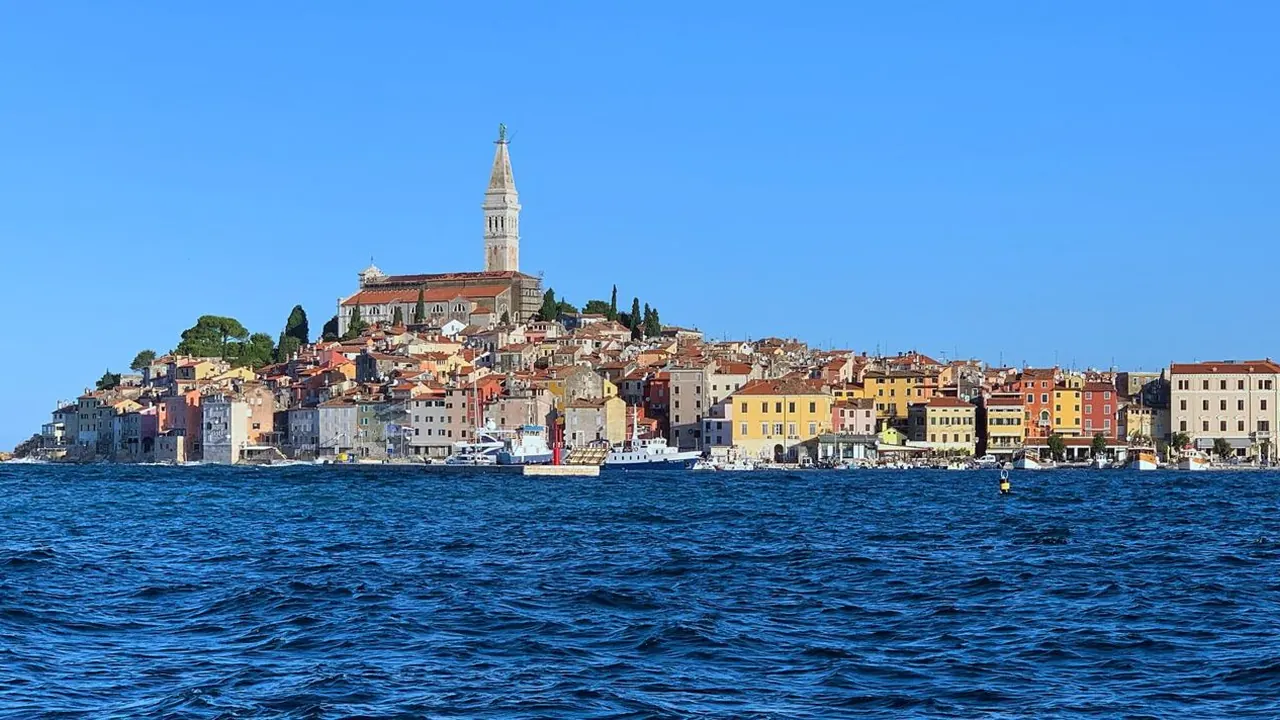
Photos: Florence by Wolfgang Weiser, Pexels License; Rovinj by Vyacheslav Bukharov, CC BY-SA 4.0, cropped.
Florence or Rovinj?
Our verdict in twelve categories, each scored against the same fixed benchmark cities, and the climate month by month, so you can choose for your trip.
Choose Florence for
- culture and sights
- shopping
- live music and the arts
Florence suits a trip built around looking and eating. The great paintings and sculpture of the Renaissance are all within walking distance of each other, evenings go to long trattoria dinners in the Oltrarno, and the region around it is the richest you could ask for. Pisa and Lucca are easy train rides, buses run to Siena, and Bologna is a quick hop by fast train. For art, craft shopping, music and the main Tuscan towns you can leave the car behind, though one makes the hill villages and Chianti wineries much easier.
Choose Rovinj for
- beaches
- families
- nature and the outdoors
If you want your days to end in the sea, go to Rovinj. You swim off limestone ledges in the Golden Cape, take taxi boats to the islands and stroll back through a small Venetian old town for dinner on the harbour. It gives you the slow seaside week that inland Florence cannot, and families whose children like the water will find it easier going. Bring a car if you want to see more of Istria.
Scoreboard
Twelve categories on one fixed scale from 0 to 100. The shaded stretch is the gap between the two.
Your match
Pick a travel style or drag the sliders, and both match scores follow your weighting.
Wins on culture and sights and shopping with your weighting.
Wins on beaches and families with your weighting.
What matters to you?
Category by category
What the scores mean for a trip.
Beaches & swimming
Swimming plays no part in a stay in Florence. It is an inland city, and its nearest sea is the sandy, lounger-lined Versilia coast, about an hour and a half away by train. In the heat, most visitors cool off in a hotel pool or one of the city's outdoor public pools.
In Rovinj the sea is part of every day. Flat limestone ledges and pebble coves run for kilometres through the Golden Cape, the water is very clear, and taxi boats reach quieter spots on St Catherine and Red Island. There is almost no sand, though, so pack water shoes.
Food & drink
Florence has the deeper food scene. There is bistecca and ribollita in Oltrarno trattorie, lampredotto rolls from street carts, two working markets at San Lorenzo and Sant'Ambrogio, and Chianti vineyards just outside the city. It is also easy to eat well cheaply standing at a counter.
Rovinj cooks from the sea and the Istrian hinterland: scampi buzara, truffled fuži, peppery olive oil and Malvazija. It is very good for a week of dinners, especially at the country konobas. There is little street food, though, and the menus on the harbour are written for tourists.
Culture & sights
The difference here is one of scale. In Florence the cathedral group alone, with Brunelleschi's dome, Giotto's bell tower and the bronze doors of the Baptistery, would be the main sight of most cities, and it is only the start. Santa Croce with its tombs, Palazzo Vecchio on Piazza della Signoria and the great galleries on both banks of the Arno make this a city you have to plan, booking ahead and accepting summer queues.
Rovinj asks for no planning at all. Its sight is a single Venetian quarter on what was once an island, with steep lanes such as Grisia climbing to St Euphemia, whose bell tower copies the campanile in Venice. The Batana House adds a local touch, telling the story of the flat-bottomed fishing boats and the songs sung on them, but this is a town to wander rather than to study.
Nightlife
Florence is no clubbing city, but it has more going on after dark. Crowds spill out of the bars on Piazza Santo Spirito, locals fill Sant'Ambrogio, there are student pubs near the centre, and in summer bars open along the Arno.
In Rovinj the evening is a long dinner followed by a drink on the rocks at sunset. A few waterfront bars keep going in high season, but the old town is quiet by midnight, and outside summer there is little open.
Nature & outdoors
Both offer gentle rather than wild landscapes, but on different ground. Around Florence you walk and cycle on land: olive terraces at Fiesole, the cypress-lined lanes of Chianti and the beech forests of the Casentino further into the Apennines.
Around Rovinj the outdoors is on the water. You can kayak, paddleboard and dive among the islands and wrecks, take a boat along the steep green Lim Fjord, or follow the pine paths of the Golden Cape.
Day trips
Florence is one of the best day-trip bases in Europe. Pisa, Lucca and Siena are all close by train or bus, Bologna is under forty minutes by fast train, and San Gimignano, Volterra and the Val d'Orcia towns fill any days left over.
Rovinj has a good short list: the Roman amphitheatre in Pula, the mosaics of the Euphrasian Basilica in Poreč, and the hill towns of Motovun and Grožnjan above the truffle woods. There are fewer first-rank places, and with no railway most of them need a car.
Good for families
Rovinj is the easier choice with children, though neither is ideal. Children enjoy the boat trips to the islands, the flat, shady paths of the Golden Cape and the resort pools and playgrounds. Watch out for the rocky shore and the steep old town cobbles.
Florence is made for adults. The best ways in for children are climbing the dome, the secret passages of Palazzo Vecchio and a run around the Boboli Gardens, but July heat and the crowds wear young children out. The Pinocchio park at Collodi is the classic family outing.
Getting around
Florence is both walkable and well connected. The Duomo, the Uffizi and the Pitti Palace are all within a short walk of each other, trams run to the airport, and Santa Maria Novella station sits in the centre for day trips by rail.
Rovinj is just as easy on foot inside town, with a car-free old town and a promenade into the Golden Cape. Beyond it there is no railway, and the buses only link the larger towns, so the hill villages and wineries really need a car.
Shopping & style
Florence is a serious place to shop. There is leather from the San Lorenzo stalls and small workshops, goldsmiths on the Ponte Vecchio, marbled paper, gilders and framers in the Oltrarno, antiques on Via Maggio and the fashion houses of Via de' Tornabuoni.
Shopping in Rovinj is about taking the region home with you: truffle products, olive oil, Teran and local brandies, plus the artists' studios along Grisia. There are no fashion streets, and the choice is thin outside summer.
Affordability
Both are expensive for their size, but the money goes in different places. In Florence, central hotels and the admission fees for museums and the Duomo climb add up. Street food, market lunches and walking everywhere keep daily costs down, and winter is the cheapest season.
Rovinj's costs peak in July and August, when old town rooms and harbourside fish dinners, priced by weight, cost what any sought-after resort does. Private apartments, the big campsites and a visit in late spring or September make the biggest saving.
Live music & performing arts
Florence has a real music season. Opera was born here, the Maggio Musicale is one of Europe's oldest festivals, and the Teatro del Maggio stages opera, concerts and ballet, though the jazz and live music scene is small.
Rovinj offers summer concerts in St Euphemia, music on the squares and sometimes the town's own bitinada singing. For anything larger, people drive to the Roman arena in Pula.
Wellness & relaxation
Neither has a bathing tradition within the town, so it comes down to what lies nearby. From Florence, the grand old spa town of Montecatini Terme is under an hour by train, the sulphur pools at Saturnia and Bagno Vignoni make an overnight trip, and a farm stay in the hills is the classic way to unwind.
Rovinj relaxes you through its pace instead. Late swims off the rocks, walks in the pines and the resort hotel spas make May, June and September restful, while the crowds of high summer push the calm out beyond the old town.
When should you go?
Pick your month. The climate figures are measured averages, not a forecast.
Florence in July
Rovinj in July
Daytime high, °C
Rainfall in the month, mm
Where the figures come from
Florence has no rain gauge within 25 km of the centre, so its rainfall comes from a gridded climate dataset read at the city rather than from a gauge further away.
Florence's sunshine is measured 71 km from the centre, at Pisa / S. Giusto.
Rovinj's temperatures are measured 64 km from the centre, at Trieste.
Rovinj has no rain gauge within 25 km of the centre, so its rainfall comes from a gridded climate dataset read at the city rather than from a gauge further away.
Temperature and rainfall are climate normals, averaged over the years shown. Florence: 1995-2020 (sunshine 1991-2020, rainfall 1991-2020) normals, Firenze / Peretola (5.6 km from centre). Rovinj: 1991-2020 normals, Trieste (63.7 km from centre).
Florence is at its best in April and May, when the days are warm enough for long walks and the rain is light. By June it is already hot, and July and August reach about 33°C in the river valley, too hot for walking the streets in the afternoon, although these are also its sunniest, driest months. September is still pleasant but the rain comes back, and October stays mild yet is one of the wettest months, with about 105mm. Winter is cool and grey but fine for museums.
Rovinj runs a few degrees milder, with highs of about 29°C in midsummer, and its season is set by the sea. The water is warm enough for swimming from June to September and reaches about 26°C in August. Unlike Florence, it gets a fair amount of rain in May, around 78mm, so late spring is greener than it is reliably sunny. Autumn is wet in both places, and from November to March the sea is too cold for swimming and Florence's museums make it the better winter choice.
Which traveller are you?
On a beach and sun trip, Rovinj is the clear choice. You can swim from the rocks below the old town, explore the coves of the Golden Cape and take taxi boats to the islands. Florence's nearest sand is a whole day's outing to the Versilia.
For a culture and arts trip, Florence is in a different league. It has the Uffizi, Michelangelo's David, Fra Angelico's frescoes at San Marco and opera at the Maggio Musicale. Rovinj offers one beautiful old town and two small museums.
On a food and nightlife trip, Florence keeps you busy from lunch to late. You can graze at market counters by day, take aperitivo, linger over dinner and still find squares full of people drinking afterwards. Rovinj eats well but goes to bed early, especially out of season.
Before you go
| Measure | Florence | Rovinj |
|---|---|---|
| Official language | Italian | Croatian |
| Currency | Euro (EUR) | Euro (EUR) |
| Sockets | CFL230 V, 50 Hz | CF230 V, 50 Hz |
| Driving side | Right | Right |
| Time zone | UTC+1, UTC+2 in summer | UTC+1, UTC+2 in summer |
| Emergency number | 112 | 112 |
| Elevation | 50 m | 0 m |
| Main airport | Florence Airport, Peretola (FLR)6 km from centre46 non-stop destinations | Pula Airport (PUY)31 km from centre34 non-stop destinations |
| Public holidays this year | 13 days | 14 days |
By the numbers
| Measure | Florence | Rovinj |
|---|---|---|
| City population | 360,930 | 12,968 |
| People per km² | 3,528 | - |
| Museums within 10 km | 141 | 1 |
| UNESCO World Heritage sites within 50 km | 4 | 1 |
| Swim season, months above 21 °C | - | 4 months |
Where else could you go?
Every comparison below shares a destination with this one, so you can follow Florence or Rovinj somewhere new.