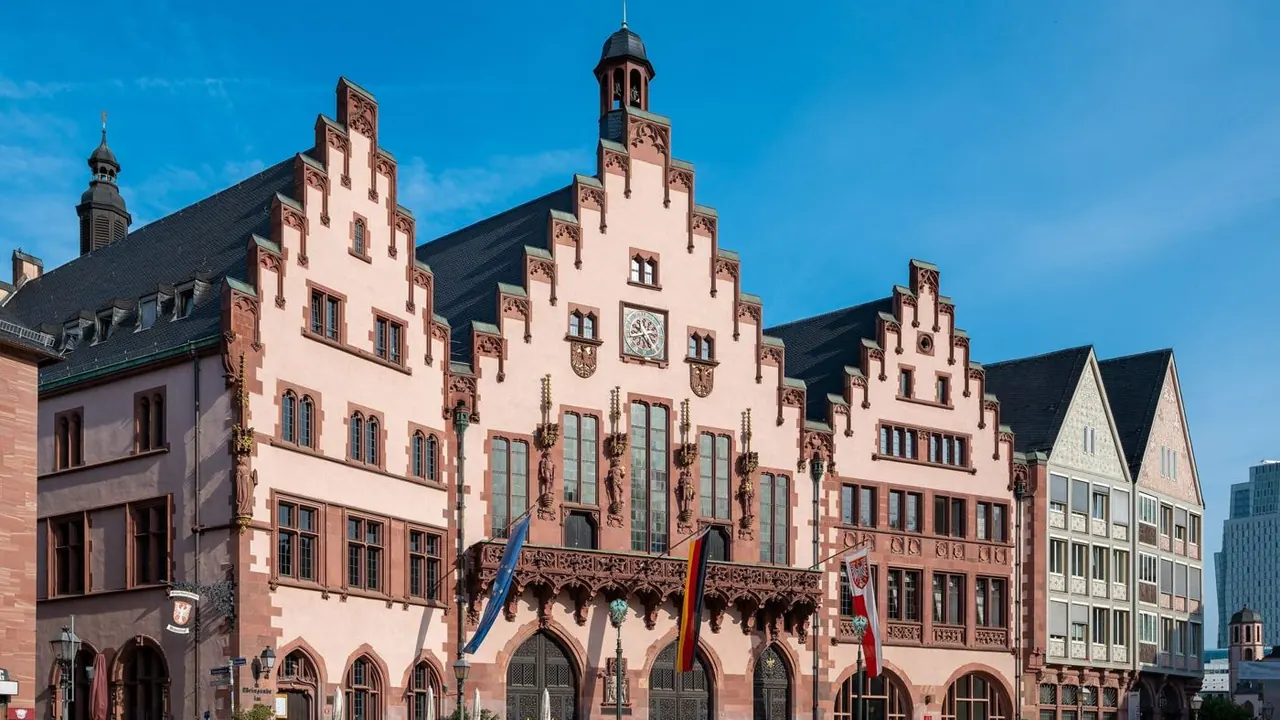
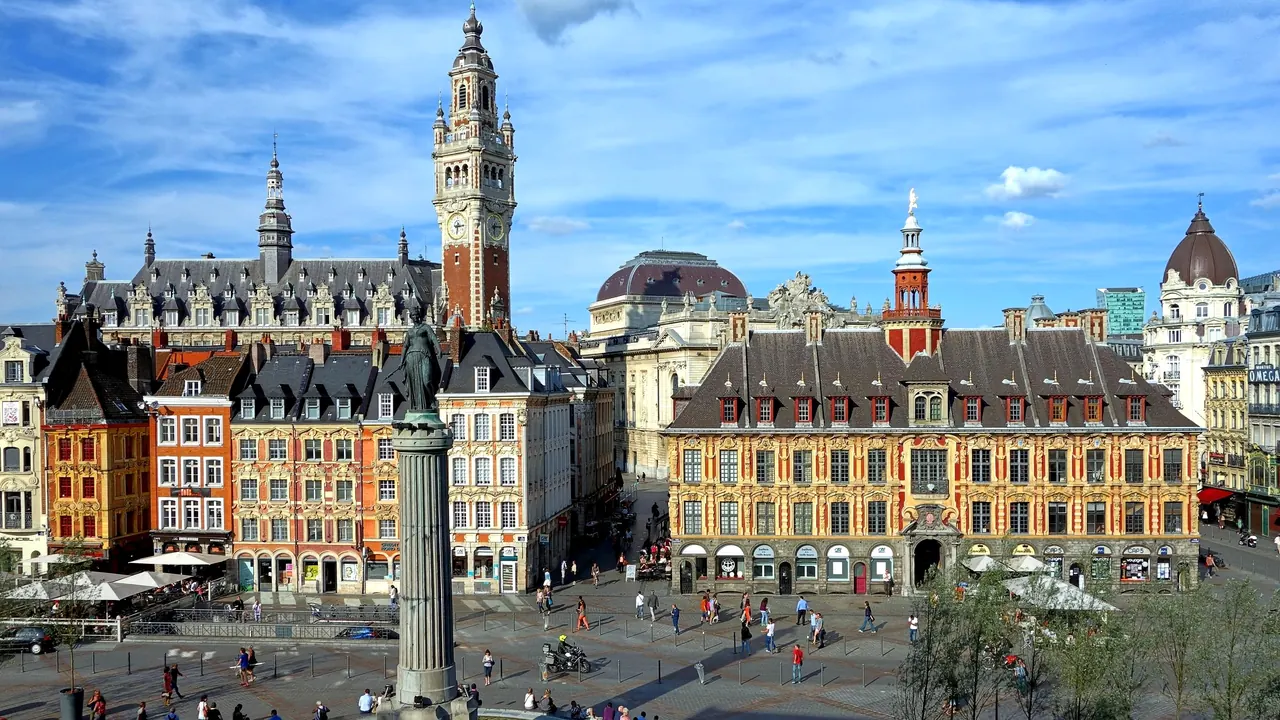
Photos: Frankfurt by Thomas Wolf, CC BY-SA 3.0 DE, cropped; Lille by Velvet, CC BY-SA 3.0, cropped.
Frankfurt or Lille?
Our verdict in twelve categories, each scored against the same fixed benchmark cities, and the climate month by month, so you can choose for your trip.
Choose Frankfurt for
- nature and the outdoors
- wellness
- live music and the arts
Frankfurt suits travellers who want green country on the doorstep and some polish in the evenings. The Taunus hills and the Rhine vineyards are close, the spa towns of Wiesbaden and Bad Homburg make a restful afternoon, and its opera company and the Alte Oper give it the stronger stage. Families do better here too, with the Senckenberg dinosaurs, a central zoo and trams that take pushchairs easily.
Choose Lille for
- beaches
- prices
- food and drink
Lille is the better pick for eating, drinking and making a budget go further. Flemish taverns and Belgian ales give it a more distinctive table, its hotels are more reasonable for most of the year, and its two stations put Brussels, Bruges and Paris within easy reach. Walking around the city is easy, but there is little for anyone after hills or a long soak.
Scoreboard
Twelve categories on one fixed scale from 0 to 100. The shaded stretch is the gap between the two.
Your match
Pick a travel style or drag the sliders, and both match scores follow your weighting.
Wins on nature and the outdoors and wellness with your weighting.
Wins on beaches and prices with your weighting.
What matters to you?
Category by category
What the scores mean for a trip.
Beaches & swimming
Neither is a beach destination, but Lille at least has the sea within reach. Malo-les-Bains at Dunkirk is about an hour by train, a wide, sandy North Sea beach where the water stays cold and the wind rarely drops. The dune beaches of the Opal Coast beyond it suit walking more than swimming.
Frankfurt has no coast within a day's travel. Swimming means outdoor pools and the gravel-pit lakes in the forest such as the Langener Waldsee, which is pleasant on a July afternoon but is a lake, not the seaside.
Food & drink
Both cities eat in old taverns with a local drink, and Lille comes out ahead. Its estaminets in Vieux-Lille serve rich Flemish dishes such as carbonnade slow-cooked in beer and the cheese-laden welsh, with Maroilles in almost everything. Northern French and Belgian ales, vanilla waffles and the Sunday market at Wazemmes complete the picture.
Frankfurt's apple-wine taverns in Sachsenhausen are just as sociable, but the local dishes are fewer: Grüne Soße, Handkäs mit Musik and sausages from the Kleinmarkthalle. Its advantage is range, as Turkish, Italian and Asian kitchens and the cheap global food of the Bahnhofsviertel give more choice beyond regional cooking.
Culture & sights
Both cities fill two or three days, but in different ways. Frankfurt has breadth: a whole riverside of museums along the Museumsufer, led by the Städel and the Senckenberg. They sit around the rebuilt Römer and Germany's only real skyline of towers.
Lille has one great collection in the Palais des Beaux-Arts, and an old town that survived. The brick and carved stone of Vieux-Lille, the Vieille Bourse and Vauban's star-shaped citadel are the original buildings, not reconstructions. La Piscine in Roubaix, an art museum inside an Art Deco swimming pool, is worth the metro ride on its own.
Nightlife
The two are about equal for nights out, but the tone differs. Frankfurt has the clubs, with a techno and house tradition it shares with Offenbach and the rough-edged cocktail bars of the Bahnhofsviertel, but as a working city it only gets busy at weekends. Lille is a student city that goes out on Thursdays along Rue Masséna and Rue Solférino, with calmer beer cafés in the cellars of Vieux-Lille, and for serious clubbing people cross into Belgium.
Nature & outdoors
Frankfurt has far more to offer outdoors. The Taunus starts at the edge of the suburbs, with beech forest and Roman frontier trails up to the Großer Feldberg at about 880m, and the Stadtwald forest lies inside the city. The vineyard paths of the Rheingau and the Rhine Gorge are close enough for a day's walking.
Lille sits in flat, farmed Flanders. The Citadel park and the canal towpaths give easy cycling, and the low Monts de Flandre offer short walks with wide views. The only dramatic landscape nearby, the chalk cliffs of the Opal Coast, takes a long day.
Day trips
Both are excellent bases, and the difference is where the trains go. From Lille they cross borders: Brussels in about half an hour, Ghent and Bruges in an hour or so, Paris by TGV, and even London for an ambitious day. The First World War battlefields lie to the south.
Frankfurt's trips stay mostly within Germany and are more about scenery: Heidelberg's castle, boats past the castles of the Rhine Gorge, Riesling in the Rheingau and Cologne cathedral by fast train. Choose Lille to add cities and countries to your trip, and Frankfurt for river landscapes and old German towns.
Good for families
Frankfurt is the easier city with children. The dinosaur hall at the Senckenberg is a real draw, the zoo is central and the Palmengarten makes a calm half-day. The Taunus adds a wildlife park and a small fairy-tale park, all reached by trams and trains that take pushchairs easily.
Lille gives you a pleasant morning in the Citadel park, with its small zoo and fairground rides, and a hands-on science centre by metro. Its biggest family outings, Pairi Daiza and the aquarium at Boulogne, mean leaving the city, and the cobbles of Vieux-Lille are hard work with a pushchair.
Getting around
Both have compact centres where you will never want a car, but their transport works differently. Frankfurt's single regional network of U-Bahn, S-Bahn and trams takes some learning, but it reaches Wiesbaden and the Taunus, and the airport is about a quarter of an hour from the centre. Lille is simpler and flatter, with its two main stations side by side next to the old town and the driverless VAL metro and the tram covering Roubaix and Tourcoing.
Shopping & style
There is little between them for everyday shopping, as each has a main street of chains and a large mall. Frankfurt has more luxury fashion around Goethestraße and independent shops on Berger Straße, while in Lille the best browsing is in the narrow streets of Vieux-Lille. Lille's one big advantage is the Braderie at the start of September, when the whole city becomes a flea market.
Affordability
Lille is the cheaper city. Its hotels are reasonable for most of the year, and estaminet meals, beer and the metro are fairly priced, though a stay is comfortable rather than cheap.
Frankfurt's hotels are priced for business travellers and become expensive and hard to find during trade fairs, so it costs more unless you go at a weekend or in summer. Once you are there, cider taverns, Turkish grills and the Museumsufer pass keep daily costs moderate.
Live music & performing arts
Frankfurt has the stronger stage. Its opera company is among the most respected in Germany for bold productions, and the Alte Oper hosts the radio symphony orchestra. Serious drama at the Schauspiel, dance at Mousonturm and jazz in cellar clubs fill out the season, which goes quiet in summer.
Lille's Opéra, the Orchestre National de Lille and the Théâtre du Nord make a dependable season, with the Zénith and the Aéronef for touring bands. It is a programme to enjoy if you are already there, not one to plan a trip around.
Wellness & relaxation
Frankfurt is the better choice for rest, though not because of the city itself. It is a working city with only municipal pools and hotel spas, but the spa towns around it are close. Wiesbaden has the Art Nouveau Kaiser-Friedrich-Therme, fed by hot springs, Bad Homburg has a spa park and a large thermal bath complex with saunas at the foot of the Taunus, and Bad Nauheim and Bad Soden keep up the old spa tradition. In town, the Palmengarten and the quieter stretches of the Main are the calm corners.
Lille has no baths of its own either. Relaxing there means a hotel or day spa, a tea room or a long afternoon on a café terrace in Vieux-Lille, and the nearest real thermal bath is at Saint-Amand-les-Eaux, a small spa town a short train ride away. Day to day, Lille moves at an easier pace than business-minded Frankfurt, but it gives you far less to do if unwinding is the point of the trip.
When should you go?
Pick your month. The climate figures are measured averages, not a forecast.
Frankfurt in July
Lille in July
Daytime high, °C
Rainfall in the month, mm
Temperature and rainfall are climate normals, averaged over the years shown. Frankfurt: 1991-2020 normals, Frankfurt Westend (2 km from centre). Lille: 1991-2020 normals, Lille (7.8 km from centre).
Both cities are at their best from late May to September. Frankfurt is warmer and noticeably sunnier in high summer, with highs of 26°C in July and August, and those long, bright days suit its forest lakes and riverside terraces. Lille peaks a little cooler at around 24°C, which many find easier for a full day on foot. Neither summer is hot enough to keep you off the streets.
The cold months are where they differ more. Frankfurt is colder and very dark in midwinter. Lille stays a degree or two milder but gets wetter through autumn, reaching 76mm in December. Spring is drier in Frankfurt, where April is the least rainy month, so April and May favour Frankfurt for walks in the Taunus. Lille's spring is mild but greyer.
Which traveller are you?
On an outdoors trip, Frankfurt lets you take a morning train to a forest trail or a mountain-bike route and still be back for an apple-wine supper, all on one regional ticket. In Lille, a day outside usually means a level canal ride, and real hiking needs a long trip.
For a relaxing and wellness trip, Frankfurt works well as a base for a slow-paced stay. You can spend a day taking the waters in an old spa town and come back to quiet glasshouses in the city. In Lille, rest mostly means long lunches and a hotel spa.
On a trip on a tight budget, Frankfurt only works if you plan around its calendar of trade fairs and stick to weekends or summer, though eating out stays cheap. Lille is easier to book in most weeks, and with Belgian cities so close, one cheap base covers several places.
Before you go
| Measure | Frankfurt | Lille |
|---|---|---|
| Official language | German | French |
| Currency | Euro (EUR) | Euro (EUR) |
| Sockets | CF230 V, 50 Hz | CE230 V, 50 Hz |
| Driving side | Right | Right |
| Time zone | UTC+1, UTC+2 in summer | UTC+1, UTC+2 in summer |
| Emergency number | 112 | 112 |
| Elevation | 101 m | 17 m |
| Main airport | Frankfurt Main Airport (FRA)13 km from centre281 non-stop destinations | Lille Airport (LIL)8 km from centre61 non-stop destinations |
| Public holidays this year | 10 days | 11 days |
By the numbers
| Measure | Frankfurt | Lille |
|---|---|---|
| City population | 760,656 | 238,246 |
| People per km² | 3,063 | 6,846 |
| Museums within 10 km | 53 | 23 |
| UNESCO World Heritage sites within 50 km | 4 | 6 |
Where else could you go?
Every comparison below shares a destination with this one, so you can follow Frankfurt or Lille somewhere new.
- Brugesvs Lille
- Ghentvs Lille
- Heidelbergvs Frankfurt
- Brusselsvs Lille
- Antwerpvs Lille
- Stuttgartvs Frankfurt