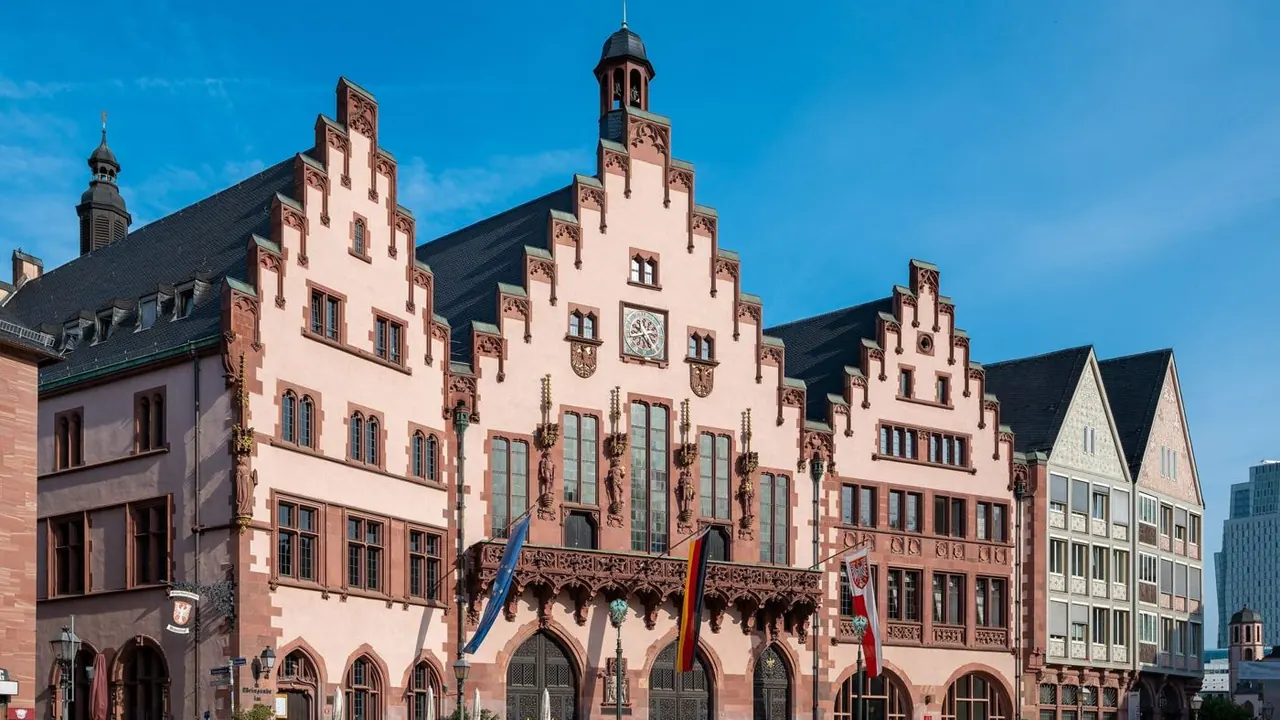
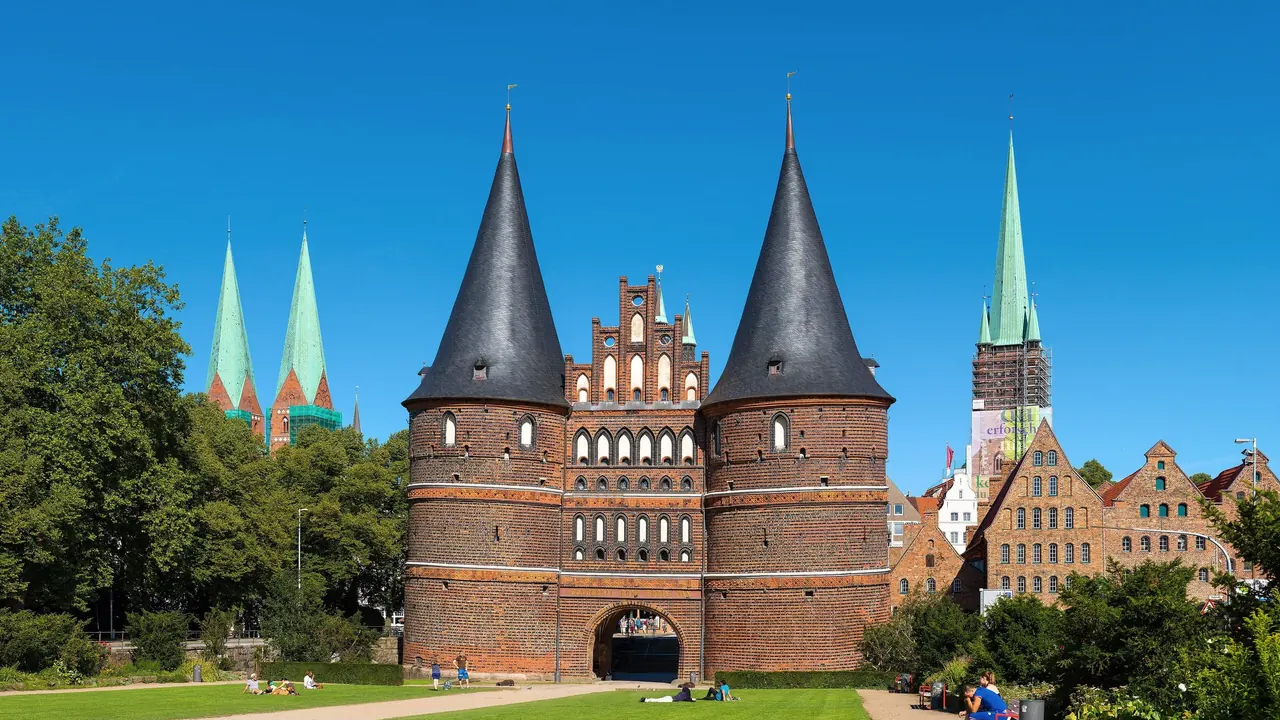
Photos: Frankfurt by Thomas Wolf, CC BY-SA 3.0 DE, cropped; Lubeck by Christian Wolf (www.c-w-design.de), CC BY-SA 3.0 DE, cropped.
Frankfurt or Lubeck?
Our verdict in twelve categories, each scored against the same fixed benchmark cities, and the climate month by month, so you can choose for your trip.
Choose Frankfurt for
- nightlife
- day trips
- live music and the arts
Frankfurt suits travellers who want a base with range rather than a single postcard. Its rail links put Heidelberg, the Rhine Gorge and Cologne within easy reach, and the evenings offer a respected opera company, apple-wine taverns in Sachsenhausen and a serious weekend techno scene. It is the stronger choice for a lively, varied city trip, provided you book around the trade fairs that push hotel prices up.
Choose Lubeck for
- beaches
- prices
- culture and sights
Lübeck is for a slower, smaller trip built around one remarkable place. The brick Gothic island of church spires, merchants' houses and hidden courtyards survives in a way Frankfurt's rebuilt core cannot match. Rooms cost less, and in summer the sandy beach at Travemünde is a short train ride away. The trade-off is early, quiet nights and fewer excursions, with Hamburg filling the gaps.
Scoreboard
Twelve categories on one fixed scale from 0 to 100. The shaded stretch is the gap between the two.
Your match
Pick a travel style or drag the sliders, and both match scores follow your weighting.
Wins on nightlife and day trips with your weighting.
Wins on beaches and prices with your weighting.
What matters to you?
Category by category
What the scores mean for a trip.
Beaches & swimming
Lübeck has a real seaside within its own boundaries. Travemünde's long sandy beach, with its hooded wicker chairs, and the bay resorts of Timmendorfer Strand and Scharbeutz give calm, tide-free water that is ideal for paddling. The Baltic stays cool even in midsummer, though, so this is beach afternoons rather than a swimming trip.
Frankfurt has nothing comparable. Its summer swimming is in outdoor pools and gravel-pit lakes such as the Langener Waldsee, which are pleasant on a hot day but are no substitute for the coast.
Food & drink
Frankfurt is the better place to eat, mainly because of its range. The apple-wine taverns of Sachsenhausen, with Grüne Soße and Handkäs at shared tables, give it a strong local ritual, the Kleinmarkthalle is an excellent market stop, and the Turkish, Italian and Asian kitchens add depth that a smaller city lacks.
Lübeck's table is narrower but distinctive: marzipan from confectioners near the town hall, herring and fish sandwiches from the harbour, and Rotspon claret from old cellars, all best enjoyed in the sea captains' guild house. Beyond that the choice soon becomes provincial.
Culture & sights
Frankfurt is the city for galleries. The Museumsufer lines both banks of the Main with more than a dozen museums, led by the Städel's old masters and modern painting, with the Schirn's big exhibitions alongside. Above ground, though, the Römer, the cathedral lanes and the Paulskirche are mostly rebuilt after 1944 and stand beneath a wall of towers.
Lübeck is the more rewarding place simply to walk through. Its UNESCO-listed island is a Hanseatic town that has largely survived, from the leaning Holstentor to the Marienkirche, the model for brick Gothic churches around the Baltic, and the gabled merchants' houses with courtyards behind them. The Hansemuseum and the Buddenbrookhaus fill in the history and literature behind what you have just walked past.
Nightlife
Frankfurt is clearly the place for a night out, though mostly at weekends. The station district has the most character, Berger Straße suits relaxed neighbourhood drinking, and the techno and house clubs carry a real musical heritage.
Lübeck's evenings are pubs and wine bars in the old town and along the Obertrave, plus Travemünde's promenade in summer. There are almost no clubs and the town is asleep by midnight, so night owls take the train to Hamburg.
Nature & outdoors
Frankfurt has the better outdoors on its doorstep. The Taunus hills rise to about 880m on the Großer Feldberg, with beech forest and Roman frontier trails under an hour away, the Stadtwald lies inside the city, and the Rhine Gorge and Rheingau vineyard paths add real scenery.
Lübeck is flatter and wetter: canoeing on the reed-lined Wakenitz, the crumbling clay cliff walk at Brodtener Steilufer and the lakes of Holstein Switzerland. What it offers that Frankfurt cannot is the sea, with sailing and windsurfing on the bay in summer.
Day trips
Frankfurt is one of the best bases in Germany for excursions. Heidelberg, the castle-lined Rhine Gorge and Cologne's cathedral are each about an hour by train, and Mainz, Wiesbaden, Würzburg, Speyer and Marburg add a week's worth of easy outings.
Lübeck has a few excellent choices but a shorter list. Hamburg is under an hour away, and Wismar and the island castle at Schwerin make strong days out. After Ratzeburg, Eutin and Kiel, though, the options soon run out.
Good for families
The two are about equally good with children, but the appeal differs and so does the timing. Frankfurt works in any season, thanks to the Senckenberg's dinosaur hall, a central zoo, the Palmengarten glasshouses and boat trips past the skyline.
Lübeck is at its best in summer, when Travemünde's shallow beach, the bay promenades and Hansa-Park turn it into a seaside-and-city stay. On a wet winter visit there is much less for children to do.
Getting around
Both centres are easy to walk, but Frankfurt's transport reaches further. One integrated U-Bahn, S-Bahn and tram network covers the city and region out to Wiesbaden and the Taunus, and the airport is about a quarter of an hour from the centre by train. The cost is a system of lines and zones that takes some learning.
Lübeck is simpler. The island old town is about 2km long and mostly pedestrianised, though cobbled, and the station sits just across the river. Buses and a short regional train to Travemünde handle the rest, but you would need a car for the lakes and smaller villages.
Shopping & style
Frankfurt gives shoppers far more. The Zeil has department stores and malls, Goethestraße holds the luxury houses, and Berger Straße and Schweizer Straße have independent boutiques and delis. Even so, it has no speciality of its own.
Lübeck's Breite Strasse and Königstrasse cover the chains, with crafts and galleries tucked into the side passages. Its one great souvenir is marzipan, and serious fashion shoppers head to Hamburg.
Affordability
Lübeck is the easier city on the wallet. Old-town guesthouses and mid-range hotels are reasonably priced, and harbour kiosks and taverns are cheap. The exception is the coast in July and August, when beach accommodation costs noticeably more.
Frankfurt's weak point is its hotels, which are priced for business visitors and become scarce and very expensive during big trade fairs. Eating in cider taverns and Turkish grills stays cheap, and weekend or summer stays are usually much better value.
Live music & performing arts
Frankfurt is the stronger stage city. Its opera company is known for adventurous productions, the Alte Oper hosts the radio symphony orchestra, and serious drama, contemporary dance and post-war jazz cellars complete the picture. Its season is quiet in summer, however.
Summer is when Lübeck has more to offer, as the Schleswig-Holstein Music Festival brings well-known performers to its halls and churches. For the rest of the year, Theater Lübeck and the organ concerts at the Marienkirche, where Buxtehude played, are its quieter highlights.
Wellness & relaxation
Frankfurt itself is a brisk working city, but it has the better spa country within reach. Wiesbaden's Art Nouveau Kaiser-Friedrich-Therme, the thermal baths at Bad Homburg and the old cure towns of Bad Nauheim and Bad Soden make easy restorative days.
Lübeck is the calmer place to simply be, with quiet courtyards and riverside benches. For proper bathing, it relies on Travemünde's long seaside spa tradition, wellness hotels and the seawater pool at Scharbeutz, which is a gentler and smaller offer.
When should you go?
Pick your month. The climate figures are measured averages, not a forecast.
Frankfurt in July
Lubeck in July
Daytime high, °C
Rainfall in the month, mm
Temperature and rainfall are climate normals, averaged over the years shown. Frankfurt: 1991-2020 normals, Frankfurt Westend (2 km from centre). Lubeck: 1991-2020 normals, Luebeck-Blankensee (6 km from centre).
Frankfurt is the warmer and sunnier of the two in summer, with highs around 26°C in July and August against about 24°C in Lübeck. July is Frankfurt's sunniest month, while Lübeck's long light peaks earlier, in May. Rain falls steadily in both all year and is a little heavier in summer, so expect the odd shower whenever you go. April is the driest month in each, and April, May and September are the most comfortable for walking the streets.
Lübeck's beach season is short. The Baltic warms only to about 18°C in July and 19°C in August, so swimming really works from late June to early September. Winters in both are cold, grey and dark, with highs around 5°C, and Lübeck runs a degree or two cooler for most of the year. That makes Frankfurt, with more to do indoors, the easier of the two in the cold months.
Which traveller are you?
On a beach and sun trip, Lübeck is the only real option. Travemünde's sandy Baltic shore and the resorts along the bay are within half an hour, with calm, shallow water. Frankfurt's nearest swimming is a forest lake.
For a food and nightlife trip, Frankfurt wins comfortably. Long evenings in Sachsenhausen's apple-wine taverns, global eating and cocktail bars in the Bahnhofsviertel and weekend techno clubs add up to far more than Lübeck's quiet pubs, which close early.
On a trip on a tight budget, Lübeck stretches money further. Old-town rooms are moderately priced, fish kiosks and taverns are inexpensive, and the island is free to walk. Frankfurt's hotels are priced for business travellers and soar during trade fairs.
Before you go
| Measure | Frankfurt | Lubeck |
|---|---|---|
| Official language | German | German |
| Currency | Euro (EUR) | Euro (EUR) |
| Sockets | CF230 V, 50 Hz | CF230 V, 50 Hz |
| Driving side | Right | Right |
| Time zone | UTC+1, UTC+2 in summer | UTC+1, UTC+2 in summer |
| Emergency number | 112 | 112 |
| Elevation | 101 m | 13 m |
| Main airport | Frankfurt Main Airport (FRA)13 km from centre281 non-stop destinations | Hamburg Helmut Schmidt Airport (HAM)53 km from centre120 non-stop destinations |
| Public holidays this year | 10 days | 10 days |
By the numbers
| Measure | Frankfurt | Lubeck |
|---|---|---|
| City population | 760,656 | 217,061 |
| People per km² | 3,063 | 1,013 |
| Museums within 10 km | 53 | 23 |
| UNESCO World Heritage sites within 50 km | 4 | 1 |
| Swim season, months above 21 °C | - | None |
Where else could you go?
Every comparison below shares a destination with this one, so you can follow Frankfurt or Lubeck somewhere new.
- Hamburgvs Lubeck
- Heidelbergvs Frankfurt
- Stuttgartvs Frankfurt
- Colognevs Frankfurt
- Baden-Badenvs Frankfurt
- Dusseldorfvs Frankfurt