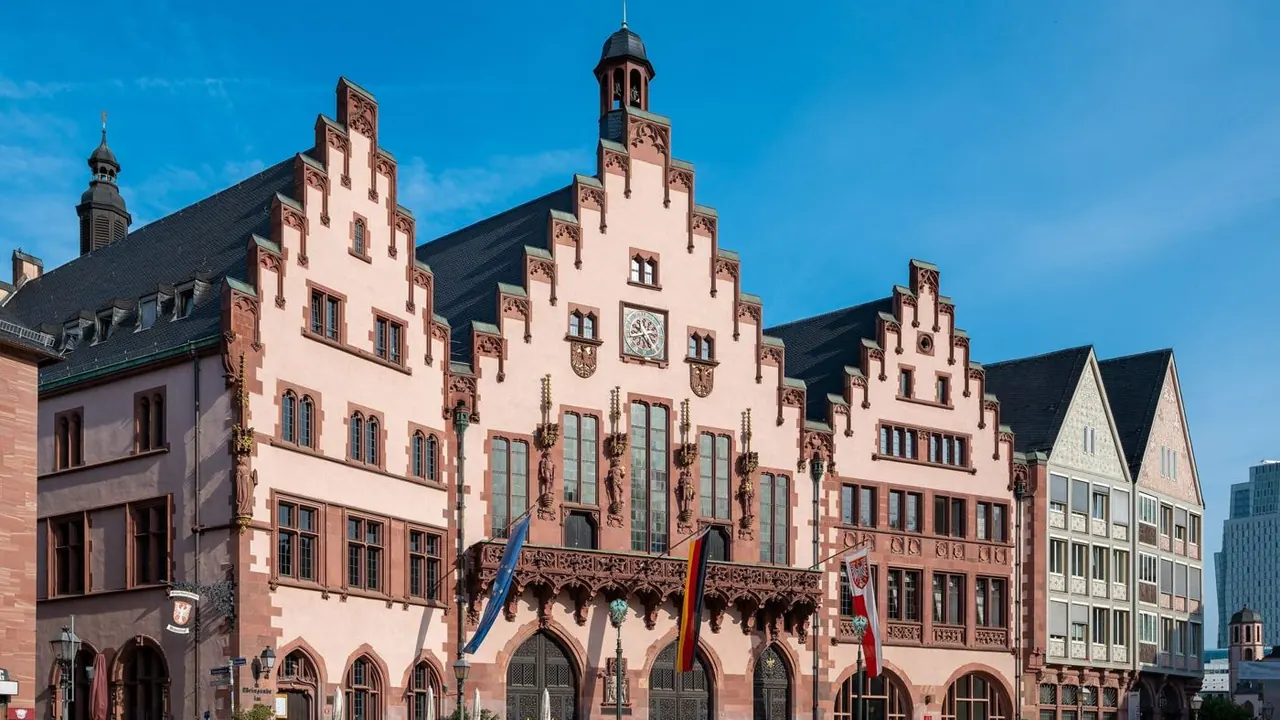
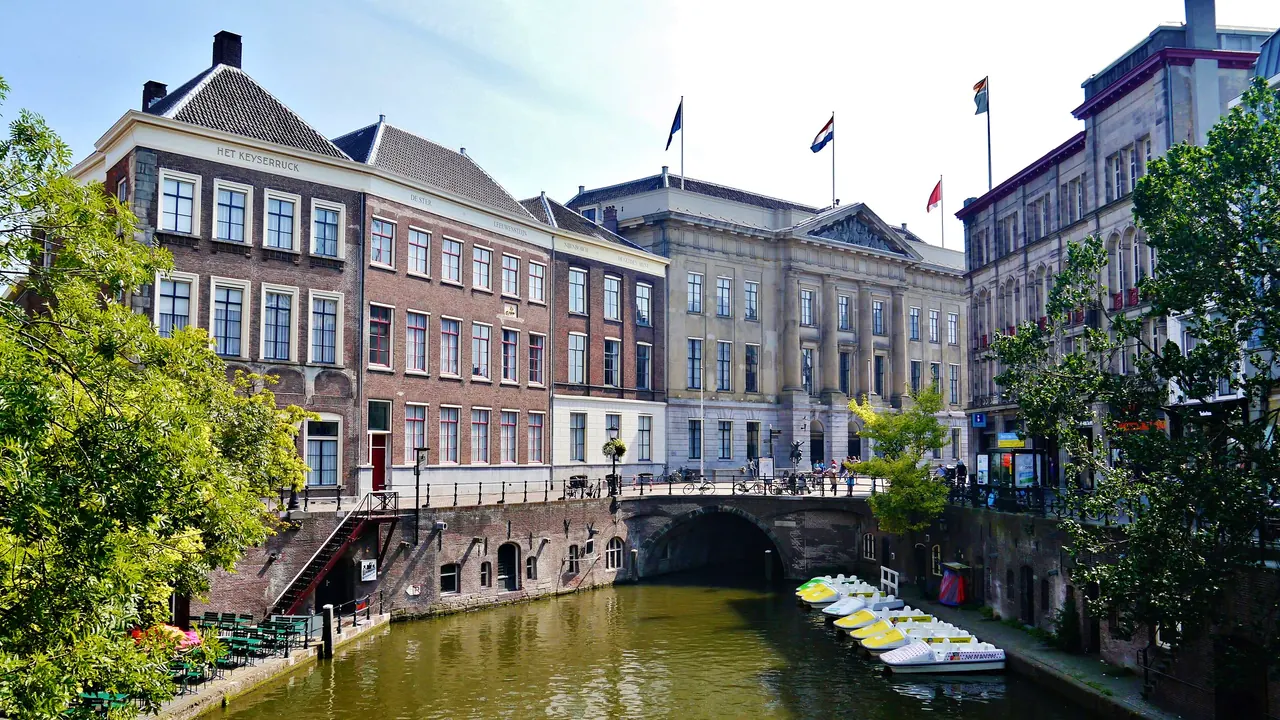
Photos: Frankfurt by Thomas Wolf, CC BY-SA 3.0 DE, cropped; Utrecht by Zairon, CC BY-SA 4.0, cropped.
Frankfurt or Utrecht?
Our verdict in twelve categories, each scored against the same fixed benchmark cities, and the climate month by month, so you can choose for your trip.
Choose Frankfurt for
- wellness
- food and drink
- nature and the outdoors
Frankfurt is the better pick for a traveller who wants more evening and more of the region around it. It has a respected opera company and a grand concert hall, apple-wine taverns with real local cooking, a club scene rooted in techno, and old spa towns like Wiesbaden and Bad Homburg close by. The Taunus hills begin at the edge of the suburbs, so the countryside is close too. It suits couples and culture-minded adults who will put up with a business city's busy weekdays to get all of that.
Choose Utrecht for
- beaches
- getting around
- families
Utrecht is the gentler, more personal choice. Its medieval centre has survived, with the Dom Tower and the two-level Oudegracht wharves just a short flat walk from the station. Children are welcome everywhere, and Amsterdam, Rotterdam and The Hague are all short train rides away. Choose it for an unhurried stay by the canals, a family trip, or a base for seeing the Netherlands by train and bike.
Scoreboard
Twelve categories on one fixed scale from 0 to 100. The shaded stretch is the gap between the two.
Your match
Pick a travel style or drag the sliders, and both match scores follow your weighting.
Wins on wellness and food and drink with your weighting.
Wins on beaches and getting around with your weighting.
What matters to you?
Category by category
What the scores mean for a trip.
Beaches & swimming
Neither city is for a beach trip, but Utrecht at least gets you to the sea. Zandvoort and Scheveningen are about an hour or so by train, though the North Sea stays cool and the season is short.
From Frankfurt the coast is a full day away. Summer swimming there means outdoor pools or forest lakes such as the Langener Waldsee, while Utrecht people head to the Maarsseveense Plassen or the Loosdrecht lakes.
Food & drink
Frankfurt gives you more to eat that belongs to the place. You can drink tart Apfelwein from stoneware jugs at a Sachsenhausen tavern, try Grüne Soße and Handkäs mit Musik, and shop for regional sausages and cheese in the Kleinmarkthalle. The Turkish grills and Bahnhofsviertel kitchens add range.
In Utrecht the setting matters more than the cooking. A meal in an old storeroom cellar at the Oudegracht waterline is pleasant mainly for where you sit, and the Indonesian and Surinamese kitchens are a good reason to look beyond Dutch staples. Fine dining is thin on the ground, so anyone who cares most about the food will get more out of Frankfurt.
Culture & sights
Each city is worth two or three days of sightseeing, but for different things. Frankfurt is a museum city: the Museumsufer lines both banks of the Main, the Städel holds paintings of international standing, and the rebuilt Römer and old-town lanes sit beneath a skyline of towers.
Utrecht's old streets are the real thing. The medieval centre survived, and the Dom Tower stands apart from the choir where a storm brought down the nave. You can climb it for views over the province. Its museums are smaller, but the Rietveld Schröder House is a gem of modern design.
Nightlife
Frankfurt has more of a night to offer, especially for music. Its techno and house clubs carry on a tradition shared with Offenbach. The station district mixes cocktail bars and late kiosks, and Berger Straße has easy neighbourhood bars. The catch is that it is a working city, so things only really come alive on Friday and Saturday.
Utrecht works the other way round. Its student crowd fills the bars around the Neude and the Janskerkhof even midweek, but the clubs are few, and for a big night out most people take the train to Amsterdam.
Nature & outdoors
Frankfurt gets you into real hills. The Taunus starts just past the northern suburbs, and the Großer Feldberg rises to about 880m with beech forest and Roman frontier trails. The vineyard paths of the Rheingau and the Rhine Gorge are within easy reach.
Utrecht's countryside is flat and best seen by bike, along the Vecht past windmills and country estates and through polders. The Utrechtse Heuvelrug adds heath and sandy forest trails, and the Loosdrecht lakes are good for sailing, but this is gentle cycling country with nothing for serious hikers.
Day trips
Both cities sit at the heart of a national rail network, and both could keep you busy for a week. What differs is what you go out to see.
From Frankfurt it is castles, rivers and cathedrals: Heidelberg's castle ruin, boats through the Rhine Gorge, Cologne by high-speed train and Riesling in the Rheingau. From Utrecht it is mostly cities in quick succession. Amsterdam is under half an hour away, and Rotterdam, The Hague, Delft and Gouda are all close, with Kinderdijk's windmills and the Kröller-Müller Museum for longer days.
Good for families
Utrecht is slightly easier with children. The Dutch take children everywhere as a matter of course, the national Railway Museum is a real highlight and the Miffy museum is made for toddlers. The steady stream of bikes is the one thing to watch.
Frankfurt does well too, with its own strengths. The Senckenberg's dinosaur hall, a central zoo, the Palmengarten glasshouses and boat trips past the skyline fill a few days, and the Taunus wildlife park is an easy outing.
Getting around
Utrecht is the simpler city to find your way around. The station sits on the edge of the old town, the sights are a short walk on flat streets, and a rental bike covers the rest. One tap-in card works on the trains, buses and trams.
Frankfurt's centre is compact as well, and its U-Bahn, S-Bahn and trams take you on to the Taunus, Wiesbaden and Mainz on one network. The airport is about a quarter of an hour from town by train. The price is a tangle of lines and zones to learn first.
Shopping & style
There is little to choose between them, but they suit different shoppers. Frankfurt has the bigger brands, with department stores and malls along the Zeil and luxury fashion and jewellery on Goethestraße.
Utrecht is better for browsing small shops. Independent design, book and fashion shops line the Oudegracht wharves and the Twijnstraat, and there are flower and textile markets. Hoog Catharijne handles the chains, and luxury shoppers head to Amsterdam.
Affordability
Both are expensive mainly because of the hotels, for different reasons. Frankfurt prices its rooms for business travellers and they jump during trade fairs, so a weekend or summer stay can save a good deal.
In Utrecht the problem is a shortage of hotels in the historic centre, and weekends cost more there, not less. You make some of it back day to day: you can walk or cycle everywhere, and student cafés keep lunch cheap. In Frankfurt the cider taverns and Turkish grills do the same job.
Live music & performing arts
Frankfurt has the deeper evening programme. Its opera company is one of Germany's most respected, the Alte Oper hosts the radio symphony orchestra, and there are jazz cellars and a long-running English-language theatre. Note that the season winds down in summer.
Utrecht does well for its size. TivoliVredenburg puts classical, pop and experimental acts under one roof, and the Festival Oude Muziek is a highlight for early-music lovers. It has no opera house, though, and most of its theatre is in Dutch.
Wellness & relaxation
Frankfurt is surrounded by the German tradition of taking the waters. Wiesbaden's Kaiser-Friedrich-Therme, fed by hot springs, is under an hour away, and Bad Homburg's thermal baths sit at the foot of the Taunus.
Utrecht's version is the Dutch sauna complex out in the green belt, which needs a bus or a drive. In the city itself, unwinding is mostly about the calm: a quiet hour in the Pandhof cloister garden or an evening on the canal wharves after the day-trippers have left.
When should you go?
Pick your month. The climate figures are measured averages, not a forecast.
Frankfurt in July
Utrecht in July
Daytime high, °C
Rainfall in the month, mm
Temperature and rainfall are climate normals, averaged over the years shown. Frankfurt: 1991-2020 normals, Frankfurt Westend (2 km from centre). Utrecht: 1991-2020 normals, De Bilt (4.3 km from centre).
Both cities are at their best from May to September, but high summer feels different in each. Frankfurt gets properly warm, with afternoons around 26°C in July and August and noticeably more sunshine. That is good for evenings on the riverbanks, though a full day of walking the streets can be tiring. Utrecht stays milder at about 23°C, which suits walking and cycling, but it is the wetter of the two. Its rain builds through late summer and autumn to around 85mm a month, while Frankfurt's driest stretch is spring, with April the driest month at about 38mm.
Winters are cold and grey in both, with short days and highs only a few degrees above freezing. Utrecht gets slightly more winter sun, and Frankfurt gets clearly more in summer. The North Sea near Utrecht only warms to about 19°C in August, so a beach day there is a brief summer extra. For walking the streets, spring and early autumn suit both cities, and Frankfurt's dry, bright April is especially good.
Which traveller are you?
On a relaxing and wellness trip, Frankfurt is the better base. Wiesbaden's Art Nouveau thermal bath and the spa park at Bad Homburg are close by. Utrecht offers sauna complexes out of town and quiet evenings by the canals.
For a food and nightlife trip, choose Frankfurt. You get shared tables in the Sachsenhausen apple-wine taverns, cheap global food in the Bahnhofsviertel and weekend techno clubs. Utrecht's evenings are pleasant but mostly student bars and canal terraces.
For a short city break, Utrecht is easier. You step off the train almost into the medieval centre, the Dom, the wharves and the museums are all a flat walk apart, and there is no transport system to learn first.
Before you go
| Measure | Frankfurt | Utrecht |
|---|---|---|
| Official language | German | Dutch |
| Currency | Euro (EUR) | Euro (EUR) |
| Sockets | CF230 V, 50 Hz | CF230 V, 50 Hz |
| Driving side | Right | Right |
| Time zone | UTC+1, UTC+2 in summer | UTC+1, UTC+2 in summer |
| Emergency number | 112 | 112 |
| Elevation | 101 m | 5 m |
| Main airport | Frankfurt Main Airport (FRA)13 km from centre281 non-stop destinations | Amsterdam Airport Schiphol (AMS)34 km from centre287 non-stop destinations |
| Public holidays this year | 10 days | 11 days |
By the numbers
| Measure | Frankfurt | Utrecht |
|---|---|---|
| City population | 760,656 | 359,370 |
| People per km² | 3,063 | 3,619 |
| Museums within 10 km | 53 | 28 |
| UNESCO World Heritage sites within 50 km | 4 | 5 |
| Swim season, months above 21 °C | - | None |
Where else could you go?
Every comparison below shares a destination with this one, so you can follow Frankfurt or Utrecht somewhere new.