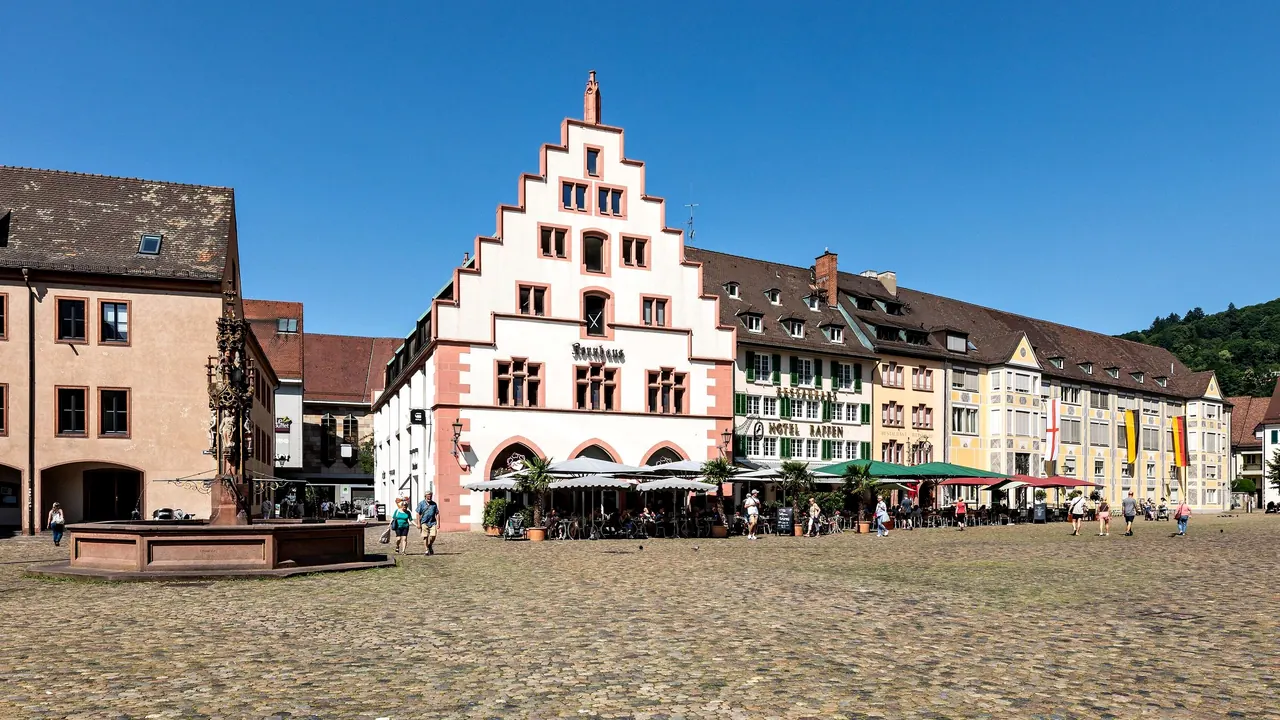
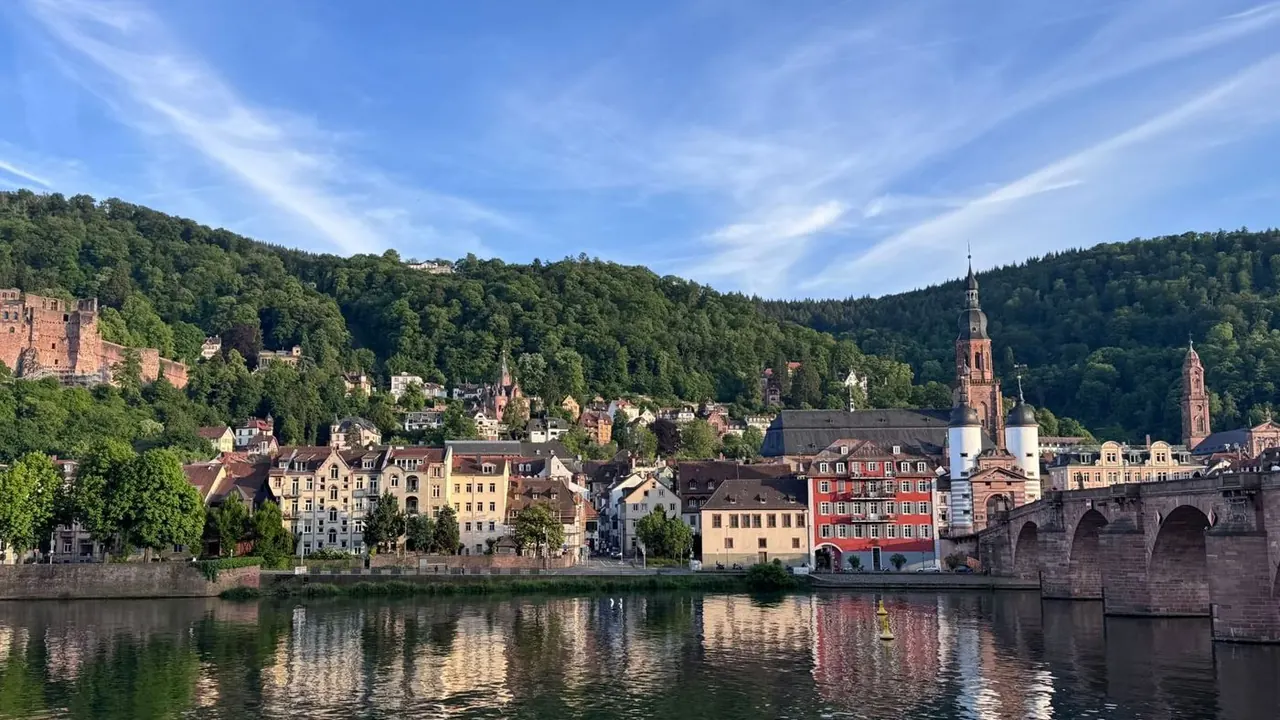
Photos: Freiburg by Dietmar Rabich, CC BY-SA 4.0, cropped; Heidelberg by Kuanling Chen, Pexels License.
Freiburg or Heidelberg?
Our verdict in twelve categories, each scored against the same fixed benchmark cities, and the climate month by month, so you can choose for your trip.
Choose Freiburg for
- nature and the outdoors
- wellness
- food and drink
Freiburg suits travellers who want the city as a base for the outdoors and for slowing down. The Black Forest starts at the edge of town, real mountains and winter snow are an hour away, and thermal baths sit both in the city and just down the road. It also eats better, with a daily market at the Münster and Baden cooking that leans towards France. Families have the stronger week here too, with Europa-Park close by.
Choose Heidelberg for
- culture and sights
- live music and the arts
- shopping
Heidelberg is the choice for a romantic old-town stay where the history is the main event. Its castle ruin above the Neckar, the Old University and the Student Prison give it a storybook setting that Freiburg's carefully rebuilt centre doesn't quite match. The summer castle festival and spring chamber music add to that. Its day trips also run in a different direction, to the great Romanesque cathedrals of Speyer and Worms rather than across the French and Swiss borders.
Scoreboard
Twelve categories on one fixed scale from 0 to 100. The shaded stretch is the gap between the two.
Your match
Pick a travel style or drag the sliders, and both match scores follow your weighting.
Wins on nature and the outdoors and wellness with your weighting.
Wins on culture and sights and live music and the arts with your weighting.
What matters to you?
Category by category
What the scores mean for a trip.
Beaches & swimming
Neither city is a beach destination, but Freiburg offers better swimming. The gravel-pit lakes on the Rhine plain warm up nicely and have grassy shores, and Titisee and Schluchsee in the Black Forest make a scenic, if cool, swim about an hour away.
Heidelberg's Neckar isn't for swimming at all, so a hot day there means the town's outdoor pools or a trip of about half an hour to similar gravel lakes.
Food & drink
Freiburg eats better. Its Baden cooking has a French lightness, and the morning market around the Münster, with its long grilled sausages in a bread roll, is a daily ritual. Dry Pinots from the Kaiserstuhl are on hand, and the surrounding region has some of Germany's best fine dining.
Heidelberg's wine is just as good, with Riesling from the Bergstrasse. Its cooking is heavier, though, and the restaurants along the Hauptstrasse are aimed at day-trippers and uneven in quality. The better meals are in Neuenheim and the side streets. Its large student population does give it more cheap kebab, pizza and Asian food than Freiburg, where the range soon repeats itself.
Culture & sights
These two are close, and both can be seen in a day or two, but the feel is different. Freiburg is built around one great monument, the Gothic Münster, whose tower you can climb, plus the little Bächle water channels and the medieval sculpture in the Augustinermuseum. Much of its centre was rebuilt after wartime bombing.
Heidelberg feels older and more theatrical. The half-ruined castle looks down on one of Germany's best-preserved old towns, and the university, founded in 1386, adds the Old University's hall and the graffiti-covered Student Prison. It's the more photogenic of the two.
Nightlife
Both cities go out the student way, with pubs and wine bars that are livelier in term time and a handful of clubs. In Freiburg the evening spreads out of doors. In summer people stay late on the squares and along the Dreisam, and a few clubs play techno and indie.
Heidelberg's nights are concentrated in the bars of the narrow Untere Strasse and in old student taverns with carved tables. The town goes quiet early out of term, and for a big club night people take the train to Mannheim or Frankfurt.
Nature & outdoors
Freiburg has the real mountains. A cable car climbs to the Schauinsland ridge at about 1,280m, with views to the Alps on clear days. The Feldberg offers summer hiking and winter skiing, and there are gorge walks such as the Ravenna valley and excellent mountain biking.
Heidelberg's outdoors is gentler. The classic walk is the Philosophers' Walk, a funicular runs up the Königstuhl at 568m, and the Heiligenberg has Celtic ramparts among the trees. Beyond that there are Neckar valley cycling and the Bergstrasse's almond blossom. It makes for green, easy walking, but there is nothing on Freiburg's scale.
Day trips
Both are excellent bases, and the difference is in where you go. From Freiburg the trips cross borders: Basel's museums by train, Colmar and the half-timbered Alsace villages such as Riquewihr by car, and Strasbourg within an hour and a half.
From Heidelberg you head into German history. The imperial cathedrals of Speyer and Worms, Lorsch Abbey and the monastery at Maulbronn are all easy outings, and there are castle-lined villages up the Neckar and Frankfurt about an hour away by train. Baden-Baden is within reach of both.
Good for families
Freiburg is the easier family base. The flat, car-free centre suits bikes and pushchairs, children love the Bächle channels, and the Mundenhof animal park is free. Its trump card is Europa-Park, Germany's biggest theme park, about 40 minutes away.
Heidelberg works well enough, with the funicular, a small fairy-tale park on the Königstuhl and a compact zoo. The Technik Museum at Speyer, where children can climb into a space shuttle, is a rainy-day option that Freiburg lacks. But the cobbled, sloping Altstadt is hard work with a pushchair.
Getting around
Freiburg is the simpler city to move around. Almost everything lies within a twenty-minute walk of the largely car-free old town, the centre is flat and laced with bike lanes, and trams reach the Schauinsland cable car.
Heidelberg's Altstadt is easy to walk along the Hauptstrasse, but the station is well to the west, so most visitors arrive by tram, and the cobbles and steep castle approach slow you down. Its strong point is a single fare system across the Rhine-Neckar area that makes day trips simple.
Shopping & style
Neither is a shopping destination. Freiburg's better finds are the independent boutiques and organic stores in the Gerberau and Konviktstrasse quarters, plus wine, ham and schnapps from the Münster market. For serious retail people go to Basel.
Heidelberg's shopping lines one very long pedestrian street, with chain stores at one end and souvenirs, beer steins and Studentenkuss chocolates at the other. Mannheim and Frankfurt fill the gap for fashion.
Affordability
Costs are much the same, and in both the expensive part is the hotel, since rooms are scarce on summer weekends. Freiburg visitors often stay in nearby Black Forest villages and get the Münster for free, though trips into Switzerland cost more.
In Heidelberg the usual workaround is to stay in Mannheim and come in by train. The regional ticket keeps day trips cheap, and the castle charges a modest entry fee.
Live music & performing arts
Both have a municipal theatre with opera, drama and dance, so the difference is in the highlights. Freiburg is home to the Freiburger Barockorchester, a leading period-instrument ensemble, and holds the summer Zelt-Musik-Festival in a tent village.
Heidelberg has the more atmospheric setting. There is chamber music during the Heidelberger Frühling in spring, plays and concerts in the castle courtyard in summer, and frequent church concerts. Mannheim's larger opera house is twenty minutes away by train.
Wellness & relaxation
Freiburg is clearly better for spa time. There is a mineral thermal bath on the city's eastern edge, Bad Krozingen's warm outdoor pools are twenty minutes south, and Badenweiler has a modern bath next to the remains of a Roman one.
Heidelberg has no baths of its own beyond hotel spas, so a proper soak means a trip to the Kraichgau or Baden-Baden. Its calm comes from evenings on the Neckar meadows and forest paths rather than warm water.
When should you go?
Pick your month. The climate figures are measured averages, not a forecast.
Freiburg in July
Heidelberg in July
Daytime high, °C
Rainfall in the month, mm
Temperature and rainfall are climate normals, averaged over the years shown. Freiburg: 1991-2020 normals, Freiburg (0.6 km from centre). Heidelberg: 1991-2020 (sunshine 1971-2000) normals, Heidelberg (4.5 km from centre).
The two cities have almost the same temperatures through the year, so the difference is in the rain and the light. Both are at their best for walking in May and September, when afternoons reach about 21°C. July and August are warm enough for the lakes and open-air pools, peaking around 27°C in Freiburg. Freiburg has noticeably more sunshine in every month, but its summers are also clearly wetter, with about 103mm of rain in May against 69mm in Heidelberg. Heidelberg's summers are drier.
Winters are cold and grey in both, though Heidelberg's are especially dim, with very little sunshine from November to January. Freiburg gets more winter light, and the higher Black Forest slopes have reliable snow. That makes December to February a real option there for skiing or snowshoeing, while in Heidelberg winter is mainly a season for museums and taverns.
Which traveller are you?
On an outdoors trip, Freiburg lets you hike, ride or ski and still sleep in a city. You can be up on a high ridge by mid-morning and back in the old town for dinner, in winter as well as summer. Heidelberg only offers gentle forest walks and riverside cycling.
For a relaxing and wellness trip, Freiburg makes slowing down easy. You can split your days between warm thermal pools, café terraces and wine villages without any long journeys in between. Heidelberg is calm enough, but every proper spa day means leaving town.
On a culture and arts trip, there is little between the two in substance, but Heidelberg has more atmosphere. The whole town looks the part, and on summer evenings there is theatre against the castle ruins. Freiburg is the pick if you're drawn by its baroque orchestra.
Before you go
| Measure | Freiburg | Heidelberg |
|---|---|---|
| Official language | German | German |
| Currency | Euro (EUR) | Euro (EUR) |
| Sockets | CF230 V, 50 Hz | CF230 V, 50 Hz |
| Driving side | Right | Right |
| Time zone | UTC+1, UTC+2 in summer | UTC+1, UTC+2 in summer |
| Emergency number | 112 | 112 |
| Elevation | 278 m | 114 m |
| Main airport | EuroAirport Basel–Mulhouse–Freiburg (BSL)50 km from centre112 non-stop destinations | Frankfurt Main Airport (FRA)69 km from centre281 non-stop destinations |
| Public holidays this year | 12 days | 12 days |
By the numbers
| Measure | Freiburg | Heidelberg |
|---|---|---|
| City population | 238,299 | 156,092 |
| People per km² | 1,558 | 1,433 |
| Museums within 10 km | 13 | 17 |
| UNESCO World Heritage sites within 50 km | 2 | 4 |
Where else could you go?
Every comparison below shares a destination with this one, so you can follow Freiburg or Heidelberg somewhere new.
- Colmarvs Freiburg
- Baselvs Freiburg
- Strasbourgvs Freiburg
- Frankfurtvs Heidelberg
- Stuttgartvs Heidelberg
- Baden-Badenvs Heidelberg