French Alps or Normandy?
Our verdict in twelve categories, each scored against the same fixed benchmark cities, and the climate month by month, so you can choose for your trip.
Choose French Alps for
- nature and the outdoors
- nightlife
- wellness
Choose the French Alps if the trip is about mountains. That means skiing the huge linked areas of the Tarentaise in winter, or walking, cycling and paragliding around Chamonix and Lake Annecy in summer. The Alps also have the livelier evenings in ski season, the warmer swimming in their clear lakes and the grander spa towns. All of this costs a good deal more, especially in the famous resorts.
Choose Normandy for
- culture and sights
- prices
- live music and the arts
Normandy is the better pick for history and sights. Mont-Saint-Michel, the D-Day beaches, the Bayeux tapestry and Rouen's cathedral can fill a week without repeating themselves. It is gentler on the budget, quiet after dark and suited to a slow trip of long lunches, cider farms and coastal walks. The trade-off is a cool sea and a landscape that is green and pleasant rather than dramatic.
Scoreboard
Twelve categories on one fixed scale from 0 to 100. The shaded stretch is the gap between the two.
Your match
Pick a travel style or drag the sliders, and both match scores follow your weighting.
Wins on nature and the outdoors and nightlife with your weighting.
Wins on culture and sights and prices with your weighting.
What matters to you?
Category by category
What the scores mean for a trip.
Beaches & swimming
Neither destination has warm-sea swimming, but the Alpine lakes give the better summer swim. Lake Annecy is clear and reaches about 23°C at the height of summer, with grassy beaches and wooden jetties at Sévrier and Talloires, and little Lac d'Aiguebelette is often warmer still.
Normandy has real sandy seaside at Deauville, Cabourg and Houlgate, with beach cabins and boardwalks. However, the Channel stays around 18°C even in August, and at low tide the water pulls back hundreds of metres. These beaches are better for sandcastles and walks along the shore than for a long swim.
Food & drink
Both are dairy country, but it ends up on the plate in different ways. The Alps cook melted cheese: fondue, raclette and tartiflette made with Beaufort and Reblochon, washed down with Savoie whites and Génépi. Above that sits a tier of decorated kitchens around Lake Annecy, Megève and Courchevel.
Normandy cooks its butter and cream into sauces and adds the sea: oysters from Saint-Vaast and Isigny, scallops, and mussels in cider, with calvados bought from the Pays d'Auge farms. Over a week, its harbour restaurants and market towns offer a little more variety than a run of resort cheese menus.
Culture & sights
Here Normandy is in another league. Mont-Saint-Michel, the D-Day beaches with the Caen Memorial, the Bayeux tapestry, and Rouen's cathedral and half-timbered streets are each worth the journey on their own. Giverny, Jumièges and Le Havre's rebuilt centre add even more.
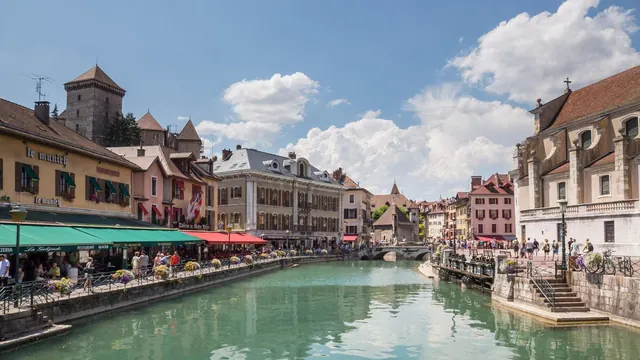
The Alps offer pleasant half days rather than a cultural itinerary. The highlights are Annecy's canals and the Palais de l'Isle, the dukes' château in Chambéry, Grenoble's fine-arts museum and Briançon's Vauban walls. They fit around the mountains rather than shaping the trip.
Nightlife
In winter, the Alps win easily. Après-ski starts on the slopes in late afternoon and carries on in the bars and clubs of Val d'Isère, Val Thorens and Méribel into the small hours. Out of season the resorts fall quiet, and summer evenings move to Annecy's lakeside terraces and Grenoble's student bars.
Normandy is a region of long dinners and early nights. Rouen and Caen have the bars and a few clubs, and Deauville has its casino, but the countryside is silent after dark.
Nature & outdoors
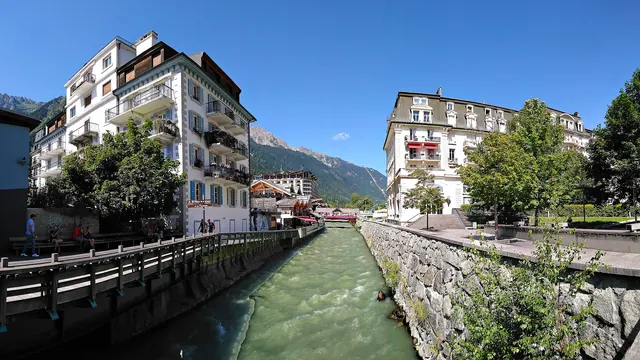
The Alps are one of the world's great mountain landscapes, and Normandy has no mountains at all. Mont Blanc above Chamonix, the cable car to the Aiguille du Midi, the Tour du Mont Blanc, the wild passes of the Vanoise and Écrins and the vast ski areas of the Tarentaise make this a trip built around the outdoors.
Normandy's finest scenery is on its coast. There are chalk arches at Étretat, windswept granite headlands at Cap de la Hague, and guided walks across the bay of Mont-Saint-Michel. Inland, the hedged bocage suits gentle cycling, and the Suisse Normande adds a little climbing and kayaking.
Day trips
Both give you plenty of outings, but from the Alps many of the best ones cross a border. From Annecy or the Lake Geneva shore, Geneva is under an hour away, lake ferries cross to Lausanne and the Lavaux vineyards, and walled Yvoire makes an easy half day. Lyon is about two hours from Annecy by train. From Chamonix, the Mont Blanc tunnel puts Courmayeur and Aosta in Italy about an hour away. The deep Tarentaise valleys are the weak spot, because too much of the day goes on the road.
Normandy's outings mostly stay within the region: the harbour at Honfleur, the cider villages of the Pays d'Auge and fishing ports such as Barfleur on the Cotentin. Saint-Malo is just over the Breton border, summer ferries cross to Jersey, and Paris is under two hours from Rouen by train.
Good for families
The Alps are the stronger choice for children, especially those old enough to ski. Ski schools are built around children, car-free resorts like Avoriaz and Flaine let families walk to the slopes, and summer brings the rack railway to the Mer de Glace and marmot spotting. Altitude, cold mornings and transfer days do tire the very young.
Normandy is calmer and easier but less exciting. It offers sandy beaches for kites and rock pools, Mont-Saint-Michel's ramparts, the walk-through submarine at Cité de la Mer in Cherbourg, and farm visits. Against that come cool water and longish drives.
Getting around
In the Alps the hard part is getting there. You transfer from Geneva, Lyon or Grenoble on winter roads that queue on Saturdays and often need snow chains. Once you are in a resort, lifts and compact villages make a car unnecessary. Summer is different, because the lakes and passes are spread across separate valleys.
Normandy has easy roads and good trains from Paris to Rouen, Caen and Bayeux, but buses barely reach the landing beaches, Étretat or Mont-Saint-Michel. Without a car you will depend on tours. The distances also make it worth splitting the stay between two bases.
Shopping & style
The Alps have more worth seeking out. Chamonix's mountaineering and ski shops are among the best places in Europe for technical gear, and Courchevel and Megève have luxury boutiques. Opinel knives and wheels of Beaufort make good things to take home, and Geneva is close if you want a wider choice.
Normandy's shopping is mostly edible: calvados, cider and cheese from farms and markets. Beyond that there is lace in Alençon and Bayeux, copper from Villedieu-les-Poêles and Rouen's faience pottery. Rouen's pedestrian streets are the region's only real shopping district.
Affordability
Normandy is clearly the cheaper trip. Cottages, chambres d'hôtes and set lunches in market towns cost what the French provinces usually do, and many D-Day sites are free. Only Deauville, Honfleur and the Mont-Saint-Michel area charge more in summer, and car hire adds to the bill.
The big Alpine ski resorts are among the costliest places to stay in Europe once lift passes, equipment hire and ski school are added. A summer stay, a low-season week or a base in Grenoble, Chambéry or the Bauges brings the Alps down to ordinary prices. Annecy in high summer stays expensive.
Live music & performing arts
Neither is a place to plan around nights at the theatre, but Normandy offers a little more. Rouen's Théâtre des Arts runs opera, ballet and an orchestral season. Caen and Le Havre have good modern stages, and little Coutances hosts a long-running spring jazz festival.
In the Alps, Grenoble's arts centre and chamber orchestra carry the year-round programme, joined in summer by chamber music at Évian and concerts in mountain churches. In ski season, it is mostly bands in the après-ski bars.
Wellness & relaxation
The Alps have the deeper spa tradition and the finer settings for it. Aix-les-Bains and Évian are grand lakeside spa towns, and Saint-Gervais has thermal baths in a wooded gorge below Mont Blanc. Smaller cure towns such as Brides-les-Bains are quiet by design, and winter adds hotel hot tubs facing the snow.
Normandy's version is built on seawater, with thalassotherapy centres at Deauville, Cabourg and Granville, plus the inland thermal town of Bagnoles-de-l'Orne. Its most restful quality is the slow pace of orchards and small harbours, except on the Côte Fleurie in August.
When should you go?
Pick your month. The climate figures are measured averages, not a forecast.
French Alps in July
Normandy in July
Daytime high, °C
Rainfall in the month, mm
Where the figures come from
French Alps's temperatures are measured 35 km from the centre, at Bourg-St-Maurice.
French Alps's station stands 179 m below the place it is measured for, so that place is likely a little cooler than the figures say.
French Alps has no rain gauge within 25 km of the centre, so its rainfall comes from a gridded climate dataset read at the destination rather than from a gauge further away.
Temperature and rainfall are climate normals, averaged over the years shown. French Alps: 1999-2020 (rainfall 1991-2020) normals, Bourg-St-Maurice (35.1 km from centre). Normandy: 1991-2020 normals, Caen (21 km from centre).
In the Alpine lake and valley towns, summer is the warm season. From late June to early September, highs reach about 27°C in July, which is warm enough for swimming in Lake Annecy and comfortable for walking at altitude. The winter months are cold, around 5°C in January even down in the valleys, and that cold frames the ski season from December to April. Rain falls heavily all year, wettest in late autumn and early winter at up to 169mm in December, so expect showers in any season.
Normandy is milder and never hot. Highs top out around 23°C in July and August, which makes for easy sightseeing all summer, and June to August are the sunniest months. The sea only reaches about 18°C in August and September, so swims are brisk. Rainfall is much lighter than in the Alps, but from October the days turn greyer and wetter. For the outdoors, the Alps' best window is summer or the snow months. Normandy is most rewarding from late spring to early autumn.
Which traveller are you?
On an outdoors trip, the French Alps give every day a different shape: a stage of a hut-to-hut trek, a tandem paraglide, a long road climb over a high pass, or a winter week on skis. Normandy suits gentler days of cliff paths and cycling.
For a culture and arts trip, the Alps give you a wet-day museum in Grenoble or an afternoon in Annecy, and not much more. Normandy has enough for a full week, with history running from the Norman conquest through medieval abbeys and the Impressionists to 1944.
On a trip on a tight budget, the Alps only work if you skip the ski season, stay in Grenoble or a Bauges village and spend the days walking. In Normandy, a rented cottage, market-town lunches and free visits to the landing beaches keep costs down, though you still have to budget for a hire car.
Before you go
| Measure | French Alps | Normandy |
|---|---|---|
| Official language | French | French |
| Currency | Euro (EUR) | Euro (EUR) |
| Sockets | CE230 V, 50 Hz | CE230 V, 50 Hz |
| Driving side | Right | Right |
| Time zone | UTC+1, UTC+2 in summer | UTC+1, UTC+2 in summer |
| Emergency number | 112 | 112 |
| Main airport | Geneva International Airport (GVA)150 non-stop destinations | Caen Carpiquet airport (CFR)10 non-stop destinations |
| Public holidays this year | 11 days | 11 days |
By the numbers
| Measure | French Alps | Normandy |
|---|---|---|
| Swim season, months above 21 °C | - | None |
Where else could you go?
Every comparison below shares a destination with this one, so you can follow French Alps or Normandy somewhere new.
- Swiss Alpsvs French Alps
- Lake Comovs French Alps
- Brittanyvs Normandy
- Devonvs Normandy
- Loire Valleyvs Normandy
- Black Forestvs French Alps