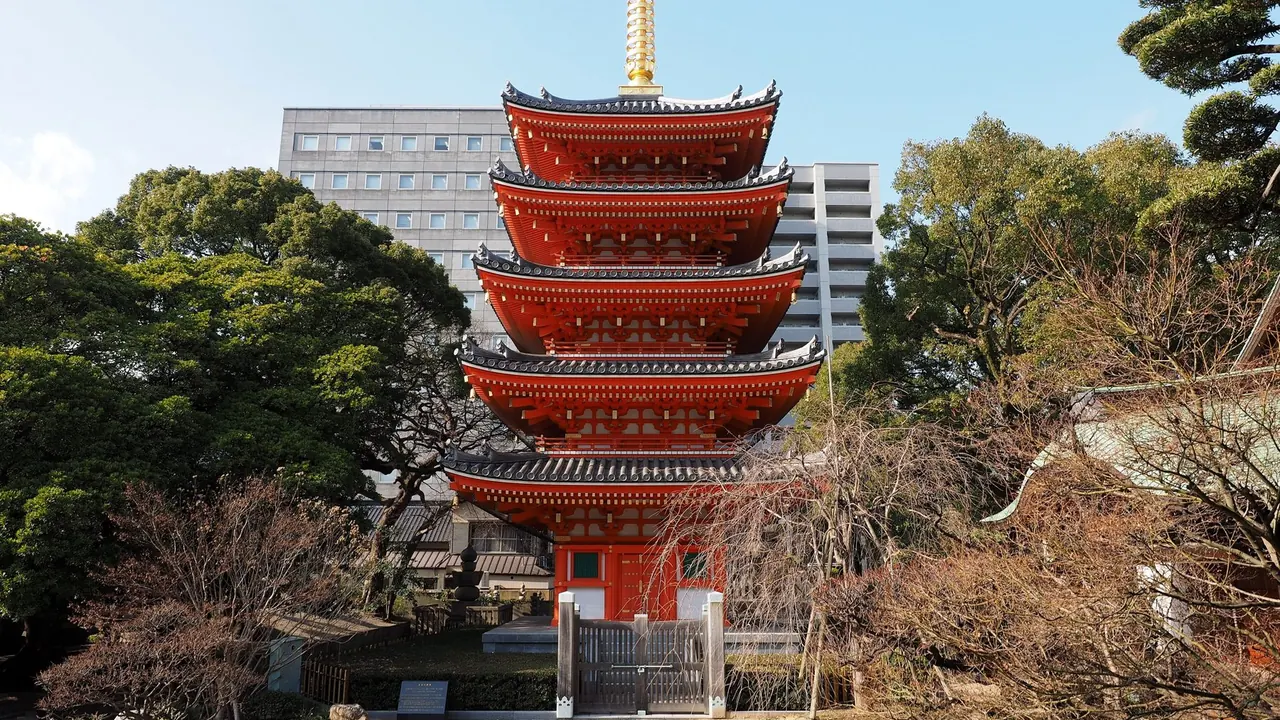
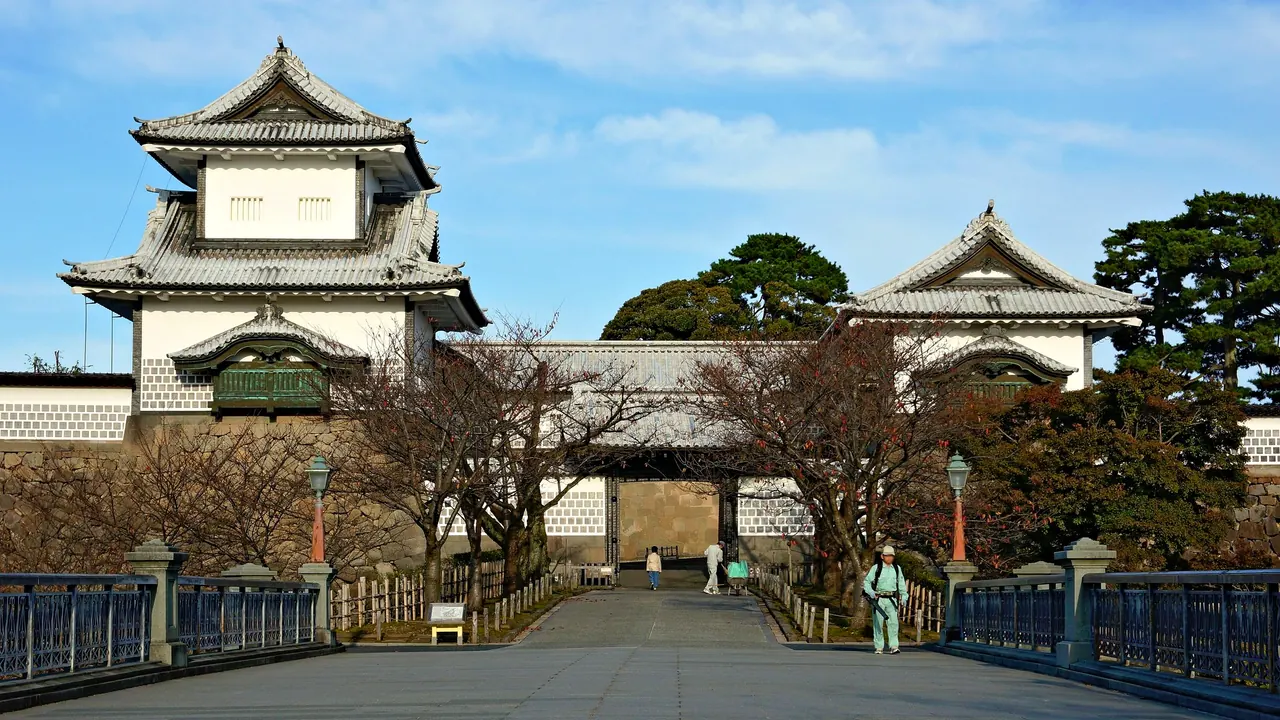
Photos: Fukuoka by Nick-D, CC BY-SA 4.0, cropped; Kanazawa by 663highland, CC BY 2.5, cropped.
Fukuoka or Kanazawa?
Our verdict in twelve categories, each scored against the same fixed benchmark cities, and the climate month by month, so you can choose for your trip.
Choose Fukuoka for
- nightlife
- families
- getting around
Fukuoka suits travellers who want an easy, sociable base. You can eat at the riverside yatai stalls and ramen counters, go bar-hopping in Daimyo and Tenjin, and take the shinkansen out to Nagasaki, Kumamoto or Hiroshima. The subway runs from the airport, the centre is flat and compact, and sights like Marine World suit children, so it is the less demanding choice for families and for anyone on a first trip to Japan.
Choose Kanazawa for
- culture and sights
- wellness
Choose Kanazawa for an old Japanese townscape that survived the war intact. It has Kenroku-en, the wooden teahouses of Higashi Chaya and the samurai lanes of Nagamachi, along with crafts such as gold leaf and Kutani porcelain. The trip is quieter and slower, with hot-spring villages close by and Shirakawa-go within reach. Evenings end early, though, and getting around depends on buses.
Scoreboard
Twelve categories on one fixed scale from 0 to 100. The shaded stretch is the gap between the two.
Your match
Pick a travel style or drag the sliders, and both match scores follow your weighting.
Wins on nightlife and families with your weighting.
Wins on culture and sights and wellness with your weighting.
What matters to you?
Category by category
What the scores mean for a trip.
Beaches & swimming
Neither city is a beach destination, but Fukuoka makes more of the sea. Momochi is close by for an evening paddle. The clear water and white sand of Itoshima, along with the islands of Shikanoshima and Nokonoshima, make proper summer days out.
Kanazawa's coast is long, plain sand at Uchinada and Chirihama. It is fine for a summer half-day alongside local families but windswept and grey outside July and August. In both cities the swimming season is short.
Food & drink
Both are serious food cities, but Fukuoka eats more broadly and more casually. Its signature dishes are tonkotsu ramen, mentaiko, motsunabe and mizutaki. The yatai stalls are Japan's nearest thing to street food, and there are izakaya on every block.
Kanazawa's strengths are narrower and more refined. It has the seafood bowls and winter snow crab of Omicho Market, Kaga dishes such as jibuni duck stew, wagashi sweets with matcha in the chaya teahouses, and sake from the Kaga plain. A few days cover its best food, while Fukuoka rewards a longer stay of grazing.
Culture & sights
On sights, Kanazawa is clearly the richer city. It escaped wartime bombing, so it keeps Kenroku-en, the latticed teahouses of Higashi Chaya and the earthen samurai walls of Nagamachi. It also has the 21st Century Museum of Contemporary Art and the D.T. Suzuki Museum.
Fukuoka's sights are pleasant rather than celebrated. The best are the temple cluster of old Hakata, including Shofukuji, the castle ruins above Ohori Park and the ancient gold seal in the City Museum. Its more important heritage is reached on day trips, starting with Dazaifu.
Nightlife
Fukuoka is the city for going out. An evening can start at the yatai on Nakasu's neon-lit riverbanks. It can then carry on late in Daimyo, Tenjin and Oyafuko-dori, through craft beer bars, whisky bars, izakaya and a handful of clubs, in a friendly mood.
In Kanazawa, nights out happen in Katamachi and Kigura-machi. Izakaya, sake bars and snack bars fill with office workers, and there are a few quiet bars in the old chaya houses. It is a good place for a long dinner and a sake bar, but not for a late night.
Nature & outdoors
Fukuoka puts more of the outdoors within easy reach. There is the walking loop around Ohori Park, the flower fields and cycle paths of Uminonakamichi, the short ferry to Nokonoshima, and the rocky capes and rice terraces of Itoshima. Mount Homan and the Sefuri range offer hikes with views over the bay.
Kanazawa has grander scenery further away: alpine hiking on the sacred Mount Hakusan and the coast of the Noto Peninsula. Most of it needs a car, and in town the outdoors means mainly the banks of the Sai and Asano rivers. Its snowy winters suit skiers who head to the Hakusan slopes.
Day trips
Fukuoka's fast trains open up two regions at once. Dazaifu's Tenmangu shrine and the Kyushu National Museum are about half an hour away, the punts of Yanagawa under an hour, and the shinkansen reaches Kumamoto's castle in under an hour and Hiroshima in about an hour, with Miyajima's floating torii a short ferry beyond. Add Nagasaki's harbour and Dejima, and the porcelain villages of Arita and Imari, and a week here can cover much of Kyushu and a corner of western Honshu.
Kanazawa has fewer outings, but they are distinctive. Buses run to the thatched farmhouses of Shirakawa-go and Gokayama and on to Takayama's merchant streets, while the Shinkansen reaches Takaoka's Zuiryu-ji in under half an hour and the Kaga hot-spring towns, Kutani pottery villages and Eihei-ji lie to the south. The best-known trips go by bus rather than fast train, so they take a bigger part of the day.
Good for families
Fukuoka has far more made for children inside the city. Marine World's dolphin show and the seaside park beside it, the hilltop zoo and botanical garden, the Anpanman Children's Museum and the science museum can fill several days, rain or shine. The main drawback is summer heat.
In Kanazawa, children like the pool installation at the 21st Century Museum best, and older ones like the trick doors of the ninja temple. The zoo, the beaches and the Fukui dinosaur museum all need a trip out of the city. Both cities are safe and spotless, but the gardens and teahouses at Kanazawa's heart can test small children's patience.
Getting around
Fukuoka is one of the easiest cities anywhere to arrive in. The airport is on the subway, a few minutes from Hakata Station. Three subway lines and a dense bus network serve a flat centre that is easy to walk.
Kanazawa is walkable too, with its main sights in a band about 2km from the station, but it has no metro or tram. The loop buses can be slow and crowded. The bike-share helps outside winter, and snow makes walking harder in the cold months.
Shopping & style
Fukuoka has the wider range. Tenjin has department stores and a long underground arcade, Daimyo and Imaizumi have independent and vintage shops, and Canal City is near Hakata Station. For gifts there is Hakata-ori silk and boxed mentaiko.
Kanazawa is narrower but excellent for crafts. Gold leaf, Kutani porcelain, Kaga yuzen silk and Wajima lacquer are sold by serious makers in the chaya districts and at the prefectural craft centre. Neither city is strong on luxury flagship stores.
Affordability
Costs are much the same in both, with business hotels, set lunches and noodle shops keeping them below Japan's biggest cities. The difference is in what tempts you to spend more. In Fukuoka it is sushi, kaiseki dinners and nights in Nakasu. In Kanazawa it is snow crab, the best Omicho seafood and ryokan stays in the Kaga onsen towns, plus the bus fares to Shirakawa-go.
Live music & performing arts
Neither city is a destination for live performance, and what they offer is different. Fukuoka leans towards large popular stages, with touring kabuki and musicals at Hakataza and the Kyushu Symphony Orchestra in the Acros building. Its festivals are a street spectacle, with the Yamakasa float races in July and the Dontaku parade in May.
Kanazawa's offer is smaller and more traditional. There is regular Noh at the prefectural theatre, geisha dance and shamisen in the chaya teahouses, and the Orchestra Ensemble Kanazawa, one of Japan's leading chamber orchestras.
Wellness & relaxation
Kanazawa is the better base for a slow trip. The streamside ryokan of Yuwaku Onsen are half an hour away, and the Kaga hot-spring towns make an easy overnight stay. Mornings in Kenroku-en and matcha in a teahouse set an unhurried pace.
Fukuoka relies more on bath complexes at the edge of the city and on Futsukaichi Onsen near Dazaifu, while Beppu and Yufuin are a long day away. It is relaxed for its size, but it is still a big city.
When should you go?
Pick your month. The climate figures are measured averages, not a forecast.
Fukuoka in July
Kanazawa in July
Daytime high, °C
Rainfall in the month, mm
Temperature and rainfall are climate normals, averaged over the years shown. Fukuoka: 1991-2020 normals, Fukuoka (1.9 km from centre). Kanazawa: 1991-2020 normals, Kanazawa (3.2 km from centre).
Fukuoka is the drier and sunnier of the two for most of the year. Spring and October are the best months for walking the streets. June and July bring the rainy season, with July reaching about 301mm. August is hot and humid at around 32°C, but it is also when the sea is warmest, near 27°C, and the Itoshima beaches are at their best. Winters are cool but fairly dry and bright, so a January city break works well.
Kanazawa sits on the snowy Sea of Japan side and gets heavy rain or snow in most months. Winter is the wettest and greyest season, with daytime highs around 7°C. April, May and October are its best times, with cherry blossom in spring and maples in autumn. August is the only reliable beach month, and the sea then is about as warm as Fukuoka's. Winter suits people who want to see Shirakawa-go under snow or eat snow crab more than those who want long walks.
Which traveller are you?
On a culture and arts trip, Kanazawa is the stronger choice. It has Kenroku-en, the Higashi Chaya teahouses, the samurai lanes of Nagamachi and the 21st Century Museum, and Noh and geisha performances fill some evenings. Fukuoka's rebuilt centre has nothing comparable.
For a food and nightlife trip, Fukuoka wins clearly. Tonkotsu ramen, motsunabe and the riverside yatai stalls of Nakasu lead into late nights in the standing bars and whisky bars of Daimyo and Tenjin. In Kanazawa, most evenings end after a sake bar.
On a family trip with children, Fukuoka is much easier. The airport is on the subway, the centre is flat, and Marine World, the zoo, the Anpanman Children's Museum and Nokonoshima island fill the days. Kanazawa's gardens and teahouses can feel slow to young children.
Before you go
| Measure | Fukuoka | Kanazawa |
|---|---|---|
| Official language | Japanese | Japanese |
| Currency | Yen (JPY) | Yen (JPY) |
| Sockets | AB100 V, 50 and 60 Hz depending on the region | AB100 V, 50 and 60 Hz depending on the region |
| Driving side | Left | Left |
| Time zone | UTC+9 | UTC+9 |
| Emergency number | Police 110, fire 119 | Police 110, fire 119 |
| Elevation | 8 m | 28 m |
| Main airport | Fukuoka Airport (FUK)5 km from centre46 non-stop destinations | Komatsu Airport / JASDF Komatsu Air Base (KMQ)29 km from centre7 non-stop destinations |
| Public holidays this year | 16 days | 16 days |
By the numbers
| Measure | Fukuoka | Kanazawa |
|---|---|---|
| City population | 1,603,043 | 462,479 |
| People per km² | 4,715 | 989 |
| Museums within 10 km | 23 | 27 |
| UNESCO World Heritage sites within 50 km | 2 | 1 |
| Swim season, months above 21 °C | 4 months | 4 months |
Where else could you go?
Every comparison below shares a destination with this one, so you can follow Fukuoka or Kanazawa somewhere new.