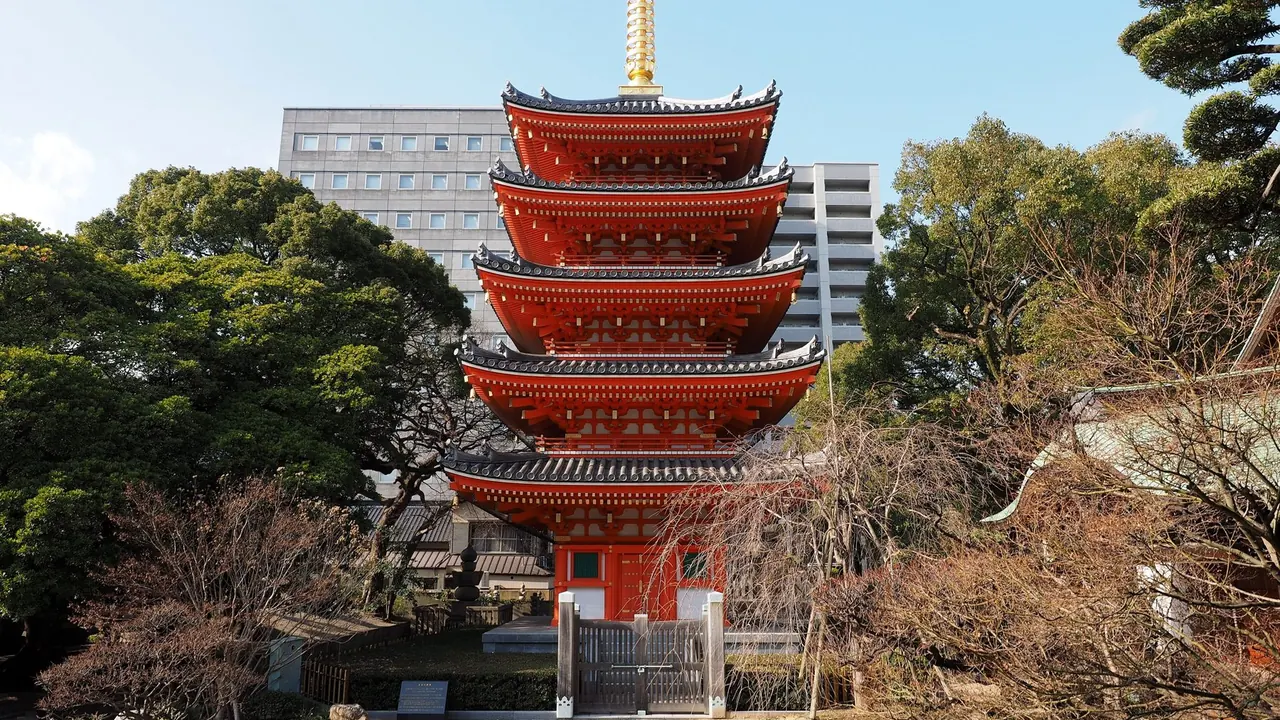
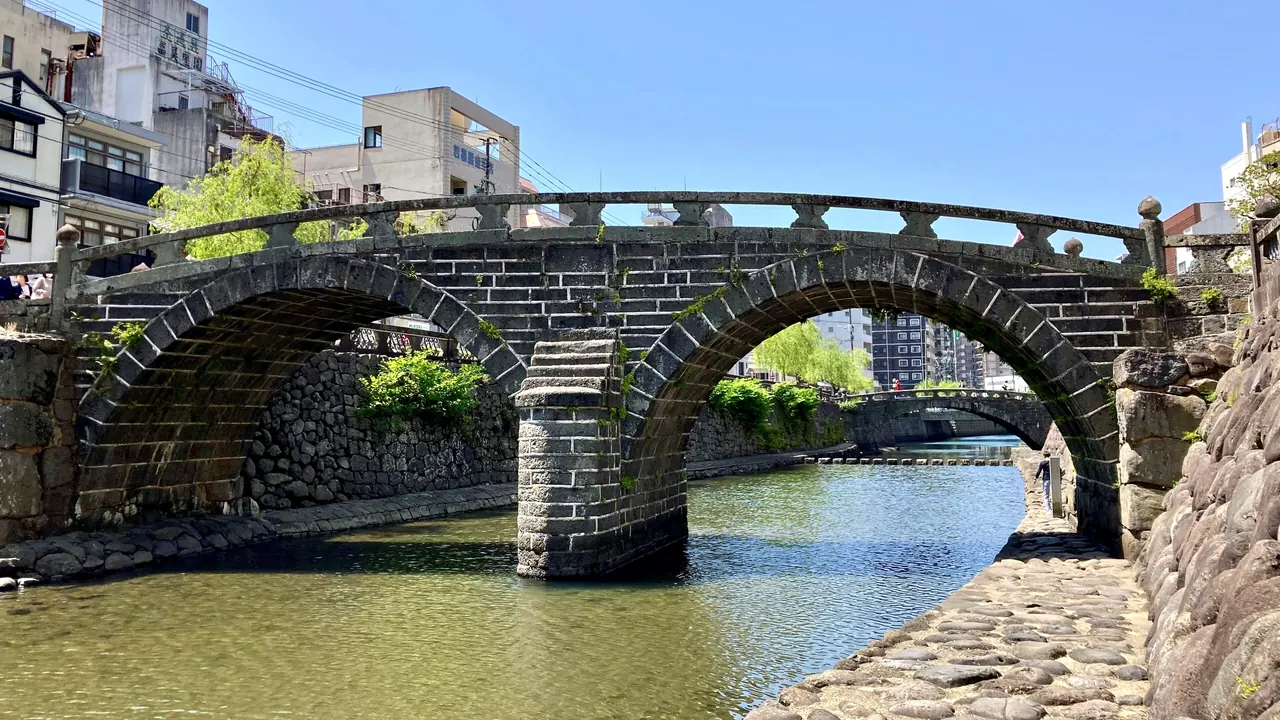
Photos: Fukuoka by Nick-D, CC BY-SA 4.0, cropped; Nagasaki by Dudva, CC0.
Fukuoka or Nagasaki?
Our verdict in twelve categories, each scored against the same fixed benchmark cities, and the climate month by month, so you can choose for your trip.
Choose Fukuoka for
- nightlife
- shopping
- families
Fukuoka suits travellers who plan their days around eating and their evenings around bars: tonkotsu ramen counters, yatai stalls by the river and long nights in Daimyo and Tenjin. It is also the better base for seeing Kyushu, with shinkansen to Kumamoto and Hiroshima, and the easier choice with small children or a shopping list.
Choose Nagasaki for
- culture and sights
- prices
Choose Nagasaki if the trip is about history. The Atomic Bomb Museum and Peace Park, Dejima, Glover Garden and Oura Cathedral tell a story of war and of centuries of contact with the outside world that no other Japanese city can match, and one simple tram network links them all. The evenings are quieter and the hills are steep, but for two or three thoughtful days it leaves the deeper impression.
Scoreboard
Twelve categories on one fixed scale from 0 to 100. The shaded stretch is the gap between the two.
Your match
Pick a travel style or drag the sliders, and both match scores follow your weighting.
Wins on nightlife and shopping with your weighting.
Wins on culture and sights and prices with your weighting.
What matters to you?
Category by category
What the scores mean for a trip.
Beaches & swimming
Neither city is a beach destination, but Fukuoka gives swimmers more to work with. Momochi Seaside Park is in the city for an evening paddle, the white sand and clear water of the Itoshima peninsula are under an hour away, and Shikanoshima and Nokonoshima offer quieter days.
Nagasaki's harbour is a working port of docks and shipyards where nobody swims. A beach day means an hour on the bus to Takahama on the Nomo coast, or the ferry to the small resort beach on Iojima. Both cities have the same short summer season, with jellyfish arriving towards the end.
Food & drink
Both cities feed you well, but Fukuoka is the greater eating destination. It is the home of tonkotsu ramen, its yatai stalls in Nakasu are the nearest thing Japan has to street food, and mentaiko, motsunabe, mizutaki and Genkai Sea sashimi cover everything from cheap counters to serious sushi.
Nagasaki's cooking is narrower but more unusual, shaped by centuries of foreign trade: champon, sara udon, castella and the shared shippoku banquet. The fish is just as good, served simply in the izakaya of Shianbashi, but there is little high-end dining and the range runs out sooner.
Culture & sights
This is where Nagasaki pulls clearly ahead. Many visitors come for the Atomic Bomb Museum and Peace Park in Urakami alone, and around them are Dejima, the merchant houses of Glover Garden, Oura Cathedral and the Chinese temples of Sofukuji and Teramachi. Together they trace a layered history of foreign contact that is unique in Japan.
Fukuoka's sights are pleasant rather than essential: the Hakata temple quarter with Shofukuji and Tochoji, the castle walls above Ohori Park and the ancient gold seal in the City Museum. Its grander heritage, such as Dazaifu, lies outside the city.
Nightlife
Fukuoka offers far the better night out. Beyond the neon of Nakasu and its riverside stalls, the backstreets of Tenjin and Daimyo hold standing bars, craft beer and whisky bars and a few clubs, and evenings run late.
In Nagasaki, going out means Shianbashi, a compact grid of izakaya, counter bars and karaoke, where many snack bars cater to regulars. It suits a quiet evening of sake and grilled fish, but the streets empty before midnight on weeknights, and many visitors choose the night view from Mount Inasa instead.
Nature & outdoors
There is little to choose between them outdoors, but the scenery differs in character. Fukuoka's is gentler and more spread out: the walking loop round Ohori Park, the flower fields and cycle paths of Uminonakamichi and the slopes of Nokonoshima, then further out the rocky capes and rice terraces of Itoshima and wooded day hikes on Mount Homan and in the Sefuri range.
Nagasaki is steeper and more dramatic right on its doorstep, a deep harbour ringed by green hills with the ropeway up Mount Inasa. About two hours away, Unzen's volcanic peaks, steaming hells and the lava dome of Heisei-shinzan make a wilder day than Fukuoka's hills, and the wooded islands of Kujukushima are best seen from a boat or kayak.
Day trips
Fukuoka is the stronger base by a wide margin, because the trains from Hakata Station reach much of Kyushu and beyond. Dazaifu is half an hour away and Yanagawa's canals under an hour, and the shinkansen reaches Kumamoto Castle and Hiroshima with Miyajima. Nagasaki itself is an easy day out.
Nagasaki has fewer outings, but they are distinctive. The boat to the ruined mining island of Hashima is unlike anything else in Japan, and Shimabara's samurai houses, Huis Ten Bosch and Hirado are rewarding, though several take most of a day and the Goto Islands need a night.
Good for families
With a pushchair, the terrain decides it. Fukuoka's centre is compact and flat, and Marine World with its dolphin show, the playgrounds and small zoo of the Uminonakamichi seaside park and the Anpanman Children's Museum will keep children busy for days.
In Nagasaki many lanes turn into stairways, which wears parents down, though children love the trams, the ropeway up Mount Inasa and the Penguin Aquarium, where the birds waddle out onto a little beach. Huis Ten Bosch makes a big day out, and the Atomic Bomb Museum needs some thought with younger children.
Getting around
Subway against tram sums up the difference. In Fukuoka the airport is on the subway a few minutes from Hakata Station, Hakata, Nakasu, Tenjin and Daimyo are a quarter of an hour apart on foot along the flat, and Hakata Station is the shinkansen hub for the whole of Kyushu.
Nagasaki's old flat-fare trams run along the valley floor from the station to the Peace Park, Dejima, Chinatown and Oura, and could hardly be simpler. Step off the valley floor, though, and the lanes become long flights of steps that no bus reaches, so on the whole Fukuoka is the less tiring city to move around.
Shopping & style
Fukuoka is Kyushu's shopping capital. It has the Tenjin department stores above their long underground arcade, independent fashion and vintage shops in Daimyo and Imaizumi, and Canal City near Hakata Station, plus Hakata-ori silk and Hakata dolls to take home.
Nagasaki has the Hamanomachi arcade and a station mall, and is really a place for gifts: boxed castella, local glassware and porcelain from Hasami and Mikawachi. Anyone looking for fashion should save their shopping for Fukuoka.
Affordability
Costs are much the same in both, and both are among the easier Japanese cities on a moderate budget, with compact business hotels and cheap noodle lunches. The difference is where the money goes: in Fukuoka it is sushi dinners and nights in Nakasu, while in Nagasaki it is the Hashima boat tours and the ropeway, with a cheap tram pass for getting around.
Live music & performing arts
Fukuoka has more on an ordinary evening: touring kabuki and musicals at Hakataza, the Kyushu Symphony Orchestra at the Fukuoka Symphony Hall, and jazz and local bands in the live houses of Tenjin and Daimyo. The Yamakasa float race in July and Dontaku in May are added extras.
In Nagasaki, performance mostly means festivals, above all the Kunchi at Suwa Shrine in October and the Lantern Festival around Chinese New Year. Outside those dates there is little a visitor can plan around.
Wellness & relaxation
Fukuoka makes it easier to bathe and unwind without leaving town. There are hot-spring complexes on the city's edge, Futsukaichi Onsen is half an hour south, and Ohori Park offers calm in the centre.
Nagasaki has only a few baths of its own, but the seaside springs of Obama and the mountain spa of Unzen on the Shimabara peninsula reward an overnight ryokan stay. In town, quiet hillside temples and harbour walks offer a slower kind of rest.
When should you go?
Pick your month. The climate figures are measured averages, not a forecast.
Fukuoka in July
Nagasaki in July
Daytime high, °C
Rainfall in the month, mm
Temperature and rainfall are climate normals, averaged over the years shown. Fukuoka: 1991-2020 normals, Fukuoka (1.9 km from centre). Nagasaki: 1991-2020 normals, Nagasaki (2.2 km from centre).
The two cities share almost the same climate, so the season matters more than the city. Spring and autumn are the times for walking, with mild days in April and May and again in October and early November. The rainy season arrives in June and lasts through July, the wettest stretch in both cities, and Nagasaki's June is the heavier at 334mm. July and August reach 32°C with high humidity, which is hard going on Nagasaki's stairways and in Fukuoka's streets alike.
For swimming, July and August are the months. By August the sea is about 27°C off Fukuoka and 28°C off Nagasaki, and it stays pleasant into September. August is also one of the sunniest months in both. Winters are cool and fairly dry, fine for sightseeing but not for the beach.
Which traveller are you?
On a culture and arts trip, choose Nagasaki and take it slowly: give the Atomic Bomb Museum a morning to itself, then walk the Teramachi temples down to Meganebashi. What you give up is the stage, where Fukuoka's Hakataza and symphony hall offer more.
For a food and nightlife trip, Fukuoka wins easily. Mentaiko, motsunabe and squid still translucent from the Genkai Sea fill the dinners, and the bars around Oyafuko-dori and Daimyo keep going long after Nagasaki's Shianbashi has gone quiet.
On a family trip with young children, Fukuoka takes less effort. Nursing rooms in stations and department stores ease the day, the hilltop zoo and botanical garden fill a morning, and the science museum or Fukuoka Tower rescues a wet afternoon. Avoid high summer in either city.
Before you go
| Measure | Fukuoka | Nagasaki |
|---|---|---|
| Official language | Japanese | Japanese |
| Currency | Yen (JPY) | Yen (JPY) |
| Sockets | AB100 V, 50 and 60 Hz depending on the region | AB100 V, 50 and 60 Hz depending on the region |
| Driving side | Left | Left |
| Time zone | UTC+9 | UTC+9 |
| Emergency number | Police 110, fire 119 | Police 110, fire 119 |
| Elevation | 8 m | 105 m |
| Main airport | Fukuoka Airport (FUK)5 km from centre46 non-stop destinations | Nagasaki Airport (NGS)19 km from centre10 non-stop destinations |
| Public holidays this year | 16 days | 16 days |
By the numbers
| Measure | Fukuoka | Nagasaki |
|---|---|---|
| City population | 1,603,043 | 404,656 |
| People per km² | 4,715 | 996 |
| Museums within 10 km | 23 | 26 |
| UNESCO World Heritage sites within 50 km | 2 | 2 |
| Swim season, months above 21 °C | 4 months | 6 months |
Where else could you go?
Every comparison below shares a destination with this one, so you can follow Fukuoka or Nagasaki somewhere new.
- Hiroshimavs Fukuoka
- Busanvs Fukuoka
- Gyeongjuvs Fukuoka
- Busanvs Nagasaki
- Hiroshimavs Nagasaki
- Gyeongjuvs Nagasaki