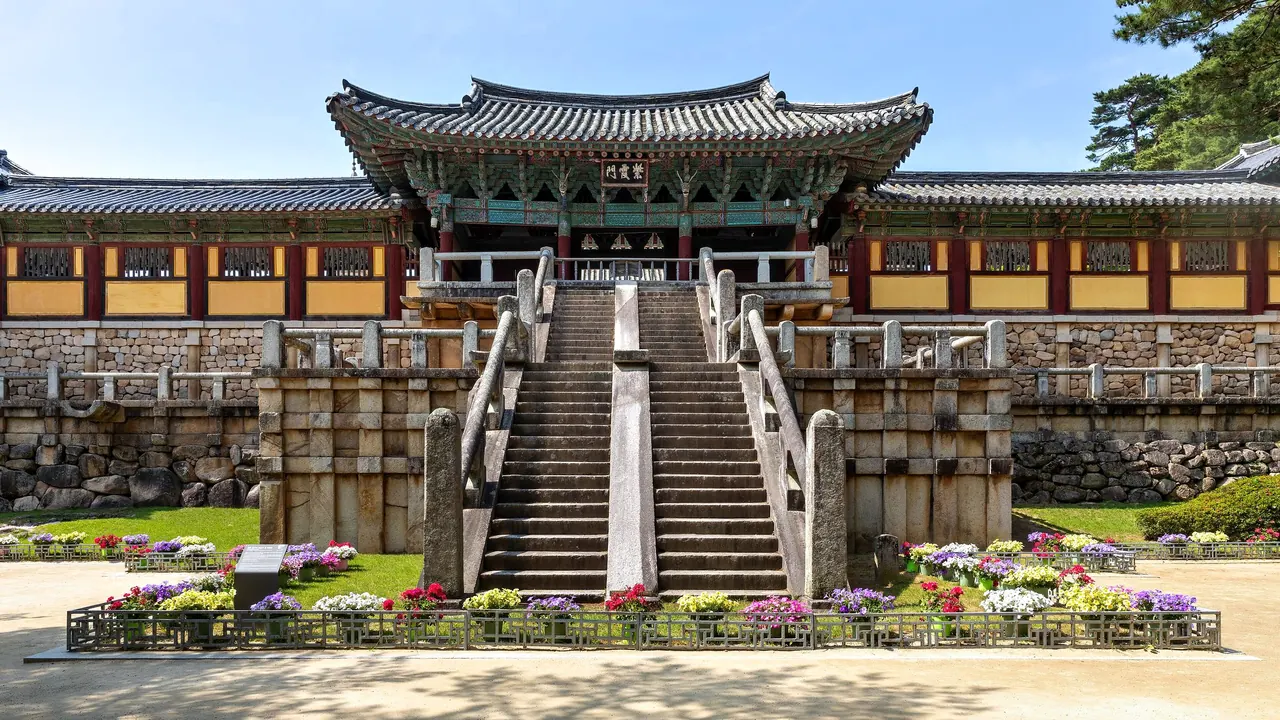
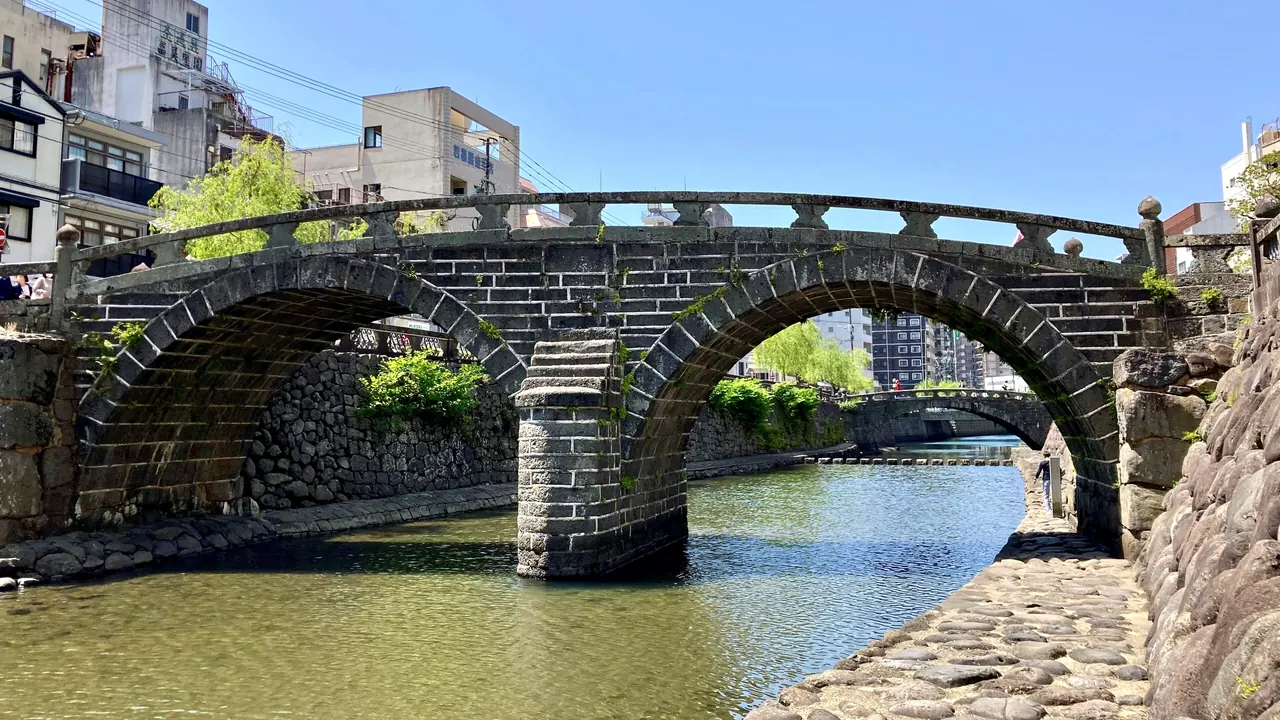
Photos: Gyeongju by Basile Morin, CC BY-SA 4.0, cropped; Nagasaki by Dudva, CC0.
Gyeongju or Nagasaki?
Our verdict in twelve categories, each scored against the same fixed benchmark cities, and the climate month by month, so you can choose for your trip.
Choose Gyeongju for
- culture and sights
- wellness
- day trips
Gyeongju suits travellers who want history to be the whole point of the trip. Royal tombs rise in the middle of town and Bulguksa and Seokguram sit on the mountain above it. Evenings are quiet enough to leave room for a temple stay or a hot-spring bath. It is also a good base for southeast Korea, with Busan and the clan village of Yangdong within easy reach.
Choose Nagasaki for
- food and drink
- nightlife
- getting around
Pick Nagasaki if you want a city that feeds you well and is easy to get around. Trams, harbour views, champon and the izakaya of Shianbashi make it the livelier and more compact stay. Its history, from the Dutch trading post at Dejima to the Atomic Bomb Museum, is a story no other Japanese city tells.
Scoreboard
Twelve categories on one fixed scale from 0 to 100. The shaded stretch is the gap between the two.
Your match
Pick a travel style or drag the sliders, and both match scores follow your weighting.
Wins on culture and sights and wellness with your weighting.
Wins on food and drink and nightlife with your weighting.
What matters to you?
Category by category
What the scores mean for a trip.
Beaches & swimming
Neither is a beach destination, and in both the sand is a side trip. Gyeongju's coast at Bonggil and Gampo is about forty minutes away. It has small sandy and pebbly beaches, with the rocks of King Munmu's underwater tomb just offshore, but the swimming season is barely two months long.
Nagasaki comes out a little ahead. It has clean sand at Takahama on the Nomo coast and a resort beach on Iojima, a short ferry ride away. Its sea is a few degrees warmer and the season lasts into early September.
Food & drink
Nagasaki eats noticeably better. Centuries as Japan's window on the world gave it dishes found nowhere else, from champon and sara udon to castella and the shared shippoku banquet. The local fish served in the izakaya of Shianbashi is excellent, and Chinatown adds buns and casual plates.
Gyeongju's food is pleasant but simpler. There are ssambap spreads near the tombs, boxes of Hwangnam bread, beopju rice wine from Gyochon and soup and rice-cake stalls in the Jungang market. Outside Korean cooking there is little else to choose from.
Culture & sights
Gyeongju has the weightier heritage. The old Silla capital sits almost on top of its past, with burial mounds between the houses and the reconstructed pavilions of Donggung Palace on Wolji Pond. Above the town on Tohamsan are two UNESCO-listed masterpieces, the stone stairways of Bulguksa and the granite Buddha of Seokguram.
Nagasaki's sights are fewer and more recent, but they tell a story with no equal in Japan. They include the Atomic Bomb Museum and Peace Park, the Dutch trading post on Dejima, Glover Garden and Oura Cathedral. This is history of contact and catastrophe rather than of kings.
Nightlife
Neither city is a place for clubbing, but Nagasaki at least has a proper area for going out. Shianbashi packs izakaya, karaoke and small counter bars into a few streets, and some of them stay open late.
In Gyeongju the evening usually ends after a look at the floodlit Wolji Pond and a drink in Hwangnidan-gil, or soju and grilled meat downtown. Anyone wanting more takes the train to Busan.
Nature & outdoors
Both cities are set among green hills, but the outdoors feels different in each. In Gyeongju it is gentle and full of history: the trails on Namsan pass Buddhas carved into the rock, and the flat valley around Bomun Lake is made for cycling under the cherry blossom.
Nagasaki's landscape is steeper and more dramatic. The ropeway climbs Mount Inasa above the harbour, the volcanic peaks of Unzen are two hours away, and the wooded islands of Kujukushima are best seen by boat.
Day trips
Gyeongju reaches more places more easily. The high-speed train puts Busan and Daegu about half an hour away. The clan village of Yangdong and the monastery of Tongdosa are each under an hour by road, and Hahoe and Haeinsa make a longer day out.
Nagasaki's day trips take more time, but they include one of the strangest sights in Japan, the ruined island of Hashima, if the weather allows a landing. The samurai street at Shimabara and the hills of Unzen are around two hours off, and Fukuoka is about an hour and a half by train.
Good for families
Both cities are safe, clean and easy with children, and the difference lies in the ground underfoot. Gyeongju's flat tomb parks suit buggies and family bikes, and Bomun Lake adds an amusement park, a water park and swan pedal boats.
Nagasaki has trams, a ropeway and a penguin aquarium, with Huis Ten Bosch as the big day out. Its stepped hillside streets are hard work with a pushchair, though.
Getting around
Nagasaki is much easier to get around. A few flat-fare tram lines along the valley floor link nearly every major sight, so the only real effort is climbing the hillside lanes.
Gyeongju's central sites are close together on flat ground and ideal on foot or by bike. However, Singyeongju station lies outside town, and reaching Bulguksa, Seokguram or the coast means slow, infrequent buses or a taxi.
Shopping & style
Shopping in Gyeongju means browsing rather than buying in bulk. The tiled hanok lanes of Hwangnidan-gil have small shops selling ceramics, stationery and accessories designed around Silla motifs, and the Jungang and Seongdong markets add dried seafood and local produce. Beyond the chain stores downtown there is little else, and serious shoppers take the train to Busan or Daegu.
Nagasaki has more choice, and its gifts show more craft. The covered Hamanomachi arcade and the mall by the station cover everyday needs. Boxed castella, Nagasaki glassware and porcelain from Hasami, Mikawachi and nearby Arita are the things worth packing. Fashion and luxury are still thin on the ground.
Affordability
Both cost less than the big cities of their own countries, but the money goes in different places. Gyeongju's tomb parks are free or nearly so, and bikes and buses cost little. Weekends, blossom season and the Bomun resort hotels push prices up, as do taxis to the outlying sites.
In Nagasaki a day on the trams is cheap and a champon lunch is inexpensive. The Hashima boats, the ropeway and evenings of sake and sashimi are where the costs add up.
Live music & performing arts
In both cities performance means festivals rather than a regular season, and Nagasaki's festivals are the bigger spectacle. The Kunchi at Suwa Shrine brings dragon dances and ship floats every October, and the Lantern Festival adds acrobatics in Chinatown around Chinese New Year.
Gyeongju's main event is the autumn Silla Cultural Festival, with court music and drumming among the tombs. In summer there are also open-air traditional shows at Bomun Lake.
Wellness & relaxation
Gyeongju is the more restful base. Hot-spring baths are right by Bomun Lake, jjimjilbang are part of everyday life, and the temple stays at Bulguksa and Golgulsa offer chanting, vegetarian meals and meditation.
Nagasaki has only a few sento and hotel baths of its own, and its real onsen at Obama and Unzen are best visited with an overnight stay. Still, the harbour city keeps an unhurried pace of its own.
When should you go?
Pick your month. The climate figures are measured averages, not a forecast.
Gyeongju in July
Nagasaki in July
Daytime high, °C
Rainfall in the month, mm
Where the figures come from
Gyeongju's temperatures are measured 25 km from the centre, at Pohang.
Gyeongju has no rain gauge within 25 km of the centre, so its rainfall comes from a gridded climate dataset read at the city rather than from a gauge further away.
Temperature and rainfall are climate normals, averaged over the years shown. Gyeongju: 1991-2020 normals, Pohang (25.3 km from centre). Nagasaki: 1991-2020 normals, Nagasaki (2.2 km from centre).
Gyeongju is at its best in April and May and again in October, when the days are mild and dry enough for long walks between the tombs and up Namsan. Summer brings heat of around 30°C and heavy rain in July and August. Those are also the only months when the East Sea is warm enough for a swim, reaching about 25°C at most. Winters are cold but often bright and dry, which is fine for sightseeing if you wrap up.
Nagasaki is a few degrees warmer all year and noticeably wetter, with the rainy season peaking in June at 334mm. August is hot and humid, but it brings the warmest sea, about 28°C, and the sunniest weather. Winters are milder than in Gyeongju, around 11°C by day, though greyer. Spring and the months from October to November are the most comfortable for climbing the hills and walking the harbour.
Which traveller are you?
On a culture and arts trip, Gyeongju goes deeper. A thousand years as the Silla capital left tomb parks, Cheomseongdae, the gold crowns in the National Museum and the UNESCO-listed Bulguksa and Seokguram. That is enough for several full days of ancient history.
For a food and nightlife trip, Nagasaki is the clear choice. Champon, castella and shippoku give it a cuisine of its own, and the izakaya and counter bars of Shianbashi make for an easy evening out. Gyeongju's lanes, by contrast, go quiet early.
On a relaxing and wellness trip, Gyeongju is the calmer place. There are hot-spring baths around Bomun Lake, temple stays at Bulguksa and Golgulsa, and early mornings among the tombs. Nagasaki's best onsen are a journey away on the Shimabara peninsula.
Before you go
| Measure | Gyeongju | Nagasaki |
|---|---|---|
| Official language | Korean, Korean Sign Language | Japanese |
| Currency | Won (KRW) | Yen (JPY) |
| Sockets | CF220 V, 60 Hz | AB100 V, 50 and 60 Hz depending on the region |
| Driving side | Right | Left |
| Time zone | UTC+9 | UTC+9 |
| Emergency number | Police 112, ambulance 119, fire 119 | Police 110, fire 119 |
| Elevation | 46 m | 105 m |
| Main airport | Gimhae International Airport (PUS)79 km from centre49 non-stop destinations | Nagasaki Airport (NGS)19 km from centre10 non-stop destinations |
| Public holidays this year | 18 days | 16 days |
By the numbers
| Measure | Gyeongju | Nagasaki |
|---|---|---|
| City population | 245,365 | 404,656 |
| People per km² | 185 | 996 |
| Museums within 10 km | 3 | 26 |
| UNESCO World Heritage sites within 50 km | 6 | 2 |
| Swim season, months above 21 °C | 4 months | 6 months |
Where else could you go?
Every comparison below shares a destination with this one, so you can follow Gyeongju or Nagasaki somewhere new.
- Busanvs Gyeongju
- Fukuokavs Nagasaki
- Fukuokavs Gyeongju
- Seoulvs Gyeongju
- Busanvs Nagasaki
- Hiroshimavs Nagasaki