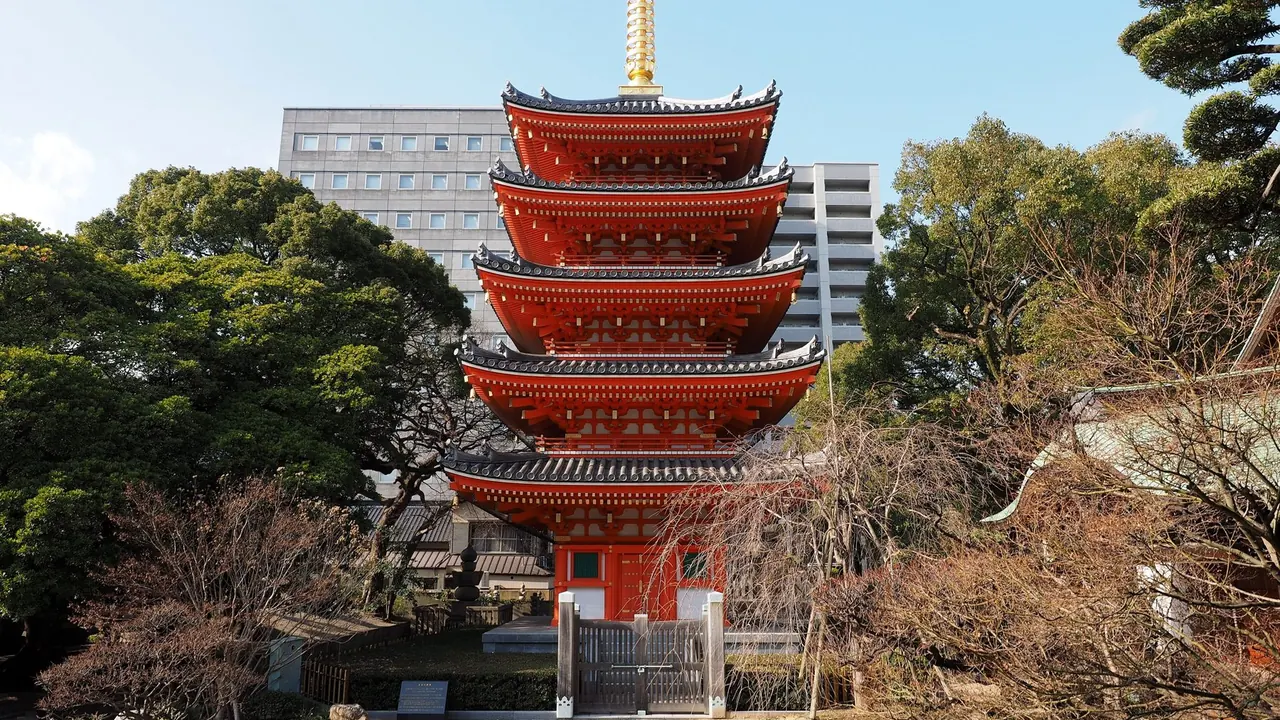
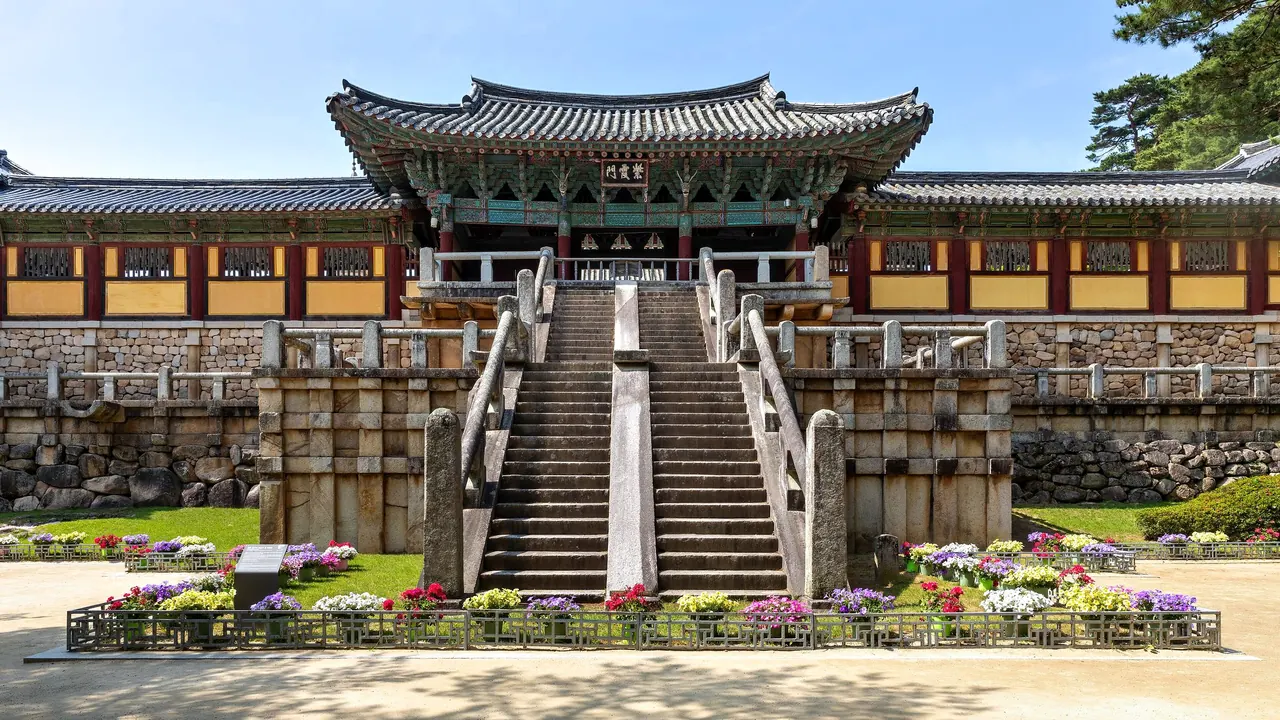
Photos: Fukuoka by Nick-D, CC BY-SA 4.0, cropped; Gyeongju by Basile Morin, CC BY-SA 4.0, cropped.
Fukuoka or Gyeongju?
Our verdict in twelve categories, each scored against the same fixed benchmark cities, and the climate month by month, so you can choose for your trip.
Choose Fukuoka for
- nightlife
- food and drink
- shopping
Fukuoka suits travellers who want a relaxed city to eat and drink their way through, with ramen counters, riverside yatai stalls and long evenings of bar-hopping in Daimyo. It is also the easier place to be. The airport is on the subway, the centre is compact, children are well looked after, and fast trains open up Hiroshima, Nagasaki and the rest of Kyushu for days out.
Choose Gyeongju for
- culture and sights
- prices
Gyeongju is the choice when the history is the point of the trip. The former Silla capital has royal burial mounds rising between the streets, Bulguksa and the Seokguram grotto on the hills above, and Buddhas carved into the rock along the trails of Namsan. In return you accept simpler food, very little shopping and a town that is in bed early. It rewards slow days on a bike and a night in a temple more than anything urban.
Scoreboard
Twelve categories on one fixed scale from 0 to 100. The shaded stretch is the gap between the two.
Your match
Pick a travel style or drag the sliders, and both match scores follow your weighting.
Wins on nightlife and food and drink with your weighting.
Wins on culture and sights and prices with your weighting.
What matters to you?
Category by category
What the scores mean for a trip.
Beaches & swimming
Fukuoka has the better beaches. Momochi Seaside Park is right in town for an evening paddle, and the white sand and clear water of the Itoshima peninsula are under an hour west, with island beaches on Shikanoshima and Nokonoshima for quieter days.
Gyeongju is inland, and its coast at Bonggil, Jeonchon and Gampo is about forty minutes away, with small beaches of sand and pebble. Bonggil's draw is as much the view of King Munmu's underwater tomb offshore as the swimming. In both places the season is little more than July and August.
Food & drink
This is one of the widest gaps between the two. Fukuoka is a destination in its own right for eating: it is the home of tonkotsu ramen, its evening yatai stalls give it a rare Japanese street-food culture, and motsunabe, mizutaki and very fresh squid and sashimi from the Genkai Sea mean you can eat something new at every meal.
Gyeongju feeds you well but simply. The ssambap spreads near the tombs, boxes of Hwangnam bread and Gyochon's beopju rice wine are worth trying, but after a couple of days the choice narrows, and anything refined means a Bomun resort hotel.
Culture & sights
Gyeongju is far ahead here. As the Silla capital for nearly a thousand years, it has royal burial mounds in the middle of town, a tomb chamber you can enter, the ancient observatory of Cheomseongdae and the pavilions on Wolji Pond. Bulguksa and the granite Buddha of Seokguram are among the finest sights in East Asia.
Fukuoka is a largely rebuilt modern city. Old Hakata's temple quarter, with Shofukuji, Tochoji's wooden Buddha and Kushida Shrine, makes a fine morning, and the gold seal in the City Museum is a real treasure, but the grander heritage sits outside the city.
Nightlife
Fukuoka is a city that likes a drink. Nakasu's neon and riverside yatai make an easy start, and the backstreets of Tenjin and Daimyo are full of craft beer and whisky bars and izakaya that keep going late. Dancing is limited, though, and the best nights are dinners that turn into bar crawls.
Gyeongju barely has a night scene. After seeing Wolji Pond floodlit, there are a few wine bars in Hwangnidan-gil and soju over grilled meat downtown, and anyone wanting more takes the train to Busan.
Nature & outdoors
Both are good for outdoor days, but the outdoors is quite different. Fukuoka's is coastal: the cycle paths of Uminonakamichi, the ferry to Nokonoshima's flower slopes, the rocky capes and rice terraces of Itoshima, and hikes up Mount Homan and the Sefuri range above the bay.
In Gyeongju, the landscape and the history are hard to separate. Namsan's trails pass rock-carved Buddhas and pagodas, Tohamsan's ridges catch the sunrise towards the sea, and the flat valley and cherry-lined shore of Bomun Lake are ideal for an easy bike ride.
Day trips
Fukuoka is the stronger base. Dazaifu's shrine and national museum are half an hour away, and the shinkansen reaches Kumamoto Castle in well under an hour and Hiroshima and Miyajima in about an hour. Nagasaki, Yanagawa's canals and the porcelain villages of Arita all make easy days out as well.
Gyeongju has fine options too, but fewer of them. Busan is half an hour by fast train, the lived-in clan houses of Yangdong and the monastery of Tongdosa are each about forty minutes away, and Andong's Hahoe village and Haeinsa take most of a day by road.
Good for families
Fukuoka is easier with children. It is compact and calm, with nursing rooms in stations and department stores, the Marine World aquarium and its dolphin show, the Anpanman Children's Museum for toddlers, and a quick ferry to Nokonoshima. The main drawback is the summer humidity.
Gyeongju has the one thing Fukuoka lacks: a proper amusement park and water park at Bomun Lake. Family bikes around the tombs and dressing up in hanbok go down well too, but the steps at Bulguksa and day after day of heritage can tire younger children.
Getting around
Fukuoka makes travel effortless. The subway runs from the airport to Hakata Station in minutes, the main districts are a short flat walk apart, and Hakata Station connects to the whole of Kyushu.
Gyeongju's historic core is a pleasure on foot or by bike, but everything beyond it takes planning. The high-speed station is outside town, and Seokguram, Yangdong and the coast are on slow, infrequent bus routes, so many visitors end up using taxis or hiring a car for a day.
Shopping & style
Fukuoka is the shopping centre of Kyushu. Tenjin has department stores such as Iwataya above a long underground arcade, Daimyo and Imaizumi have vintage and select shops, and there are Hakata dolls, woven silk and boxed mentaiko to take home.
Gyeongju's shopping amounts to an afternoon in the hanok lanes of Hwangnidan-gil, with stationery and ceramics on Silla themes, plus dried seafood at Jungang market. For anything more, you would go to Busan or Daegu.
Affordability
The two cost much the same, and both are cheaper than their countries' largest cities. Fukuoka's savings come from compact business hotels, cheap ramen and set lunches, and low transport fares, and costs climb mainly with sushi dinners and nights in Nakasu.
In Gyeongju, the tomb parks are free or nearly so and bike hire is cheap, but weekends, blossom and foliage season, and taxis between outlying temples all push the bill up.
Live music & performing arts
Fukuoka has the fuller stage. Touring kabuki and musicals play at Hakataza, the Kyushu Symphony Orchestra is based at the Acros hall, and small live houses in Tenjin host jazz and local bands. In July, the dawn float races of the Hakata Gion Yamakasa are a sight in themselves.
Gyeongju offers open-air traditional music and dance at Bomun Lake in the warmer months and costumed shows on Silla themes. Its highlight is the autumn Silla Cultural Festival, when court music and drumming fill the streets around the tombs.
Wellness & relaxation
The two are evenly matched for rest, in different ways. Fukuoka has hot-spring bath complexes on its edge, the old onsen town of Futsukaichi half an hour south, and Beppu and Yufuin within a long day's reach. The calm of Ohori Park also makes the city feel unhurried.
Gyeongju has the more distinctive retreat: temple stays at Bulguksa or at Golgulsa, the cave temple known for sunmudo, with early chanting and vegetarian meals. It also has hot-spring spas around Bomun Lake. Weekends and blossom season break the quiet.
When should you go?
Pick your month. The climate figures are measured averages, not a forecast.
Fukuoka in July
Gyeongju in July
Daytime high, °C
Rainfall in the month, mm
Where the figures come from
Gyeongju's temperatures are measured 25 km from the centre, at Pohang.
Gyeongju has no rain gauge within 25 km of the centre, so its rainfall comes from a gridded climate dataset read at the city rather than from a gauge further away.
Temperature and rainfall are climate normals, averaged over the years shown. Fukuoka: 1991-2020 normals, Fukuoka (1.9 km from centre). Gyeongju: 1991-2020 normals, Pohang (25.3 km from centre).
Spring and autumn are the best seasons in both places. April, May and October are warm enough to walk all day without the summer heat. Fukuoka gets hotter and much wetter: the rainy season peaks around 301mm in July, and August highs reach 32°C in sticky humidity. That same August sea, at about 27°C, makes July and August the only real swimming months, with cloud and rain likely between beach days.
Gyeongju runs a little cooler and drier through most of the year, though July and August still bring heavy rain, around 221mm a month. Its winters are colder than Fukuoka's, with January highs near 7°C, but they are noticeably sunnier and very dry. Crisp, clear days among the tombs are possible there in midwinter, while Fukuoka's winter is milder but greyer.
Which traveller are you?
On a culture and arts trip, Gyeongju is the clear pick. Silla tombs, Cheomseongdae, the National Museum's gold crowns and two UNESCO-listed temple sites outweigh Fukuoka's pleasant but modest Hakata temples and castle walls, even if Fukuoka has the better theatre and concerts.
For a food and nightlife trip, Fukuoka wins easily. Tonkotsu ramen, yatai stalls along the river, mentaiko and fresh Genkai Sea fish are followed by late nights in Daimyo's standing bars. Gyeongju offers ssambap and rice wine, then sends you to bed early.
On a shopping trip, choose Fukuoka. Tenjin's department stores and underground arcade, independent shops in Daimyo and Imaizumi, and crafts such as Hakata-ori silk and Arita porcelain give it real range. Gyeongju has a few design shops in Hwangnidan-gil and little else.
Before you go
| Measure | Fukuoka | Gyeongju |
|---|---|---|
| Official language | Japanese | Korean, Korean Sign Language |
| Currency | Yen (JPY) | Won (KRW) |
| Sockets | AB100 V, 50 and 60 Hz depending on the region | CF220 V, 60 Hz |
| Driving side | Left | Right |
| Time zone | UTC+9 | UTC+9 |
| Emergency number | Police 110, fire 119 | Police 112, ambulance 119, fire 119 |
| Elevation | 8 m | 46 m |
| Main airport | Fukuoka Airport (FUK)5 km from centre46 non-stop destinations | Gimhae International Airport (PUS)79 km from centre49 non-stop destinations |
| Public holidays this year | 16 days | 18 days |
By the numbers
| Measure | Fukuoka | Gyeongju |
|---|---|---|
| City population | 1,603,043 | 245,365 |
| People per km² | 4,715 | 185 |
| Museums within 10 km | 23 | 3 |
| UNESCO World Heritage sites within 50 km | 2 | 6 |
| Swim season, months above 21 °C | 4 months | 4 months |
Where else could you go?
Every comparison below shares a destination with this one, so you can follow Fukuoka or Gyeongju somewhere new.
- Busanvs Gyeongju
- Hiroshimavs Fukuoka
- Busanvs Fukuoka
- Seoulvs Gyeongju
- Hiroshimavs Gyeongju
- Osakavs Fukuoka