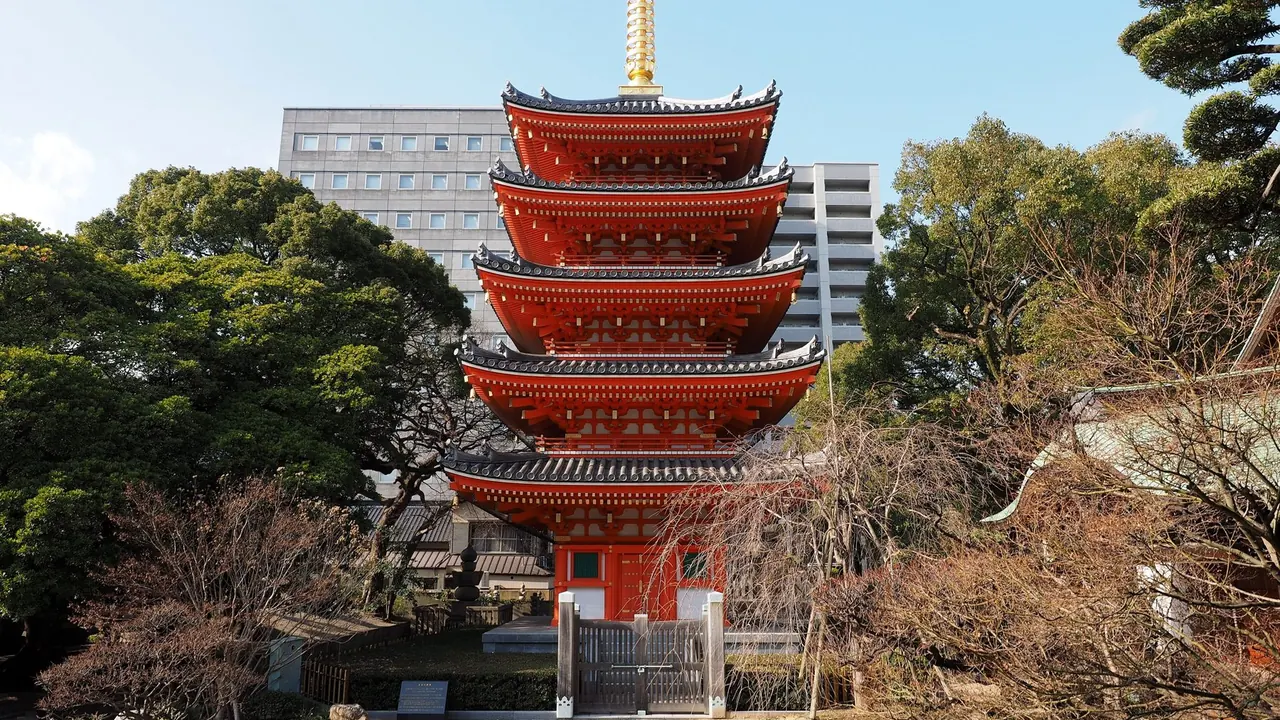
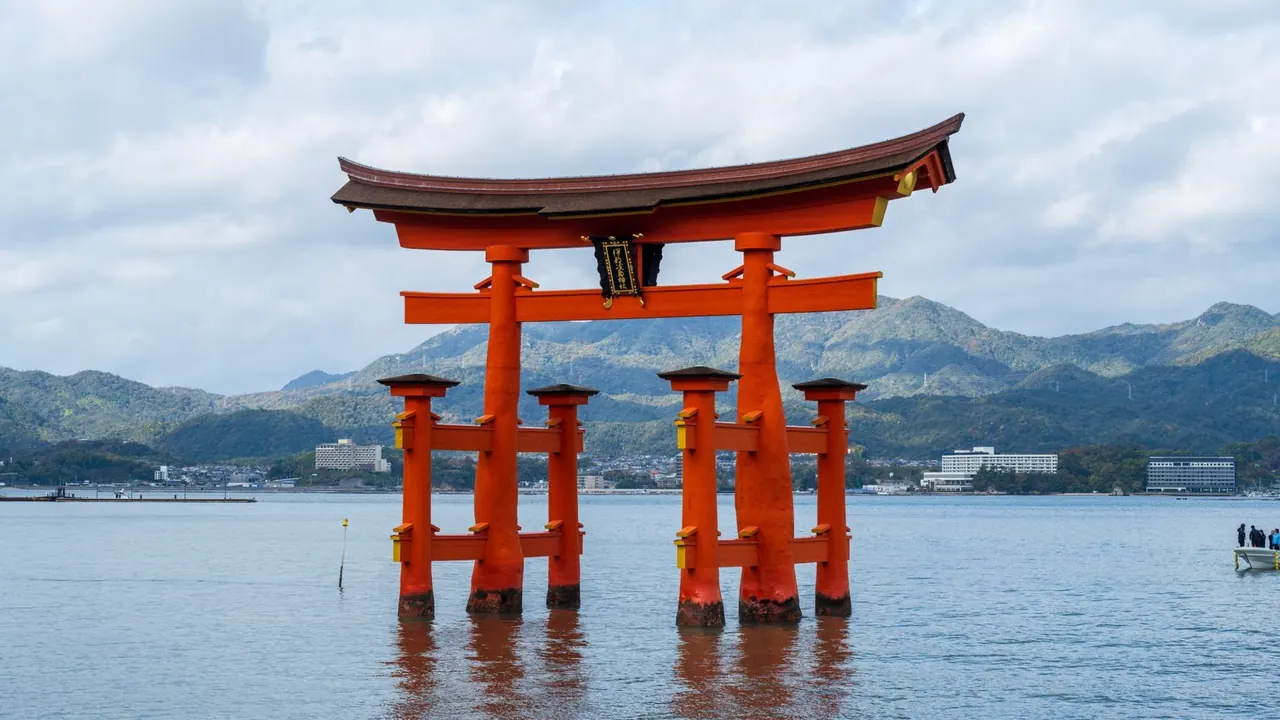
Photos: Fukuoka by Nick-D, CC BY-SA 4.0, cropped; Hiroshima by Guohua Song, Pexels License.
Fukuoka or Hiroshima?
Our verdict in twelve categories, each scored against the same fixed benchmark cities, and the climate month by month, so you can choose for your trip.
Choose Fukuoka for
- beaches
- families
- food and drink
Fukuoka suits travellers who plan their days around the next meal and their evenings around the next bar. Ramen counters, riverside yatai stalls and late nights in Daimyo give it more appetite and energy than its neighbour. It is also the easier city with children, with a real summer beach day on Itoshima and an airport only a few minutes from the centre by subway.
Choose Hiroshima for
- culture and sights
Hiroshima is the choice for a trip with weight to it. The Peace Memorial Park and its museum are among the most affecting places in Japan, and the islands of the Inland Sea, starting with Miyajima, give the stay a gentler, scenic second half. The food is simpler, the nights quieter and the shopping thinner, but few travellers come here for those.
Scoreboard
Twelve categories on one fixed scale from 0 to 100. The shaded stretch is the gap between the two.
Your match
Pick a travel style or drag the sliders, and both match scores follow your weighting.
Wins on beaches and families with your weighting.
Wins on culture and sights with your weighting.
What matters to you?
Category by category
What the scores mean for a trip.
Beaches & swimming
Fukuoka is the better choice for a swim. Momochi Seaside Park is a beach right in the city for an evening paddle, and within the hour the Itoshima peninsula offers white sand, clear water and surf-shack cafés, with Shikanoshima and Nokonoshima as quieter options.
Hiroshima's shore is all port, so swimming means taking a ferry to the small beaches on Miyajima, Ninoshima or Etajima. The calm, sheltered water there suits small children, but the beaches are modest. In both cities the season is only July and August, and jellyfish arrive towards the end of it.
Food & drink
Few cities in Japan eat as well as Fukuoka, and it offers the wider range. It is the home of Hakata-style tonkotsu ramen, its yatai stalls in Nakasu and Tenjin are the nearest thing Japan has to street food, and motsunabe, mizutaki and very fresh Genkai Sea squid give plenty to try beyond noodles.
Hiroshima's food centres on okonomiyaki, layered on the griddle in whole buildings of small stalls, along with oysters from the bay, best in winter on Miyajima. A sake-tasting afternoon in Saijo is its strongest extra. Neither city has much international cooking.
Culture & sights
This is where Hiroshima clearly leads. The A-Bomb Dome and the Peace Memorial Museum make for a half-day few visitors forget, and Shukkeien and the castle's moats and original stone walls round out the city's sights.
Fukuoka's sights are pleasant rather than profound. The old temple quarter of Hakata, with Shofukuji, Tochoji's wooden Buddha and the Kushida Shrine, is the best walk, and the City Museum holds the ancient gold seal from China. The region's grander heritage, such as Dazaifu, lies outside the city.
Nightlife
Fukuoka has more going on after dark. Nakasu is western Japan's most famous entertainment district, but visitors do better in Daimyo and Tenjin, with their standing bars, craft-beer and whisky bars and a few clubs, or on the student strip of Oyafuko-dori.
Hiroshima's Nagarekawa is a large grid of tiny bars, karaoke boxes and izakaya, at its busiest after a home baseball game. An evening there is slower and more local, usually ending at a counter bar with the owner pouring sake.
Nature & outdoors
The two are evenly matched outdoors, but the landscapes differ. Fukuoka's green space is coastal and close at hand: the loop around Ohori Park, the flower fields and cycle paths of Uminonakamichi, the rocky capes and rice terraces of Itoshima, and hikes in the Sefuri hills.
Hiroshima looks out on the island-studded Inland Sea. The best of it is the climb up Mount Misen on Miyajima among wild deer, the riverside walk through Sandankyo Gorge in autumn, and the Shimanami Kaido cycling route across the islands from Onomichi.
Day trips
Both are excellent bases, and the real difference is direction. Fukuoka opens up Kyushu: Dazaifu's shrine and national museum within half an hour, punting in Yanagawa, Kumamoto's castle, and Nagasaki's layered harbour history, with Hiroshima itself about an hour away by shinkansen.
Hiroshima faces the Inland Sea and east towards Kansai. Miyajima is an easy half-day rather than a full outing, and Onomichi, Tomonoura, rabbit-filled Okunoshima, Kurashiki and Himeji Castle are all in reach.
Good for families
With young children, Marine World on the Uminonakamichi peninsula is the single best day out in either city: a good aquarium and dolphin show beside playgrounds, a small zoo and flower fields. In Fukuoka the Anpanman Children's Museum adds a sure hit for toddlers, and the science museum and Fukuoka Tower cover a rainy day.
Hiroshima has charming moments: feeding the deer on Miyajima, the rabbits of Okunoshima and a noisy evening at the baseball. But it has no large aquarium, and parents have to judge how much of the Peace Memorial Museum younger children should see.
Getting around
Fukuoka is the smoother city to move around. The airport sits on the subway a few minutes from Hakata Station, three subway lines run along the main axis, and Hakata, Nakasu, Tenjin and Daimyo are all within short walks of each other.
Hiroshima's centre is just as flat and walkable, with the Peace Park, Hondori and the castle close together. Its large tram network is easy for visitors to use but slow at busy times, so JR trains are the quicker way to Miyajima.
Shopping & style
Tenjin is Kyushu's main shopping district, and it gives Fukuoka the edge. Department stores stand above a long underground arcade, Daimyo and Imaizumi hold independent fashion and vintage shops, and Canal City and the station complex cover the big brands. Hakata-ori silk and Arita porcelain are the crafts to look for.
Hiroshima's shopping centres on the covered Hondori arcade and is more a pleasant browse. Its best buys are small and specific: Kumano brushes, Miyajima rice paddles, momiji manju cakes and Saijo sake.
Affordability
Both are among the cheaper big cities in Japan, with fairly priced business hotels and filling meals of ramen or okonomiyaki. Where the money goes differs. In Fukuoka it is sushi dinners and nights in Nakasu, though the airport subway is a real saving.
In Hiroshima the costs come from shinkansen fares for day trips and a night on Miyajima, while the Peace Park itself is free to walk.
Live music & performing arts
What sets the two apart is their own traditions. In Fukuoka it is the street festivals, above all the Hakata Gion Yamakasa float races at dawn in July and the Dontaku parade in May. Its stages are also a little larger, with touring kabuki and musicals at Hakataza and the Kyushu Symphony Orchestra at the Acros hall.
Hiroshima's distinctive offering is kagura, the masked, drum-driven Shinto dance-drama, put on in regular evening shows for visitors. Beyond that, its concert halls and live houses are modest.
Wellness & relaxation
Fukuoka is better for a bath. Futsukaichi Onsen, one of Kyushu's oldest hot-spring towns, is about half an hour away near Dazaifu, there are large hot-spring complexes on the city's edge, and Beppu and Yufuin are within a long day's reach.
Hiroshima has no hot springs of its own, so a true onsen means an hour's journey into the hills. Its gentler pleasures are a ryokan night on Miyajima after the day-trippers leave and the ponds of Shukkeien.
When should you go?
Pick your month. The climate figures are measured averages, not a forecast.
Fukuoka in July
Hiroshima in July
Daytime high, °C
Rainfall in the month, mm
Temperature and rainfall are climate normals, averaged over the years shown. Fukuoka: 1991-2020 normals, Fukuoka (1.9 km from centre). Hiroshima: 1991-2020 normals, Hiroshima (1.7 km from centre).
The two cities share almost the same climate, and both are at their best in spring and autumn. April, May, October and early November bring mild days in the low to mid twenties, which suit long walks and day trips. June and July are the wettest months in both, with close to 300mm falling in July. By August the heat reaches 31°C or more and humidity makes walking the streets tiring in the middle of the day. Winters are cool but rarely harsh.
The differences are small but real. Late summer is the only time for swimming in either city, and Fukuoka's sea is slightly warmer, at about 27°C in August. Hiroshima dries out sooner after the rainy season, so its August is much less wet than Fukuoka's. It also gets noticeably more winter sunshine, which makes it the better choice of the two from December to February.
Which traveller are you?
On a food and nightlife trip, Fukuoka offers more variety. An evening can start at a riverside yatai over ramen and skewers, then move on to craft-beer and whisky bars or a club in Daimyo. Hiroshima's Nagarekawa stays mostly local: izakaya, karaoke and counter bars.
On a family trip with children, Fukuoka is gentler on parents. Stations and department stores have nursing rooms, and Ohori Park, the hilltop zoo or the short ferry to Nokonoshima fill an easy half-day. Hiroshima's main sight is a sombre memorial, not a children's outing.
On a culture and arts trip, Hiroshima gives more. The A-Bomb Dome and Peace Memorial Museum leave a lasting impression, Shukkeien is a fine Edo-period garden, and kagura dance-drama is staged for visitors in the evening. Fukuoka's temple quarter is pleasant but slighter.
Before you go
| Measure | Fukuoka | Hiroshima |
|---|---|---|
| Official language | Japanese | Japanese |
| Currency | Yen (JPY) | Yen (JPY) |
| Sockets | AB100 V, 50 and 60 Hz depending on the region | AB100 V, 50 and 60 Hz depending on the region |
| Driving side | Left | Left |
| Time zone | UTC+9 | UTC+9 |
| Emergency number | Police 110, fire 119 | Police 110, fire 119 |
| Elevation | 8 m | 3 m |
| Main airport | Fukuoka Airport (FUK)5 km from centre46 non-stop destinations | Hiroshima Airport (HIJ)43 km from centre10 non-stop destinations |
| Public holidays this year | 16 days | 16 days |
By the numbers
| Measure | Fukuoka | Hiroshima |
|---|---|---|
| City population | 1,603,043 | 1,198,021 |
| People per km² | 4,715 | 1,324 |
| Museums within 10 km | 23 | 18 |
| UNESCO World Heritage sites within 50 km | 2 | 2 |
| Swim season, months above 21 °C | 4 months | 4 months |
Where else could you go?
Every comparison below shares a destination with this one, so you can follow Fukuoka or Hiroshima somewhere new.