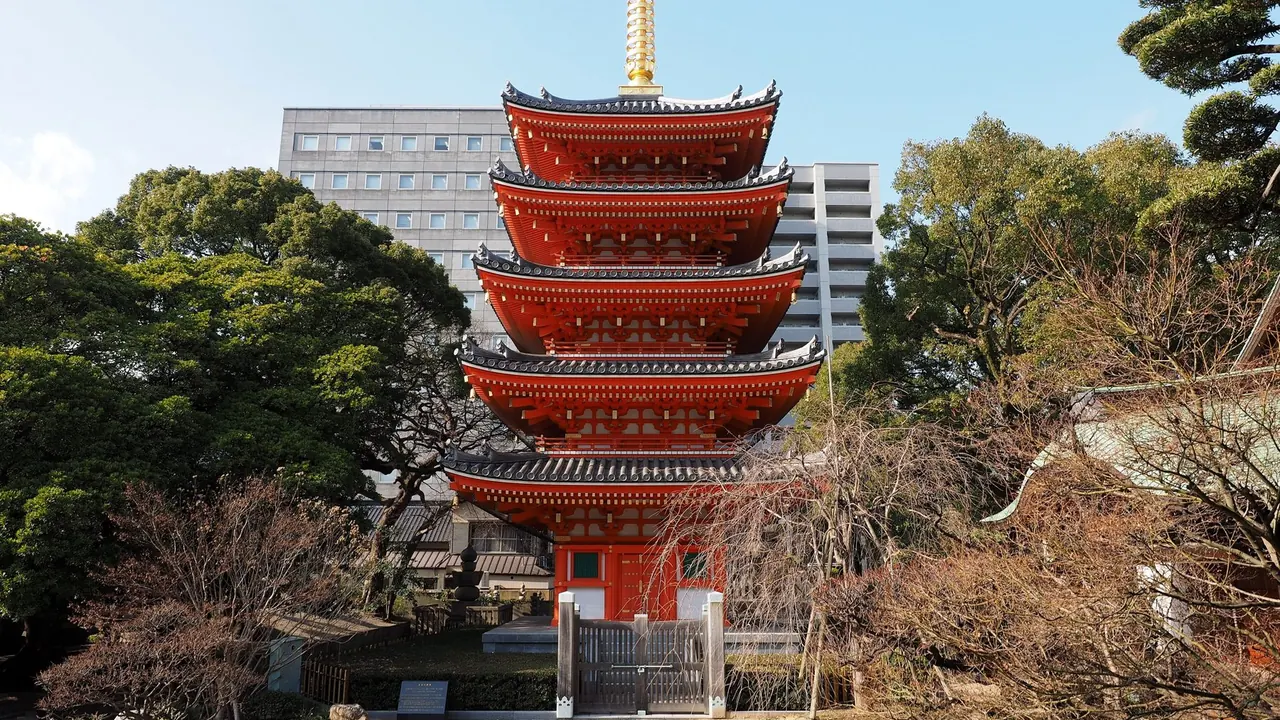
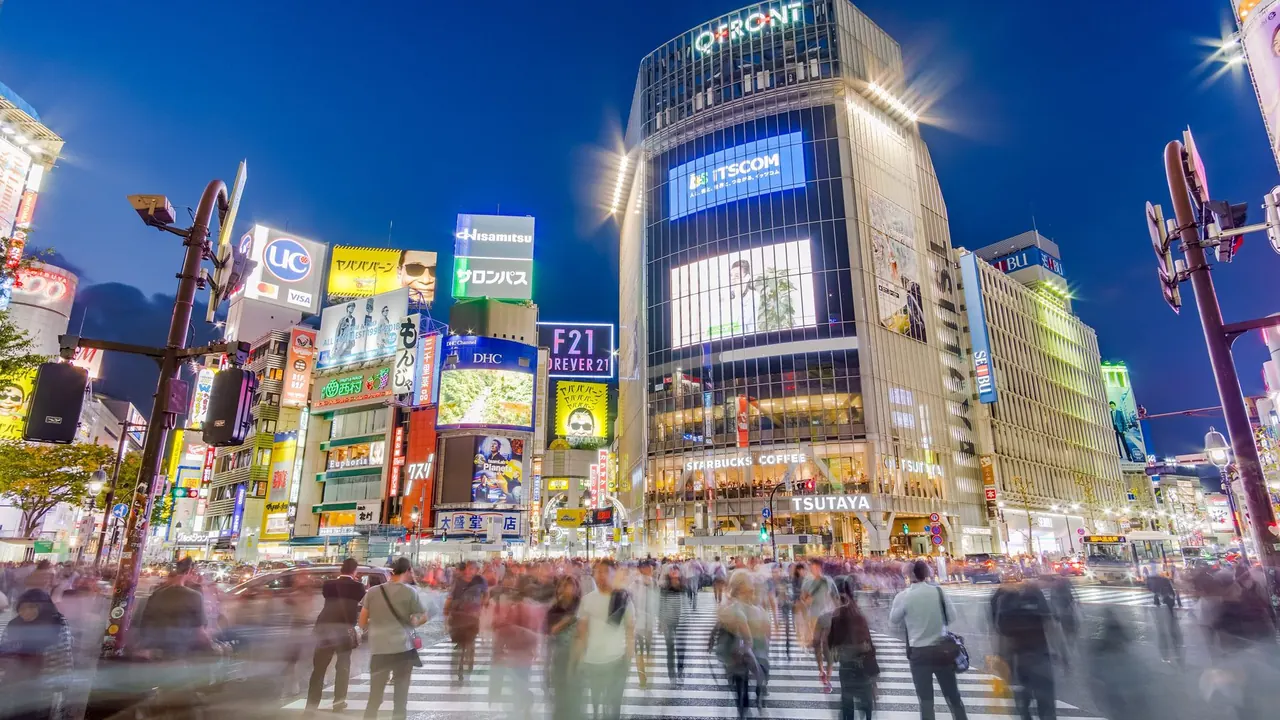
Photos: Fukuoka by Nick-D, CC BY-SA 4.0, cropped; Tokyo by Benh LIEU SONG, CC BY-SA 2.0, cropped.
Fukuoka or Tokyo?
Our verdict in twelve categories, each scored against the same fixed benchmark cities, and the climate month by month, so you can choose for your trip.
Choose Fukuoka for
- beaches
- prices
Fukuoka suits travellers who want Japan at an easier pace and a lower cost: a compact, flat city where the airport is a few subway stops from the centre, evenings are spent at riverside yatai stalls over tonkotsu ramen, and the beaches of Itoshima are close enough for a summer afternoon. It also makes a natural base for Kyushu, with Nagasaki, Kumamoto and even Hiroshima within a train ride.
Choose Tokyo for
- live music and the arts
- culture and sights
- shopping
Tokyo is the choice for anyone who wants depth in almost everything. The food, the shopping from Ginza to Shimokitazawa, the museums of Ueno, kabuki and concert halls, and a night that runs from Golden Gai's tiny bars to clubs in Shibuya all go far beyond what Fukuoka offers. Families do especially well here, with Disneyland, the Ghibli Museum and a transport system built for ease, as long as they accept bigger crowds and pricier rooms.
Scoreboard
Twelve categories on one fixed scale from 0 to 100. The shaded stretch is the gap between the two.
Your match
Pick a travel style or drag the sliders, and both match scores follow your weighting.
Wins on beaches and prices with your weighting.
Wins on live music and the arts and culture and sights with your weighting.
What matters to you?
Category by category
What the scores mean for a trip.
Beaches & swimming
Neither city is a beach destination, but Fukuoka makes swimming easier. Momochi Seaside Park lies within the city for an evening paddle, and the clear water and white sand of the Itoshima peninsula are under an hour away, with Nokonoshima and Shikanoshima as quieter islands.
Tokyo's bay shore at Odaiba and Kasai is for strolling, so swimming means a train ride of about an hour to Kamakura, Zushi or Enoshima on the Shonan coast. The sand there is dark and volcanic, and summer weekends bring the crowds of a capital.
Food & drink
Fukuoka is a superb place to eat in its own regional way: tonkotsu ramen in Hakata and Nagahama, yatai stalls along the river in Nakasu, mentaiko, motsunabe and very fresh fish from the Genkai Sea. It is a focused, local food city.
Tokyo goes much further. Its specialist counters, kaiseki rooms and sushi masters sit alongside the depachika food halls, the Tsukiji outer market and the yakitori alleys under the tracks at Yurakucho, and its French, Italian and Chinese cooking reaches a standard Fukuoka cannot match. For a trip built around eating, the capital offers far more choice.
Culture & sights
Both cities lost much of their past and were rebuilt, but Tokyo kept or restored far more. Senso-ji in Asakusa, Meiji Jingu, the Imperial Palace moats and the gardens of Hama-rikyu and Rikugien sit beside the Ueno museums, led by the Tokyo National Museum's vast collection of Japanese art.
Fukuoka's sightseeing fits into two or three days: the temple quarter of old Hakata with Shofukuji and Tochoji, the castle walls above Ohori Park, and the City Museum's ancient gold seal. Pleasant rather than essential, and its grander heritage, such as Dazaifu, lies outside the city.
Nightlife
Fukuoka is a friendly, late-drinking city, but its nights are built around long dinners, yatai stools in Nakasu and bar-hopping through Daimyo and Tenjin, with only a small club scene.
Tokyo's night is on another scale. Golden Gai's two hundred tiny bars, whole buildings of whisky and vinyl bars, and the yakitori smoke of Omoide Yokocho lead on to clubs in Shibuya and Roppongi that run until the first morning trains. For dancing, Tokyo is the only real option of the two.
Nature & outdoors
Tokyo has the slightly stronger outdoors, mainly because its trains reach mountains: Mount Takao for an easy forest hike, the gorges of Okutama, and Hakone and the Fuji Five Lakes for views of Mount Fuji.
Fukuoka's nature is more about sea and coast: the rocky capes and rice terraces of Itoshima, the flower slopes of Nokonoshima, cycling at Uminonakamichi and hikes in the Sefuri range. Its big volcanic scenery at Aso and Kuju is a long day away.
Day trips
Both are excellent bases, but they serve different trips. From Fukuoka the shinkansen spreads out across a whole island and beyond: Kumamoto castle, Nagasaki's harbour history and even Hiroshima and Miyajima, with Dazaifu and the canal town of Yanagawa close by.
Tokyo's day trips stay nearer and lean towards temples and resorts: Kamakura's Great Buddha, the Toshogu shrine at Nikko, Yokohama's harbour, the Edo streets of Kawagoe and the hot springs of Hakone.
Good for families
Fukuoka is calm, compact and clean, with Marine World's dolphin show, the Anpanman Children's Museum and easy half-days in Ohori Park. Its drawback is the lack of any big theme-park resort.
Tokyo has that and much more: Disneyland and DisneySea across the bay, the Ghibli Museum, Ueno Zoo and Miraikan in Odaiba. Lifts, baby rooms and spotless toilets are everywhere, so a longer family stay is easy to fill. Huge stations and rush-hour trains take more patience than Fukuoka does.
Getting around
Fukuoka wins on arrival, with the airport just minutes by subway from Hakata Station, and its flat centre links Hakata, Nakasu, Tenjin and Daimyo on foot. Beyond its three subway lines, though, the buses take some working out.
Tokyo's rail network is in a different class: the Yamanote loop, the metro and overground lines put almost every sight a short walk from a station, with English signs throughout. Expect confusing giant stations at first and crammed trains at rush hour.
Shopping & style
Fukuoka's shopping centres on Tenjin's department stores and underground arcade, Daimyo's independent fashion and Canal City by Hakata Station, with Hakata-ori silk and Arita porcelain as local crafts.
Tokyo is a shopping destination in its own right. Ginza and Omotesando carry luxury and architectural flagships, Harajuku and Shimokitazawa are full of vintage, and districts such as Akihabara, Kappabashi and Jimbocho each specialise deeply. For a trip where shopping matters, the capital is far ahead.
Affordability
Fukuoka is the gentler city on the wallet. Food is cheap in both, but Fukuoka's business hotels near Hakata and Tenjin cost less, and the short airport subway ride saves money from the first hour.
In Tokyo, rooms are where the budget goes, as central hotels are small and pricey and climb further in cherry-blossom season and Golden Week. Eating the way residents do keeps the rest manageable.
Live music & performing arts
Tokyo's stage life is vastly richer. The Kabuki-za's single-act tickets, Noh theatres, the Takarazuka Revue, opera and ballet at the New National Theatre and acoustically famous halls such as Suntory Hall are backed by jazz listening bars and live houses in Koenji and Shimokitazawa.
Fukuoka offers touring shows at Hakataza and the Kyushu Symphony Orchestra in the Acros building. Its most striking performance is outdoors: the dawn float races of the Hakata Gion Yamakasa in July.
Wellness & relaxation
Bathing culture runs deeper in Tokyo, where hundreds of neighbourhood sento survive, some fed by dark mineral spring water, and large complexes with saunas fill whole afternoons. Hakone's onsen inns are about ninety minutes away.
Fukuoka's strength is closer, easier calm: Futsukaichi Onsen half an hour south, and an unhurried city pace around Ohori Park. Beppu and Yufuin are the bigger prize, but they take a long day.
When should you go?
Pick your month. The climate figures are measured averages, not a forecast.
Fukuoka in July
Tokyo in July
Daytime high, °C
Rainfall in the month, mm
Temperature and rainfall are climate normals, averaged over the years shown. Fukuoka: 1991-2020 normals, Fukuoka (1.9 km from centre). Tokyo: 1991-2020 normals, Tokyo (3.6 km from centre).
The two cities share a calendar in broad strokes: mild, pleasant walking weather in April, May, October and November, and heavy, humid heat in July and August, when daytime highs reach about 32°C in both. In those summer months the sea is warm enough for swimming, and Fukuoka's water is slightly the warmer of the two at around 27°C in August.
The rain falls at different times. Fukuoka gets its wettest weather early in summer, with July bringing about 300mm, so its autumn is the more reliable. Tokyo stays drier in early summer, but its wettest months are September and October. Winter also differs: Tokyo's cold months are bright and clear, with far more sunshine than Fukuoka, which makes December to February a better time for a winter city break in the capital.
Which traveller are you?
On a culture and arts trip, Tokyo gives far more days of looking. Fukuoka's Asian Art Museum and the art museum beside the Ohori pond fill an afternoon, while Tokyo adds the Nezu, the Mori Art Museum, the National Museum of Western Art and Tange's Olympic gymnasium.
For a shopping trip, bring an empty suitcase to Tokyo. Fukuoka offers Hakata dolls, boxed mentaiko and vintage in Imaizumi. Tokyo adds the design boutiques of Daikanyama and Nakameguro, lacquer, washi and indigo textiles, and stationery stores worth a whole afternoon.
On a trip on a tight budget, Fukuoka goes further. You walk its small centre instead of riding, the Ohori Park loop and the Hakata temples cost nothing, and set lunches are cheap. Tokyo has conveyor-belt sushi and good-value lunch menus too, but a stay there costs more overall.
Before you go
| Measure | Fukuoka | Tokyo |
|---|---|---|
| Official language | Japanese | Japanese |
| Currency | Yen (JPY) | Yen (JPY) |
| Sockets | AB100 V, 50 and 60 Hz depending on the region | AB100 V, 50 and 60 Hz depending on the region |
| Driving side | Left | Left |
| Time zone | UTC+9 | UTC+9 |
| Emergency number | Police 110, fire 119 | Police 110, fire 119 |
| Elevation | 8 m | 6 m |
| Main airport | Fukuoka Airport (FUK)5 km from centre46 non-stop destinations | Tokyo Haneda International Airport (HND)18 km from centre98 non-stop destinations |
| Public holidays this year | 16 days | 16 days |
By the numbers
| Measure | Fukuoka | Tokyo |
|---|---|---|
| City population | 1,603,043 | 14,264,798 |
| People per km² | 4,715 | 6,501 |
| Museums within 10 km | 23 | 192 |
| UNESCO World Heritage sites within 50 km | 2 | 1 |
| Swim season, months above 21 °C | 4 months | 4 months |
Where else could you go?
Every comparison below shares a destination with this one, so you can follow Fukuoka or Tokyo somewhere new.