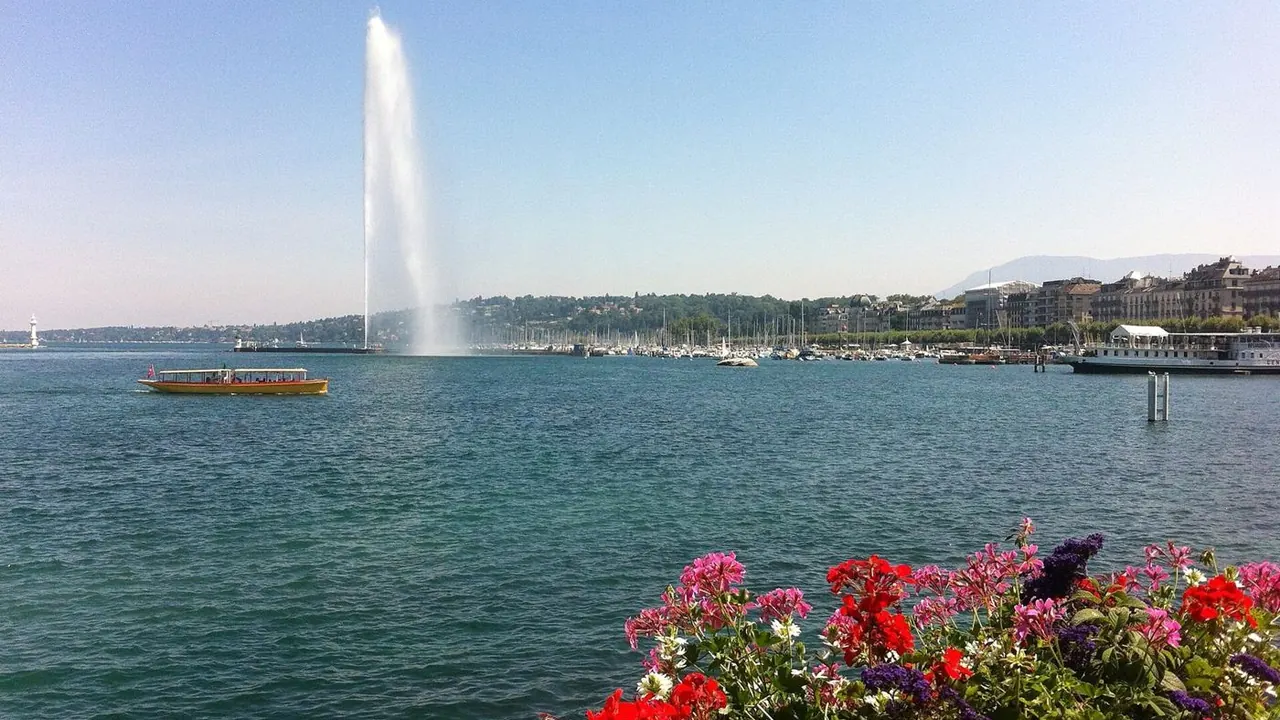
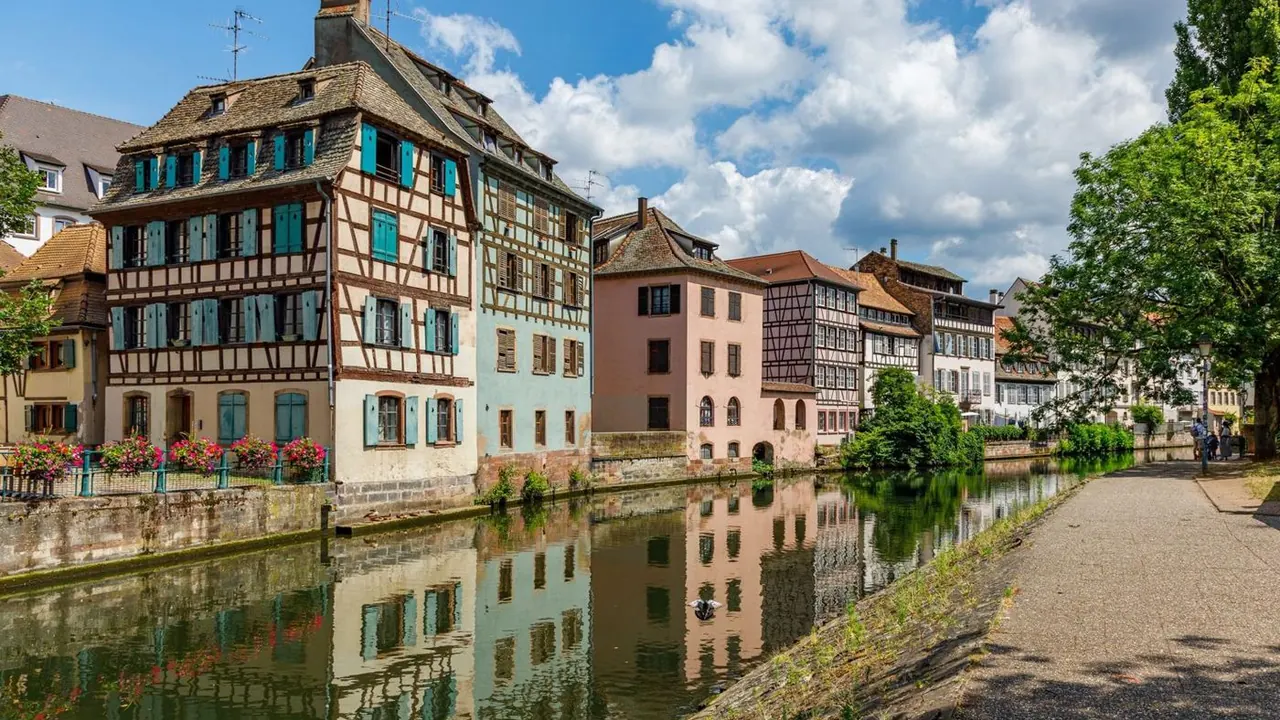
Photos: Geneva by Diviosen, CC BY-SA 3.0, cropped; Strasbourg by Edoardo Colombo, Pexels License.
Geneva or Strasbourg?
Our verdict in twelve categories, each scored against the same fixed benchmark cities, and the climate month by month, so you can choose for your trip.
Choose Geneva for
- beaches
- nature and the outdoors
- shopping
Geneva suits travellers who want mountains and water as much as the city itself. The Salève, the Jura and the road to Chamonix are close by, the lake is clean enough to swim in all summer, and trams, trains and harbour boats make every outing easy. It also suits anyone shopping for watches or jewellery. The catch is cost, which is steep at every level, so it rewards a short, active stay or a generous budget.
Choose Strasbourg for
- prices
- culture and sights
- food and drink
Strasbourg is the better choice for a slower trip built around old streets, Alsatian cooking and the wine country. The timber-framed Grande Ile and Petite France, long meals in a winstub and days among the Alsace wine villages give it more to linger over than Geneva, and it costs far less. Families do better here too, with a children's science centre in town and Europa-Park within reach.
Scoreboard
Twelve categories on one fixed scale from 0 to 100. The shaded stretch is the gap between the two.
Your match
Pick a travel style or drag the sliders, and both match scores follow your weighting.
Too close to call, level with your weighting
Wins on beaches and nature and the outdoors with your weighting.
Wins on prices and culture and sights with your weighting.
What matters to you?
Category by category
What the scores mean for a trip.
Beaches & swimming
Neither city has a sea, but Geneva has much the better summer swimming. Its lake is clean enough for the whole city to use, from the diving jetty at the Bains des Pâquis with the Jet d'Eau in view to the lawns and pools of Genève-Plage, and boats go on to quieter village shores.
Strasbourg's options are old gravel-pit lakes on the edge of town, such as the Baggersee at the end of a tram line, with grassy banks and lifeguards only in July and August. They are fine for a hot afternoon, but they are a fallback rather than part of the city's summer life.
Food & drink
Geneva cooks French with a Swiss accent: perch fillets from the lake, fondue and raclette in old wood-panelled brasseries, and Chasselas and Gamay from the canton's own vineyards. Where it does best is range. The international organisations keep a wide spread of world cuisines going, along with polished fine dining in Carouge and the Old Town. Casual eating is scarce, though, and every meal is expensive.
Strasbourg has the stronger and more distinctive table. Choucroute, baeckeoffe and tarte flambée in a winstub with a pichet of Riesling, plus foie gras and a covered market full of Munster and charcuterie, give it a regional character that Geneva cannot quite match, and everyday meals cost noticeably less. There is less choice outside Alsatian cooking, and the tourist menus around the cathedral and Petite France are best avoided.
Culture & sights
Geneva's sights are more about ideas than streets. The Old Town hill carries the memory of Calvin and the Reformation, and the rest of the story is told across the river in the buildings of diplomacy and humanitarian work, with CERN out on the edge of town for the scientifically curious. Each visit is worthwhile, but the sights are spread out, and you go to them one at a time rather than wander between them.
Strasbourg has more to offer because the city itself is the sight. The medieval lanes of the island, the tanners' houses leaning over the locks of Petite France and the broad imperial avenues the Germans laid out after 1871 make the walk between museums as rewarding as the museums themselves. Its collections also cover more ground, from the cathedral's original sculpture to Alsatian folk life and modern art. Both cities fill two or three days, but Strasbourg's are the richer ones.
Nightlife
Neither is a place for big nights out, and the difference lies in the kind of evening. Strasbourg is a student bar town, with beer cellars and cocktail bars around Krutenau and Place Saint-Étienne and very few clubs.
Geneva has a little more edge: late bars in the rough-edged Pâquis and club nights with a small electronic scene in the squat-born cultural centres of Plainpalais and Jonction. A night out there costs far more, though.
Nature & outdoors
Geneva is the far better base for the outdoors. Mont Blanc shows at the end of the lake, the Salève has a cable car up to cliffs, trails and paragliding just over the border, and the Jura gives forest hikes and cross-country skiing. Chamonix and the ski resorts are close enough for a day.
Strasbourg's own landscape is flat, best enjoyed by bike along the Rhine and the canals, with storks and herons in the riverside forests. The gentler Vosges and the Black Forest lie about an hour away, but a car makes them much easier to reach.
Day trips
Both are excellent bases, and the difference lies in where you go. From Geneva the outings follow the lake by steamer or fast train: Lausanne, Montreux and Chillon, the Lavaux terraces, with Yvoire and Annecy across the French side.
From Strasbourg the trips split between Alsace and Germany: Colmar and the wine-route villages such as Riquewihr and Eguisheim, then Baden-Baden, Freiburg and Heidelberg across the Rhine. The wine villages are easier with a car or bike, where Geneva's lake trips work well without one.
Good for families
Strasbourg has more for children. Le Vaisseau is a hands-on science centre built for them, the Orangerie has nesting storks, playgrounds and rowing boats, and Europa-Park, one of Europe's largest theme parks, is about an hour away. The Christmas market adds a winter treat.
Geneva is safe and easy with a pushchair, and its Natural History Museum dioramas and the harbour boats go down well. Beyond that it is thin, with no zoo, aquarium or theme park, so families there usually fill the gaps with mountain days.
Getting around
Both have walkable centres and good trams, but Geneva's network reaches further. The airport is a few minutes from the main station by train, the yellow harbour boats are part of the same system, and regional rail goes well into the mountains and the rest of Switzerland, so you rarely need a car.
Strasbourg's pedestrianised island and excellent cycle lanes make it a joy within the city, and a tram crosses the Rhine to Kehl. For the wine villages and the hills, though, a car is far more useful than it is around Geneva.
Shopping & style
Geneva is the destination for serious shopping. The Rue du Rhône holds the flagship boutiques of the great Swiss watch houses and luxury brands, Carouge has small design and craft workshops, and the Plainpalais flea market is good for antiques.
Strasbourg's offer is more local: chain stores around Place Kléber, delicatessens and bookshops near the cathedral, and Alsatian things to take home, such as Soufflenheim pottery, printed linens and kougelhopf moulds. The Christmas market is its peak, though much of what's sold there is mass-produced.
Affordability
This is the widest gap between the two. Geneva is among the most expensive cities in the world, from hotel rooms to a simple glass of wine. Free museums and cheap lake lidos help a little, but many careful spenders stay or eat across the border in France.
Strasbourg costs about as much as any large French regional city, which by comparison feels very reasonable. Winstub meals, pichets of wine and trams are good value. Hotels are the main expense, and they jump during the Christmas market and when the European Parliament sits.
Live music & performing arts
The two are closely matched, with different strengths. Geneva leans towards music, with opera and ballet at the Grand Théâtre, the Orchestre de la Suisse Romande in the acoustically admired Victoria Hall, and concerts in the old pumping station in the Rhône.
Strasbourg's strength is drama and new work. The Théâtre National de Strasbourg is one of France's leading stages, and the autumn Musica festival makes it a centre for contemporary music, alongside the Opéra national du Rhin and a jazz festival.
Wellness & relaxation
Both are calm places with a bathing habit rather than spa resorts in their own right. Geneva's ritual is the winter sauna and hammam at the Bains des Pâquis, with a plunge into the cold lake, and Évian and Divonne are close by.
Strasbourg has its tiled early twentieth-century Bains municipaux, and true thermal water at Baden-Baden's Friedrichsbad and Caracalla baths under an hour away. Strasbourg loses its calm in December, when the Christmas market crowds take over the centre.
When should you go?
Pick your month. The climate figures are measured averages, not a forecast.
Geneva in July
Strasbourg in July
Daytime high, °C
Rainfall in the month, mm
Temperature and rainfall are climate normals, averaged over the years shown. Geneva: 1991-2020 normals, Geneve-Cointrin (5.7 km from centre). Strasbourg: 1991-2020 normals, Strasbourg (9.1 km from centre).
The two cities run almost in step on temperature. Both are cold from December to February, with daytime highs around 5°C, and both warm into pleasant walking weather from May. July and August are the only months warm enough for swimming, in Geneva's lake or Strasbourg's gravel-pit lakes, with highs near 27°C and rarely too hot for sightseeing. Late spring and September are the most comfortable months for walking the streets and heading into the hills from either city.
Where they differ is the rain and the light. Geneva is sunnier in high summer but much wetter from autumn into winter, with October bringing about 94mm. Strasbourg's winters are noticeably drier, with only around 35mm in January, and its wettest spell comes in late spring and early summer. For a winter visit Strasbourg is the drier bet. For a bright summer trip Geneva has the edge.
Which traveller are you?
On a trip on a tight budget, Strasbourg is the clear choice. Winstub meals, wine by the pichet and cheap trams keep daily costs manageable, while Geneva is among the costliest cities anywhere, so most budget visitors there end up sleeping in France.
For an outdoors trip, Geneva wins. The Salève cable car, Jura ridge hikes, sailing on the lake and ski resorts within a day's reach are all close at hand. Strasbourg's hills are an hour away and much easier with a car.
On a culture and arts trip, Strasbourg gives more. The UNESCO-listed old town and Neustadt, the cathedral with its astronomical clock and the Palais Rohan museums outweigh Geneva's Reformation sites and diplomatic landmarks, though Geneva's opera and orchestra hold their own.
Before you go
| Measure | Geneva | Strasbourg |
|---|---|---|
| Official language | French, German, Italian, Romansh | French |
| Currency | Swiss Franc (CHF) | Euro (EUR) |
| Sockets | CJ230 V, 50 Hz | CE230 V, 50 Hz |
| Driving side | Right | Right |
| Time zone | UTC+1, UTC+2 in summer | UTC+1, UTC+2 in summer |
| Emergency number | 112 | 112 |
| Elevation | 403 m | 132 m |
| Main airport | Geneva International Airport (GVA)5 km from centre150 non-stop destinations | Strasbourg Airport (SXB)10 km from centre43 non-stop destinations |
| Public holidays this year | 9 days | 11 days |
By the numbers
| Measure | Geneva | Strasbourg |
|---|---|---|
| City population | 211,152 | 293,771 |
| People per km² | 13,280 | 3,752 |
| Museums within 10 km | 34 | 21 |
| UNESCO World Heritage sites within 50 km | 2 | 1 |
Where else could you go?
Every comparison below shares a destination with this one, so you can follow Geneva or Strasbourg somewhere new.