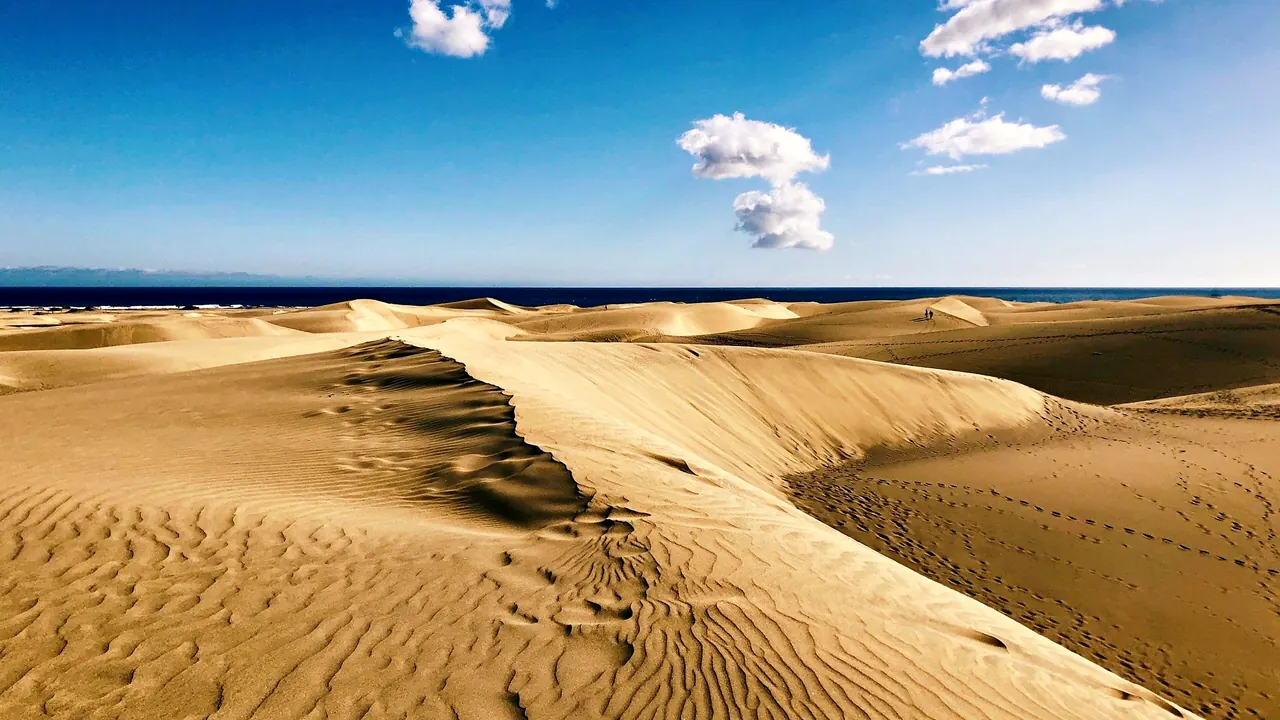
Photos: Gran Canaria by Marcela Střelcová, CC BY-SA 4.0, cropped.
Gran Canaria or La Gomera?
Our verdict in twelve categories, each scored against the same fixed benchmark cities, and the climate month by month, so you can choose for your trip.
Choose Gran Canaria for
- nightlife
- families
- beaches
Gran Canaria suits a sun vacation with plenty around it. It has long sandy beaches and calm coves, a lot laid on for children, and Las Palmas, a real city with an old quarter, a theatre and late nights. It is also the easier island to reach and get around, with its own airport and a motorway down the east coast. Pick it if you want beach days with the option of mountains, museums or an evening in town.
Choose La Gomera for
- nature and the outdoors
Walkers who like a quiet island will be happier on La Gomera. You give up long sandy beaches, shops, nightlife and most of the choice at the table. In return you get Garajonay's laurel forest, terraced ravines and one of the best trail networks in the Atlantic, with simple family-run cooking in the villages at the end of the day. Getting there takes a ferry crossing. Come to hike by day and watch the sun go down into the sea in the evening.
Scoreboard
Twelve categories on one fixed scale from 0 to 100. The shaded stretch is the gap between the two.
Your match
Pick a travel style or drag the sliders, and both match scores follow your weighting.
Wins on nightlife and families with your weighting.
Wins on nature and the outdoors with your weighting.
What matters to you?
Category by category
What the scores mean for a trip.
Beaches & swimming
Gran Canaria is the beach island of the two. Maspalomas and Playa del Inglés give you miles of golden sand backed by dunes. The south-west coves at Amadores, Puerto Rico and Mogán are calm enough for nervous swimmers, and Las Canteras in Las Palmas is a city beach sheltered by a reef.
La Gomera has the same Atlantic water but no long pale sand. Its beaches are narrow coves at the mouths of ravines, some with dark sand and others with grey pebbles, and swell often rolls in. Valle Gran Rey has several dark-sand beaches and calm water at La Playa, Playa de Santiago has a quieter pebble shore, and the seawater pools built into the rocks are often the safest places to swim. This is an island for a swim after a walk rather than whole days on a towel.
Food & drink
Both islands cook from the same Canarian base of wrinkled potatoes with mojo and fresh fish, but Gran Canaria has far more range. There are tapas bars in Vegueta and Triana, harbour fish at Agaete and Arguineguín, and the island's own rum, cheese and wine. Its weak spot is the southern resort strip, where it pays to eat away from the promenade.
La Gomera's food is simpler and more homely. Family-run places in Valle Gran Rey and Playa de Santiago serve almogrote, palm honey and watercress stew. It is honest cooking, but after a week you will have tried most of what is on offer.
Culture & sights
Columbus links the two. Both capitals have a Casa de Colón, and La Gomera was his last stop before the 1492 crossing. Beyond that shared story, Gran Canaria offers much more: the cobbled old quarter of Vegueta with its cathedral and the Museo Canario, the painted cave at Gáldar and the UNESCO cave sites of Risco Caído.
La Gomera's monuments take a day to see in San Sebastián, around the Torre del Conde and the church where Columbus's crew are said to have prayed. Its most remarkable culture is not a building at all. It is Silbo Gomero, the whistled language still taught in schools.
Nightlife
This is the biggest gap between the two islands. Gran Canaria has two kinds of night out: the long-running gay scene and late bars around the Yumbo in Playa del Inglés, and a more Spanish evening of terraces and weekend clubs in Las Palmas. In winter the capital also holds one of the largest carnivals in Spain.
On La Gomera, an evening out means drinks at sunset on the Valle Gran Rey seafront, sometimes to drums, and then bed. For a club you would have to cross to Tenerife.
Nature & outdoors
Both are steep volcanic islands cut by ravines, and both reward walkers. La Gomera comes out slightly ahead because nature is its whole point. Garajonay's laurel forest is often in cloud, terraced ravines drop to Valle Gran Rey and Hermigua, and a dense network of marked trails includes a path around the whole island. Pilot whales and dolphins are often seen off Los Órganos.
Gran Canaria's outdoors is on a larger scale and offers more sport. There are Roque Nublo and the Tejeda caldera below a summit of about 1,950m, the Tamadaba pine forest, the protected Maspalomas dunes, winter road cycling and windsurfing at Pozo Izquierdo. It suits an active trip that mixes hiking with time on the water.
Day trips
Gran Canaria gives you more to fill your days. From the resorts, Las Palmas is a full day out on its own. Inland Tejeda and Teror, the north-coast towns of Arucas, Gáldar and Agaete, and Puerto de Mogán each make a different outing, and fast ferries from Agaete reach Tenerife in good time for a day trip.
La Gomera's outings are short hops to Agulo, Hermigua, Vallehermoso and San Sebastián, pleasant but quickly done. Tenerife is under an hour away by ferry, but the drive on to La Laguna or Garachico makes for a long day.
Good for families
Gran Canaria makes family life easy. The weather stays warm without getting too hot in any month, and children are welcome at the table late into the evening. The camel rides in the dunes and the Wild West theme town add a few extra days out.
La Gomera suits families who already like boats and the outdoors. Dolphin trips, short forest loops in Garajonay and the Charco del Conde rock pool keep children busy, and Playa de Santiago is the gentlest base. But the island has no water park, zoo or aquarium. On both islands the twisting mountain roads can upset children who get car sick.
Getting around
Gran Canaria is simple to arrive in and get around. It has its own airport, and a motorway runs along the east coast to Las Palmas and the southern resorts, with buses that cover that stretch well. You only need a car for the interior.
La Gomera takes more effort. Most visitors fly into Tenerife and take the ferry, and on the island the roads twist so much that San Sebastián to Valle Gran Rey takes about an hour. Buses are rare, so a hire car is close to essential unless you plan to walk from village to village.
Shopping & style
Gran Canaria at least has a proper shopping city. Calle Mayor de Triana has independent shops, Avenida Mesa y López has the chains and a department store, and there are markets in Puerto de Mogán and Teror. On La Gomera, shopping means food and crafts to take home: palm honey, almogrote, cheese, wine and the pottery of El Cercado, still shaped by hand without a wheel.
Affordability
The two cost about the same overall, but the money goes in different places. On Gran Canaria, winter is high season at the better southern hotels, while package stays, self-catering apartments and cheap car hire keep costs down.
La Gomera's rural houses and apartments cost less than on the busier islands, and prices stay steady all year. The ferry from Tenerife and the car you will almost certainly need add to the bill.
Live music & performing arts
Las Palmas gives Gran Canaria a real stage. The philharmonic plays at the Auditorio Alfredo Kraus at the end of Las Canteras, the Teatro Pérez Galdós has an opera season, and the winter Canary Islands Music Festival brings visiting orchestras. Carnival adds its music contests and drag gala.
La Gomera has no theatre or concert hall. Its performances are the baile del tambor at village fiestas, the music of the festival for the Virgin of Guadalupe and demonstrations of the whistled language put on for visitors.
Wellness & relaxation
Neither island has thermal springs, so rest here means a spa or simply slowing down. Gran Canaria has more of the facilities, with large hotel spas around Meloneras and Maspalomas and the seawater thalassotherapy pools that are a local speciality. It also has quiet rural houses inland.
La Gomera has fewer treatments, but the whole island moves more slowly. There are yoga and retreat houses on the terraced slopes of Valle Gran Rey, and watching the sunset is the evening ritual. It suits calm and walking more than pampering.
When should you go?
Pick your month. The climate figures are measured averages, not a forecast.
Gran Canaria in July
La Gomera in July
Daytime high, °C
Rainfall in the month, mm
Where the figures come from
Gran Canaria's temperatures are measured 28 km from the centre, at Gran Canaria - Canary Islands.
Gran Canaria has no rain gauge within 25 km of the centre, so its rainfall comes from a gridded climate dataset read at the destination rather than from a gauge further away.
La Gomera's temperatures are measured 54 km from the centre, at Tenerife Sur.
La Gomera has no rain gauge within 25 km of the centre, so its rainfall comes from a gridded climate dataset read at the destination rather than from a gauge further away.
Temperature and rainfall are climate normals, averaged over the years shown. Gran Canaria: 1991-2020 normals, Gran Canaria - Canary Islands (27.7 km from centre). La Gomera: 1991-2020 normals, Tenerife Sur (53.5 km from centre).
These figures come from one coastal measuring point on each island: the southern resort coast on Gran Canaria and the shore where most visitors stay on La Gomera. At both points it is warm in every month. Winter highs sit in the low twenties, and August reaches about 28°C on Gran Canaria and a degree more on La Gomera. The sea goes from about 19°C in late winter to 23°C or a little more in September and October. A swim early in the year is bracing, and the water is most comfortable from June to November. From May to September the coast gets almost no rain, and sunshine peaks in July and August. The hottest weeks are fine for the beach but hard work for steep climbs at midday.
At the coast the rain falls between October and February, and La Gomera's point records more of it. December is the wettest month there, at about 56mm, a little under twice what falls on Gran Canaria's south coast, though both still get plenty of winter sun. The high interiors are different. The mountains around Tejeda on Gran Canaria and the Garajonay plateau on La Gomera are cooler and often cloudier than the shore, so walkers should bring a warm layer in any month.
Which traveller are you?
On an outdoors trip, choose La Gomera. Garajonay's laurel forest and the marked paths down into Valle Gran Rey and Hermigua turn the whole island into a walking route, and boats off Los Órganos regularly meet pilot whales and dolphins. On Gran Canaria the mountains share the trip with the resorts.
On a family trip with young children, Gran Canaria is clearly better. It has sheltered sandy coves at Amadores and Anfi, resort pools with children's clubs, Palmitos Park and the Las Palmas aquarium. La Gomera's pebbly beaches and steep trails suit older children who already like to walk.
For a food and nightlife trip, go to Gran Canaria. Las Palmas has tapas bars in Vegueta and Triana, late terraces and clubs at weekends, and the bars of Playa del Inglés stay open late all year. La Gomera offers good home cooking and drinks at sunset, and then the evening is over.
Before you go
| Measure | Gran Canaria | La Gomera |
|---|---|---|
| Official language | Spanish | Spanish |
| Currency | Euro (EUR) | Euro (EUR) |
| Sockets | CF230 V, 50 Hz | CF230 V, 50 Hz |
| Driving side | Right | Right |
| Time zone | UTC, UTC+1 in summer | UTC, UTC+1 in summer |
| Emergency number | 112 | 112 |
| Main airport | Gran Canaria Airport (LPA)122 non-stop destinations | Tenerife Sur Airport (TFS)111 non-stop destinations |
| Public holidays this year | 12 days | 12 days |
By the numbers
| Measure | Gran Canaria | La Gomera |
|---|---|---|
| Population | 863,943 | 22,436 |
| People per km² | 554 | 61 |
| Swim season, months above 21 °C | 6 months | 7 months |
Where else could you go?
Every comparison below shares a destination with this one, so you can follow Gran Canaria or La Gomera somewhere new.
- Tenerifevs La Gomera
- La Palmavs La Gomera
- Tenerifevs Gran Canaria
- Fuerteventuravs Gran Canaria
- Lanzarotevs Gran Canaria
- La Palmavs Gran Canaria